Turkey's S-400 gambit to rejoin the F-35
Turkey's S-400 gambit to rejoin the F-35 program
Model Diplomat10 min readMiddle East
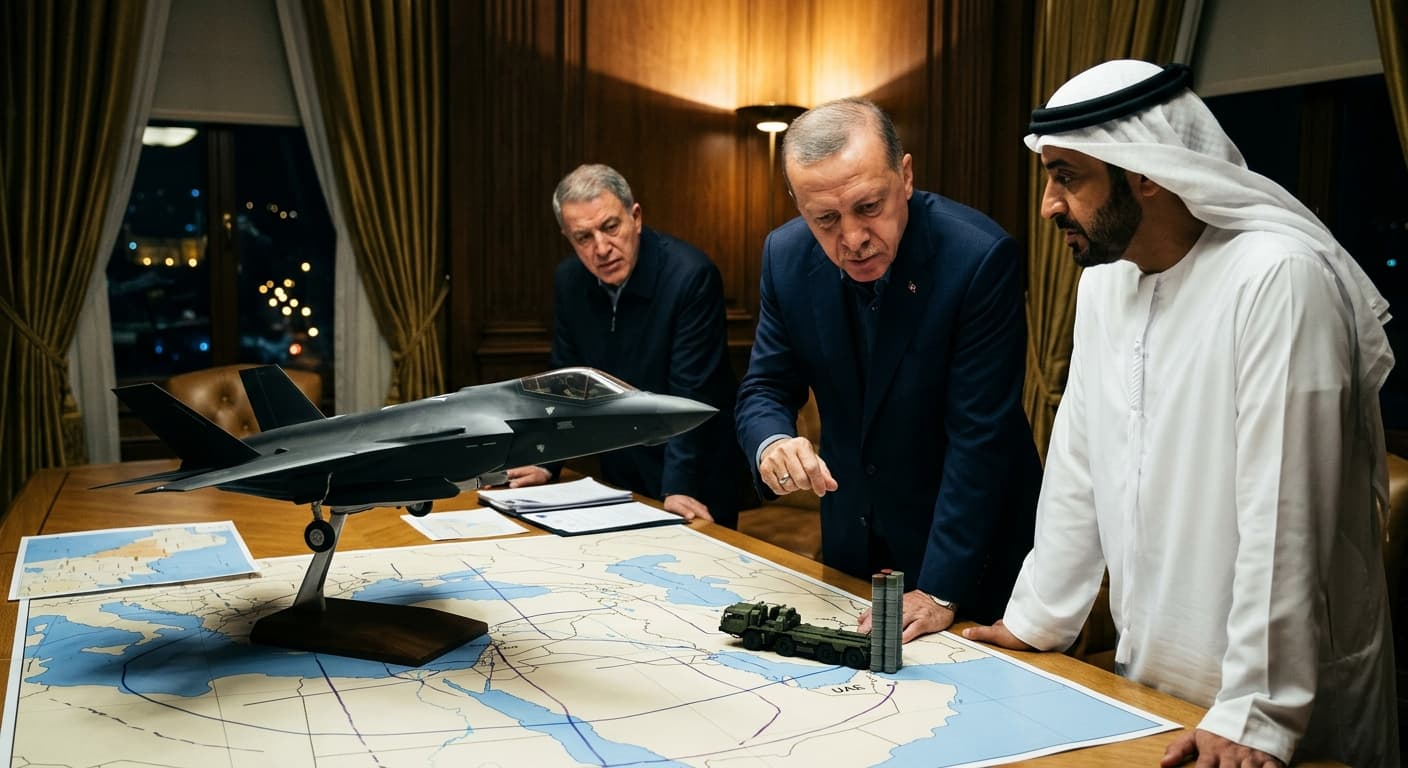
Turkey Is Shopping Its Russian S-400 to the UAE. The Real Buyer Is the Pentagon.
Turkey's proposed transfer of its Russian S-400 system to the UAE is less about Ankara's F-35 ambitions than about the Gulf's collapsing air-defense stockpile — and the unexpected leverage that gives Recep Tayyip Erdoğan over a Pentagon that needs Emirati skies to stay closed.
Turkey is shopping its Russian S-400 to the UAE, but the real buyer is the Pentagon, the Wall Street Journal reported on July 19, 2026—an extraordinary three-way gambit to remove the single largest obstacle to Ankara's return to the F-35 program. The report, citing U.S. and regional officials, lands less than two weeks after President Donald Trump stood beside President Recep Tayyip Erdoğan at the NATO summit in Ankara and declared that CAATSA sanctions on Turkey would be lifted and an F-35 sale was "certainly something we will consider," according to Al Jazeera. That timing is no coincidence. The UAE is burning through interceptor missiles faster than the West can replace them, and Turkey, stuck with a $2.5 billion system it has never activated, has found a buyer whose desperation matches its own.
The proposal would unwind the central defense-policy crisis in U.S.-Turkish relations since 2019 in a single transaction. But its viability depends on four governments whose interests only partially overlap: a White House eager to claim a diplomatic win, a Congress that wrote the legal ban on F-35 transfers to Turkey, a Kremlin that holds a contractual end-user veto over any S-400 re-export, and an Emirati leadership that has absorbed 48 percent of all Iranian projectiles fired at Gulf states since February 28.
The Buyer's Calculus: Why the UAE Needs a System It Can't Integrate
The UAE has been the principal target of Iran's retaliatory campaign since the U.S.-Israel war on Iran began on February 28. In the conflict's first week alone, the Emirati Ministry of Defense reported intercepting 165 ballistic missiles, two cruise missiles, and 541 drones, per the BBC. By March 8, the tally had risen to 1,422 detected drones and 246 missiles, according to an analysis by the Center for Strategic and International Studies'
Missile Threat project, meaning the UAE accounted for roughly 55 percent of all recorded strikes in the Gulf theater and 66 percent of all drones.
Those interceptions have come at a punishing cost. The UAE operates a layered air-defense architecture anchored by U.S.-made Terminal High Altitude Area Defense (THAAD) batteries and Patriot PAC-3 systems, supplemented by the South Korean Cheongung-II KM-SAM, as detailed by Breaking Defense. A single Patriot PAC-3 MSE interceptor costs approximately $4 million. A THAAD interceptor runs higher. Iran's Shahed-series one-way attack drones, produced domestically at a rate exceeding 10,000 units in 2025 with combat success rates above 60 percent, cost perhaps $20,000 to $50,000 each, according to the
CSIS drone campaign analysis.
The arithmetic is unsustainable. By mid-March, the Emirati Ministry of Defense stopped publicly differentiating between "detected" and "intercepted" munitions — a shift that analysts interpreted as an effort to mask interceptor depletion. Shaan Shaikh, deputy director of the CSIS Missile Defense Project, noted at the time that "as we are almost two weeks into this war, air defense capabilities of most Gulf states are struggling in terms of depletion." The U.S. has already moved to backfill losses: in March, the State Department approved a $4.5 billion THAAD radar and command package for the UAE under emergency authority, explicitly designed to restore sensor and fire-control architecture after radar sites came under repeated attack, according to Army Recognition. Separately, the U.S. approved $8.4 billion in arms sales to the UAE — drones, missiles, radar systems, and F-16 upgrades — declared an emergency to bypass congressional review, as reported by
Al Jazeera.
None of that replaces a functioning interceptor battery's raw magazine depth. The S-400, despite its incompatibility with NATO systems and the UAE's U.S.-centric C4ISR architecture, offers something the Emirates needs immediately: a combat-proven, long-range air-defense battery with a deep magazine of 48N6 and 40N6 missiles capable of engaging ballistic missiles and aircraft at ranges up to 400 kilometers. It would not plug into the Emirati integrated air-defense network; it would operate as a standalone strategic asset, much as it was intended to function in Turkey. Abu Dhabi is effectively shopping for a trauma buy.
The Seller's Logic: Seven Years of Sunk Cost
Turkey paid $2.5 billion for the S-400 system, signing the contract with Russia in September 2017 and taking delivery of the first components in July 2019, according to the CSIS Missile Defense Project. The United States responded within days, suspending Turkey from the F-35 program and later imposing sanctions under the Countering America's Adversaries Through Sanctions Act (CAATSA). Turkish defense firms lost an estimated $10 billion in F-35 supply-chain contracts. The S-400 has never been made fully operational. Turkey test-activated the system in 2020 and then repacked it; it has sat idle in storage ever since.
The strategic context has shifted decisively against keeping the system. As Foreign Affairs reported in a detailed analysis of Turkey's geopolitical recalibration, Erdoğan asked Putin in December 2025 to take the S-400 back — abandoning years of insistence that Turkey would purchase a second batch. Assad's fall in late 2024 stripped Russia of its Syrian client and removed Erdoğan's primary incentive to maintain a transactional relationship with Moscow over air-defense procurement. Meanwhile, Iranian missiles entered Turkish airspace during the current Gulf conflict and were intercepted by NATO-linked systems — not by the idle, expensive Russian hardware. "Turkey's highly expensive S-400s, by contrast, remained idle as the country came under direct missile threat," Foreign Affairs noted.
The UAE transfer solves Erdoğan's most expensive diplomatic error at a moment when the buyer is more motivated than the seller. Turkey recovers prestige, eliminates the S-400 as a congressional obstacle, and positions itself for the prize it has sought since 2019: readmission to the F-35 program. Erdoğan told reporters after the July 7 NATO summit that Trump had "promised" five F-35 jets and that "when the F-35s are delivered, the whole world will say 'the U.S. kept its word,'" according to BBC Türkçe.
The Congressional Gate: Section 1245 and the "No Longer Possesses" Test
The legal architecture blocking an F-35 sale to Turkey is precise — and not easily bypassed by executive enthusiasm alone. The FY2020 National Defense Authorization Act included Section 1245, "Limitation on Transfer of F-35 Aircraft to the Republic of Turkey," which formally prohibits any transfer so long as Turkey possesses the S-400. The conference summary from the Senate Armed Services Committee explicitly "prohibits the transfer of the F-35 to Turkey" and calls on the president to implement CAATSA sanctions. The companion legislation, H.R. 7639, specifies that sanctions may only be terminated if the president certifies that "the Government of Turkey and any person acting on its behalf no longer possesses the S-400 air and missile defense system," as recorded in the
Congressional text.
A transfer to the UAE would meet the letter of that requirement — divestment is divestment — but the political burden remains. Senator Lindsey Graham, a staunch Israel ally, told Türkiye Today on July 7 that "there might be some pushback in Congress, but a solution might be found." That is Senate-speak for: the votes are not automatic, but they are acquirable if the administration presents a clean divestment, verifiable removal from Turkish territory, and credible assurances that Russia will not retain remote access to the system's radar architecture.
Israel remains the most vocal opponent. Prime Minister Benjamin Netanyahu told Fox News on July 6 that selling F-35s to Turkey would "destroy the power balance in the Middle East, because Turkey, I think, has aggressive aspirations," as reported by BBC Türkçe. But Netanyahu's leverage is diminished: Israel relied on U.S. THAAD and Patriot batteries to survive the Iranian missile campaign, and Washington's attention is fixed on reconstituting Gulf defenses, not preserving Israel's qualitative military edge in perpetuity.
The Russian Veto: Moscow's "Very Delicate Matter"
Kremlin spokesman Dmitry Peskov responded to the transfer reports on July 10 with calibrated restraint, calling the matter "very delicate" and confirming that "we have had contacts with the Turkish side on this issue and will remain in touch," per BBC Türkçe. The original S-400 contract includes a standard end-user clause requiring Russian consent for any re-export. Moscow can block the transfer outright.
Whether it will is an open question that turns on Russia's broader calculus. Moscow has lost its Syrian naval and air bases in the post-Assad landscape; its relationship with Ankara, always transactional, no longer commands the leverage it did in 2019. Putin could block the transfer to punish Erdoğan for his NATO realignment — but doing so would leave Russia holding a demonstration that its premier export air-defense system ended up in permanent storage, unused, a strategic dead end. Allowing the transfer to the UAE preserves the S-400's reputation as a combat-relevant system, keeps Russian technicians potentially involved in maintenance and training in the Gulf, and earns Moscow hard currency or political capital from the Emirates at a moment when its global arms-export pipeline is under pressure from Western sanctions and production bottlenecks.
The Turkish columnist Abdülkadir Selvi wrote in Hürriyet on July 10 that Turkey had already sold the S-400 to a Gulf country and that an announcement was imminent — a claim no government has confirmed, but one that suggests the negotiations are further advanced than the cautious language of diplomatic briefings implies. Asked directly about the S-400 at his post-summit press conference, Erdoğan offered only: "Keep watching us."
Who Wins, Who Loses
Turkey is the clearest winner — if the transfer goes through. It offloads a radioactive asset, removes the statutory barrier to F-35 acquisition, and repositions itself inside the Western defense-industrial architecture from which it was expelled. The cost: $2.5 billion in sunk expenditure, partially or fully recouped depending on what the UAE pays.
The UAE gets a near-immediate infusion of air-defense magazine depth at a moment when its interceptor stockpiles are critically depleted. The tradeoff is an orphan system that will never integrate with its U.S.-built sensor network. The S-400 is a standalone strategic insurance policy, not a NATO-compatible layer — but when you are absorbing 48 percent of Iran's total strike volume, a standalone battery is better than an empty launcher.
The United States gets the S-400 off NATO territory — the foundational intelligence concern since 2019, articulated repeatedly by the Pentagon: that the S-400's radar could collect the F-35's electronic signature and transmit it to Russian analysts. CSIS's Defense360 analysis captured the concern precisely: "Turkish operation of the two systems together would allow the S-400 to acquire intimate knowledge of the F-35's radar signature. Such insights would almost immediately find their way back to Russia." A transfer to the UAE — a non-NATO state, operating the system far from any F-35 deployment — neutralizes that threat. The U.S. also avoids the ugly scenario of a NATO ally's air-defense system sitting idle while Iranian missiles fly overhead.
Russia faces the most ambiguous outcome. It loses its symbolic foothold inside NATO's second-largest military, but it may gain a new customer relationship with one of the wealthiest Gulf states — and it preserves the S-400's reputation as a system that states fight to acquire. If the transfer is structured as a Turkish sale with Russian consent rather than a Russian reclamation, Moscow can claim it never lost the customer, merely changed the delivery address.
Israel loses influence. Netanyahu's opposition is on the record, but Israel's security establishment has been quietly reliant on the same U.S. interceptor stocks now being diverted to Gulf defense. The UAE has already accepted Israeli Iron Dome batteries and personnel, the first known deployment of the system outside Israel, confirmed by U.S. envoy Mike Huckabee in May, according to Al Jazeera. The Abraham Accords infrastructure is deeper than Netanyahu's rhetorical opposition to Turkish F-35s.
The Interceptor Math: The Number That Drives Everything
The CSIS analysis of U.S. interceptor expenditure during the Iran war, published in May, quantified the depletion: between 190 and 290 THAAD interceptors fired out of a pre-war stockpile of approximately 400, and between 1,060 and 1,430 Patriot interceptors expended, per The War Zone. Replacement timelines stretch to 2029. Lockheed Martin's THAAD production is surging to 96 interceptors per year, with a planned expansion to 400 annually — but that scale-up will not deliver meaningful inventory replenishment before the end of the decade.
The UAE's willingness to consider a Russian system it cannot integrate into its command architecture makes sense only against this arithmetic. The Gulf air-defense crisis is not a capability gap — it is a magazine-depth crisis masquerading as one. Every major system in the Emirati inventory works. None has enough ammunition. The S-400 arrives with its own missile stockpile, its own radar, and its own fire-control chain. It is not an elegant solution. It is the solution of a buyer who has run the numbers and concluded that elegance is a luxury it can no longer afford.
What to Watch
Three decision points will determine whether this proposal becomes a transaction or another chapter in the S-400 saga:
- Russian consent (August-September 2026). Moscow's end-user veto is the single most important variable. If Putin authorizes re-export, the remaining obstacles are political, not contractual. If he refuses, the entire proposal collapses and Turkey returns to the "storage in a box" status quo.
- Congressional certification (September-October 2026). The NDAA requires a presidential certification that Turkey "no longer possesses" the S-400 before any F-35 transfer can proceed. Expect Senate Foreign Relations Committee hearings, likely led by senators with Israeli security commitments, testing whether a UAE transfer constitutes genuine divestment or a shell game.
- UAE interceptor stockpile data (war duration). If the Iran conflict continues at current intensity through autumn, the UAE's need will shift from urgent to existential — and the price Abu Dhabi is willing to pay, in both financial and political terms, will rise accordingly.
The Bottom Line
Turkey's proposed S-400 transfer to the UAE is the most elegant solution to a seven-year crisis that nobody in Washington, Ankara, or Moscow planned for — but it is being driven not by diplomacy but by the brute fact that the UAE is out of interceptors and Turkey is out of patience. If Moscow consents, the deal unlocks Erdoğan's path back to the F-35, gives the Emirates a desperately needed air-defense battery, and removes from NATO soil the Russian radar system the Pentagon has spent seven years trying to expel. If Moscow refuses, the S-400 stays in storage, Turkey stays frozen out, and the UAE keeps burning through Patriot interceptors at a rate the West needs until 2029 to replace.
Discover more
Global Politics
Xi Jinping Calls China-Russia Ties 'Precious'
Xi Jinping's description of China-Russia ties as 'precious' reflects a strategic imbalance, with Beijing dictating terms in the partnership.
India
Congress Accuses Modi of Stalling Women's Law
Congress accuses Modi of stalling women's reservation law by linking it to delimitation, revealing a deeper electoral strategy.

India
BJP's Misunderstanding of Women's Quota Needs
The BJP's linking of the Women Reservation Bill to delimitation risks delaying women's empowerment in India, misreading the aspirations of female voters.

Economics
Fed's Amex AML order puts correspondent banking on notice
Federal Reserve's Amex AML order requires board-level controls and a 90-day plan; OCC fined the bank $350 million over enterprise-wide deficiencies.