Turkey's S-400 Becomes Geopolitical Currency
Turkey's S-400 transfer to the UAE could unlock F-35s and sanctions relief
Model Diplomat10 min readMiddle East
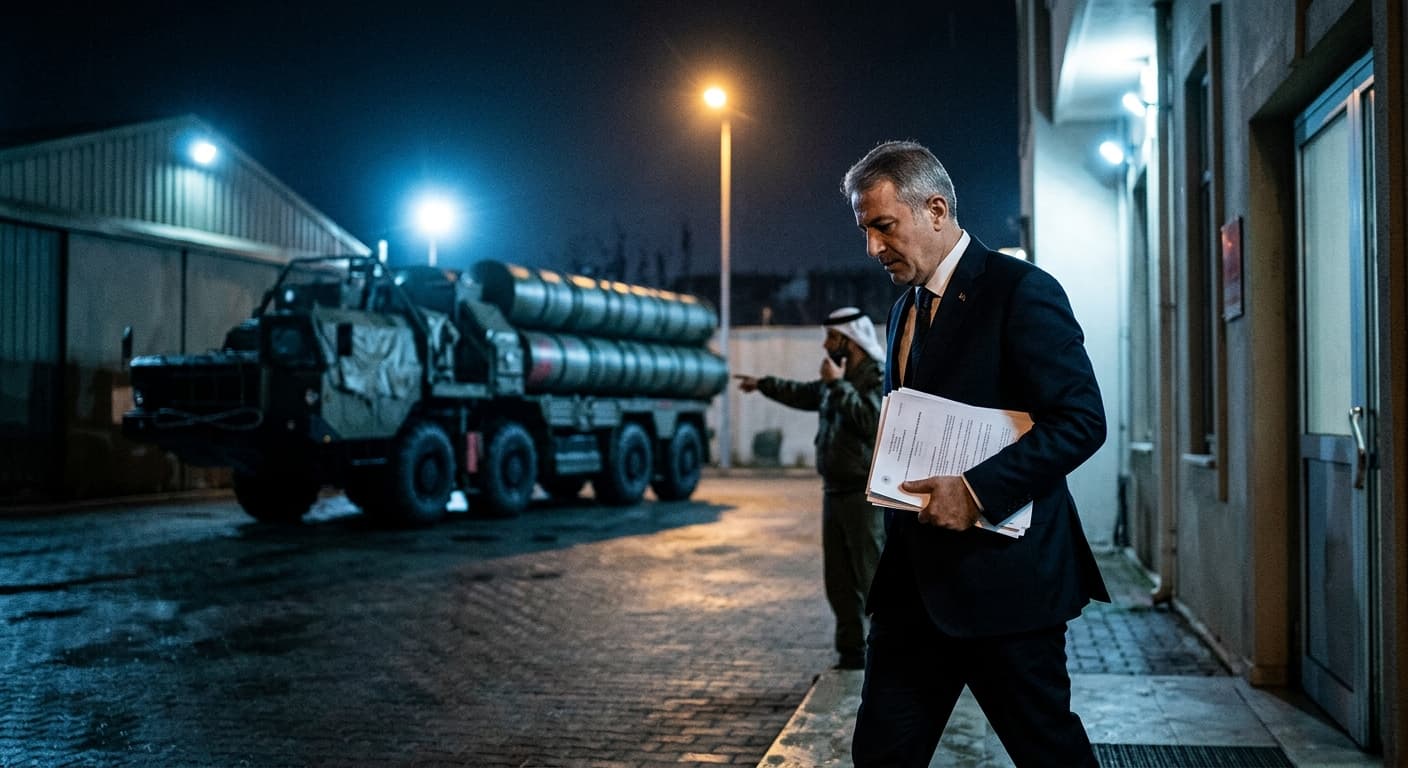
Turkey's S-400 Is No Longer a Weapon — It's Currency
Turkey's plan to transfer its Russian S-400 air defense system to the UAE, reported July 19, uses the Iran war's pressure on Gulf air defenses to solve Ankara's seven-year F-35 exile and CAATSA sanctions — a three-way trade where the real loser is Israel's regional air monopoly.
Turkey is discussing transferring its Russian-made S-400 air defense system to the United Arab Emirates, the Wall Street Journal reported on July 19, citing US and regional officials. Worthy News syndicated the report. The prize Ankara is pursuing is readmission to the F-35 Joint Strike Fighter program and the removal of sanctions imposed under the Countering America's Adversaries Through Sanctions Act (CAATSA) — sanctions that have, by Turkey's own estimate, obstructed roughly $20 billion in F-16 spare parts and defense procurement since December 2020.
The S-400, acquired from Russia in 2019 for $2.5 billion, has spent seven years as the single most expensive object lesson in NATO-Russia hedging. Now, with Iran raining ballistic missiles on Gulf capitals and interceptor stockpiles depleting at rates unseen in modern warfare, the system has gained a second life: not as a weapons platform, but as geopolitical currency. Turkey's bet is that the same missile battery that got it thrown out of the West's most advanced fighter program can now buy its way back in, provided the buyer is a sufficiently desperate Gulf monarchy.
This is not an arms sale. It is a four-way hostage exchange dressed as a defense procurement. The real loser is Israel's regional air monopoly.
The UAE's Air Defense Emergency
The UAE has absorbed the heaviest Iranian bombardment of any Gulf state since the US-Israeli war on Iran began on February 28, 2026. According to NPR, the UAE's defense ministry reported intercepting nearly 200 missiles and more than 1,000 drones in the war's first week alone. Dubai International Airport — the world's busiest for international travel — was struck by a drone. Amazon data centers were hit, knocking out banking services across much of the country. Five-star hotels on Dubai's Palm Jumeirah caught fire from falling interceptor debris.
The interceptor math has become unsustainable. Ukraine's defense ministry noted in March that Gulf countries had fired 800 Patriot missiles in the first three days of the Iran conflict. That is more than the 600 Ukraine expended in four years of war against Russia, according to The Economist. Each Patriot PAC-3 missile costs roughly $4 million. The UAE is burning through them faster than the US industrial base can replenish. This is true even after the State Department approved an $8.4 billion emergency arms package for the Emirates in March, which Secretary Marco Rubio pushed through under emergency authority, bypassing Congress.
Al Jazeera reported the package included drones, missiles, radar systems, and F-16 aircraft.
Even Israel — which had previously refused to export Iron Dome batteries to Ukraine — deployed Iron Dome systems and personnel to the UAE, as US Ambassador to Israel Mike Huckabee confirmed in May. Al Jazeera called it the first known instance of the technology being used outside Israel.
The S-400 would offer the UAE something its current layered defense — THAAD, Patriot, Israeli Barak, and the South Korean Cheongung 2 — cannot: a long-range area-denial system capable of engaging targets at up to 400 kilometers with the 40N6 missile and tracking 100 targets simultaneously. Abu Dhabi has been shopping. It already bought the Cheongung 2, a system partly derived from the Russian S-400 design, in a $3.5 billion deal with South Korea in 2022. Al Jazeera reported that the Cheongung 2 was explicitly chosen to fill gaps in the UAE's tiered architecture. A used, battle-ready S-400 battery from Turkey would be faster than any factory order — and cheaper than burning through another 800 Patriots.
Israel's Veto: The QME Red Line
The transfer's most vocal opponent is not Russia. It is Israel.
Prime Minister Benjamin Netanyahu, speaking to Fox News on July 6 ahead of the NATO summit in Ankara, declared that selling F-35s to Turkey would "destroy the power balance in the Middle East, because Turkey, I think, has aggressive aspirations." BBC Türkçe reported his full statement:
"When you give them that power, you're going to see aggression in its wake."
Netanyahu escalated further, describing Turkey as a "Muslim Brotherhood-infected regime that hates the United States" — language calibrated for a domestic Israeli audience and a Trump administration that has chafed under Netanyahu's Lebanon campaign, which repeatedly threatened to derail the US-Iran ceasefire.
Israel's objection is not rhetorical. It is anchored in US law. Since 1968, every American administration has committed to preserving Israel's Qualitative Military Edge (QME) — the principle that Israel must be able to defeat any likely combination of regional adversaries. Al Jazeera has documented how that principle has blocked F-35 sales to Arab states for two decades. Israel remains the only Middle Eastern country operating the F-35, with a fleet expected to reach 50 aircraft. Turkey fielding even five F-35As — the number Erdoğan says was promised — would end that monopoly.
Israel's defense establishment has already reclassified Turkey as a potential adversary. In January 2025, the government-commissioned Nagel Committee recommended preparing for possible direct confrontation with Turkey, warning that a Turkish-aligned Syria could "evolve into something even more dangerous than the Iranian threat." Brookings noted that former Prime Minister Naftali Bennett has publicly called Turkey "the new Iran."
The paradox: Israel is currently defending the UAE with Iron Dome batteries. That is the very country that would receive the transferred S-400 and indirectly unlock Turkish F-35s. Netanyahu is caught between two imperatives: protecting an Abraham Accord partner from Iranian missiles and preventing that partner from enabling Turkey's return to the fifth-generation fighter club. The UAE's calculus is simpler. It needs air defense now, and the S-400 delivers capability Israel's Iron Dome cannot match — long-range high-altitude interception that Patriot and THAAD batteries are depleting at alarming speed.
The Kremlin's Leverage: A Veto Russia Can't Afford to Use
Russia holds a contractual choke point: the S-400 deal with Turkey almost certainly includes an end-user clause prohibiting re-export without Moscow's consent, standard in Russian arms contracts for advanced systems. Kremlin spokesman Dmitry Peskov told reporters the matter was "very sensitive" and confirmed contacts with the Turkish side. BBC Türkçe reported Peskov as saying, "We have had contacts with the Turkish side on this issue, and we will remain in contact."
But Moscow's leverage is thinner than it appears. Since late 2024, when the Assad regime fell and a new Damascus government aligned with Ankara stripped Russia of its Syrian foothold, Turkey's need to curry favor with Putin has collapsed. Foreign Affairs reported in a June 2026 analysis that Erdoğan had already asked Putin to take back the S-400 in December 2025 — a remarkable reversal from years of insisting a second S-400 batch was imminent. When Iranian missiles entered Turkish airspace during the current war, it was NATO-linked systems in the eastern Mediterranean — not the idle S-400 — that intercepted them. The system Turkey spent $2.5 billion to acquire sat dormant during the country's most acute aerial threat since the Cold War.
Russia's commercial interest also militates against a veto. Moscow has spent years trying to position the S-400 as a competitor to the Patriot in the Gulf market. A UAE deployment — operational, visible, intercepting Iranian missiles — would be the best advertisement Russian arms exporters could ask for. Saudi Arabia signed a memorandum of understanding for the S-400 during King Salman's 2017 Moscow visit, though the deal stalled under US pressure. Seeing the system perform in Emirati hands could revive that pipeline. CSIS documented the Saudi interest.
The more acute Russian concern is intelligence. Operating the S-400 in proximity to US and Israeli F-35s — which the UAE does not currently field but neighbors do — could expose the system's radar signature and tracking algorithms to Western signals intelligence. That was, after all, the precise American objection to Turkey operating both systems simultaneously. The same concern now cuts in Russia's direction.
Congress: The NDAA Lock and the Trump Key
Section 1245 of the FY2020 National Defense Authorization Act (NDAA, P.L. 116-92) prohibits the Defense Department from transferring F-35s to Turkey unless Turkey no longer possesses the S-400. Congressional Research Service confirms this restriction remains in effect, alongside Section 1241 of the FY2021 NDAA governing the termination of CAATSA sanctions. The FY2026 NDAA, which passed in December 2025 as Public Law 119-60, did not include amendments that some House members had proposed to add further restrictions on defense transactions with Turkey.
The legal pathway is clear — if narrow: Turkey must divest the S-400, the administration must certify that it no longer possesses the system, and CAATSA sanctions must be formally rescinded. A transfer to the UAE, if Russia consents, satisfies the first condition. The second depends on congressional acquiescence, which is not guaranteed.
In July 2026, ten members of Congress, mostly Republicans, sent a letter to Trump opposing an F-35 sale to Turkey. Representative Dina Titus, a Nevada Democrat, called on House leaders to initiate a Joint Resolution of Disapproval process to block any sale. BBC Türkçe reported her statement citing Turkey's S-400 acquisition, military presence in Cyprus, and threats toward Greece.
But there are counterweights. Senator Lindsey Graham, a staunch Israel supporter, told Turkiye Today on July 7 that "there might be some pushback in Congress, but a solution might be found." Al Jazeera reported Graham's openness to the deal. The Senate Foreign Relations Committee Chairman Jim Risch had previously indicated he had placed a "hold" on F-35s to Turkey but acknowledged the possibility of resolution.
The Trump-Erdoğan personal chemistry is the wild card. Their relationship survived the S-400 crisis, CAATSA sanctions, and Turkey's rhetorical broadsides against Israel. At the Ankara NATO summit, Trump told reporters, "We're going to be taking the sanctions off." Erdoğan replied that he had been promised five jets and expected a "favorable decision." If the transaction materializes, it would be the most vivid demonstration yet of personal diplomacy overriding institutional constraints in the Trump era.
The Costs Already Incurred
The bill for Turkey's S-400 adventure has already been steep. When the Pentagon ejected Turkey from the F-35 program in July 2019, then-Undersecretary of Defense for Acquisition Ellen Lord estimated it would cost $500 million to $600 million to retool the supply chain away from Turkish manufacturers. Defense One reported that Turkey lost $9 billion in projected workshare over the F-35's lifecycle. Ten Turkish suppliers producing over 900 parts — later expanded to 1,005 — were removed from the program.
Six Turkish-owned F-35As remain in storage in the United States, and the $1.7 billion Ankara paid for them is reportedly still in US hands. The Government Accountability Office flagged in 2020 that 15 key parts previously sourced from Turkey were not being produced at the necessary rate, contributing to a $1.5 billion increase in Block 4 modernization costs. Breaking Defense documented the supply chain disruption.
Turkey's fifth-generation fighter program, the KAAN, has faced delays partly because of restricted access to US components — precisely at a moment when Gulf states are looking for alternatives to Western platforms, according to Brookings. Erdoğan's defense industry, which hit $10 billion in exports in 2025, has been forced to localize supply chains and seek non-Western partnerships, achieving growth despite restrictions but operating below potential. Al Jazeera reported Roketsan's ambitions to break into the global top 10 defense exporters, currently ranking 71st.
Restoring Turkey to the F-35 consortium would reverse all of this. But it would also reward what US law defined as a "significant transaction" with the Russian defense sector — a precedent that China, India, and other S-400 operators would note carefully.
Diplomat View
Erdoğan's calculation is that the Iran war has created an air defense emergency in the Gulf so acute that Washington will accept an S-400 transfer to the UAE as a lesser evil — removing the Russian system from NATO territory while arming a frontline ally against Iranian missiles. If it works, Turkey gets F-35s and sanctions relief; the UAE gets a long-range air defense system faster than any factory can produce; Russia gets to keep the S-400 operational in-region; and Washington gets the diplomatic win of re-anchoring Turkey to NATO's defense ecosystem. The price is Israel's regional air monopoly and the credibility of CAATSA as a deterrent against Russian arms purchases.
The forecast: The transfer has a better than even chance of proceeding because each of the four parties — Turkey, the UAE, the US, and Russia — has an independent reason to say yes. The Russian re-export veto is the most cited obstacle but the weakest in practice. Moscow gains more from an operational S-400 in Emirati hands than from a dormant system in Turkey that Erdoğan has already tried to return. Congressional opposition is real but can be finessed through the same emergency authority Rubio used for the March arms package — or through a presidential certification that the transfer serves US national security interests.
What would change the forecast: A significant Israeli escalation — either in Lebanon or Syria — that forces the Trump administration to prioritize the Netanyahu relationship over the Erdoğan one. If Israel convinces enough Senate Republicans that Turkish F-35s represent an existential threat to QME, the deal stalls regardless of Trump's personal inclinations. Alternatively, a Russian demand for technology-transfer guarantees in the UAE — co-production, maintenance access, radar data rights — could spook Washington into blocking the transfer on the same intelligence-security grounds it cited against Turkey in 2019.
Three signals to track:
- Russian consent timeline: Kremlin's formal position on re-export. Peskov's "very sensitive" framing suggests Moscow is negotiating terms, not blocking outright. A decision likely within 4–6 weeks.
- Congressional notification: If the administration notifies Congress of an F-35 sale to Turkey under the Arms Export Control Act, the 30-day review clock starts. Watch for a Joint Resolution of Disapproval, particularly in the House.
- FY2027 NDAA markup: The House and Senate Armed Services Committees begin drafting in September. Any member can propose language conditioning F-35 transfers on Israeli QME certification — which would kill the deal regardless of the S-400's location.
Discover more
India
Congress Accuses Modi of Stalling Women's Law
Congress accuses Modi of stalling women's reservation law by linking it to delimitation, revealing a deeper electoral strategy.
India
700 Activists Accuse PM Modi of MCC Breach
Over 700 activists allege PM Modi breached election code with a televised address attacking opposition parties just before state elections.

India
BJP's Misunderstanding of Women's Quota Needs
The BJP's linking of the Women Reservation Bill to delimitation risks delaying women's empowerment in India, misreading the aspirations of female voters.

Economics
Fed's Amex AML order puts correspondent banking on notice
Federal Reserve's Amex AML order requires board-level controls and a 90-day plan; OCC fined the bank $350 million over enterprise-wide deficiencies.