Saïed's Second Term: Power and Turnout
Kais Saïed's inauguration highlights Tunisia's political landscape.
Model Diplomat3 min readafrica
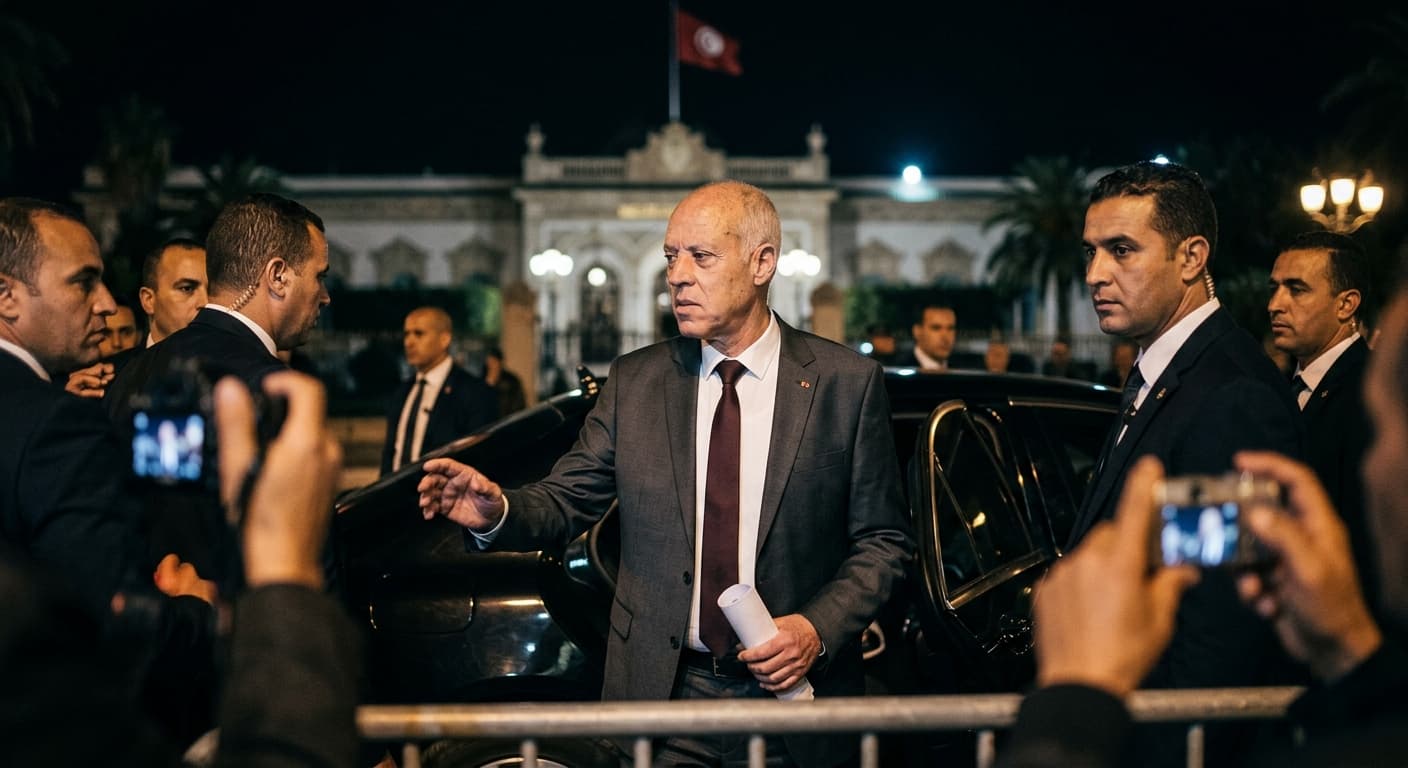
Saïed Sworn In for Second Term — The Mandate Is Total, the Turnout Was Not
Winning 90.7% on 28.8% turnout, Tunisia's president now holds every lever of state power. His inauguration speech made clear he intends to use them.
Kais Saïed was sworn in for a second five-year term on October 21 before a tightly controlled session of Tunisia's parliament, vowing a "cultural revolution" against unemployment, terrorism, and corruption — and promising no quarter for "thieves and traitors" he claims have sabotaged his first term. The National
The ceremony closed the loop on an election cycle that was over before it began. Saïed secured 90.7% of the vote on October 6, but only 2.7 million of 9.7 million registered voters cast a ballot — the lowest turnout since Tunisia's 2011 revolution, at 28.8%. BBC His nearest challenger, businessman Ayachi Zammel, won 7% while sitting in prison, sentenced to 12 years for falsifying endorsements five days before the vote.
Al Jazeera
The result is less an electoral mandate than the institutional endpoint of a three-year power consolidation that has left Saïed without meaningful rivals — inside or outside the state.
How he got here
Saïed has methodically dismantled the post-2011 constitutional architecture since his July 2021 power grab, when he suspended parliament, dismissed the prime minister, and began ruling by decree. A rewritten constitution, ratified in a 2022 referendum on just 30% turnout, concentrated executive authority in the presidency and abolished the checks that defined Tunisia's brief democratic experiment. AP
In the run-up to this election, the consolidation accelerated. Of 17 candidates who filed, the president-appointed electoral commission (ISIE) approved only three. The administrative court — Tunisia's last independent judicial body — ordered three barred candidates reinstated. Parliament, packed with Saïed loyalists, promptly stripped the court of its electoral oversight powers. Al Jazeera Key opposition figures — Ennahda's Rached Ghannouchi, Free Destourian Party leader Abir Moussi — remain imprisoned. The National Syndicate of Tunisian Journalists condemned authorities after reporters were blocked from covering Monday's swearing-in.
The National
Who holds leverage: Saïed holds all of it domestically. No functioning parliament can defy him. No court can review his electoral legitimacy. No opposition figure of stature is free to organize. The question is whether he can convert raw institutional control into economic delivery.
The economic reality check
Tunisia's official unemployment rate sits at roughly 16% — among the highest in the region, per the World Bank — and growth remains too weak to absorb a restive youth population. The National Saïed's first-term answer was to target alleged profiteers and blame foreign interference. His inauguration speech doubled down: "The arms of the old regime were like vipers circulating everywhere."
The "cultural revolution" framing is significant. It signals that Saïed intends to treat Tunisia's crisis as a moral purification project rather than a technical policy challenge — one requiring the excision of "counterrevolutionary forces" and "traitors on the payroll of foreigners." That narrative consolidates his base but does nothing to unlock the external financing Tunisia needs. An IMF deal, stalled since 2022, remains politically toxic for a president who has staked his identity on resistance to foreign diktat.
What to watch
The EU-Tunisia migration compact, signed in July 2023, is the pressure point. Brussels has calibrated its criticism of Saïed's authoritarian turn against its interest in Tunisian cooperation on Mediterranean migration control. Now, with a fresh five-year term confirmed, European capitals must decide whether to treat Saïed as a permanent fixture — and whether financial support for Tunis continues without democratic conditionality. Watch the next European Council conclusions on Tunisia, and whether Saïed makes any gesture toward the IMF in his first 100 days. If he does not, the economic math grows unforgiving.
Discover more
India
CPI(M) Calls to Decouple Quota from Delimita
CPI(M) advocates for a 33% women's quota in Lok Sabha by 2029, removing the need for delimitation and census linkage.

International Relations
U.S.–Iran Peace Deal
A narrow US-Iran deal on nuclear and regional issues could reshape Middle East diplomacy, offering a pragmatic path forward despite grand bargain obstacles.
India
Congress Advocates 33% Women’s Quota
Congress calls for a 33% women's reservation in the existing 543 Lok Sabha seats, countering Modi's plan to expand the house to 850 seats.

Economics
Fed's Amex AML order puts correspondent banking on notice
Federal Reserve's Amex AML order requires board-level controls and a 90-day plan; OCC fined the bank $350 million over enterprise-wide deficiencies.