Trump's Ultimatum Fails: Russia, China Veto
How Russia and China vetoed Trump's ultimatum at the UN.
Model Diplomat8 min readMiddle East

Trump's Hormuz Ultimatum Fails: Russia and China Veto at the UN
How a Russia–China double veto on April 7, 2026 gutted Trump's Strait of Hormuz ultimatum — and why Beijing, not Washington, emerged the strategic winner.
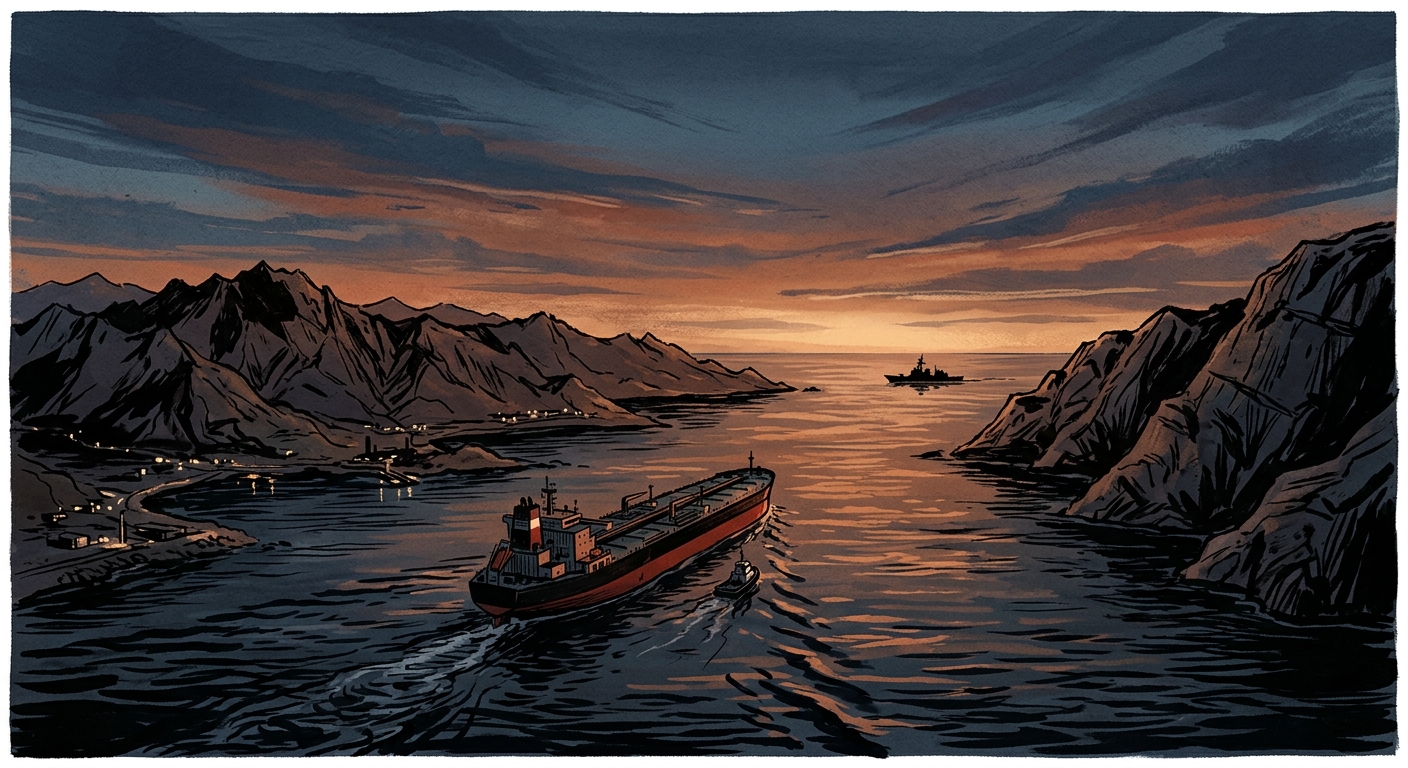
President Donald Trump's demand that Iran reopen the Strait of Hormuz by 8pm on April 7, 2026 collapsed at the United Nations Security Council seven hours before the deadline, when Russia and China vetoed a Gulf-drafted resolution 11–2–2 that would have blessed "defensive" military action to protect shipping. The veto did more than kill a text — it stripped Washington of the international-law cover it needed to bomb, forced Trump into a face-saving 90-minute climbdown, and confirmed a durable feature of the new Council arithmetic: on any Middle East file where the United States wants coercive authority, Moscow and Beijing now have both the votes and the appetite to say no. Three months on, the strait is open under an Iran–US memorandum of understanding that codifies Tehran's leverage, not Washington's.
The vote that broke the ultimatum
The tally is on the record. According to the UN Security Council's official report on its 10,130th meeting, draft resolution S/2026/273, sponsored by Bahrain, Jordan, Kuwait, Qatar, Saudi Arabia and the United Arab Emirates, received 11 votes in favour, two against — China and the Russian Federation — and two abstentions, from Colombia and Pakistan. The draft would have "strongly encouraged" states to coordinate defensive maritime efforts through the strait; earlier iterations had gone further and were watered down repeatedly in a failed bid to buy Chinese and Russian abstentions,
Al Jazeera reported.
Beijing's explanation of vote, delivered by Ambassador Fu Cong, framed the veto as a rejection of legal cover for further US and Israeli force. From the meeting record:
"At a time when the United States is openly threatening the survival of a civilization and when the current war imposed on Iran is very likely to escalate further, the draft resolution, had it been adopted, would have sent the wrong message and had very serious consequences. The Security Council has recent lessons to learn from issues such as Libya and the Red Sea, and such past mistakes must not be repeated."
Russian Ambassador Vasily Nebenzia said Moscow and Beijing would circulate a rival Middle East text. The UK deputy permanent representative, Archie Young, told the chamber that "Russia and China chose to shield their ally, Iran," noting that fewer than nine vessels had transited Hormuz in the previous 24 hours against a normal load of up to 150, per his statement published by the Foreign, Commonwealth & Development Office. US Ambassador Mike Waltz called the vetoes "a new low," accusing Moscow and Beijing of "holding the global economy at gunpoint."
Trump's 90-minute climbdown
The ultimatum itself had been theatrical. About twelve hours before the deadline, Trump wrote on Truth Social that "a whole civilisation will die tonight, never to be brought back again. I don't want that to happen, but it probably will." UN Secretary-General António Guterres said he was "deeply troubled" by the language; UN human rights chief Volker Türk warned that deliberately attacking civilian infrastructure would be a war crime,
the BBC reported. Pope Leo XIV called the threat "truly unacceptable."
At 6:32pm Eastern — 88 minutes before the deadline — Trump reversed. He credited Pakistani Prime Minister Shehbaz Sharif and army chief Field Marshal Asim Munir with brokering a two-week pause, contingent on Iran's "complete, immediate, and safe opening of the Strait of Hormuz," NPR reported. Iran's Foreign Minister Abbas Araghchi qualified the concession within hours, warning of "technical limitations." The strait did not, in fact, fully reopen — and would not for another ten weeks.
The sequence matters because it establishes the veto's operational effect. Without a Chapter VII authorisation — even the diluted "defensive coordination" language of S/2026/273 — a US strike on Iranian bridges and power plants would have been an unambiguously unauthorised attack on civilian infrastructure, exposing US personnel and allies to legal liability and Gulf partners to Iranian reprisal without a UN umbrella. Russia and China removed that umbrella. Trump, staring at the timer, found a mediator and took the exit.
The angle: China won this round without firing anything
The conventional read of April 7 is that the UN "failed." That gets the story backwards. The council did exactly what its permanent members designed it to do — and the winner is Beijing, which converted a veto into strategic ground without deploying a single warship.
Before the war, Bruegel estimated that China was importing roughly 1.4 million barrels a day of Iranian crude — about 13% of its total imports and 80–90% of Tehran's exports. The International Crisis Group put the share of Iran's oil going to China at around 90%, calling US sanctions a paradoxical subsidy because they kept the discount deep,
in a June 2026 commentary. That is the material interest behind the veto. But the strategic gain is larger. Brookings scholar William A. Galston,
writing in June 2026, put it flatly: "The United States and Israel fought Iran, and China won." Beijing let Washington deplete political and military capital on a war it could not finish, while positioning itself as a supplier of jet fuel and energy to hedging US allies including Thailand and the Philippines.
The counter-evidence is real. A separate Brookings analysis by Ryan Hass and colleagues noted that Chinese crude imports from the Gulf fell 25% year-on-year in March 2026, and that the closure exposed the same Malacca-style chokepoint vulnerability that has haunted Chinese planners since the Hu Jintao era. Beijing hedged: it vetoed the Bahraini text while publicly condemning Iranian attacks on Gulf states and, in the Xi–Trump summit of May 14–15, offering what the Crisis Group called "tepid rhetorical support" for reopening the strait but no coercive lever against Tehran. Xi sent Trump home "embarrassingly empty-handed," in Crisis Group's phrasing.
The primary document nobody has repealed
The legal terrain that Russia and China defended on April 7 is now being tested in real time by the Persian Gulf Strait Authority — the body Iran's Supreme National Security Council announced on May 18, 2026 to manage transits, insurance and, eventually, tolls. That directly clashes with Article 44 of the UN Convention on the Law of the Sea, which bars states bordering international straits from hampering transit passage and states plainly: "There shall be no suspension of transit passage." International Maritime Organization Secretary-General Arsenio Dominguez said in April that "any introduction of tolls is something that is against international law,"
per Al Jazeera.
Iran's answer is that it signed but never ratified UNCLOS and does not accept the transit-passage regime as customary law — only the narrower right of innocent passage, which coastal states can regulate and, arguably, suspend. That position, laid out in a June 2026 Japan Institute of International Affairs briefing, is legally contested but not frivolous — and it is exactly what the Russia–China veto quietly protected. Without a Chapter VII resolution declaring Iran's conduct a threat to international peace and security, the Gulf states have no multilateral instrument to sanction, seize or escort. They are left with the pre-war 1968 Iran–Oman traffic separation scheme, which Iran can now interpret as it likes.
What the June 17 MoU actually locked in
The war formally paused on June 17, 2026, when Trump and Iranian President Masoud Pezeshkian signed a memorandum of understanding. The core bargain, according to a Brookings interview with Bruce Jones: Iran uses "best efforts" to allow free transit for 60 days without charge; the US lifts its naval blockade of Iranian ports; sanctions waivers permit Tehran to sell oil in dollars again; Iran begins demining within 30 days.
Read the fine print and Iran's leverage is intact. The PGSA has not been dismantled. Iran's national insurance company has opened a policy that transiting vessels are expected to apply for. Iran committed to consult Oman on "future administration" of the strait — a formulation Jones called "a major departure from … the status quo ante." On June 25, Al Jazeera reported that the IRGC declared "the only authorised transit routes through the Strait of Hormuz are those designated by the Islamic Republic of Iran," rejecting a new Omani corridor coordinated with the IMO. On July 5, Iran's ambassador to China Alireza Enayati vowed
special Hormuz treatment for "friendly" countries — a euphemism for Beijing that turns the strait into a discriminatory transit regime, precisely what UNCLOS Article 42(2) prohibits.
Traffic reflects the coercion. On July 2, 2026, MarineTraffic recorded 38 confirmed transits through Hormuz, per Al Jazeera reporting on OPEC+'s July 6 decision to raise output by 188,000 barrels per day. Pre-war baseline was roughly 130 daily crossings. Brent settled at $72 the same day — briefly above $126 in April. Saudi Arabia has more than doubled shipping volume since June 17; Iran has pushed nearly 50 million barrels to market since the US blockade lifted. The market has adapted to a strait that Iran, not the US Navy, effectively administers.
Diplomat View
The April 7 veto looks in hindsight like the pivot of the war. Before it, Washington held escalation dominance and a plausible path to a Chapter VII cudgel; after it, the physics reversed. Russia and China did not save Iran with weapons. They saved it with a procedural act that denied Trump the one thing his ultimatum required — international legitimacy for kinetic action against civilian infrastructure. Everything that followed, from the two-week pause to the June 17 MoU to Iran's PGSA and its yuan-denominated transit fees, flows from that thirty-minute meeting in the Council chamber.
The forecast: a second Hormuz crisis is more likely than not within 18 months. The 60-day no-toll window in the MoU expires in mid-August 2026, at which point Tehran can lawfully — under its own reading — reintroduce charges. If it does so selectively, favouring Chinese and Russian-linked shipping, expect the US and UK to seek a new Chapter VII resolution and expect Beijing to veto again on identical grounds. What would falsify this call: a durable US–Iran nuclear deal that folds strait governance into a formal Iran–Oman–GCC framework with IMO endorsement, or a Chinese reversal driven by a Taiwan-linked need to court Gulf goodwill. Neither is on the table today.
What to watch next
- Mid-August 2026 — expiration of the 60-day free-transit window in the US–Iran MoU. Iranian statements on tolls or "service fees" will be the first signal of a second crisis.
- September 2026 — expected China–Arab States Cooperation Forum, which the International Crisis Group flagged as the venue where Beijing may be forced to choose between Iran and the GCC.
- Fourth-quarter 2026 — completion or breakdown of Iranian demining under the MoU's 30-day (now-extended) commitment, per the Brookings assessment that clearance will take "months and months."
Read more from Global Politics.
Discover more

Global Politics
US Seizes Iranian Ship, Tensions Surge
The US seizure of the Iranian ship Touska highlights a shift in control over the Strait of Hormuz, favoring Iran's strategic position.

Conflict & Security
Drone Warfare Killing Aid Workers at Unprec
Over 1,000 humanitarian workers killed in three years as cheap armed drones collapse legal protections. Gaza, Sudan, Ukraine, and DRC see deliberate targeting of aid convoys and hospitals with zero prosecutions.
Global
World Normalises Taliban as Afghan Women Eras
UN data shows Afghan women erased from public life as Russia recognises the Taliban, EU hosts officials in Brussels, and ICC warrants for gender persecution go unenforced.
Conflict & Security
West Africa Food Crisis: Three Shocks in 2026
Conflict, climate extremes, and the Strait of Hormuz closure drive a severe food crisis in West and Central Africa, with fertilizer prices surging 80% and millions displaced.