Trump's Tariff Strategy Faces Court Ruling
Court ruling limits Trump's tariff authority amid ongoing trade tensions.
Model Diplomat3 min readNorth America
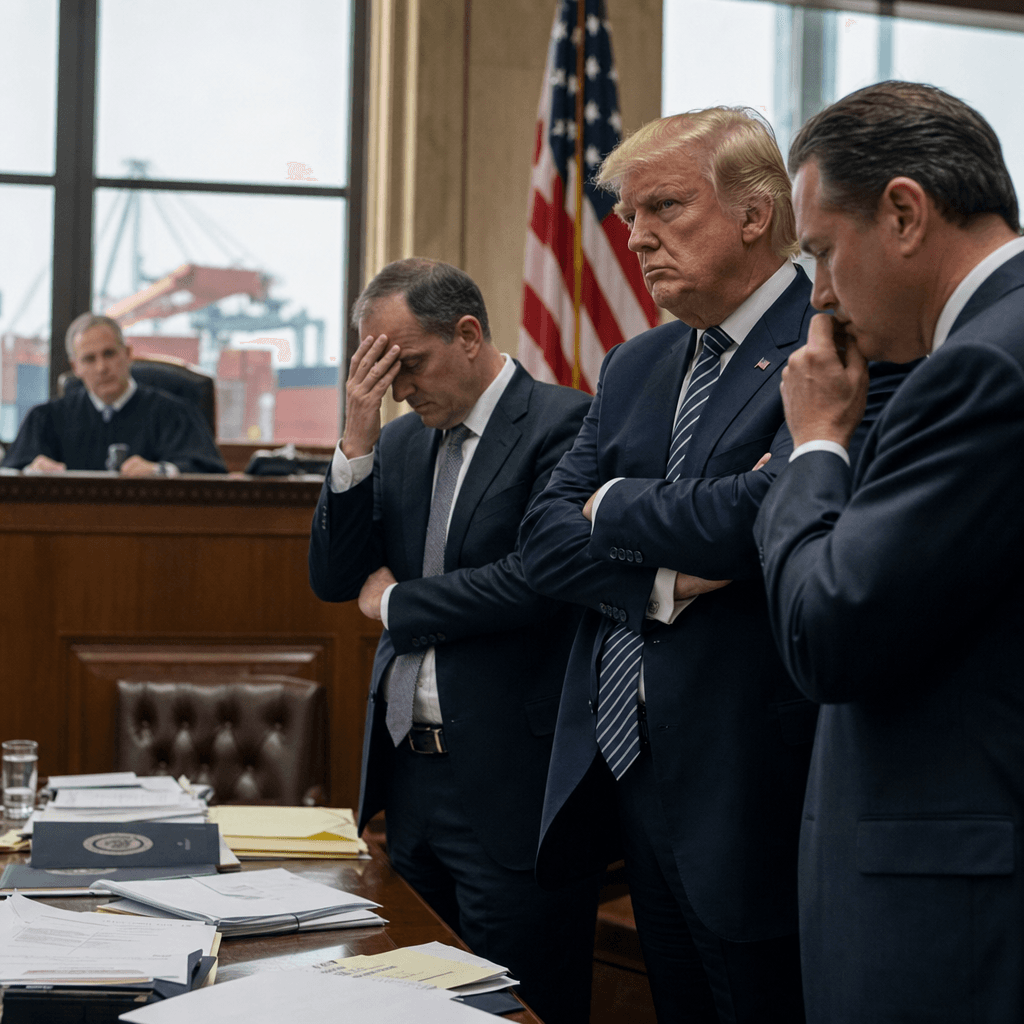
Trump’s tariff fallback gets boxed in again
The trade court’s ruling narrows the president’s tariff leverage, but the case is still only partly binding and the administration is already looking for another route.
Donald Trump’s tariff strategy took another legal hit on Thursday when the U.S. Court of International Trade ruled that his new 10% global duties were not justified under Section 122 of the 1974 Trade Act, according to CNN and
CBC News. The 2-1 decision came after the Supreme Court earlier this year knocked out Trump’s broader emergency tariffs, forcing the White House to shift to a different legal authority. That is the core dynamic: Trump still wants tariff leverage, but the courts keep narrowing the tools he can use to apply it fast and broadly.
Courts are cutting into the tariff playbook
The New York-based trade court found that the administration had not shown the kind of “large and serious” balance-of-payments problem required for Section 122, CNN reported. The ruling was not a total shutdown. It applies directly only to the plaintiffs — two private importers and the state of Washington — and the court declined to issue a universal injunction,
CBC News reported. That matters. Trump can still collect the 10% tariff from everyone else for now, and the levies are scheduled to expire in July unless the administration changes course or wins on appeal.
That limited remedy is the White House’s opening. It can keep the policy alive while appealing to the Federal Circuit and, potentially, the Supreme Court, CBC News said. Trump’s own response was telling: he told reporters he would “do it a different way,”
CNN reported. In other words, the administration is treating the ruling less as a veto than as a search problem.
Why this matters for trade power
This is not just about one tariff schedule. It is about who controls the pace of U.S. trade policy. The president wants tariffs he can deploy unilaterally and quickly as bargaining chips against China, allies, and domestic opponents. The courts are signaling that those tools still exist, but only within narrower statutory lanes and with more room for challenge. That shifts leverage toward importers, litigants, and legal specialists — not Congress, but not the White House alone either.
There is also a second-order effect for markets. Even when a ruling does not immediately erase a tariff for every importer, it adds uncertainty about refunds, compliance, and how long a levy will survive. CNN noted that refund procedures from the earlier Supreme Court loss are still being phased in, while
CBC News cited trade lawyers saying more companies may now sue for broader relief. For companies shipping into the U.S., that is a planning problem; for Trump, it is a political one.
For broader political context, see US Politics and
Global Politics.
What to watch next
The next decision point is whether the Justice Department appeals immediately and whether other importers seek a wider injunction before the tariffs expire in July. If the administration pivots to another statute — especially Section 301 investigations already underway, as CBC News reported — the fight moves from whether Trump can use tariffs to how durable any replacement can be. That is the date that matters: July, when this tariff layer either dies, mutates, or gets folded into a new legal challenge.
Discover more

Economics
US Tariffs on Brazil: A Political Play
US imposes 25% tariff on Brazil but exempts 66% of exports, targeting manufactured goods ahead of Brazil's October election. Analysis of the political calculus, exemptions, and Brazil's response options.

Economics
Trump's 50% Tariff on Canada Ends USMCA's Tar
Trump invokes Section 338 of the Tariff Act of 1930 for the first time, imposing 50% tariffs on $20 billion of Canadian goods and ending the USMCA tariff shield.
Economics
Trump Fires 96-Year-Old Tariff Cannon at
Trump signs 50% tariffs on $20B of Canadian goods using Section 338 of Tariff Act of 1930, breaching USMCA for first time. Canada faces pressure as Mexico negotiates separately.
Economics
Brazil Becomes Trump's Section 301 Guinea Pig
Brazil faces a 25% US tariff from July 22, 2026, as the first test of Trump's post-IEEPA Section 301 regime. Exemptions covering 65% of exports reveal US industrial dependence.