Trump's Executive Order on Medical Research
Examining the impact of Trump's orders on US science funding
Model Diplomat7 min readUnited States

Trump's Executive Orders on Medical Research: The Real Rewire
Trump's medical-research executive orders don't just fund psychedelics and pediatric-cancer AI — they hand political appointees veto power over every NIH grant, rewiring US science.
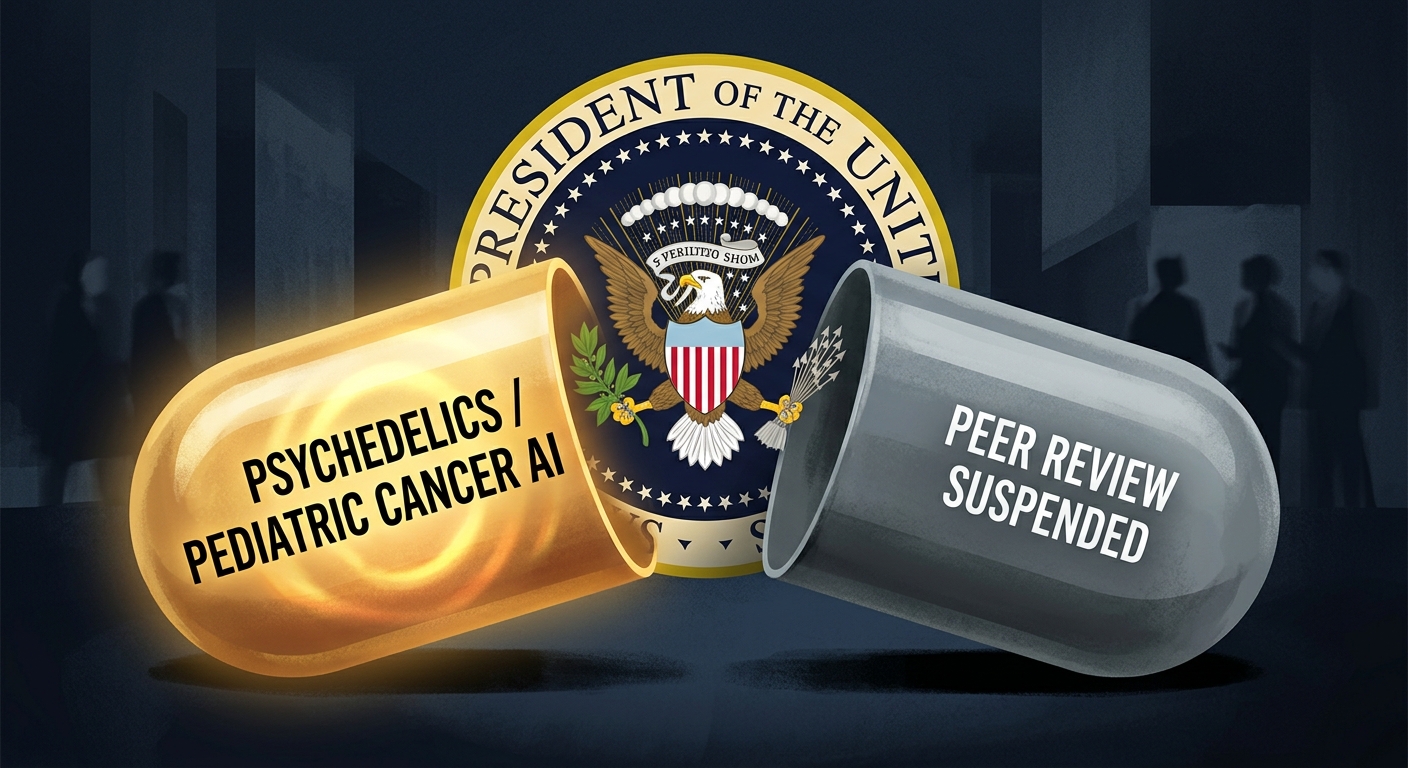
The story of Trump's executive orders on medical research is not the $50 million he sent to psychedelic startups on April 18, 2026, nor the artificial-intelligence pediatric-cancer order he signed on September 30, 2025. It is what those headline orders provide cover for: a parallel sequence of directives — signed May 23, 2025, August 7, 2025, and codified in a 412-page Office of Management and Budget rule on June 26, 2026 — that quietly transferred final authority over which US medical research gets funded from career scientists and peer-review panels to political appointees answerable to the president. The winners are a small set of White House-aligned biotech founders and MAHA-friendly disease areas. The losers are the roughly 300,000 researchers who, according to the Congressional Research Service, depended on NIH's traditional two-stage peer review — a system that funded fewer than six mid-stream terminations in the 13 years to January 2025, and 1,392 in the 15 months after.
The two-track order stack
Read as a single package, the administration's medical-research orders divide cleanly into two tracks that reinforce each other.
The public-facing track is therapeutic and populist. Executive Order 14401, "Accelerating Medical Treatments for Serious Mental Illness," directs the FDA to issue "Commissioner's National Priority Vouchers" for psychedelics with Breakthrough Therapy designation, opens a Right-to-Try pathway for ibogaine, and allocates "$50 million from existing funds" through ARPA-H to match state programs. FDA Commissioner Marty Makary told reporters the agency would issue vouchers for three psychedelics within a week of the signing, potentially cutting review to weeks, according to
NPR. Executive Order 14355 of September 30, 2025,
published in the Federal Register, pushes AI into pediatric-cancer research. The May 5, 2025 order on gain-of-function work — cheered by lab-leak proponents —
ends federal funding for such research in "countries of concern."
The structural track is administrative and quieter. On May 23, 2025, Trump signed Executive Order 14303, "Restoring Gold Standard Science," which requires every federal agency to rewrite its scientific-integrity policies under Office of Science and Technology Policy guidance. It looks anodyne on paper — reproducibility, transparency, unbiased peer review. In practice, as
Science reported May 27, 2025, it hands a political appointee the authority to decide when findings need "correction" and to discipline researchers accused of scientific misconduct. Kris West of COGR, which represents research universities, told the journal the omission of any bar on political interference before publication is "quite an omission."
Then came the August 7, 2025 executive order that the White House labeled "Stops Wasteful Grantmaking." Its operative sentence: "President Trump's appointees will review funding opportunity announcements and grant awards to verify that each grant dollar benefits Americans."
Nature called it an order that would "centralize power and upend the process that the US government has used for decades to award research grants." NIH Director Jay Bhattacharya has argued the order changes nothing because "the NIH director has always been a political appointee." The Office of Management and Budget's June 26, 2026 proposed rule,
reported by Science, makes his argument moot: it codifies mandatory senior-appointee sign-off across every research agency into binding regulation.
The numbers behind the rewire
The therapeutic track is small money. The structural track is where the balance sheet moved.
By April 10, 2026, according to Congressional Research Service analysis of federal spending data, HHS had terminated 1,392 NIH grants worth $539 million in unliquidated obligations. Justice Ketanji Brown Jackson noted in a June 2025 dissent — cited in the same CRS memo — that NIH had terminated fewer than six grants mid-stream in the entire 13-year period before Trump's return. On August 5, 2025, the Government Accountability Office
determined that HHS had violated the Impoundment Control Act by withholding NIH funds from obligation between February and June of fiscal year 2025.
Congress pushed back. The bipartisan FY2026 appropriations law (P.L. 119-75) restored NIH's full budget, wrote statutory prohibitions on modifying indirect-cost policy, and required congressional notification before any HHS award termination, NPR reported on February 4, 2026. It did not stop the slowdown. Jeremy Berg, a former NIH institute director, told NPR in May 2026 that NIH had made roughly
2,300 new grants at one point in 2026 — half the count at the same point in 2025. A separate analysis by 22-year NIH program officer Elizabeth Ginexi found that 205 of 336 posted funding forecasts were past their promised posting date without ever being formally announced. As Rachael Sirianni, a pediatric-cancer researcher at UMass Chan, told NPR of a grant caught in the delay: "the chances of that grant being funded in 2026 are basically zero."
Who wins under EO 14401
The psychedelic order is not merely symbolic policy — it is targeted industrial policy for a specific corner of biotech.
Science noted that the executive order was, by Trump's own account, prompted by a text from Joe Rogan about ibogaine; Rogan attended the signing. The most direct commercial beneficiaries are the handful of companies with Breakthrough Therapy designations in the psychedelic pipeline — Compass Pathways (psilocybin for treatment-resistant depression), Atai Life Sciences, and Beond, whose CEO Tom Feegel
praised the order's "$50 million Federal funding commitment to ibogaine research." Texas, which committed its own $50 million to ibogaine trials in 2025, according to the
BBC, is positioned to draw down federal matching funds first.
Former FDA Commissioner Scott Gottlieb, writing for the American Enterprise Institute, argued the order "pairs faster drug development with continued FDA oversight" — a defensible balance. That balance rests entirely on the "Commissioner's National Priority Voucher" mechanism, which routes selected drugs to expedited review "if they are in line with our national priorities," in Makary's words. The vouchers are, in effect, an FDA-branded political preference channel — precisely the discretionary power the structural orders concentrate at the top of agencies.
The bet the structural orders make
The unifying logic across Trump's medical-research executive stack is the assertion that scientific merit and political priority are the same variable, and that whoever controls the second controls the first. Historian Naomi Oreskes told NPR in January 2026 that what distinguishes this administration from Nixon-era skepticism of science is that Nixon "never tried to just unilaterally withdraw grants that had been legally authorized." Harvard's Sheila Jasanoff, who has studied science-and-law interaction since 1978, told the same reporter: "In that time, I've never seen a systematic shutting down of areas of inquiry under any president."
The consequences are already legible. NIH suspended 40 pathogen studies covering tuberculosis, influenza and COVID-19 after the gain-of-function order, with 172 more flagged, according to a July 3, 2025 internal draft letter obtained by Science. More than 340 NIH scientists in June 2025 signed the "Bethesda Declaration" charging the agency with censoring research on health disparities, COVID-19, climate-linked health effects and gender. And in April 2026, the White House
dismissed all 22 members of the National Science Board — a body created by Congress in 1950 — invoking the Supreme Court's U.S. v. Arthrex decision. Duke's Jeff Powell called the White House's legal reasoning "a puzzling disconnect."
Brookings scholars Richard Frank and Sherry Glied estimate in their 2026 health-budget analysis that over 95% of new drugs approved in the United States are derived from NIH-supported research. The proposed FY2026 budget — rejected by Congress but still shaping obligation patterns — sought a 40% cut to NIH and a 38% reduction in National Cancer Institute grants. That is the disinvestment envelope inside which Trump's therapeutic executive orders promise acceleration.
Diplomat View
The defensible thesis: Trump's medical-research executive orders are best read as a two-part transaction. The White House buys populist headline wins on psychedelics, pediatric-cancer AI and gain-of-function bans — each of which polls well and mobilizes a specific base — while simultaneously converting NIH's peer-review architecture into a political-appointee pipeline. The rebate on the transaction is paid by cancer, cardiovascular and neurodegenerative research programs that are not politically salient enough to earn their own executive order but rely on the traditional grant machinery that is now slowed, screened and legally exposed.
The near-term forecast: expect the OMB rule to be finalized in fall 2026 substantially as drafted, expect litigation from research universities and Democratic attorneys general within 30 days of finalization, and expect NIH obligations for FY2026 to close September 30, 2026 below prior baseline despite Congress's appropriation. The forecast would change if either a federal court enjoins the OMB rule on Administrative Procedure Act grounds — as the indirect-cost cap was enjoined in early 2025 and upheld on appeal in January 2026 — or if the November 2026 midterm shifts one chamber of Congress and produces enforceable notification requirements with teeth.
Watch these dates:
- August 10, 2026 — 45-day comment period on OMB's grantmaking rule closes; final rule expected in fall.
- September 30, 2026 — End of FY2026; NIH's obligation pace determines whether billions revert to Treasury and become the baseline for FY2027.
- Late 2026 — First FDA decisions on psychedelic Breakthrough Therapy applications carrying Commissioner's National Priority Vouchers; a rejection would test whether the vouchers are review shortcuts or approval guarantees.
The bottom line: Trump's medical-research executive orders are a therapeutic wrapper around an administrative revolution. Psilocybin and ibogaine will get their day at the FDA; the deeper legacy is a US biomedical funding system in which political appointees, not peer reviewers, decide what science America pays for. Whether that survives the courts and the next Congress is the only question that will matter to US science policy for the rest of the decade.
Discover more
Conflict & Security
De la Espriella's Razor Win Resets US-Colomb
De la Espriella's razor-thin election win signals a reset in US-Colombia relations, reshaping security ties and the agenda under a Trump-aligned approach.
International Relations
Colombia's Razor-Thin Rightward Pivot
Colombia swings right as Abelardo de la Espriella narrowly wins the presidential runoff by under one percent, exposing a deeply divided and polarized nation.
Global Politics
Iran Demands US Enforce Ceasefire
Iran insists the United States must enforce a ceasefire in Lebanon to uphold the memorandum of understanding, raising pressure on Washington and Netanyahu.

Conflict & Security
Trump's Iran Deal Faces Bipartisan Backlash
Trump's Iran deal draws fierce criticism from both Republicans and Democrats, exposing deep political divides over the ceasefire and the terms of the agreement.