Trump's Executive Order on Ibogaine
Analyzing the impact of Trump's ibogaine order on psychedelics
Model Diplomat9 min readUnited States
Trump's Executive Order on Ibogaine: Who Really Wins
Trump's April 18, 2026 executive order names ibogaine — but the FDA's first psychedelic priority vouchers went to psilocybin and methylone. Here's who benefits.
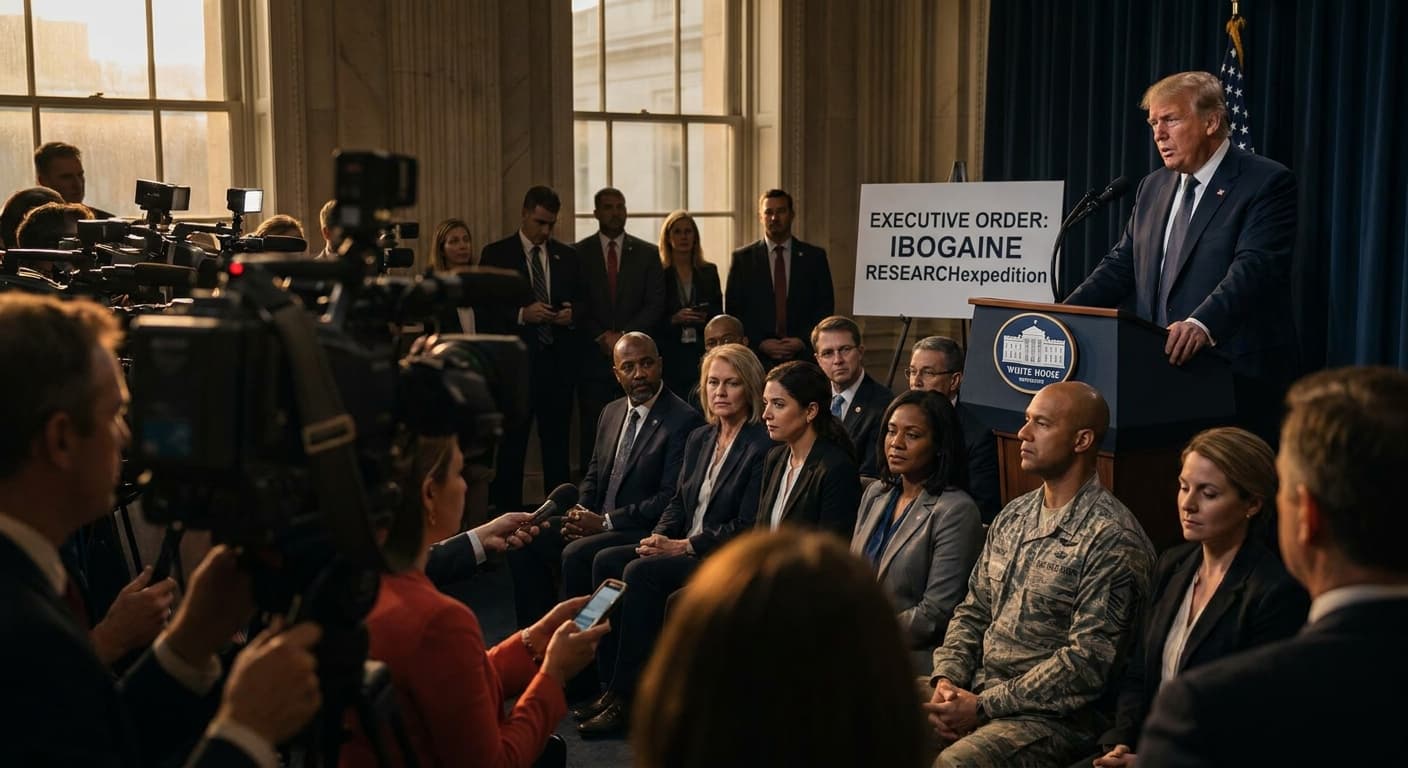
President Donald Trump signed Executive Order 14401 on April 18, 2026, directing the Food and Drug Administration to fast-track psychedelic therapies for serious mental illness and committing $50 million in federal funds to state-level psychedelic research programs. The Oval Office ceremony was staged around ibogaine — Joe Rogan, former Navy SEAL Marcus Luttrell and Americans for Ibogaine chief W. Bryan Hubbard stood behind the president — but six days later the FDA's implementing action told a different story. The regulatory windfall is going almost entirely to psilocybin, not to the West African plant alkaloid the White House used to sell the order. The political winner is the veterans' lobby and the MAHA coalition around Health Secretary Robert F. Kennedy Jr.; the commercial winner is a British biotech called Compass Pathways.
The order itself, Executive Order 14401, does five things. It instructs the FDA commissioner to issue Commissioner's National Priority Vouchers to psychedelic drugs with Breakthrough Therapy designation. It directs the FDA and Drug Enforcement Administration to build a Right to Try pathway for Schedule I compounds "including ibogaine compounds," using waiver authority under the Controlled Substances Act. It orders HHS to allocate at least $50 million through the Advanced Research Projects Agency for Health to match state psychedelic research programs. It tells HHS, FDA and the Department of Veterans Affairs to sign data-sharing memoranda pooling clinical evidence. And it directs the Attorney General to complete rescheduling reviews for any Schedule I product that finishes Phase 3, "as quickly as practicable."
What the FDA actually did — and didn't do — for ibogaine
The gap between the branding and the regulatory reality is the story. On April 24, the FDA announced it was issuing national priority vouchers to three companies: two for synthetic psilocybin (one for treatment-resistant depression, one for major depressive disorder) and one for methylone (post-traumatic stress disorder). Ibogaine received none. What ibogaine got instead was a single Investigational New Drug clearance for DemeRx NB to run a Phase 1 study of noribogaine — an ibogaine metabolite, not ibogaine itself — for alcohol use disorder. FDA Commissioner Marty Makary called it "the first instance in which the FDA has allowed a clinical study in the U.S. of a derivative of ibogaine."
That distinction matters. Ibogaine itself remains stalled by the safety signal that has dogged it for two decades: profound QT-interval prolongation and a documented risk of the ventricular arrhythmia known as torsades de pointes. A 2021 open-label study published in Addiction found that all but one of 14 opioid-dependent patients dosed with 10 mg/kg ibogaine developed clinically significant QTc prolongation, and half exceeded the 500-millisecond threshold at which the risk of an adverse cardiovascular event in an emergency-room drug overdose is 11.2 times higher. In six of the 14 subjects, that prolongation persisted beyond 24 hours. The paper's conclusion was categorical: ibogaine use "outside a well-controlled medical context (i.e. by underground providers) should be avoided due to its high cardiac risk profile."
A follow-up pharmacokinetic study on PubMed linked cardiac toxicity directly to ibogaine rather than noribogaine, and correlated dose variability to CYP2D6 genotype — meaning the same dose produces radically different plasma levels in different patients. That is why DemeRx is testing the metabolite: it appears to carry the anti-addictive signal without the cardiotoxicity ceiling. A broader
review of ibogaine's cardiac pharmacology traces the mechanism to hERG channel inhibition, the same pathway responsible for the QT-prolonging side effects that pulled multiple drugs from the U.S. market in the 1990s.
The evidence base the White House cites is thinner than the ceremony suggested. The Nature Medicine MISTIC study — the trial that put ibogaine on Republican radar — deliberately co-administered magnesium precisely to blunt QT prolongation, and it was conducted at Ambio Life Sciences in Mexico because Stanford could not lawfully run it in the United States. Its 30 male Special Operations Forces veterans reported a Cohen's d of 2.54 improvement in PTSD symptoms one month post-treatment, an effect size larger than anything conventional psychiatry produces. But the paper acknowledges it was not a randomized controlled trial; participants self-selected and traveled abroad, and Stanford "played no role in ibogaine administration." A March 2025
narrative review of three decades of ibogaine research concluded that no double-blind randomized controlled trial has yet demonstrated efficacy for opioid use disorder, and that "serious ibogaine-related adverse events have been reported, especially cardiotoxicity due to QT prolongation, which represents a considerable risk given the currently unproven efficacy."
The commercial winner sits in London
Read the fine print of the executive order and the beneficiary becomes obvious. Section 2 conditions FDA priority vouchers on prior Breakthrough Therapy designation and completion of the National Priority Voucher pilot criteria — a program the FDA launched in June 2025, Brookings notes, offering 30- to 60-day expedited review to sponsors that advance designated public health priorities. Ibogaine has no Breakthrough designation and no active U.S. Phase 3 program. Compass Pathways' COMP360 psilocybin has both.
Per a February 2026 report in The Economist, Compass announced positive Phase 3 results in treatment-resistant depression on February 17, 2026, exactly two months before Trump signed the order. Compass CEO Kabir Nath
praised the executive order the day it was signed, noting the company is "already actively working with the FDA on a rolling submission and review for COMP360 in TRD" and that if approved, Compass would "be ready to make this treatment available to patients." Section 5 of the order — the rescheduling clause — is written for exactly this scenario: a Schedule I substance completing Phase 3 with a live FDA application in hand.
The second-order effect is a market timing shift. Per Kai Kupferschmidt in Science, observers had previously expected psilocybin approval to arrive in 2027; the executive order and the CNPV route now pull that window forward, potentially by months. If the CNPV process delivers on its 30- to 60-day promise — Brookings observes that a comparable Priority Review Voucher has commanded more than $150 million on secondary markets — then Compass and Definium Therapeutics, whose CEO Rob Barrow is
developing DT120 lysergide tartrate for generalized anxiety disorder and major depressive disorder, are positioned to be the first commercial beneficiaries. Methylone's PTSD sponsor, whose company the FDA has not publicly named, joins that queue.
Former FDA Commissioner Scott Gottlieb, writing for the American Enterprise Institute, reads the order as a deliberate compromise inside the Kennedy HHS: it accelerates approval "while maintaining the Food and Drug Administration's oversight role," a model Trump also used in December 2025 when the federal government moved to reschedule marijuana. Gottlieb warns that some MAHA-aligned advocates "seek validation of a path that bypasses the established framework altogether" — a reference to Right to Try expansions that would let physicians directly administer Schedule I drugs without an FDA-sanctioned trial. The executive order gestures toward that pathway in Section 2(b) but leaves the actual DEA rulemaking to be written.
The veterans coalition — and the political trade
The order is best understood as a payoff to a specific coalition, not a scientific verdict. Ibogaine went from a fringe cause to White House policy because a bipartisan lane opened around veteran suicide. Per the White House release, 17 U.S. veterans die by suicide daily, and the order itself cites more than 6,000 annual veteran suicides sustained over two decades. Senators Lindsey Graham and Dave McCormick, plus former Texas Governor Rick Perry, have made ibogaine a signature cause. Texas Republicans committed $50 million to ibogaine clinical trials in 2025, per
BBC Future — the funding pool the federal $50 million is now designed to match. NPR
reported in May 2025 that Perry became a convert after a former Navy SEAL friend used ibogaine to break an opioid addiction, and Amber Capone's Veterans Exploring Treatment Solutions has funded veterans traveling to Mexico for treatment for years.
The historical parallel here is Kentucky's aborted 2023–24 effort. As NPR documented in January 2024, Hubbard proposed spending $42 million from Kentucky's opioid settlement pool on ibogaine research when he chaired the state opioid commission. A new attorney general, Russell Coleman, replaced him with a former DEA agent and the plan collapsed. Hubbard rebranded his campaign nationally as Americans for Ibogaine — and two years later stood in the Oval Office watching Trump sign the order Kentucky wouldn't fund. The Kentucky collapse produced a lesson the ibogaine lobby applied: state-by-state persuasion is too slow and too vulnerable to a single election. A federal executive order clears the map at once.
The legislative track continued in parallel. Congressman Jack Bergman and Rep. Lou Correa introduced the Expanding Veterans' Access to Emerging Treatments Act (H.R. 7091) on January 15, 2026, directing the VA to establish an investigational research and compassionate-access program for ibogaine, MDMA, psilocybin, 5-MeO-DMT and ketamine within 90 days of enactment. That bill and a companion measure,
H.R. 6434, which would create a Controlled Substances Act special registration allowing physicians to directly administer Schedule I investigational drugs under the Right to Try Act, are what Executive Order 14401 operationalizes without waiting for Congress. Existing DEA regulations under
21 CFR § 1316.24 already allow the DEA administrator to exempt registered researchers from prosecution for handling Schedule I substances; the new pathway extends that logic to treating physicians and their eligible patients — a significant expansion the
Congressional Research Service has previously flagged as a departure from the tight registration architecture Congress designed in 1970.
The losers
Three groups lose. The first is the caution community inside academic psychiatry: as Nature reported in April 2026, the executive order will accelerate work on a class of drugs whose mechanism, particularly for ibogaine, remains poorly understood. Stanford's Clayton Olash
told BBC Future bluntly: "We don't have a clear mechanism, not nearly as good as we do for the other psychedelics." The order also raises the risk profile for the FDA itself: if a patient dies during a rushed CNPV review or a Right to Try administration, the political blowback will land on the agency that greenlit the shortcut.
The second loser is the offshore ibogaine industry. Ambio Life Sciences in Mexico and clinics in Costa Rica, Portugal and New Zealand have built a decade-long business treating American veterans and addicts abroad, and a functioning U.S. pathway erodes that market. Beond, whose CEO Tom Feegel applauded the order, operates its ibogaine hospital in Cancún. If the U.S. builds "hospital-grade" domestic ibogaine infrastructure, medical tourism migrates home.
The third loser is Lykos Therapeutics, whose MDMA-for-PTSD application the FDA rejected in 2024. Lykos is not among the CNPV recipients, and the Al Jazeera report on the signing notes that the executive order does not revisit that rejection. In a field where MDMA was the frontrunner two years ago, Compass and its psilocybin peers have leapfrogged.
Diplomat View
The executive order's political theater is ibogaine; its operational content is psilocybin. Compass Pathways is the first-order commercial winner, and the CNPV pathway plus the Section 5 rescheduling clause make a psilocybin approval and Schedule II reclassification plausible inside 2026 — a full year ahead of the previous consensus. That is the forecast. It would be revised if: the DemeRx NB Phase 1 produces a cardiac safety signal that spooks the FDA on the entire iboga class; Congress moves H.R. 7091 or H.R. 6434 faster than expected, giving the VA statutory backing that supersedes the executive order; or a patient death under a Right to Try ibogaine administration in a MAHA-friendly state triggers a political backlash that consumes the whole psychedelics agenda. Watch the DemeRx trial readout, the Compass rolling submission, and the DEA's Right to Try rulemaking — those three, not the Oval Office photo, will determine whether the order is remembered as a regulatory breakthrough or a Rogan-driven overreach.
What to watch next:
- DemeRx NB Phase 1 readout — the first U.S. clinical safety data on any iboga-derived compound. Any cardiac signal reshapes the debate.
- Compass Pathways FDA submission decision — the rolling submission for COMP360 psilocybin in treatment-resistant depression, on track under CNPV review windows.
- DEA Right to Try rulemaking — the notice implementing Section 2(b) will define whether physicians can directly administer Schedule I ibogaine outside a trial, and under what safeguards.
Discover more

Conflict & Security
De la Espriella's Razor Win Resets US-Colomb
De la Espriella's razor-thin election win signals a reset in US-Colombia relations, reshaping security ties and the agenda under a Trump-aligned approach.

International Relations
Colombia's Razor-Thin Rightward Pivot
Colombia swings right as Abelardo de la Espriella narrowly wins the presidential runoff by under one percent, exposing a deeply divided and polarized nation.

Global Politics
Iran Demands US Enforce Ceasefire
Iran insists the United States must enforce a ceasefire in Lebanon to uphold the memorandum of understanding, raising pressure on Washington and Netanyahu.

Conflict & Security
Trump's Iran Deal Faces Bipartisan Backlash
Trump's Iran deal draws fierce criticism from both Republicans and Democrats, exposing deep political divides over the ceasefire and the terms of the agreement.