Trump's Cuban Miami Betrayal Explained
Examining the shift in U.S. policy towards Cuban refugees
Model Diplomat7 min readAmericas
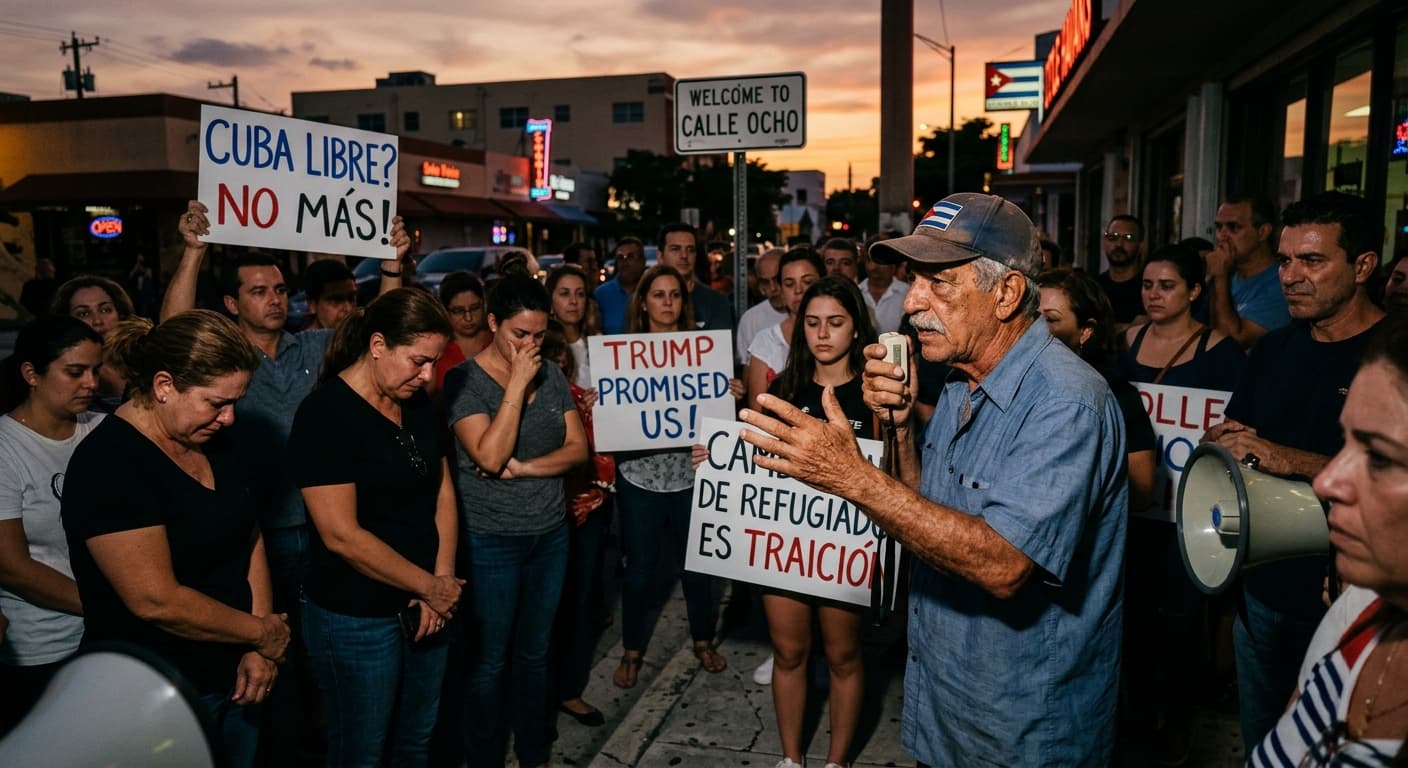
Trump's Cuban Miami Betrayal: Refuge to Removal in 60 Years
Trump's second term has deported more Cubans than his first — while using Miami's Freedom Tower, the old refugee center, as backdrop for a Castro indictment.
The building where the U.S. government once processed Cuban exiles into new American lives is now the stage on which the same government revokes that lineage: on May 20, 2026, Acting Attorney General Todd Blanche indicted Raúl Castro for murder from the Grand Hall of Miami's Freedom Tower — 14 months after his administration stripped legal status from roughly 110,900 Cubans and began the largest removal of Cuban nationals in the diaspora's history. The through-line Ada Ferrer and Miriam Pensack draw in the July 23, 2026 issue of The New York Review of Books is that Cuban Miami's Cold War bargain — hard-line rhetoric against Havana in exchange for uniquely soft-landing refugee treatment at home — has collapsed under a Republican president Cuban Americans elected by more than two-to-one. That collapse is not rhetorical. It is a set of federal actions with documented human-rights consequences, and it is redefining what "refugee" means for a community that spent 60 years as America's model exile.
The policy break, in primary documents
The load-bearing document is a March 25, 2025 Federal Register notice from the Department of Homeland Security terminating the Cuba–Haiti–Nicaragua–Venezuela (CHNV) parole process created by the Biden administration. Under the notice, "the temporary parole period of aliens in the United States under the CHNV parole programs… will terminate on that date unless the Secretary makes an individual determination to the contrary," according to DHS's notice in the Federal Register. It applied to approximately 532,000 people, including 110,900 Cubans, per
BBC News.
On May 30, 2025, the Supreme Court in Noem v. Doe stayed the district court injunction that had paused the rollback, allowing DHS to strip status en masse while litigation continued. Justice Ketanji Brown Jackson, dissenting, wrote that granting the stay would "immediately effectuate the en masse truncation of all parole grants for approximately 500,000 current CHNV parole beneficiaries," per the Supreme Court order. One year later, in June 2026, the White House claimed a further "major Supreme Court win on TPS termination," extending the same logic to Temporary Protected Status designations, according to
a White House release.
The result on the ground is quantifiable. Human Rights Watch documented that between January 2025 and March 2026 the U.S. deported an estimated 4,353 Cubans to Mexico — a country most had never set foot in — making Cubans the largest single nationality group in a broader surge of third-country removals, according to the HRW report "Casting Us Aside to Die". Since June 2025, more Cubans have been sent to Mexico each month than to Cuba, because Havana continues to refuse most returns. Seventy-eight percent were arrested in Florida or Texas; 97% had been in ICE detention first. That is the operational meaning of the "betrayal" Ferrer and Pensack describe.
The historical bargain that just broke
To understand why this is a rupture rather than a policy adjustment, follow the money and the statute. The Freedom Tower, as The New York Review of Books recounts, housed the federal Cuban Refugee Center from 1962 to 1974. Washington funded English classes, childcare, job training and cash assistance for arriving Cubans — the same public services routinely denied to other immigrant groups. Emilio Estefan's family passed through it.
The legal scaffold was the Cuban Adjustment Act of 1966. Under the CAA, "Cubans who are admitted or paroled into the United States become automatically eligible for a green card, a permanent visa, after a year and a day," as immigration scholar Marc Rosenblum described the statute on NPR. No other nationality receives that treatment. In peer-reviewed work in Cold War History, historian Michael Bustamante shows the CAA survived Obama's 2017 termination of "wet-foot/dry-foot," but only for Cubans "inspected" at a port of entry — precisely the pathway CHNV had provided before Trump closed it, per
Taylor & Francis.
That is why the CHNV termination hits Cubans harder than the raw numbers suggest. Ending parole does not merely deport recent arrivals; it forecloses the on-ramp to the CAA that made Cuban Miami possible in the first place.
The human-rights arithmetic on both sides of the Straits
The refugee framing exists because Cuba's repression is real and current. Freedom House counts "more than 1,280 political prisoners" detained on the island as of June 2026, describing the moment as one in which "political prisoners are leveraged as bargaining chips while the system itself and the humanitarian conditions facing ordinary Cubans remain unchanged." Amnesty International, marking a year of "opaque selective releases," has demanded the immediate freedom of Sayli Navarro, Félix Navarro, Loreto Hernández García, Maykel "Osorbo" Castillo and artist Luis Manuel Otero Alcántara,
warning in January 2026 that "some of the people released in 2025 were forced into exile, while others were returned to prison." Human Rights Watch has separately documented that Cuba's April 2, 2026 release of 2,010 prisoners "excludes critics," with more than 700 political prisoners still behind bars, per
HRW's April statement.
Those are the conditions the U.S. is now returning people toward. HRW's interviewees "expressed despair at being removed to Mexico, a country most of them had never even visited," and reported being told by ICE agents: "Cuba does not accept you." Fifty-seven percent of Cubans sent to Mexico had prior criminal convictions; the rest, per HRW's dataset, did not.
Domestically, the enforcement machine has grown to industrial scale. The Council on Foreign Relations reports that ICE detained nearly 69,000 people as of early January 2026 and that Trump signed the One Big Beautiful Bill Act, providing roughly $170 billion for immigration enforcement over four years, including $45 billion for detention capacity, according to CFR. Brookings estimates that roughly 400,000 immigrants have been booked into ICE detention since January 2025, and that around 145,000 U.S.-citizen children have experienced parental detention,
per Brookings analysis. NPR, citing detention monitors, reported 23 in-custody deaths between October 2025 and early March 2026 — already exceeding the prior fiscal year,
per NPR. A Cuban national became the 18th ICE-custody death of calendar 2026 by May,
according to Al Jazeera.
The Freedom Tower as prop
On May 20, 2026, Acting Attorney General Todd Blanche stood in the Freedom Tower's Grand Hall and unsealed a superseding indictment charging Raúl Castro and five co-defendants with conspiracy to kill U.S. nationals, four counts of murder and two counts of destroying aircraft over the 1996 downing of two Brothers to the Rescue planes. "For nearly 30 years, the families of four murdered Americans have waited for justice," Blanche said, per Al Jazeera. Senator Ashley Moody's office called the venue "a beacon for those forced from their homes by a Communist dictatorship,"
in her official release.
The tableau is what makes the policy contradiction legible: the U.S. government invoking the exile symbolism of the Freedom Tower to prosecute a Cuban leader for killing Americans, while the same administration is deporting the exiles' relatives out the back door. Council on Foreign Relations fellow Roxanna Vigil, quoted by BBC News, flagged the question openly: whether the indictment will be used as legal cover for military action, as the Maduro indictment was used against Venezuela.
The political cost is already visible
Cuban Miami is beginning to move. CBS/BBC polling found Latino approval of Trump falling to 38% by early 2026, from 49% in February 2025, with 70% disapproving of his immigration handling, per the BBC. Republican State Senator Ileana Garcia, founder of "Latinas for Trump," has called the deportations "unacceptable and inhumane." Representative María Elvira Salazar (R-FL), the daughter of Cuban exiles, told NPR she was "heartbroken" and has re-introduced the bipartisan Dignity Act to create a temporary legal-status pathway,
according to NPR. Abel Delgado, who runs Miami-Dade's Democratic Hispanic Caucus, put the shift starkly to NPR: "We didn't deport people to Cuba on a regular basis before. That has changed."
The Cuban American exile political machine — from the Cuban American National Foundation founded by Jorge Mas Canosa to today's Miami congressional delegation — built its influence on the premise that Washington would combine maximum pressure abroad with maximum welcome at home. That premise is what Ferrer and Pensack argue has been broken. It is also, per the historical modeling of exile-driven Republican affiliation, the exact bargain that produced Cuban Miami's Republican realignment in the first place.
What to watch
- Noem v. Doe on the merits. The Supreme Court's May 30, 2025 stay was procedural. The First Circuit case out of Judge Indira Talwani's Massachusetts court continues; a merits ruling on whether DHS can en masse revoke individually granted paroles is the next legal hinge.
- The Dignity Act before August recess. Rep. Salazar has said the window closes with recess. Watch whether the White House signals openness — Representative Veronica Escobar's co-sponsor has framed it as the last practical vehicle before the midterms,
per her office.
- The Raúl Castro indictment's second act. Blanche confirmed an arrest warrant. Whether the administration follows the Maduro precedent — treating a criminal indictment as predicate for kinetic action against Cuba — is the geopolitical question Havana's foreign ministry raised on June 30, 2026, when it reported "no progress" in bilateral talks,
per Al Jazeera.
- The November 2026 midterms in Miami-Dade. Salazar's FL-27 and Mario Díaz-Balart's FL-26 are the tell. If the Cuban vote share slides more than five points, the exile-Republican alignment Mas Canosa built at the Freedom Tower is functionally over.
The Bottom Line
The Trump administration is doing something no prior U.S. government has done: deporting Cubans in large numbers to a third country while simultaneously invoking Cuban exile symbolism to prosecute the Castro regime — dismantling, from both ends, the 60-year bargain that made Cuban Miami a Republican fortress. Ferrer and Pensack's "betrayal" is not a metaphor but a measurable break: 4,353 Cubans removed to Mexico by March 2026, roughly 110,900 stripped of parole by federal notice, and 1,280 political prisoners still held in Cuba the United States is now returning people toward. If the next Supreme Court ruling upholds the mass termination and the Dignity Act dies at recess, the practical meaning of the Cuban Adjustment Act — America's oldest standing refugee statute — will have been hollowed out without Congress ever repealing it.
Discover more
US Politics
Virginia's Redistricting Referendum
Virginia's redistricting referendum is drawing a flood of dark money, shaping future elections and the fight for congressional control amid party stakes.

Global Politics
Xi Jinping Calls China-Russia Ties 'Precious'
Xi Jinping's description of China-Russia ties as 'precious' reflects a strategic imbalance, with Beijing dictating terms in the partnership.

India
Women’s Reservation in India
India's 33% women's reservation law is enacted but won't take effect until after 2029 due to political setbacks and census delays.

Economics
Fed's Amex AML order puts correspondent banking on notice
Federal Reserve's Amex AML order requires board-level controls and a 90-day plan; OCC fined the bank $350 million over enterprise-wide deficiencies.