Trump's Cuba Policy: Deportations Surge
UN warns of humanitarian crisis in Cuba amid deportations.
Model Diplomat7 min readAmericas
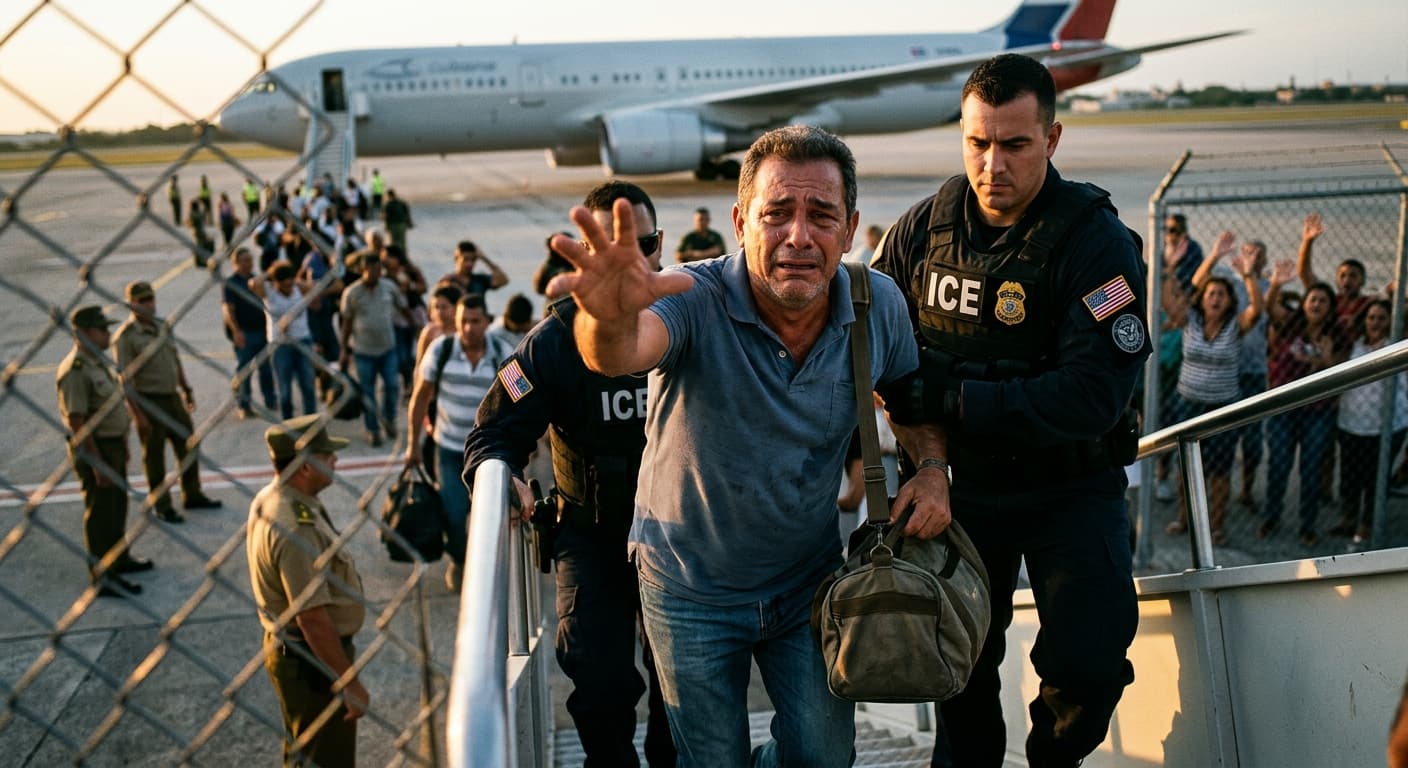
Trump's Cuba Squeeze: Deportations Rise as UN Cites 'Energy Starvation'
The Trump administration has revoked legal status for 110,900 Cuban parolees while the UN warns his January 2026 fuel blockade is causing "widespread harm" on the island — a rupture of the 60-year Cuban Miami bargain.
On May 20, 2026, Acting Attorney General Todd Blanche stood inside Miami's Freedom Tower — the 1925 Mediterranean Revival skyscraper that housed the federally funded Cuban Refugee Center from 1962 to 1974 — and unsealed a murder indictment against 94-year-old Raúl Castro. The staging was deliberate: the building where Washington once processed and paid to resettle Cubans fleeing communism is now the podium from which the same government announces criminal charges against Havana. What Ada Ferrer and Miriam Pensack argue in The New York Review of Books is that the symbolism inverts a historic pact. Since President Donald Trump returned to office, the sanctions half of the old Cold War bargain has been dramatically expanded while the sanctuary half has been dismantled — with the United Nations now describing the resulting humanitarian collapse in Cuba as "energy starvation" that has doubled infant mortality on the island.
The Freedom Tower as stage set
The Freedom Tower press conference was not a routine indictment. Blanche, flanked by Senator Ashley Moody and a hall packed with exile organisations, told the audience: "The community here — you all — understands the history of the Cuban regime better than anyone in America," according to Al Jazeera's account of the event. The underlying case — the 1996 downing of two Brothers to the Rescue civilian aircraft that killed four men — is 30 years old; three lower-ranking Cuban military officers were charged over the same incident in 2003. What is new is the choice of venue and the elevation of a former head of state, whom U.S. prosecutors know they cannot extradite. A superseding indictment unsealed the same day in the Southern District of Florida charges Castro with conspiracy to kill U.S. nationals, two counts of destruction of aircraft, and four counts of murder, per the court's
order to unseal.
Roxanna Vigil of the Council on Foreign Relations, quoted by the BBC, read the sub-text plainly: the open question is "whether the Trump administration will use this indictment in a similar way that it used the indictment against Maduro, as a justification to carry out a military operation under the cover of a law enforcement action." That is the tell. The Freedom Tower — designated a National Historic Landmark in 2008 precisely because it was where the federal government funded English classes, housing, childcare, and job training for arriving Cubans — is being repurposed as the backdrop for an escalation.
The pact, broken
The pact was simple. From the 1960s onward, Washington paid to resettle Cubans in exchange for a hard line against Havana. The 1966 Cuban Adjustment Act let Cubans apply for a green card after one year and a day on U.S. soil — a privilege denied every other nationality, as the Council on Foreign Relations documents in its history of U.S. postwar immigration policy. Under the "wet-foot, dry-foot" doctrine, any Cuban who touched U.S. soil was allowed to stay. The generosity was ideological: welcoming Cubans embarrassed Castro and served the sanctions strategy.
That machinery is now running in reverse. On March 22, 2025, DHS Secretary Kristi Noem revoked the Biden-era CHNV humanitarian parole for 532,000 Cubans, Haitians, Nicaraguans, and Venezuelans — including 110,900 Cubans, BBC News reported. The termination took effect on April 24, 2025; on May 30, 2025, the Supreme Court stayed a district-court injunction and let the terminations proceed, according to
NPR's account of the ruling. By December 2025, more than 1.6 million immigrants had lost legal status in eleven months, NPR reported in a
year-end analysis — the largest en-masse stripping of protections in modern U.S. history.
Cubans, historically insulated, now feel it directly. NPR's Jasmine Garsd told the network's July 2025 broadcast that "one of the groups that most called me to give me tips about the conditions was Cubans and Cuban Americans, who — many of whom voted for this but who once, you know, you engage in conversation, said, well, I didn't think it was going to affect me." Republican Congresswoman María Elvira Salazar of Miami said Cuban deportations left her "heartbroken" and confronted DHS Secretary Noem in June 2025, per
NPR. State Senator Ileana García, founder of Latinas for Trump, publicly called the deportations "unacceptable and inhumane."
The scale of ICE detention has broken records. Physicians for Human Rights told Al Jazeera that by May 2026, 18 people had died in ICE custody in the calendar year — the fifth by apparent suicide, and one of them, 33-year-old Cuban Denny Adan Gonzalez, in Georgia. TRAC data cited in the same report showed detention had risen from just under 40,000 in January 2025 to more than 70,000 by January 2026.
The atrocity finding
The second half of the bargain — sanctions on Havana — has been escalated to a level UN treaty-body experts are now calling a human-rights violation in itself. Trump re-designated Cuba as a State Sponsor of Terrorism on his first day in office, reversing Biden's January 14, 2025 delisting; a group of UN special rapporteurs called it a "regressive step" that would have "the most devastating impact on vulnerable groups," in an OHCHR statement.
Then, in January 2026, Trump issued an executive order imposing an additional market-value duty on any country supplying oil to Cuba — a secondary sanction that cut off Venezuelan shipments and threatened Mexico. UN Special Rapporteurs Surya Deva, Sofía Monsalve Suárez, and Pedro Arrojo-Agudo characterised the measure in a May 2026 statement as follows:
"Cuba has been subjected to energy starvation by the United States, a condition in which the lack of fuel cripples the functioning of essential services required for a dignified life. This unlawful blockade is not only disrupting daily life but also undermining the enjoyment of a wide range of human rights."
The OHCHR release cited 96,000 pending surgeries, including 11,000 for children, and delays in the National Immunisation Programme. In June 2026, UN High Commissioner Volker Türk went further, calling for the immediate lifting of the sanctions and citing figures from his office: infant mortality doubled to 9.9 per 1,000 live births; childhood cancer survival rates fell from 85 to 65 percent; essential medicines available at only 30 percent of normal supply, per
UN News. Daily blackouts by mid-May 2026 were regularly exceeding 20 hours.
That is the atrocity finding — not a court ruling, but a treaty-body chorus rare in its bluntness toward Washington. It is also the material context for the deportations: DHS is returning Cubans to a country the UN describes as facing possible humanitarian "collapse," a phrase UN News attributed to Secretary-General António Guterres in February 2026.
Who benefits, who loses
The immediate political beneficiaries are the hard-line legacy institutions of Cuban Miami — the Cuban American National Foundation network Jorge Mas Canosa built after buying the Freedom Tower in 1997, and Republican members of Florida's congressional delegation who traded endorsements for pressure on Havana. The Castro indictment is a gift to that constituency. The White House posted the DOJ announcement prominently; Senator Moody's office
circulated video of the Freedom Tower event.
The losers are more numerous and less visible. They include the roughly 110,900 Cuban parolees now facing expedited removal; the estimated 671 political prisoners still held by Havana from the 11 July 2021 protests, per Amnesty International — people whose cause is invoked in Washington but whose government has hardened repression under the pressure of the fuel blockade; and the Cuban Americans in Miami-Dade who voted 68 percent for Trump in 2024 and now find relatives detained at routine ICE check-ins. NPR/PBS/Marist polling from April 2026 showed Trump's overall approval at 37 percent, its lowest ever,
reported NPR's Domenico Montanaro — a slide driven partly by Hispanic defection.
There is also a structural loser: the U.S. refugee-admissions doctrine itself. The Cuban Adjustment Act still exists on paper, but the tourist visas that let Cubans reach U.S. soil in the first place have been curtailed, the CHNV air route is closed, and — per Al Jazeera — expedited removal now applies to any Cuban present under two years. The privileged pathway of 1966 has been narrowed to a technicality.
What to watch
- The Douhan final report to the UN Human Rights Council in September 2026. Special Rapporteur Alena Douhan visited Cuba from 11–21 November 2025 to assess the human-rights impact of U.S. sanctions, per her
preliminary statement; the final report will be the most authoritative treaty-body finding to date.
- The November 2026 U.S. midterms. Miami-Dade's 27 Cuban-American state legislative seats and two U.S. House seats — held by Salazar and Carlos Giménez — are the test of whether the deportation backlash translates into ballot losses. Brookings
projects a Democratic edge of 5.3 points on the generic ballot.
- The Castro indictment's operational sequel. Whether DOJ pairs the murder charges with the sort of interdiction or covert action that followed the Maduro indictment will signal whether "law enforcement" is a pretext for military escalation, as Vigil and other analysts have warned.
The bottom line
The bottom line: the same building that once welcomed Cubans as refugees is now the stage from which Washington indicts their former rulers, while the administration deports the newest arrivals and starves the island of fuel — a rupture of the 60-year pact that made Cuban Miami possible. The evidence that the sanctions half of that bargain has become a distinct human-rights problem no longer comes only from Havana; it comes from the UN High Commissioner and three Special Rapporteurs. Ferrer and Pensack's argument — that Trump has betrayed the very community that lifted him — is now measurable in ICE detention numbers, infant-mortality data, and a Miami-Dade approval collapse.
Discover more
US Politics
U.S. House Passes Alert Act for Aviation
The House passed the ALERT Act 396–10, replacing the ROTOR Act after Pentagon intervention, impacting aviation safety regulations.
US Politics
SNAP Food Assistance Faces Legal Challenges
In 2026, SNAP faces stricter eligibility rules and mounting legal challenges, threatening food assistance for the millions of Americans who rely on the program.

Global Politics
US Seizes Iranian Ship, Tensions Surge
The US seizure of the Iranian ship Touska highlights a shift in control over the Strait of Hormuz, favoring Iran's strategic position.
Economics
Fed's Amex AML order puts correspondent banking on notice
Federal Reserve's Amex AML order requires board-level controls and a 90-day plan; OCC fined the bank $350 million over enterprise-wide deficiencies.