Trump's Challenge to OPEC
How Trump's policies reshaped the oil cartel landscape
Model Diplomat8 min readGlobal
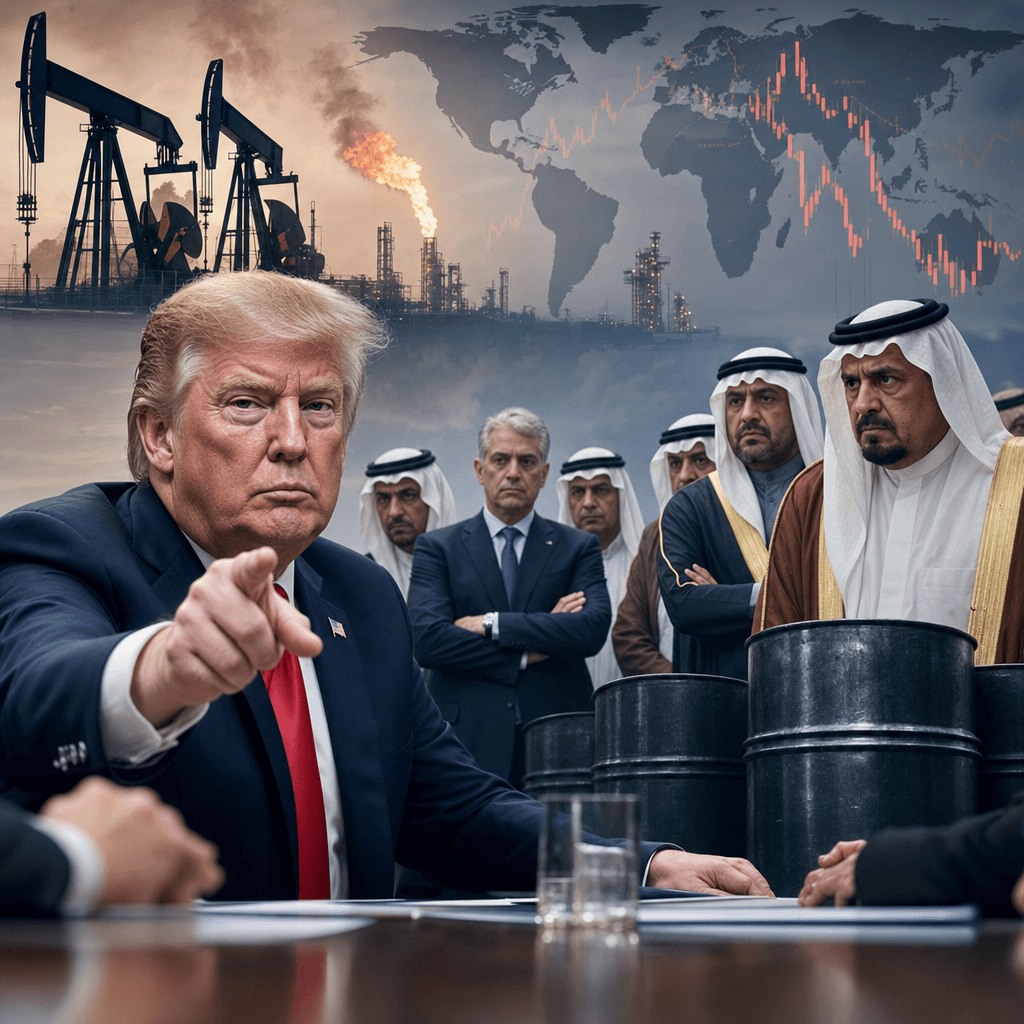
Trump's Challenge to OPEC: How Washington Broke the Cartel's Grip
A once-cohesive oil cartel is now fragmented — with the UAE gone, Venezuela under US administration, and Saudi Arabia doing the heavy lifting alone. Here's what Trump's pressure campaign actually achieved, and where it fails.
On July 6, 2026, seven remaining OPEC+ producers announced an 188,000 barrel-per-day quota hike for August — the fifth consecutive monthly increase, and by the group's own admission a "paper formality" while barrels remain constrained by the aftershocks of the war on Iran, Al Jazeera reported. The real story is not the number. It is that Donald Trump has, in 18 months, done what four US presidents could not: turned OPEC from a price-setter into a price-taker. Not by drilling more — US shale is running flat — but by militarising the supply side. He seized Venezuela's oil, drove the UAE out of the cartel, bombed Iran into a Hormuz shutdown, then negotiated its reopening on Washington's terms. The cartel that survived the shale revolution has not survived him.
The cartel Trump inherited, and the one he leaves
When Trump returned to the White House in January 2025, OPEC+ was managing 2.2 million barrels per day of voluntary cuts and defying his calls to lower prices. On March 3, 2025, eight members agreed to start unwinding those cuts from April — a decision analysts told Axios bore Trump's fingerprints after a Davos speech in which he accused the group of "ripping off the rest of the world."
The White House translated that rhetoric into policy at speed. Trump's January 2025 "national energy emergency" order directed agencies to fast-track drilling permits and use emergency authorities to boost fossil-fuel output, as NPR reported. The White House now claims US crude output hit an all-time high of 13.6 million barrels per day, with LNG exports crossing 100 million metric tons in a single year — figures published in an
April 2026 White House release claiming the US now produces "more oil than Saudi Arabia and Russia combined."
That figure is the ceiling of the domestic story. The rest of the leverage came from outside US borders.
The Venezuela shock: seizing a member state
The most audacious move was direct. On January 3, 2026, Operation Absolute Resolve — a special-forces raid rehearsed for months on a replica of Maduro's compound — extracted the Venezuelan president to face drug and weapons charges in the US, according to reporting from the BBC. His deputy Delcy Rodríguez was installed as interim president. Within four weeks, the Venezuelan National Assembly had passed a privatisation bill capping royalties at 30% and moving disputes out of Venezuelan courts, per
Al Jazeera. Trump announced Caracas would "turn over" up to 50 million barrels — worth about $2.8 billion — with revenue held in a US-controlled Treasury account,
the BBC reported.
The Middle East Council on Global Affairs called it "the beginning of a new global oil order," noting the US has since seized at least seven "shadow fleet" tankers carrying sanctioned Venezuelan exports, per MECGA analysis. But the operational reality is thinner than the rhetoric. Venezuela produces roughly one million barrels a day — under 1% of global supply — and ExxonMobil's Darren Woods told Trump at a White House meeting the country remains "uninvestable," according to
the BBC. Only Chevron is moving barrels at scale, currently importing about 250,000 bpd of Venezuelan crude on average.
The point of the Venezuela play was never the barrels. It was jurisdiction. An OPEC member is now administered by Washington, its export revenues clearing through the US Treasury, its sanctions relief titrated by the White House. Brookings analysts flagged the legal ambiguity — the US had until January still recognised the 2015 National Assembly as Venezuela's "only legitimate branch" — but the Brookings piece noted Trump has simply run over the contradiction.

The UAE walks: the cartel's second defection
Then came the split from inside. On April 29, 2026, the UAE announced it would exit OPEC and OPEC+ effective May 1, ending a nearly 60-year membership. Trump welcomed the departure the next day, telling reporters Mohamed bin Zayed was "very smart" and that the exit was "a good thing for getting the price of gas down," according to Al Jazeera.
Rystad Energy's Jorge Leon told reporters that losing "a member with 4.8 million barrels per day of capacity, and the ambition to produce more, takes a real tool out of the group's hands." He added the harder line: "Saudi Arabia is now left doing more of the heavy lifting on price stability, and the market loses one of the few shock absorbers it had left." That quote captures the structural shift. OPEC's discipline mechanism required unanimity; the UAE's departure — after years of chafing at its baseline quota — signals that any producer with spare capacity and low costs can now walk.
Saudi Arabia's response has been muted. Energy Minister Prince Abdulaziz bin Salman travelled to St Petersburg on June 4, 2026 to meet Russian counterpart Alexander Novak, calling only for "stability" and conceding, per Novak, that "no one really knows what to expect regarding demand." That is not the language of a cartel setting the price. It is the language of one hoping the market sets a tolerable one.
The Iran war: coercion by chokepoint
The most consequential lever was also the most reckless. On February 28, 2026, the US and Israel launched strikes on Iran; Iran effectively closed the Strait of Hormuz, through which roughly a fifth of global oil and LNG normally passes. Total OPEC+ output collapsed from 42.77 million bpd in February to 33.13 million bpd in May, per OPEC figures cited by Al Jazeera. Brent topped $126 in April.
The Council on Foreign Relations documented the paradox in a March 2026 analysis: Trump's war on Iran forced his own administration to issue sanctions waivers to Iran and Russia to keep barrels moving. The US Treasury's Office of Foreign Assets Control issued
General License U on March 20, 2026 authorising the sale of Iranian-origin crude already loaded on vessels — an inversion of eight years of maximum-pressure policy. Then on June 17, 2026, Trump and President Masoud Pezeshkian signed a memorandum of understanding ending the war, reopening Hormuz and lifting the US naval blockade. Brent has since fallen back below $72, below its February 27 pre-war close. Iran, per BBC Verify, has pushed roughly 50 million barrels of crude to market since the blockade lifted.
The war's second-order effect is what Trump's team likely counts as strategic gain. It broke Saudi and Emirati confidence that Gulf infrastructure is untouchable. It forced OPEC+ to sit through a supply shock it could not manage. And it embedded a US-controlled licensing regime — General License U, then W on May 1 — as the gating mechanism for Iranian and Venezuelan barrels reaching global markets. The cartel does not price oil. Washington does, one general license at a time.
Where the strategy strains
None of this means Trump has "won." Three fault lines are visible.
First, US shale is not delivering the price cut he promised. As NPR's March 2026 reporting noted, lower prices actively disincentivise US producers from drilling — particularly in high-cost Alaska plays the administration opened. Chatham House warned in a
February 2026 analysis that "energy dominance" as domestic rhetoric collides with a market that rewards discipline, not volume. The World Bank's
Oxford-Analytica briefing noted Saudi output was already running below its OPEC+ allowance in mid-2025.
Second, Venezuela is a mirage on the timeline that matters. BP's former CEO Lord Browne told the BBC reviving Venezuela's industry is "a very long term project"; Capital Economics' Neil Shearing said oil prices in 2026 would see little change from Venezuela regardless. Trump's ask of $100 billion in industry investment produced no commitments at the January 2026 White House meeting.
Third, China remains the swing buyer. Beijing has condemned the US demand for exclusive Venezuelan supply as "bullying" and has kept buying discounted Iranian and Russian crude. As Brookings' June 2026 Hormuz analysis argued, OPEC has for decades set quotas but never controlled all barrels — and the war showed how quickly non-cartel flows fill the gap.
Diplomat View
The evidence supports a specific call, not a triumphalist one. Trump has not destroyed OPEC — he has reduced it to a rump of Saudi Arabia plus five smaller producers plus a wounded Russia, with the UAE freelancing, Venezuela under US administration, and Iranian exports gated by OFAC. That is not the same organisation Jimmy Carter faced. It is a Saudi-led production committee whose quota decisions are, as one analyst put it Monday, "essentially meaningless" in the short term.
The forecast: if Brent stays in a $65–80 band through Q4 2026, this is the new equilibrium, and OPEC's next crisis is internal — Kuwait or Iraq following the UAE out. What would revise the call: a second Hormuz closure (Iran has already reneged partially, with strikes on tankers on June 26 and June 29), a Saudi decision to defend prices unilaterally through a deep cut, or a court ruling striking down Trump's executive order shielding Venezuelan oil revenue from creditor seizure. Any of those, and the "energy dominance" architecture cracks.
The named condition to watch is the August 2 OPEC+ meeting. If Saudi Arabia signals a pause on the phase-out — the group explicitly reserved the right to "pause or reverse" — the market will read that as Riyadh drawing a floor without Emirati or Iranian cooperation. That is the moment the cartel either reconstitutes around a smaller core, or admits Washington is now setting the price.
What to watch next
- August 2, 2026 — Seven-member OPEC+ virtual meeting on September quotas; first real test of Saudi price tolerance.
- August 21, 2026 — Expiry of the US Treasury general license permitting Iranian crude sales; renewal terms will signal whether the Trump-Pezeshkian MoU is holding.
- Late 2026 — First quarterly report on Venezuelan oil revenue routed through the US Treasury account; any court challenge to Trump's shielding executive order becomes the sanctions-regime stress test.
The Bottom Line
Trump has not out-produced OPEC — he has out-manoeuvred it. By seizing Venezuela, welcoming the UAE's exit, and using the Iran war to gate Middle Eastern barrels through US sanctions licences, he has converted the cartel from a price-setter into a price-taker inside a Washington-controlled framework. The next OPEC+ meeting on August 2 will show whether Saudi Arabia accepts that reality or tries to reclaim the pricing power the Gulf lost between February and June 2026. For readers tracking Global Politics, this is the geoeconomic pivot of the year: the oil order is no longer negotiated in Vienna.
Discover more
Global Politics
Trump's Conflicting Messages on Iran War
Trump's mixed messages on Iran reflect a strategy of audience management, benefiting Tehran amid a complex geopolitical landscape.

Global Politics
US Seizes Iranian Ship, Tensions Surge
The US seizure of the Iranian ship Touska highlights a shift in control over the Strait of Hormuz, favoring Iran's strategic position.

Conflict & Security
Drone Warfare Killing Aid Workers at Unprec
Over 1,000 humanitarian workers killed in three years as cheap armed drones collapse legal protections. Gaza, Sudan, Ukraine, and DRC see deliberate targeting of aid convoys and hospitals with zero prosecutions.

Global
World Normalises Taliban as Afghan Women Eras
UN data shows Afghan women erased from public life as Russia recognises the Taliban, EU hosts officials in Brussels, and ICC warrants for gender persecution go unenforced.