Trump's AI Bargain: Deregulation for China
A closer look at Trump's AI export control strategy
Model Diplomat9 min readNorth America
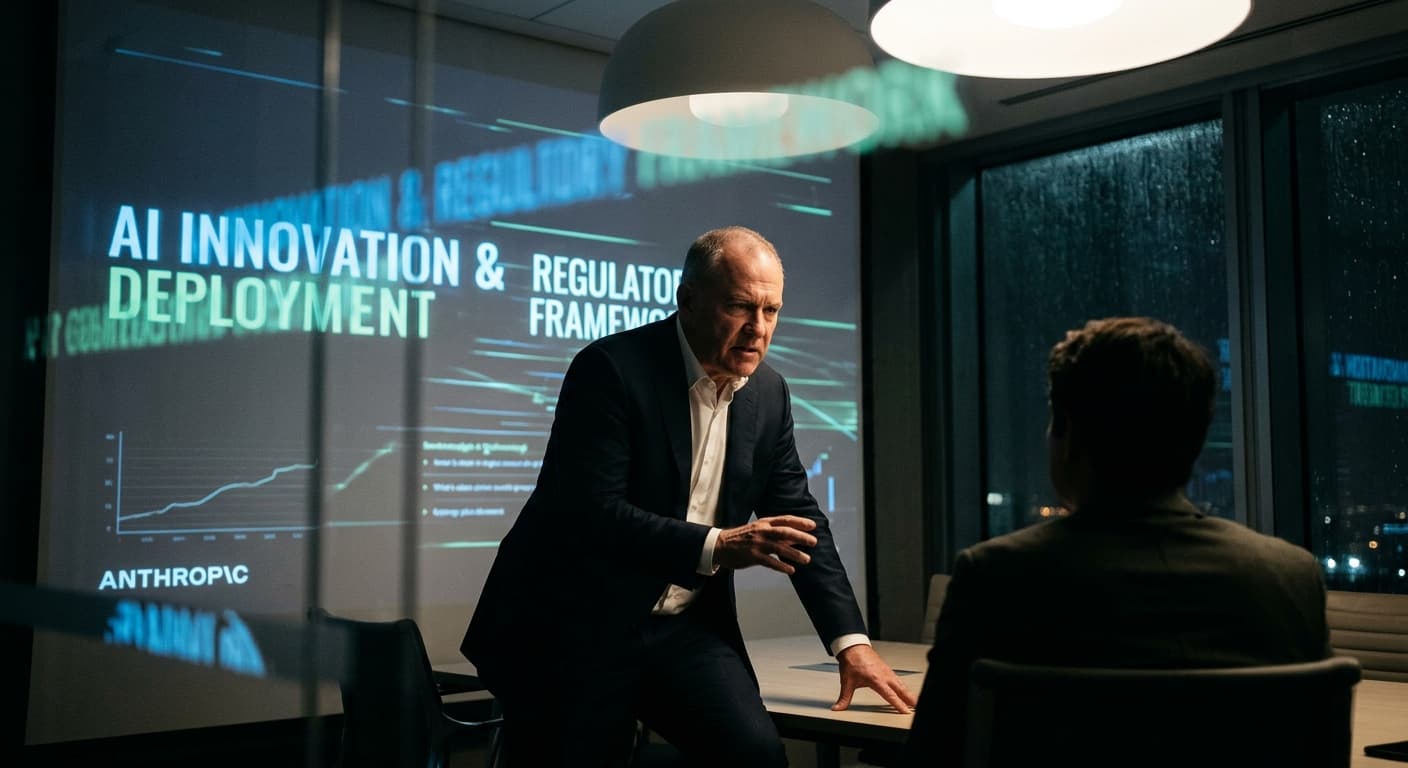
Trump's AI Bargain: Deregulation for China, Discipline for Anthropic
Trump lifted export controls on Anthropic's Claude Mythos 5 on July 1, 2026, but the truce shows Washington now governs frontier AI by discretionary deal — with China as the pretext and Anthropic as the leverage.
The U.S. Commerce Department restored foreign access to Anthropic's Claude Fable 5 and Mythos 5 on July 1, 2026, ending a nineteen-day export freeze — but the reprieve arrived with strings that reveal the Trump administration's real AI policy: not deregulation, but a bespoke, case-by-case gatekeeping regime in which China is the pretext and Anthropic is the lever. According to Al Jazeera, Commerce Secretary Howard Lutnick's letter conditioned the license waiver on Anthropic "proactively detecting" security risks, coordinating on standards for future models, and reporting "malicious activity." The company most publicly at odds with the White House now operates under bespoke federal supervision that no statute created and no other lab has been forced to accept.
That is the story. The public frame is a laissez-faire White House pushing back on state and federal AI rules to keep pace with Beijing. The operating reality is a transactional export-control state in which access to frontier models — and to the Chinese market for the chips that train them — is negotiated model by model, company by company, at presidential discretion. And the company paying the highest cost of that discretion is not a Chinese lab. It is the most valuable AI startup in the world.
The policy stack the White House actually built
Start with the primary documents. President Trump's June 2, 2026 executive order on "Promoting Advanced Artificial Intelligence Innovation and Security" directs the National Security Agency to define a "covered frontier model" and gives the federal government up to 30 days of pre-release access to any system that meets the threshold. The order is explicit: "Nothing in this section shall be construed to authorize the creation of a mandatory governmental licensing, preclearance, or permitting requirement." That language was deliberately inserted to head off an FDA-style regime for AI that Sam Altman had once floated and that industry lobbyists have fought for two years.
Layered above the order sits the July 2025 AI Action Plan, which frames AI as a race "the U.S. must win" and calls for "removing onerous Federal regulations that hinder AI development and deployment." The Council on Foreign Relations
described the June executive order as "an attempt to engineer a cybersecurity window of opportunity" — preferential defender access to frontier capabilities, delayed adversary access, all executed through supposedly voluntary channels. CFR also noted that Trump had pulled an earlier draft in May 2026 because its 90-day review window "would blunt U.S. labs' competitiveness with China." The final text cut that to 30 days.
Voluntary on paper. Not in practice. The Center for Strategic and International Studies warned that when Commerce restricted Fable 5 and Mythos 5 on June 12, 2026, "the confusion over BIS's authority to impose it raises uncertainty for all of U.S. industry." Bureau of Industry and Security precedent for licensing an American software product had to be improvised in real time; CSIS observed that export controls "are not a clear fit for resolving national security concerns for how models are being accessed and used."
The state-preemption piece completes the picture. Republican legislators have twice tried to bar states from regulating AI — including with H.R. 5388, which would have imposed a five-year moratorium on state AI laws — and lost both times, with the Senate voting 99–1 against a similar rider on the "Big Beautiful Bill." That failure is why, as the
Center for American Progress notes, the administration is now instructing the attorney general to head an "AI Litigation Task Force" to sue states with "onerous" laws and to withhold broadband funding from noncompliant jurisdictions. Meanwhile California's SB-53 and New York's RAISE Act have converged around transparency and incident-reporting rules — a "trust but verify" model that, per
Carnegie, the White House has partially absorbed into its own AI Action Plan.
The China frame is doing heavy lifting
The White House sells all of this as necessary to counter Beijing. The evidence is thinner than the rhetoric.
DeepSeek released its V4 model on June 26, 2026. The Council on Foreign Relations' assessment is blunt: the company's own
technical paper concedes V4 "trails state-of-the-art frontier models by approximately 3 to 6 months," and outside analysts estimate the United States retains a roughly seven-month lead over China at the frontier. V4 is impressive on efficiency — a 1.6-trillion-parameter mixture-of-experts model with a one-million-token context window, running at 27% of V3.2's per-token inference cost. It is priced at least four times cheaper than U.S. rivals. But DeepSeek is still, per CFR, "extraordinarily dependent on U.S. technology" beneath the hood, and the frontier gap is not closing — it may be widening as leading American labs use AI to accelerate the next round of training runs.
That gap has not stopped the administration from opening the taps on the chip side. On December 8, 2025, Trump authorized Nvidia to sell its H200 chip — the world's second-most-advanced AI processor — to "approved" Chinese customers in exchange for a 25% cut of revenue to the Treasury, BBC reported. CFR analysts
warned that at plausible export volumes — three million H200s in a year, roughly consistent with pre-controls Chinese revenue share — the decision "could at least triple the amount of aggregate AI computing power China could add domestically next year," effectively ending the Biden-era "as large of a lead as possible" doctrine and enabling what CFR called a possible "AI Belt and Road" to compete with U.S. cloud providers.
So the administration is simultaneously loosening the semiconductor export regime that most directly constrains Chinese AI compute — while tightening bespoke, discretionary controls over the American labs that build models on U.S. soil. The Merics think tank documented that Trump repealed the Biden-era AI Diffusion Framework — the tiered scheme that would have policed transshipment through the UAE and Malaysia — in favor of an as-yet-undefined replacement. The June ban on foreign access to Fable 5 hit G7 partners without warning; French President Emmanuel Macron
called for European "self-reliance," and G7 leaders opened talks on a "trusted partner" scheme designed to route around U.S. discretion. That is the second-order effect: allies who assumed U.S. AI was a shared strategic asset are quietly hedging.
Why Anthropic keeps drawing fire
Anthropic is a $965 billion company that recently confidentially filed for what Pitchbook analyst Harrison Rolfes called "the most scrutinized public offering in tech history." According to
Al Jazeera, the company reported annualized revenue of $47 billion as of May 2026 and expects to turn a profit in the first half of the year. It is also the only frontier lab publicly refusing two Pentagon demands: unrestricted use of Claude for domestic mass surveillance, and for fully autonomous weapons.
That combination — commercial dominance plus vocal safety posture — has made Anthropic the administration's designated example. The timeline is unambiguous. On February 24, 2026, Defense Secretary Pete Hegseth threatened to invoke the Defense Production Act and blacklist Anthropic as a "supply chain risk" if CEO Dario Amodei did not drop his guardrails. Amodei publicly
refused, saying his company would not "accede to their request." On February 27, Trump
ordered every federal agency to stop using Anthropic products, calling the founders "left-wing nut jobs" and threatening "the Full Power of the Presidency" in "major civil and criminal consequences."
On March 4, the Pentagon formally designated Anthropic a supply-chain risk under 41 U.S.C. § 4713 — a statute never before used against an American firm, per Anthropic's D.C. Circuit filing, which describes the authority as designed for "hostile nation states and other bad actors." Anthropic filed two lawsuits five days later. On March 26, Judge Rita F. Lin of the Northern District of California
issued a preliminary injunction, writing that the government's actions "appear designed to punish Anthropic" and constitute "classic First Amendment retaliation." Judge Lin found the designation "likely both contrary to law and arbitrary and capricious," and rejected what she called "the Orwellian notion that an American company may be branded a potential adversary and saboteur of the U.S. for exposing a disagreement with the government."
The June export order — over a purported jailbreak of Fable 5 flagged by Amazon researchers and, per Semafor reporting cited by Al Jazeera, a suspected China-linked probe of Anthropic's systems — was the second act of the same play. Chatham House
called the July 1 reversal a "U-turn" that "sends mixed signals on AI governance." The
Economist's assessment was sharper: "The administration now controls who gets access to the best models" — through a system that is billed as voluntary and turns out not to be.
Who wins, who loses
OpenAI is the quiet beneficiary. Within hours of Anthropic's blacklisting, Sam Altman inked a Pentagon deal for classified cloud deployments — a contract Altman himself said had "more guardrails than any previous agreement for classified AI deployments, including Anthropic's." The stated red lines are similar; the negotiating posture is not. OpenAI is willing to sign; Anthropic is willing to litigate. That difference is now worth government contracts, priority frontier-model reviews, and — increasingly — regulatory forbearance.
Nvidia is the other clear winner. The company preserved Chinese market access through the H200 approval and secured a permanent negotiating channel that runs through Jensen Huang and the Oval Office. Palantir, which continues to partner with Anthropic on national-security work but also serves as the connective tissue for OpenAI's Pentagon deployments, is hedged on both sides.
The losers are more diffuse. European AI users spent nineteen days locked out of the world's most capable model with no warning and no legal recourse; the "trusted partner" G7 conversation is the direct downstream. Congressional preemption advocates lost a 99-1 vote and now watch the White House attempt via executive order what it could not win legislatively. Federal courts — first Judge Lin, next the D.C. Circuit — are being asked to police a discretionary export regime that Congress never authorized. And Anthropic, despite its trillion-dollar valuation and its IPO filing, now enters public markets with a bespoke federal compliance regime attached, a live First Amendment case pending, and a president who has publicly promised civil and criminal consequences.
Historical parallel
The closest analogue is not export controls on Cold War supercomputers. It is the Clipper Chip fight of the mid-1990s, when the Clinton administration tried to secure privileged government access to commercial encryption. That effort collapsed under industry resistance and constitutional challenge, and produced the modern liberalized crypto export regime. The Trump AI regime is running the same play — privileged government access, discretionary licensing, national-security framing — with two differences that cut in opposite directions. The technology is far more strategically consequential. And the administration is far more willing to punish individual companies for refusing.
What to watch next
- D.C. Circuit ruling on Anthropic's § 4713 challenge. A ruling that upholds Judge Lin's injunction would strip the administration of its most potent stick against individual labs.
- DeepSeek V5 and next-generation Chinese models. If the seven-month U.S. lead narrows meaningfully in the next two release cycles, expect the H200 approval to be re-examined and export controls to snap back.
- Anthropic IPO pricing and disclosure. The S-1 will be the first document to force Anthropic to characterize its federal-government relationship in writing — and the first market test of whether investors price political risk into a frontier AI valuation.
- State AI laws taking effect. California's SB-53 and New York's RAISE Act begin enforcement in 2026-2027. The AI Litigation Task Force's first test case will define whether the White House can preempt by lawsuit what Congress refused to preempt by statute.
The Bottom Line
Trump's AI regime is not deregulation. It is discretion — a system in which the president decides, model by model and company by company, who ships, who is licensed, and who is punished, with China invoked as the justification and Anthropic used as the demonstration. The July 1 reprieve did not end the pressure on Anthropic; it formalized it, moving the company from open confrontation into a bespoke compliance relationship that no statute created. Expect more of both: more chips to Beijing, more strings on Claude.
Discover more
US Politics
SNAP Food Assistance Faces Legal Challenges
In 2026, SNAP faces stricter eligibility rules and mounting legal challenges, threatening food assistance for the millions of Americans who rely on the program.
India
Congress Accuses Modi of Stalling Women's Law
Congress accuses Modi of stalling women's reservation law by linking it to delimitation, revealing a deeper electoral strategy.
India
BJP's Misunderstanding of Women's Quota Needs
The BJP's linking of the Women Reservation Bill to delimitation risks delaying women's empowerment in India, misreading the aspirations of female voters.

Conflict & Security
Drone Warfare Killing Aid Workers at Unprec
Over 1,000 humanitarian workers killed in three years as cheap armed drones collapse legal protections. Gaza, Sudan, Ukraine, and DRC see deliberate targeting of aid convoys and hospitals with zero prosecutions.