Trump Kills AI Testing Order, Giving Silicon Valley Leverage
Trump’s 11th-hour retreat shows AI regulation still yields to competitiveness arguments—and to the tech voices closest to him.
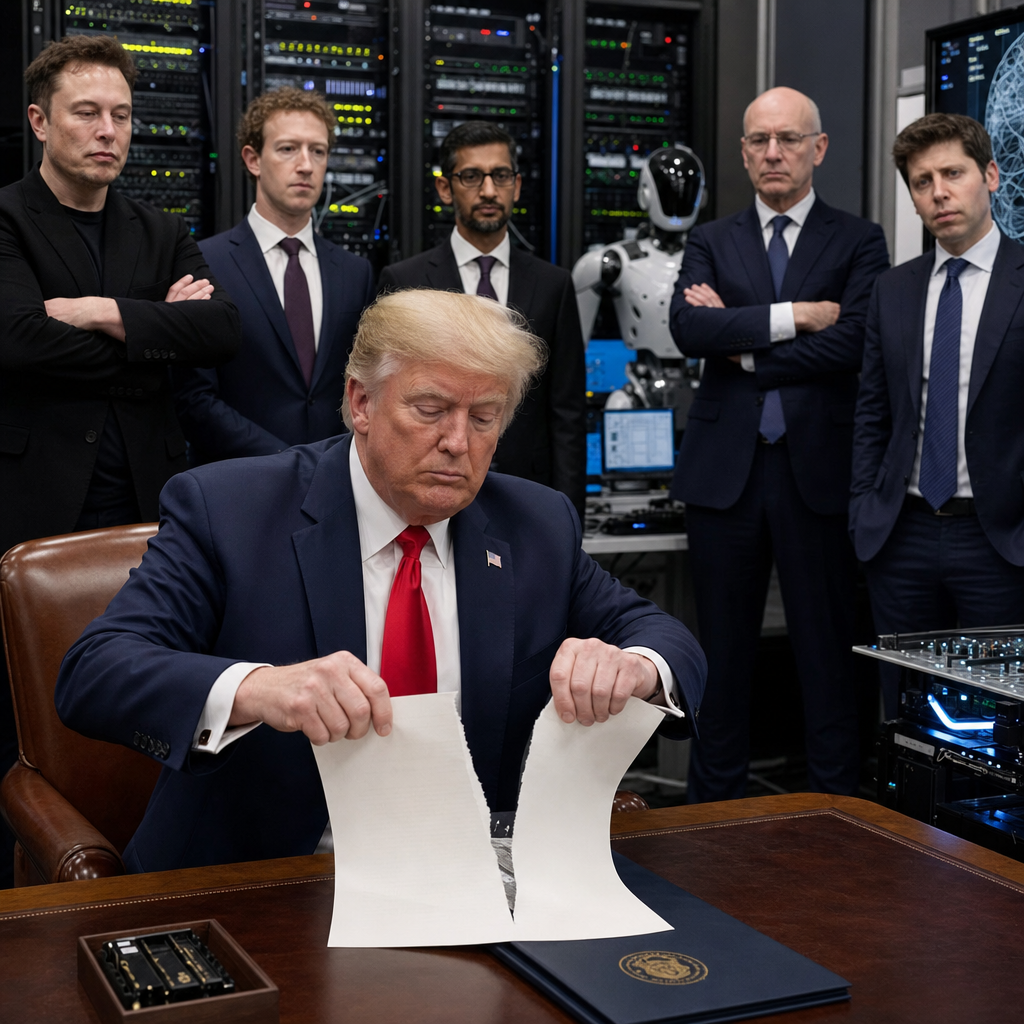
Trump abruptly scrapped a planned executive order that would have created a voluntary federal testing process for advanced AI models before public release, after last-minute objections from David Sacks and reported calls with Elon Musk and Mark Zuckerberg, according to  The Hill and the
  Associated Press. The president said he did not like “certain aspects” of the draft and did not want to do anything that would slow the United States in its race with China, the AP reported.
Why the pullback matters
The leverage here sits with Silicon Valley’s anti-regulatory camp, not with the agencies trying to build guardrails. The draft order would have let AI firms voluntarily submit frontier models for up to 90 days of government testing, but it stopped short of creating a mandatory licensing regime, The Hill reported. Even that light-touch framework drew pushback from Sacks, who argued the voluntary review could harden into de facto regulation and slow U.S. firms in competition with China, the  Wall Street Journal reported.
That is the real significance: this was not a fight over whether AI needs oversight, but over who gets to define “oversight”. White House chief of staff Susie Wiles said the administration was “not in the business of picking winners and losers,” The Hill reported, while AP said Vice President JD Vance framed the policy line as pro-innovation but still attentive to cybersecurity and privacy. Those are not small differences. They are competing theories of state power inside the same White House.
For readers tracking the broader domestic power struggle, this is classic  US Politics: a policy that looks technical on paper becomes a proxy for which faction has the president’s ear.
Who wins, who loses
The immediate winners are frontier AI firms and the investors backing them. A federal pre-release testing regime would have created another layer of scrutiny for model developers such as Anthropic, OpenAI and Google, which AP said were part of the broader voluntary collaboration under discussion. Pulling the order preserves the current advantage of moving fast and negotiating only case by case.
The losers are AI safety advocates, national security officials, and anyone who wanted a single federal rulebook before powerful models spread further.  Politico reported that the order is expected to go back to the drawing board, but that the collapse left few people confident about what comes next. That uncertainty matters because the administration has already signaled it wants to fight state-level AI regulation; if Washington cannot produce its own framework, states will keep filling the gap.
The bigger institutional loser is the White House itself. The Hill’s reporting shows an administration split between cyber hawks, economic nationalists, and Silicon Valley allies, with no settled process for reconciling them. In that kind of vacuum, policy becomes reactive: one phone call, one meeting, one presidential instinct.
What to watch next
Watch for a revised draft that narrows the issue to cybersecurity and drops anything that looks like preclearance. Politico reported that National Cyber Director Sean Cairncross is expected to keep leading the talks, but the fact that senior officials were not fully looped in before Trump pulled the plug suggests the process is still fragile. If a new version does not emerge before the end of May, the administration will have effectively conceded that federal AI guardrails are still subordinate to the politics of speed, China, and the people closest to the president.