Pope Leo’s AI Warning Fuels Oversight Push
The pope's stance on AI emphasizes human dignity and regulation.
Model Diplomat3 min readGlobal
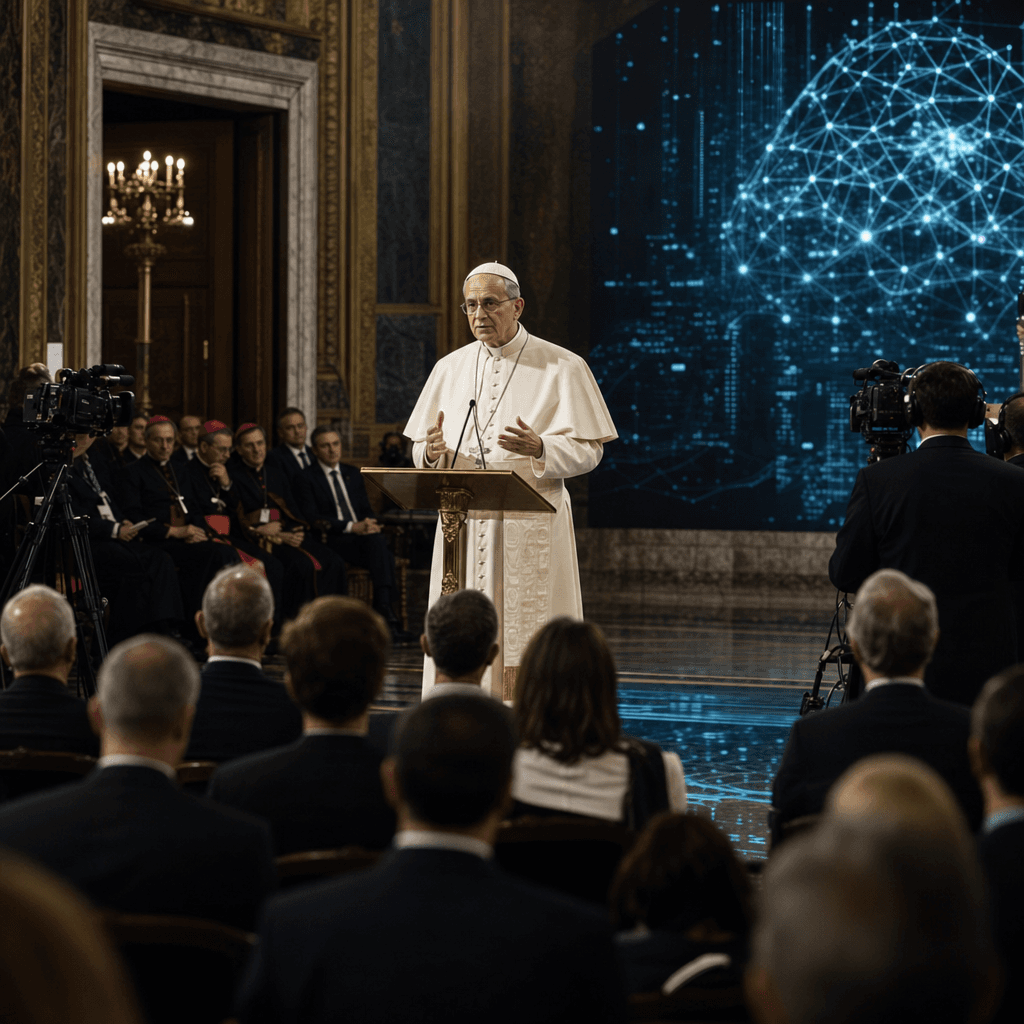
Pope Leo’s AI Warning Could Fuel a New Oversight Push
The pope is turning AI into a human-dignity issue, backing regulation and data limits that could strengthen lawmakers already uneasy about Big Tech power.
Pope Leo is using the first major teaching document of his papacy to put artificial intelligence in the same moral category as workers’ rights and social justice, a move that gives regulators a new source of cover as they confront powerful AI firms (CNN Politics;
Reuters). CNN reported that Leo said AI cannot be treated as “morally neutral,” while Notre Dame law professor Paolo Carozza said the pope is warning against a “culture of power” and insisting on the dignity of each person (
CNN Politics).
Why the Vatican is entering the AI fight
This is not a symbolic sermon. Reuters reported that Leo formally signed the AI text on May 15, tied it to the 135th anniversary of Rerum Novarum, and called for robust international regulation, including a warning that ownership of AI data should not be left solely in private hands (Reuters). That matters because the Vatican is not trying to out-engineer Silicon Valley; it is trying to define the terms of the debate. Once AI is framed as a dignity, labor, and power problem, the burden shifts to companies and governments to defend their models, not just their growth forecasts.
For policymakers in Global Politics, that is the useful part. The Catholic Church still commands attention far beyond its membership, and papal teaching has historically given political leaders moral language to justify action. Reuters noted that past encyclicals such as Pacem in Terris and Laudato Si’ helped shape debates on nuclear risk and climate change, even if unevenly (
Reuters). Leo is betting the same mechanism can work on AI.
Who gains, and who loses
The immediate beneficiaries are governments, labor groups, privacy advocates, and AI safety researchers who want outside validation for tougher rules. The Vatican’s position reinforces arguments already circulating in Brussels and Washington that AI should be constrained when it amplifies discrimination, manipulation, or surveillance; Brookings noted that the Vatican under Francis had already backed restrictions on AI that cause harm, exclude disabled people, or violate privacy (Brookings). Leo is not inventing a new regulatory theory; he is giving an old one a global megaphone.
The losers are the firms that prefer voluntary guardrails and data concentration to hard rules. If the pope’s language sticks, AI companies will face more pressure to explain where training data comes from, who controls it, and how model outputs affect hiring, credit, speech, and warfare. That does not force a policy change by itself, but it raises the reputational cost of resisting one. It also makes it harder for governments to dismiss AI oversight as anti-innovation when the Vatican is arguing it is pro-humanity.
What to watch next
The next test is whether Leo’s message stays at the level of moral witness or becomes a reference point for lawmakers and regulators over the coming weeks. Watch for reactions from the White House, the European Commission, and major AI firms after today’s Vatican rollout, and watch whether church bodies start translating the encyclical into operational guidance for schools, hospitals, and Catholic institutions. If that happens, Leo will have done more than issue a warning: he will have given the AI debate a new center of gravity.
Discover more
US Politics
Congress Targets AI Chatbot Access for Terror
The House passed the Generative AI Terrorism Risk Assessment Act, focusing on AI's role in terrorism and potential surveillance implications.

US Politics
House Ethics Committee Pushes Sexual Miscond.
The House Ethics Committee has shifted responsibility for sexual harassment settlement records to the Office of Congressional Workplace Rights, complicating disclosure efforts.

Economics
Fed's Amex AML order puts correspondent banking on notice
Federal Reserve's Amex AML order requires board-level controls and a 90-day plan; OCC fined the bank $350 million over enterprise-wide deficiencies.

Conflict & Security
Guatemala: El Niño 2026–27 becomes regional security test
UNICEF: 25.8M children face El Niño risks in Latin America; Guatemala maps 188 municipalities for drought and food insecurity amid regional security test.