Trump Greenlights Hermosa Mine in Arizona
Arizona's first mine under Trump's critical minerals push
Model Diplomat10 min readNorth America
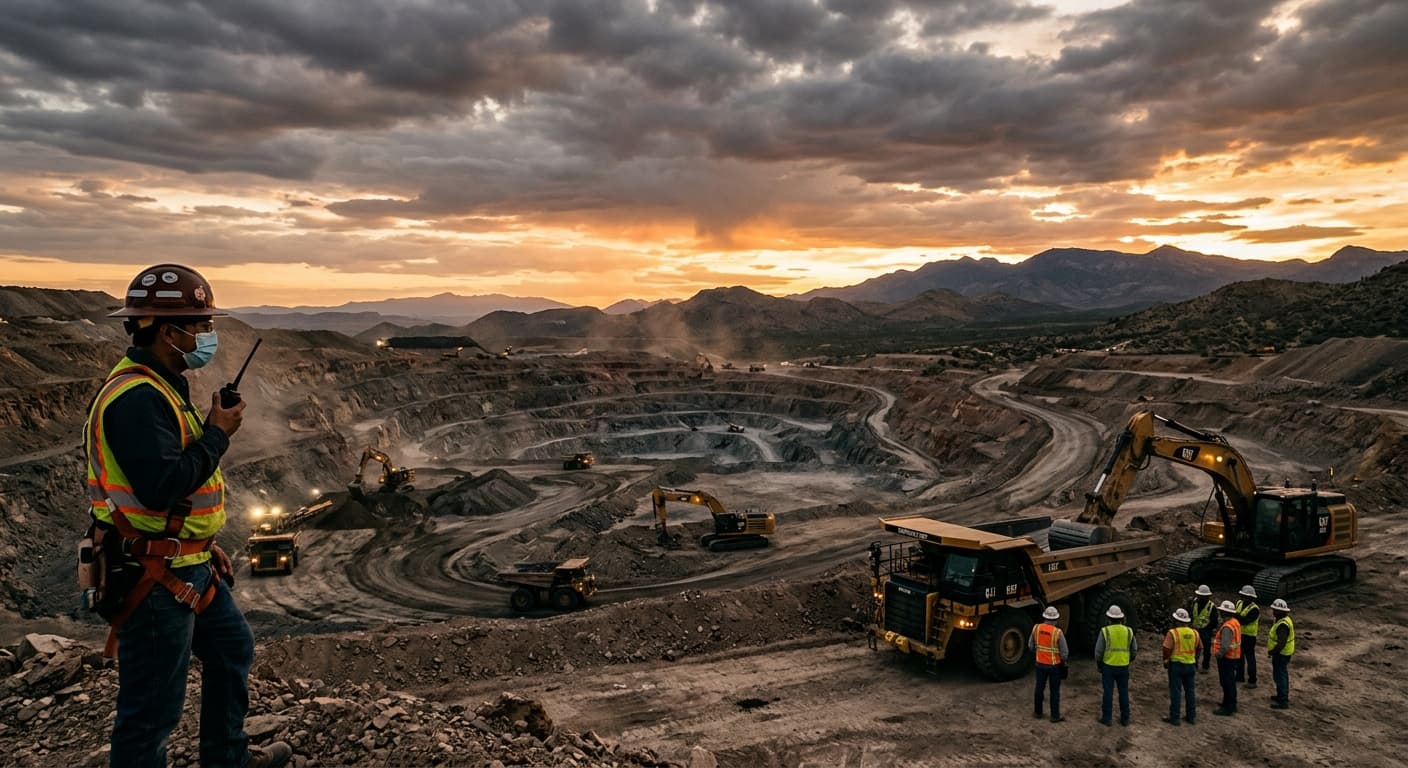
Trump Greenlights Hermosa Mine: Arizona's Bet Against China
A U.S. Forest Service Record of Decision on South32's $3.3 billion Arizona zinc-manganese project will make Hermosa the first mine cleared under Trump's fast-tracked critical minerals push — and expose how narrow that win really is.
The Trump administration is preparing, within days, to sign a Record of Decision authorizing South32's Hermosa Critical Minerals Project in the Patagonia Mountains of southern Arizona — the first mine ever pushed fully through the White House's FAST-41 fast-track process for critical minerals. According to a July 6, 2026 report aggregated on Biztoc from Bloomberg, the U.S. Department of Agriculture is expected to issue its final decision this month, clearing a project South32 now estimates at roughly $3.3 billion in capital cost. The political win for Washington is real; the supply-chain win is smaller than it looks. Hermosa will be, on paper, America's first new domestically produced source of manganese since the 1970s and its largest new zinc mine in decades — but every ton it produces still has to travel through refining and battery chemistry chains that Beijing controls.
That gap between the ribbon-cutting and the balance sheet is the story.
What Washington is actually approving
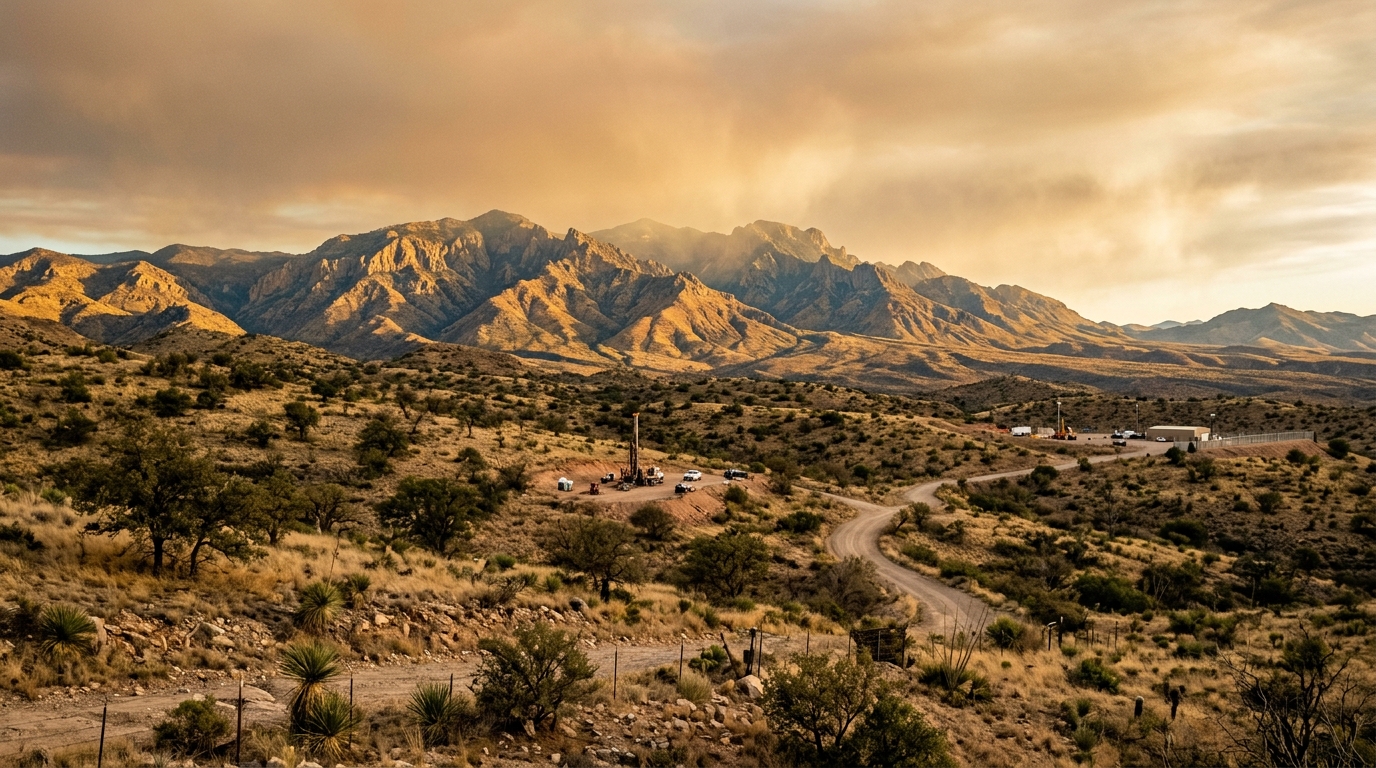
Hermosa sits on two stacked orebodies inside the Coronado National Forest, roughly 12 miles from the Mexican border. According to a Center for Strategic and International Studies analysis published in 2025, the deeper Taylor deposit holds an estimated 153 million tons of zinc-lead-silver sulfide resource averaging 3.53% zinc, 3.83% lead, and 77 grams of silver per ton, with a projected mine life of about 28 years. Above it, the Clark deposit contains zinc-manganese-silver oxide mineralization — and, crucially, the potential to produce battery-grade manganese. As of early 2025, CSIS notes, Hermosa was "the only advanced U.S. mining project capable of producing both zinc and manganese."
The permitting itself is the political artifact. According to the House Natural Resources Committee's report on the Protecting Domestic Mining Act, Hermosa in 2023 became the first mine ever designated a "covered project" under FAST-41, the interagency permitting acceleration codified at
42 U.S.C. §4370m-1. The White House then, in a May 2025
announcement, added ten more critical-minerals projects to the Permitting Council's dashboard under President Trump's executive order "Immediate Measures to Increase American Mineral Production." That order was itself the second tranche; the first ten had been posted a month earlier in April, with more explicitly promised in "the coming weeks." Hermosa is the first of those covered projects to cross the finish line.
The U.S. Forest Service released its Final Environmental Impact Statement and Draft Record of Decision in March 2026, Mining Weekly reported, signalling agency intent to authorize the underground mine and its expansion onto National Forest System land. Under
7 C.F.R. §1b.8, the USDA can now publish a final ROD, at which point South32 may begin implementation. First saleable production is targeted for the second half of fiscal 2027 on CSIS's timeline, or late 2028 in South32's own updated guidance — a slip that already tells you something about how a "fast-track" mine still lives on mine-industry time.
Why the manganese line matters more than the zinc line
Zinc dominates the Hermosa headlines because the numbers are bigger. The politically loaded metal is manganese.
According to the U.S. Geological Survey's 2025 Critical Minerals List, published in the Federal Register on November 7, 2025 and summarized by the Congressional Research Service here, the United States remains 100% net-import-reliant on manganese and lists it among the 60 minerals whose supply disruption would produce measurable damage to U.S. GDP. Carnegie Endowment researchers, in an October 2025
study, put the point bluntly: "Manganese ore has also not been extracted domestically since the 1970s." Their supply-demand model projects U.S. manganese demand around 810,000 tons a year by 2035 — against a domestic-production pipeline of, effectively, zero.
Hermosa does not close that gap. It opens a door.
Carnegie's own read on the Clark deposit is that expected output "will fall short of domestic battery demand," even before accounting for steel-industry manganese consumption, which alone eclipses U.S. reserves in a single year. That matters because manganese is where the battery-chemistry story is quietly shifting. According to a peer-reviewed supply-chain assessment in Resources Policy, U.S. measured, indicated and inferred manganese resources total 50.5 Mt with no established reserves, and modelled U.S. demand scenarios show known resources sufficient for only "decades" — not the "hundreds of years" the same study finds for graphite. Chinese producers already dominate roughly 90% of the world's high-purity manganese sulfate — the input for lithium-manganese-iron-phosphate (LMFP) and NMC cathodes — and Ford and GM are both piloting high-manganese chemistries to reduce nickel and cobalt exposure. A 2024
analysis in Nature Communications modelling battery-chemistry supply vulnerabilities put the manganese vulnerability index for U.S. cathode chains at 71%–80% — the highest of any input metal studied.
In other words, opening one Arizona mine does not shift the vulnerability index. Opening it, combined with domestic refining, might.
The refining gap Washington is racing to fill
The Trump administration appears to know this. In December 2025, Al Jazeera reported that the Department of Defense had taken a 40% equity stake in a $7.4 billion Korea Zinc project to build the first new U.S. zinc smelter in decades, at Clarksville, Tennessee, backed by $4.7 billion in federal loans and $210 million in CHIPS Act subsidies. That facility, targeted for phased commercial operation from 2029, would produce 300,000 tons of zinc, 200,000 tons of lead, 35,000 tons of copper and 5,100 tons of rare earths per year — a downstream anchor for exactly the kind of concentrate Hermosa will ship.
The pairing is the actual policy: Hermosa mines the concentrate, Clarksville refines it, and the United States finally has a vertically integrated non-Chinese zinc chain. Without both, the Carnegie research team notes, "the United States would still need to increase imports of nickel, manganese, graphite, and copper" even under the most optimistic 2035 buildout. Absent that smelter, Hermosa's zinc concentrate would follow the pattern CSIS documents for 2024, when the United States exported 580,000 tons of zinc concentrate and imported 600,000 tons of refined zinc — a 73% import-reliance rate on refined product driven by the collapse of domestic smelting since 1995, when a congressional hearing document records the U.S. operating three primary and seven secondary zinc smelters that produced 0.60 million tons of refined zinc; by 2020 that had fallen to one primary smelter and 0.15 million tons.
That is the historical parallel Washington cannot afford to repeat. Between 1995 and 2020, U.S. zinc mine production held roughly flat while refined output collapsed by three-quarters — because refining, not mining, followed the electricity price and the environmental permit. Chinese zinc-metal output over the same window rose from 1.1 million tons to 6.2 million tons. A CSIS analysis of South Africa illustrates how the same dynamic played out elsewhere: more than a dozen South African manganese smelters closed in recent years, leaving Transalloys as the last functioning smelter by late 2025, largely because ferrochrome cost roughly $119 per ton to produce there against $103 in China. Mines without smelters lose to the country with the smelters.
The strategic bet is legible: use FAST-41 to break the mining-permitting bottleneck, use the Defense Production Act and DoD equity to break the refining bottleneck, and use tariffs to keep prices high enough to make the whole thing economic. According to the Council on Foreign Relations, the administration has run a Section 232 probe on critical minerals, layered new duties on Canadian and Chinese imports, and signed a Quad critical-minerals initiative with Australia, India and Japan. Congress has moved in parallel: the House passed the Critical Mineral Dominance Act,
H.R. 4090, by a 224–195 vote on February 4, 2026, directing the Department of the Interior to identify priority mine projects for expedited approval on federal land, and a separate
SECURE Minerals Act (H.R. 7126) would go further — creating a Strategic Resilience Reserve to finance projects and setting a statutory ceiling of 75% import dependence for each critical mineral.
Who wins, who pays
South32 is the direct beneficiary — a mid-cap Australian miner that acquired the Hermosa asset for $1.3 billion in 2018, per the Financial Times' South32 archive, and has since watched Washington reclassify the deposit as a strategic national priority. Its Perth-listed shares now trade against a project whose commodity mix — zinc, manganese, lead, silver, copper — hits five separate lines on the USGS 2025 critical minerals list.
The domestic constituencies are messier. The Forest Service decision will authorize expansion onto federal land in Coronado National Forest, in the congressional district of Representative Adelita Grijalva, a Democrat whose community, per the House committee report, has "expressed significant concerns about the project's potential impact on the area's scarce water resources and renowned biodiversity." Patagonia Area Resource Alliance and allied groups have been litigating Hermosa-adjacent permits since 2023 in Patagonia Area Resource Alliance v. U.S. Forest Service in the U.S. District Court for the District of Arizona, where Judge Jennifer Zipps granted South32's intervention as defendant in July 2023. NPR
reporting from 2023 noted local opposition centered on selenium-laden discharge into Harshaw Creek, a waterway already contaminated by legacy mining; South32's Hermosa president Pat Risner told NPR that the project's new water-treatment plant uses "proven, patented technology for removing selenium" and asked opponents to weigh "the trade-offs" against Chinese processing.
That fight will not disappear on the day the ROD posts. It will migrate to Arizona Department of Environmental Quality permits — the state-level Aquifer Protection Permit and Air Quality Class II permit remain outstanding — and to whatever litigation the coalition files under the Administrative Procedure Act and the National Historic Preservation Act. The Rosemont copper mine, sited elsewhere in the Coronado National Forest, was vacated by a federal court that found the Forest Service had acted arbitrarily in accepting the operator's waste-rock disposal plan on unpatented mining claims — an outcome laid out in the court's own order and analyzed by CRS in a
2024 report on the Mining Act. Hermosa's engineering — an underground mine, not an open pit sprawling waste over 2,447 acres of federal forest — was deliberately designed to avoid the Rosemont vulnerability. The lawsuits will test whether that design holds.
The parallel litigation over the Resolution Copper land swap at Oak Flat, still in emergency motion practice before the Supreme Court per a March 2026 filing, is a reminder that even an approved land transfer can be paused by a district court on the eve of ground-breaking.
The geopolitical winner, oddly, may be Australia. Two of the three mines most likely to define U.S. critical-minerals policy in the late 2020s — Hermosa (South32) and Resolution Copper (Rio Tinto/BHP) — are Australian-controlled assets on U.S. federal land, being fast-tracked by an administration whose stated goal is reducing foreign dependency. The strategic reading is that "foreign" now means China, and the Quad allies are inside the tent. The losers, on the current design, are Canadian and Mexican refiners. CSIS notes that between 2020 and 2023 Canada supplied 59% and Mexico 16% of U.S. refined-zinc imports; the 25% tariff Trump imposed on Canadian imports in early 2025 prompted Teck's CEO Jonathan Price to say publicly the company was redirecting zinc sales to Asia. Hermosa's concentrate plus Clarksville's smelter is designed to substitute for exactly that flow.
Diplomat View
Approving Hermosa buys Washington optics, not sovereignty. The mine's decisive contribution will be political — it makes FAST-41 a working machine, gives the White House a symbolic first-of-kind win, and puts a fact-based floor under the argument that critical-minerals permitting can move faster than a decade. But even at full nameplate output in 2028–2029, Hermosa's manganese fraction will not meet U.S. battery-industry demand, let alone steel demand, and its zinc concentrate will require the Korea Zinc smelter in Tennessee to become anything more than an export commodity destined for Asian refining. The forecast is falsifiable in three ways: if Arizona's ADEQ denies or materially delays the state permits; if the Patagonia Area Resource Alliance litigation secures an injunction analogous to the 2022 Rosemont vacatur; or if commodity prices collapse before South32 commits its full capex — any one of those revises the timeline out past 2030. Absent those shocks, the Hermosa ROD is the most consequential single mining decision of Trump's second term, and the clearest signal that Washington's critical-minerals policy has moved from strategy documents to signed permits.
What to watch next
- July 2026: USDA Forest Service publishes final Record of Decision on the Hermosa Mining Plan of Operations; South32 may begin authorized construction on National Forest land.
- Q4 2026: Arizona Department of Environmental Quality decisions on the outstanding Aquifer Protection Permit and Air Quality Class II permit.
- Late 2026 – 2027: Expected APA challenges from Patagonia Area Resource Alliance and Center for Biological Diversity; watch the U.S. District Court for the District of Arizona (Judge Zipps) and the Ninth Circuit for injunctive relief motions.
- 2027: Senate action on H.R. 4090 (Critical Mineral Dominance Act), currently before the Senate Energy and Natural Resources Committee, and floor movement on the SECURE Minerals Act.
- 2029: Korea Zinc's Clarksville, Tennessee smelter targeted commercial start — the downstream capacity Hermosa needs to reach a U.S. buyer without transiting China.
Cross-cutting reading: Global Politics.
Discover more

US Politics
House Ethics Committee Pushes Sexual Miscond.
The House Ethics Committee has shifted responsibility for sexual harassment settlement records to the Office of Congressional Workplace Rights, complicating disclosure efforts.

India
Romanian Coalition Party Demands PM Resign
Romania's Social Democrats withdrew from coalition, joining far-right AUR to topple PM Bolojan, risking €10 billion in EU funds by August 2026.
Global Politics
Trump's Conflicting Messages on Iran War
Trump's mixed messages on Iran reflect a strategy of audience management, benefiting Tehran amid a complex geopolitical landscape.

Conflict & Security
Drone Warfare Killing Aid Workers at Unprec
Over 1,000 humanitarian workers killed in three years as cheap armed drones collapse legal protections. Gaza, Sudan, Ukraine, and DRC see deliberate targeting of aid convoys and hospitals with zero prosecutions.