Trump Faces Court Battle Over ICC Sanctions
Judges argue sanctions violate US law and court independence
Model Diplomat4 min readNorth America
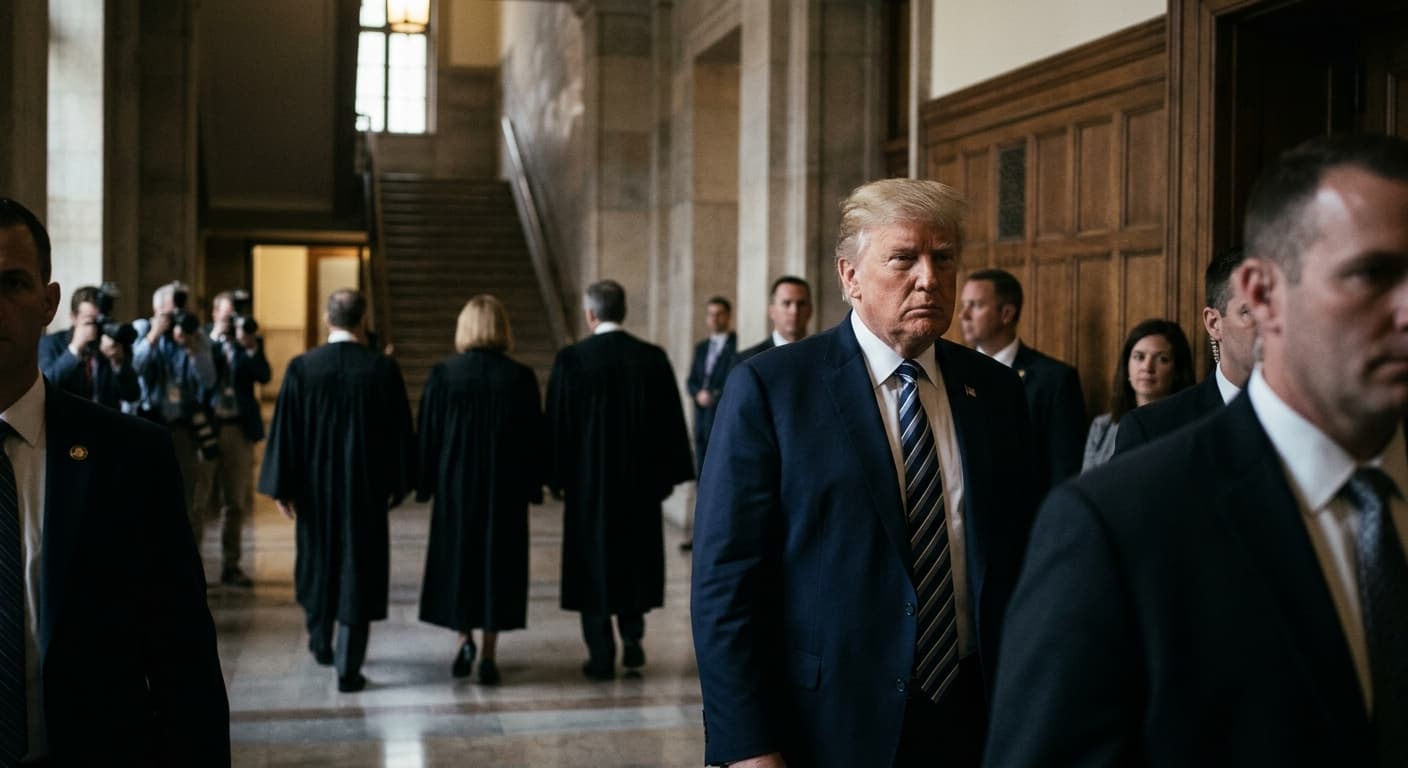
Trump Faces Court Battle Over ICC Sanctions
Three judges sue in Manhattan, arguing sanctions block court independence and violate US law
Three International Criminal Court judges filed suit against Donald Trump and his administration in a Manhattan federal court on Wednesday, contending that sanctions imposed last year were unlawful and designed to suppress judicial independence. The move escalates what has become an open confrontation between Washington and the Hague, signaling a shift from political pressure to legal resistance.
Judges Kimberly Prost of Canada, Solomy Balungi Bossa of Uganda, and Reine Adelaide Sophie Alapini-Gansou of Benin argue in the complaint that the Trump administration violated the International Emergency Economic Powers Act (IEEPA) by sanctioning them without a genuine national emergency. The sanctions, which freeze US-based assets and bar all US transactions—including credit card use, banking services, and access to platforms like Google and Amazon—amount to what the lawsuit calls "the financial death penalty," preventing the judges from working, traveling, or obtaining insurance.
The Trump administration began the sanctions campaign in June 2025, targeting four judges over the ICC's issuance of an arrest warrant for Israeli Prime Minister Benjamin Netanyahu and the court's investigation into alleged US war crimes by troops in Afghanistan. Trump has since expanded the sanctions regime: by December 2025, he had sanctioned 11 ICC staffers, marking the first time a US president has systematically targeted international court officials.
The Core Legal Attack
The lawsuit zeros in on statutory overreach. The judges contend that IEEPA—a 1977 law meant to respond to emergency threats to US national security or foreign policy—does not authorize presidentially imposed sanctions on foreign judges simply for making decisions Trump opposes. The lawsuit states the sanctions were "designed to exert extra-judicial pressure" with the goal of "punishing them for prior judicial decisions and coercing them into prioritizing their private interests over deciding cases on the basis of the law and facts."
This argument carries new weight. In February 2026, the Supreme Court ruled 6–3 that Trump had overstepped his authority in invoking IEEPA to impose sweeping global tariffs, holding that the law does not grant the president power to reshape trade policy unilaterally. The same reasoning—that IEEPA demands a narrow interpretation and genuine emergency justification—applies directly to the ICC sanctions. Trump's defense of the tariffs ("the US facing six national emergencies") was essentially mocked by Chief Justice John Roberts as self-defeating, and the judges' lawyers are likely to deploy identical logic here.
What the Evidence Shows
The Trump White House has not disputed that the sanctions target judges for their judicial output. Secretary of State Marco Rubio explicitly tied sanctions to the Netanyahu warrant and Afghanistan investigation, making intent plain. That directness is a vulnerability in court: courts reviewing exercises of IEEPA authority look for whether the stated emergency is genuine and whether the measure is reasonably tailored. Punishing judges for decisions is neither.
The broader pattern is also part of the record. NPR reported that Trump's Treasury Department has weaponized sanctions beyond the ICC, targeting a Brazilian justice deciding a case against Trump ally Jair Bolsonaro and sanctioning Colombian President Gustavo Petro after he criticized US military conduct. This suggests pattern and practice, not emergency response—a telling weakness on IEEPA grounds.
The Stakes
If the court rules against Trump, the decision could gut the administration's primary tool for pressuring the ICC to abandon its Netanyahu and Afghanistan probes. A loss would also invite challenges from other sanctioned judges and raise the question of whether the thousands of sanctions Trump has imposed on foreign judges, activists, and officials can survive statutory scrutiny.
For the ICC itself, the lawsuit may offer breathing room. The EU has pledged support to the court, and individual states have threatened to activate blocking statutes (EU law that bars European companies from complying with sanctions the EU deems unlawful). A US court finding the sanctions exceed IEEPA would strengthen that hand. Conversely, if Trump wins, he has demonstrated a willingness to sanction any judicial system that moves against Israeli or US interests—a precedent that threatens the court's legitimacy and its ability to recruit qualified personnel.
What to Watch
The first decision point is Trump's motion to dismiss, expected within weeks. If the court denies dismissal and allows the lawsuit to proceed, discovery will be brutal for the administration—forcing the White House to produce documents showing intent, deliberation, and any acknowledgment that no emergency justified the sanctions. A trial is likely to land before the November 2026 election cycle, making this a test not just of law but of political appetite: whether Trump is willing to take a federal judge's ruling head-on or whether the litigation calculus shifts once his motives are exposed in open court.
Discover more

US Politics
SNAP Food Assistance Faces Legal Challenges
In 2026, SNAP faces stricter eligibility rules and mounting legal challenges, threatening food assistance for the millions of Americans who rely on the program.
India
UN Expert Albanese: India Violates Law
UN Rapporteur Francesca Albanese accuses India of breaching international law, spotlighting human rights concerns in Kashmir and prompting diplomatic pushback.

Global Politics
US Seizes Iranian Ship, Tensions Surge
The US seizure of the Iranian ship Touska highlights a shift in control over the Strait of Hormuz, favoring Iran's strategic position.

Economics
Fed's Amex AML order puts correspondent banking on notice
Federal Reserve's Amex AML order requires board-level controls and a 90-day plan; OCC fined the bank $350 million over enterprise-wide deficiencies.