Trump Eases AI Rules to Race China
Anthropic remains an exception in AI deregulation.
Model Diplomat7 min readNorth America
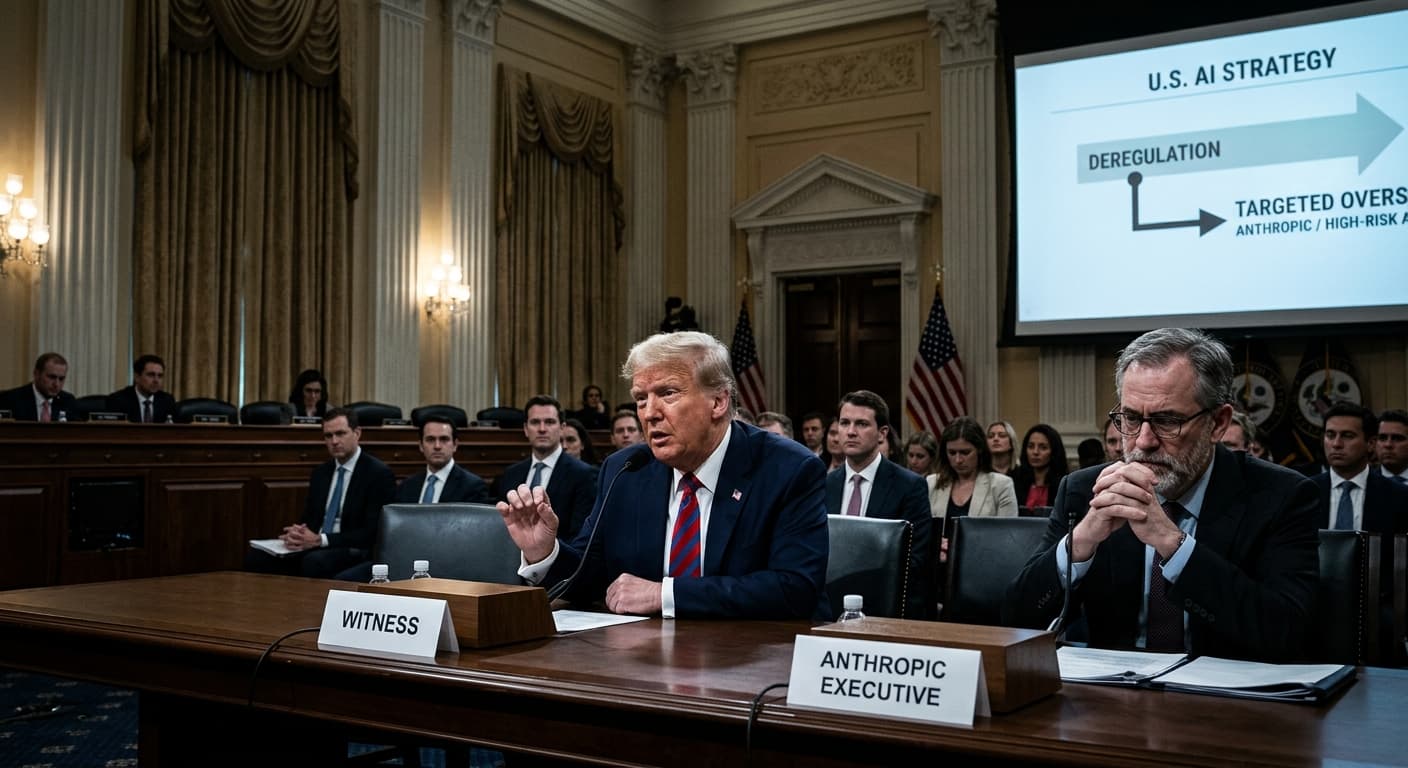
Trump Eases AI Rules to Race China — but Anthropic Stays in the Crosshairs
Trump's June 2, 2026 executive order enshrines a light-touch AI regime to counter China, yet Anthropic remains the exception that proves the rule.
On July 1, 2026, U.S. Commerce Secretary Howard Lutnick lifted the export ban on Anthropic's Claude Fable 5 and Mythos 5 — 19 days after his own bureau had ordered the models pulled worldwide. The reversal was not a policy shift. It was a settlement. The Trump administration's June 2 executive order, "Promoting Advanced Artificial Intelligence Innovation and Security," expressly bars any mandatory federal licensing of frontier AI; the White House has cast every restraint as a threat to the U.S. lead over China. And yet one company keeps getting singled out. The thesis: Washington is running a two-track AI policy — deregulation for the industry, discretion for the holdout — and Anthropic, alone among major U.S. labs in publicly refusing Pentagon uses it deems unsafe, will remain the case study in what "voluntary" oversight looks like when a firm says no.
A deregulatory frame, written in the order itself
Executive Order 14409, signed June 2, is the clearest statement yet of the second Trump administration's AI posture. The White House text opens by declaring that U.S. leadership rests on a refusal "to stifle this innovation with overly burdensome regulation," and its accompanying
fact sheet states that "nothing shall be construed to authorize creation of any mandatory governmental licensing, pre-clearance, or permitting requirement for the development, publication, release or distribution of AI models."
That last clause is load-bearing. It kills, in one sentence, the FDA-style frontier-model licensing regime that Sam Altman floated to Congress in 2023 and that circulated briefly inside the White House in May. As the Council on Foreign Relations noted, an earlier draft with a 90-day pre-release review window was pulled hours before its signing ceremony over industry lobbying and a Trump comment to reporters: "We're leading China... I don't want to do anything that's going to get in the way of that lead." The signed order cut the window to 30 days and made everything voluntary — a change
CSIS analysts called evidence "accelerationists still rule the roost."
The White House will not build a licensing regime for OpenAI, Google, xAI or Anthropic. It has built the tools to punish any of them individually, and it has used them once.
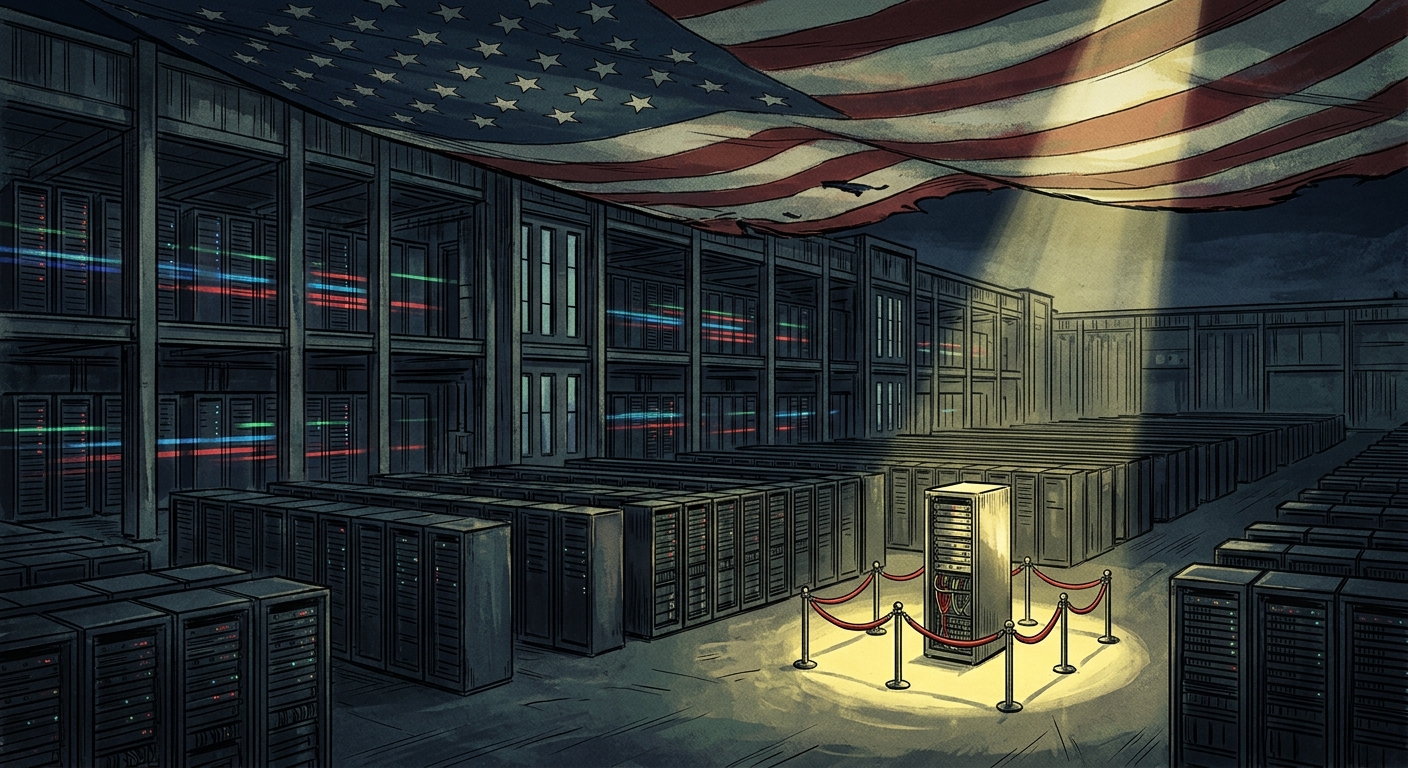
The Anthropic exception
The Anthropic file is now a year of escalating confrontations, all triggered by one decision. On February 26, 2026, CEO Dario Amodei publicly refused to let Claude be used for autonomous weapons or domestic surveillance. On March 3, Defense Secretary Pete Hegseth designated Anthropic a "supply chain risk" — a label the BBC reported is normally reserved for foreign intelligence services — and Trump ordered every federal agency to stop buying its products.
Anthropic sued. On March 26, Judge Rita Lin of the Northern District of California issued a preliminary injunction, writing that the designation was "likely both contrary to law and arbitrary and capricious" and that the measures "appear designed to punish Anthropic." She called the government's conduct "classic First Amendment retaliation." Her opinion is the most consequential judicial finding in the AI-policy file to date: it establishes that the executive branch cannot use national-security instruments as blunt tools against a company for its stated safety policy.
Ten weeks later, the administration tried a narrower tool. On June 12, the Commerce Department's Bureau of Industry and Security ordered Anthropic to bar all foreign nationals — including its own H-1B employees — from accessing Fable 5 and Mythos 5, citing an unspecified "jailbreak." Anthropic said it had received only "verbal evidence of a potential narrow, non-universal jailbreak" and disabled both models worldwide. As CSIS observed, the legal authority cited — Section 734.13 of the Export Administration Regulations — had "never been used before as the basis for issuing a control" on model access.
The July 1 climbdown was quiet. Lutnick's letter, reported by the BBC, noted only that Anthropic had agreed to "proactively detect and address security risks," collaborate on future releases, and "alert the government of any malicious activity." Commerce reserved the right to reimpose restrictions. Chatham House
called it a "U-turn" sending "mixed signals on AI governance." That reading understates it. The administration has now demonstrated it will reach for export controls to bring individual American labs to heel — and lift them once the lab signs a private governance deal.
The China rationale, and what it actually looks like
The story the White House tells is that every constraint on U.S. labs helps China. The reality is more textured. The Chinese startup DeepSeek released V4 on April 24, 2026; its own technical paper conceded the model "trails state-of-the-art frontier models by approximately 3 to 6 months." CFR's assessment put the overall U.S. lead at roughly seven months. Chinese open-weight models, however, have decisively won the adoption war:
an April 2026 arXiv report tracked 1.15 billion cumulative downloads for Chinese open models against 723 million for U.S. ones by March 2026, with Alibaba's Qwen alone accounting for nearly a billion.
That is the environment in which White House chief science adviser Michael Kratsios issued an April 24 memo accusing "principally" Chinese firms of "industrial-scale campaigns to 'distill'" U.S. models. Anthropic, in February,
named DeepSeek and two other Chinese labs as culprits. This is the awkward symmetry the administration has to manage: Anthropic is simultaneously the company Washington leans on to expose Chinese IP theft — and the company Washington was, weeks later, restricting from selling its models abroad.
The Carnegie Endowment's Matt Sheehan made the sharper point: China itself has passed "over a half-dozen binding national regulations on AI" over the same years it has closed most of the gap. The claim that any U.S. regulation hands the lead to Beijing does not survive contact with Beijing's own rulebook. Yet the argument continues to structure every deregulatory move Trump makes, from the July 2025 AI Action Plan and July 2025 executive orders — analyzed by
CSIS — through this June's cyber EO.
Deregulation with a hammer: chips, states, and selective enforcement
The pattern of the past 15 months is not laissez-faire. It is deregulation-plus-discretion. On chips, Trump has moved to expand, not restrict, exports: Nvidia's H20 line was greenlit for China in July 2025 after Jensen Huang's lobbying, then extended in August 2025 to include a
15% U.S. cut of China sales, and later to Nvidia's more advanced H200 processors with a
25% fee. Hudson Institute's Michael Sobolik told NPR the H20 decision risked "diluting what is our most significant advantage in the AI race."
On state AI laws, the administration in December 2025 issued an executive order directing the Justice Department to set up an "AI Litigation Task Force" to sue states over their AI-related laws and directing Lutnick to study withholding federal rural broadband money from non-compliant states. Even Republican governors — including Florida's Ron DeSantis and Utah's Spencer Cox — publicly broke with the White House on preemption, and legal scholars quoted by NPR called the order unlikely to survive review.
The through-line is unmistakable. Where the industry wants openness — chip sales, no state law, no federal licensing — the White House delivers. Where a single company steps out of line — Anthropic on Pentagon use, then again on model release — the administration reaches into the export-control toolbox, the procurement toolbox, or both. Brookings analyst Lauren Tokos wrote on July 1 that the Mythos episode "scorches" the administration's own goal of exporting American AI, because allied users cannot trust that access won't be yanked without warning.
Diplomat View
The administration's operating theory is that competition with China justifies a minimal regulatory floor combined with a maximal enforcement ceiling — deregulate the market, then pick winners and losers by executive action. Anthropic is the test case, and it is not over. Judge Lin's ruling has boxed in the Pentagon lane; the Commerce lane just proved usable once and then, after industry pushback, walked back. Expect a third instrument. The likely candidate is the classified "covered frontier model" benchmarking process that EO 14409 hands to NSA and CISA over the next 60 days — a designation that would let the executive branch quietly gate any model it chooses, without ever using the word "license." If that benchmarking process is used to single out Anthropic's next release, the "voluntary" framework is voluntary in name only, and the courts will be back in play. The forecast changes if two things happen: OpenAI or Google publicly refuses a Pentagon use case in the way Amodei did, forcing Washington to choose between consistency and coercion; or the Ninth Circuit affirms Lin's injunction on the merits, hardening a constitutional ceiling on this kind of enforcement.
What to watch
- Late July / early August 2026 — NSA's classified benchmark and the "covered frontier model" threshold under Sec. 3 of EO 14409 are due within 60 days of signing. Who gets designated, and how, is the whole game.
- Fall 2026, Ninth Circuit — appellate review of Judge Lin's injunction against the Pentagon's supply-chain-risk designation will set the constitutional ceiling on retaliatory enforcement.
- Ongoing — DOJ's "AI Litigation Task Force" first suits against state AI laws; Florida, California, Colorado, and New York statutes are the likeliest early targets. Republican governors' opposition means the political coalition here is not what it looks like on paper.
The Bottom Line
Trump's AI regime is not deregulation. It is deregulation for the compliant and discretionary punishment for the outlier — with China competition as the load-bearing justification for both. Anthropic is the outlier because it is the only major U.S. lab willing to publicly refuse a Pentagon use case, and until another major lab draws the same line, it will remain the administration's demonstration project for what "voluntary" oversight really means.
Read today's full |
Discover more
India
Congress Accuses Modi of Stalling Women's Law
Congress accuses Modi of stalling women's reservation law by linking it to delimitation, revealing a deeper electoral strategy.
US Politics
SNAP Food Assistance Faces Legal Challenges
In 2026, SNAP faces stricter eligibility rules and mounting legal challenges, threatening food assistance for the millions of Americans who rely on the program.
India
BJP's Misunderstanding of Women's Quota Needs
The BJP's linking of the Women Reservation Bill to delimitation risks delaying women's empowerment in India, misreading the aspirations of female voters.

Conflict & Security
Drone Warfare Killing Aid Workers at Unprec
Over 1,000 humanitarian workers killed in three years as cheap armed drones collapse legal protections. Gaza, Sudan, Ukraine, and DRC see deliberate targeting of aid convoys and hospitals with zero prosecutions.