Trump Asks Supreme Court to Rehear Birthright
Trump seeks Supreme Court rehearing on citizenship ruling.
Model Diplomat9 min readNorth America
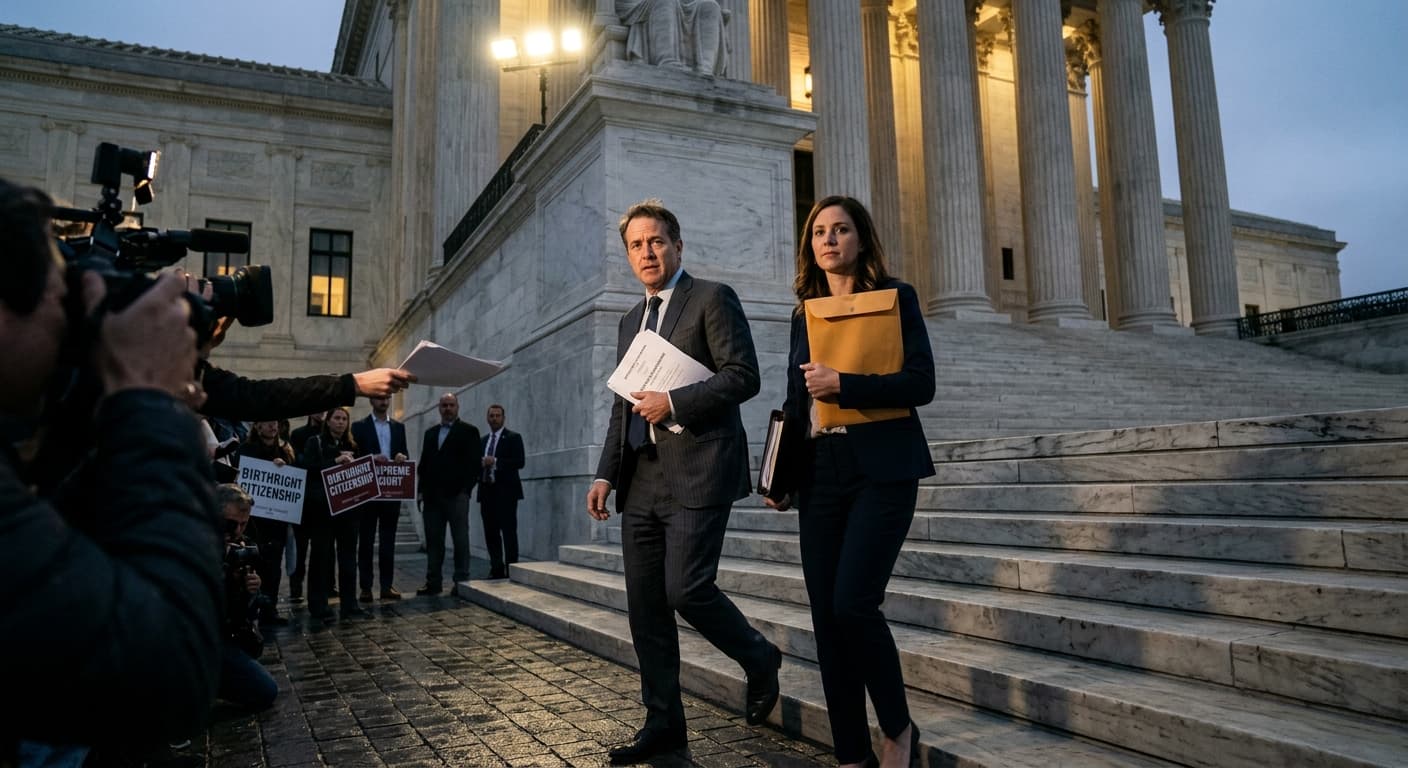
Trump Asks Supreme Court to Rehear Birthright Citizenship Case
Trump wants the Supreme Court to reconsider its 6–3 birthright citizenship ruling. The bid is likely futile — but it reveals the real strategy: keep the question live.
President Donald Trump on July 8, 2026 said he will petition the US Supreme Court for a rehearing of Trump v. Barbara, the 6–3 decision that eight days earlier struck down his executive order limiting birthright citizenship. The petition keeps a legally settled question politically alive, tests the narrow statutory door Justice Brett Kavanaugh cracked open in his concurrence, and telegraphs the case-selection strategy conservative litigants will use to bring the 14th Amendment back before a differently composed Court. The real fight has already shifted from the courtroom to Congress, the states, and the next Supreme Court vacancy.
What the Court actually decided — and did not
On June 30, 2026, Chief Justice John Roberts, writing for a five-justice majority joined in judgment by Kavanaugh, held that children born in the United States to parents "unlawfully or temporarily present" are "citizens at birth" under the Citizenship Clause. The full slip opinion, published by Cornell's Legal Information Institute, rejects the government's argument that "subject to the jurisdiction thereof" requires parental domicile. Roberts anchors the holding in United States v. Wong Kim Ark (1898) and English common law: birth on US soil plus subjection to US law is sufficient. Executive Order 14160, signed hours after Trump's second inauguration and published at
90 Fed. Reg. 8449, directed federal agencies to withhold citizenship documents from two categories: children of mothers unlawfully present, and children of mothers on temporary visas — in each case where the father was neither a US citizen nor a lawful permanent resident.
The Roberts opinion is unusually direct on the historical question. Writing for the majority, he framed the stakes in language later cited across the coverage: "Citizenship, then and now, was the right to have rights — to freely participate in our political community," per the BBC's live coverage. The Framers of the 14th Amendment, Roberts continued, "extended that promise to every free-born person in this land. We keep that promise today." That is not the language of a chief justice looking for a narrow rationale. It is the language of a chief justice closing a door.
But the vote itself reveals the ruling is narrower than headline treatment suggests. Only five justices — Roberts, the three liberals, and Amy Coney Barrett — held Executive Order 14160 facially unconstitutional under the 14th Amendment. Kavanaugh concurred in the judgment on statutory grounds, writing that the order violated the Immigration and Nationality Act rather than necessarily the Constitution. Justices Thomas, Alito, and Gorsuch dissented. Thomas produced a 91-page originalist assault built on "domicile" and "allegiance," per the Brookings Institution — arguing that individuals must establish domicile to demonstrate allegiance and thus become subject to US jurisdiction. Alito described the ruling as a "serious mistake" that "confers citizenship on virtually anyone who happens to be born in this country," according to the
BBC. In practical terms, four sitting justices accept some version of the administration's theory. That is a thinner constitutional firewall than the 6–3 tally implies — and Trump's legal team knows it.
The rehearing bid is a formality — and Trump's lawyers know it
Trump wrote on Truth Social that "AMERICAN CITIZENSHIP IS NOT FOR SALE!" and demanded "a Rehearing by the United States Supreme Court, IMMEDIATELY," according to Al Jazeera. Under
Supreme Court Rule 44, a rehearing petition must be filed within 25 days of the judgment — a window that closes around July 25, 2026 — and "will not be granted except by a majority of the Court, at the instance of a Justice who concurred in the judgment or decision."
Read that clause carefully. To even consider the petition, one of the six justices who ruled against Trump — Roberts, Kavanaugh, Barrett, Sotomayor, Kagan, or Jackson — must ask for it. The three dissenters cannot force it. The rule further specifies that "in the absence of extraordinary circumstances, the Court will not grant a petition for rehearing without first requesting a response," a signal that even a summary review by the clerk's office normally ends the matter. Rehearing grants in argued merits cases are, in the modern era, essentially nonexistent; as Al Jazeera noted, "it has been decades since the court last allowed a retrial after issuing a ruling in an argued case."
A rehearing grant here would require Kavanaugh or Barrett to publicly reverse a position they took eight days earlier — behavior the Court's institutional norms are structured to prevent. A 1991 SSRN survey of rehearing practice documents that even the confirmation of a new justice is not treated as grounds for rehearing, precisely because doing so would concede that outcomes depend on personnel rather than law. Nina Totenberg's
NPR reporting on the April oral argument captured the Court's institutional resistance: even conservative justices had "tough questions" for Solicitor General D. John Sauer, and Justice Gorsuch — who ultimately dissented — asked how the government could administer a citizenship test that turned on a father's status when parents are unmarried or unknown.
The real strategy: preserve the issue for the next docket
If the rehearing petition is futile, why file it? Three second-order effects explain the move.
First, it prevents the ruling from calcifying as settled expectation. The Court's institutionalist wing — Roberts and Kavanaugh — writes narrowly when they can. Kavanaugh's concurrence explicitly invited Congress to legislate on statutory grounds. Senator Eric Schmitt of Missouri announced within hours that Kavanaugh "MAY have left Congress a door" and that he would "file legislation to walk through it," per Al Jazeera's reaction roundup. Senator Lindsey Graham pledged to make the issue a top priority in the Senate Judiciary Committee. A statute amending 8 U.S.C. § 1401(a) — the Immigration and Nationality Act provision codifying birthright citizenship — would produce a new case with a new question presented: not whether Executive Order 14160 exceeds statutory authority, but whether Congress itself may narrow the citizenship guarantee. Kavanaugh has indicated he views that question as open.
Second, it disciplines the base and pressures Republican leadership. White House Chief of Staff Stephen Miller called the ruling "one of the most destructive and outrageous decisions" in Court history, per the BBC, and told Al Jazeera the administration will keep "fighting" through Congress. Trump's public demand for a rehearing signals that acceptance is not on the table — a message aimed at Republicans who might otherwise treat Barbara as final. It also puts pressure on House Speaker Mike Johnson and Senator Mike Lee, both of whom have publicly said only a constitutional amendment can now achieve the president's goal — a route Brookings notes is "almost impossible" to secure given today's polarization, since amendments require two-thirds of both chambers and ratification by three-quarters of the states.
Third, it lays predicate for a future challenge. Empirical work on certiorari in the Roberts Court — including a recent SSRN study — finds "historically unparalleled interest in using its docket discretion to select cases for the purpose of revisiting, and perhaps over-ruling, precedent." Rehearing petitions, even when denied, generate written record — dissents from denial, statements respecting denial — that later litigants cite. If Thomas, Alito, or Gorsuch write separately when the petition is denied, they hand future advocates a roadmap and signal to state solicitors general which fact patterns are worth manufacturing.
The population the order would have reached
The stakes explain the intensity. An amicus brief filed in Barbara by demographers led by Penn State's Jennifer Van Hook, submitted to the Court and available on the Supreme Court's docket, estimated that Executive Order 14160 would have stripped 4.8 million future US-born children of citizenship by 2045 and 12.8 million by 2075 — roughly 255,000 births per year, or one in every 18 American births. The brief warned the order would create a "heritable and intergenerational" undocumented caste, disrupting "150 years of intergenerational upward mobility for immigrants."
The Migration Policy Institute's Julia Gelatt told NPR in December 2024 that ending birthright citizenship could grow the unauthorized population by 11 to 16 million by 2050 — because a policy meant to shrink the undocumented class would produce a new one each generation. The
American Enterprise Institute has documented that so-called "birth tourism" accounts for only about 8,000 births a year, undermining the administration's public rationale that citizenship-shopping drives migration. AEI's review of the German experience — Berlin conditionally extended birthright citizenship in 2000 — found that children of immigrants covered by the policy had better health, better educational tracking, and more integrated parents. The evidence base for the administration's counterfactual is thin; the evidence base for the majority's institutional caution is thick.
There is also a quieter administrative dimension. A recent SSRN law review article argues that the consequences of ending universal birthright citizenship "sweep even further than is commonly understood." In a federal system lacking a centralized birth registry, a state-issued birth certificate is the sufficient proof of citizenship for a passport, Social Security number, or Medicaid enrollment. Under EO 14160, every American parent would need to document parental status alongside the birth certificate. The Center for American Progress
estimates that roughly 13 million US citizens — 7 percent of the population — lack any government proof of citizenship beyond that certificate. The order was not just an immigration measure; it was, functionally, a federal citizenship-verification regime.
The historical parallel that reframes this
The closest analog is not another citizenship case but the arc of Roe v. Wade. That precedent stood for 49 years while conservative legal advocates, denied a rehearing, systematically built state-level test cases, developed academic scholarship, and waited for the Court's composition to change. Dobbs arrived when it did because the machinery had been ready for decades.
Justice Thomas's Barbara dissent — with its extensive originalist evidence for a domicile requirement — reads as an invitation to that same machinery. As one legal scholar told Al Jazeera after the ruling, birthright-citizenship restriction "has now become a major issue on the right, and I think unless significant court reform occurs, you're going to see a years-long, maybe decades-long fight over birthright citizenship of a similar kind."
What to watch
The precedent problem for opponents is that Barbara did not foreclose statutory revision — it foreclosed the executive-order route. That distinction is where the next round of litigation will be fought.
- By roughly July 25, 2026: Trump's rehearing petition must be filed under Rule 44's 25-day window. Watch whether Solicitor General Sauer signs it and how narrowly the grounds are framed — a filing pitched at Kavanaugh's statutory concurrence would signal a serious legal strategy rather than pure political theater.
- Fall 2026 congressional calendar: Senator Schmitt has said he will introduce legislation amending the Immigration and Nationality Act. Speaker Johnson has publicly said "you got to amend the Constitution to fix this," per
Brookings — a signal House leadership sees the statutory route as futile. Whether the bill gets a markup will indicate how serious the leadership actually is.
- State-level litigation: Several red states are expected to pursue executive actions on driver's licenses, state IDs, and Medicaid eligibility that turn on parental status — creating new vehicles to bring the constitutional question back before the Court on a different procedural posture.
- The next Supreme Court vacancy: With Justices Thomas (78), Alito (76), and Sotomayor (72) the oldest on the bench, a single retirement could shift the Barbara coalition. Trump has already appointed three justices; a fourth would remake the majority that ruled against him.
The Bottom Line
Trump's rehearing petition will lose — Supreme Court Rule 44 makes it structurally impossible without a defector from the majority, and the Court has not granted a rehearing in an argued merits case in living memory. But the filing is not a legal move; it is a political one, designed to keep birthright citizenship an unsettled question while Republicans in Congress test Justice Kavanaugh's invitation to legislate and while the administration waits for the composition of the Court to change. Trump v. Barbara is the law today. Whether it survives a second Trump term with an additional appointment is the question that actually matters.
Discover more
US Politics
House Ethics Committee Pushes Sexual Miscond.
The House Ethics Committee has shifted responsibility for sexual harassment settlement records to the Office of Congressional Workplace Rights, complicating disclosure efforts.

Global Politics
US Seizes Iranian Ship, Tensions Surge
The US seizure of the Iranian ship Touska highlights a shift in control over the Strait of Hormuz, favoring Iran's strategic position.

Global Politics
U.S. Naval Blockade Heightens Iran Tensions
The U.S. naval blockade of Iran collapsed oil exports, creating a new maritime regime in Hormuz that favors Tehran.

Economics
Fed's Amex AML order puts correspondent banking on notice
Federal Reserve's Amex AML order requires board-level controls and a 90-day plan; OCC fined the bank $350 million over enterprise-wide deficiencies.