TRT Censors NATO Question on Comedian
State broadcaster edits out key NATO press conference details
Model Diplomat7 min readEurope
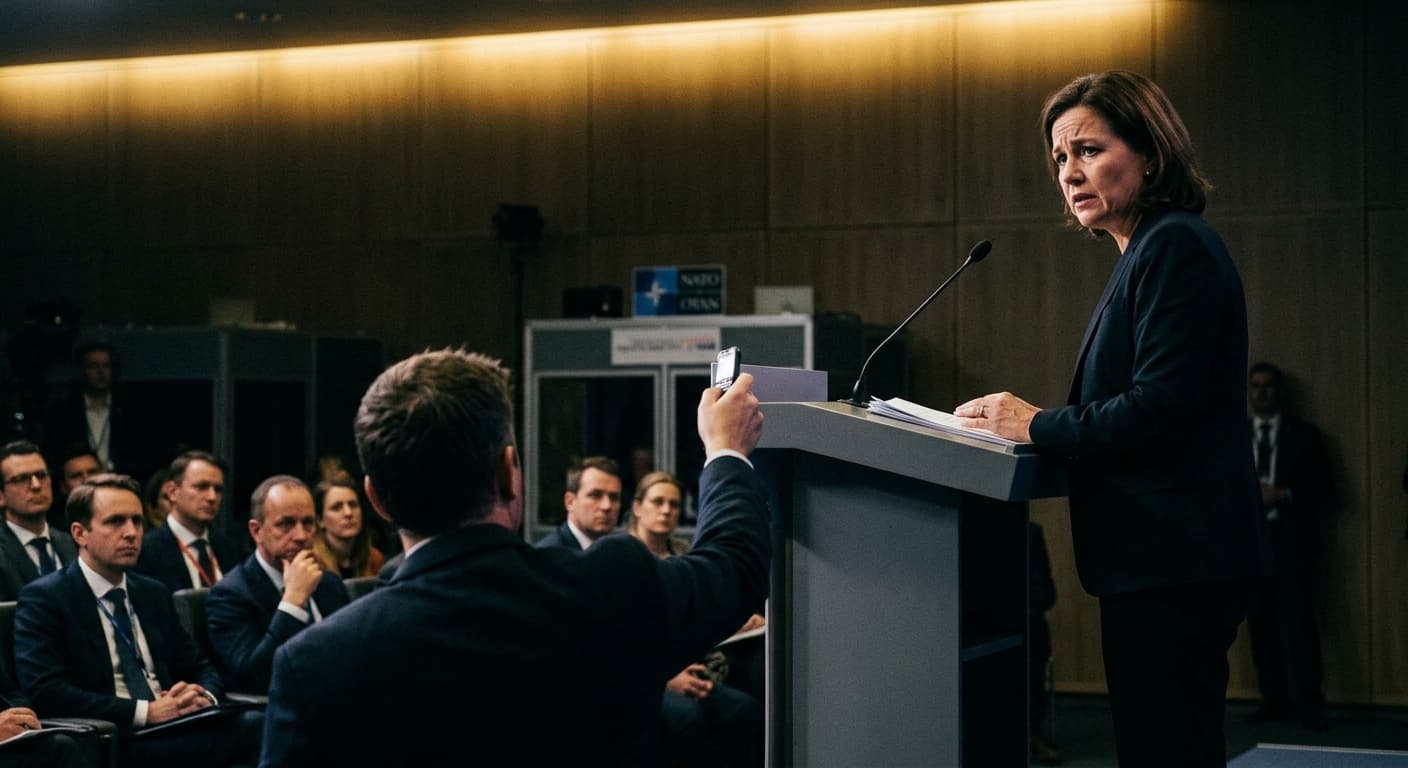
TRT Censors NATO Question on Jailed Turkish Comedian Deniz Göktaş
Turkey's state broadcaster dropped references to jailed comedian Deniz Göktaş and 225 pre-summit detentions from its live translation of a NATO question on July 6, 2026.
On July 6, 2026, Turkey's state broadcaster TRT aired a live Turkish translation of a NATO press conference that erased every reference to jailed stand-up comedian Deniz Göktaş and to the 225 detentions carried out in the week before the alliance's Ankara summit. The edit — flagged in real time by journalist Damla Doğan Tuncel and documented by the Stockholm Center for Freedom — is a small technical act with an outsized diplomatic function: it lets Turkish audiences watch NATO's own Secretary General discuss democracy in their capital without hearing that the host government has just jailed a comic for calling the president a dictator. That is the point where a domestic press-freedom story becomes an alliance credibility problem.
What was censored, and by whom
The original English question, put to NATO Secretary General Mark Rutte at the pre-summit press conference at the Beştepe Presidential Compound, asked whether Ankara was a suitable venue for a gathering of "liberal democracies" given the recent crackdown on opposition figures — naming Göktaş and referencing the detention of critics ahead of the summit. TRT's simultaneous Turkish translation, according to a side-by-side comparison Stockholm Center for Freedom published on July 7, summarised the question as a generic query about democracy, the judiciary and the Erdoğan administration — stripping the specifics that give it teeth.
TRT viewers also reportedly did not hear the load-bearing part of Rutte's reply. According to NATO's own primary transcript infrastructure, the pre-summit press conference was carried live in multiple languages on the alliance's channels and made available with a full transcript on the NATO Multimedia portal. Rutte's answer, as reported by
Ghana News Agency and Turkish outlet
Sok Gazetesi, invoked free media, independent journalism and the right to demonstrate as fundamental democratic principles — a rebuke that lands only if the audience knows what it is rebuking.
The mechanics matter. NATO's Ankara summit media programme lists the pre-summit press conference as open to all accredited media and simulcast on host TV, EBU Worldfeed and the alliance's own YouTube channel — every one of which carried the original English audio uncut. The censorship is confined to what Turkish speakers heard on the state channel; the primary record on nato.int is unedited.
The comedian at the centre of the story
Deniz Göktaş, 32, is a stand-up comedian arrested at Istanbul Atatürk Airport on July 2, 2026 on his return from holiday and jailed pending trial the following day. Prosecutors charged him with "insulting the president" and "publicly inciting hatred and hostility" over his "Ölü Deniz" (Dead Sea) show, a routine performed for nearly three years in Turkish cities and uploaded to YouTube on June 24. The BBC reported the recording had drawn 9.4 million views before his arrest, and that the Istanbul chief public prosecutor's office had received 185 complaints — a number consistent with an organised complaint drive rather than spontaneous outrage.
In his statement to prosecutors, quoted by BBC Türkçe, Göktaş denied any intent to insult Erdoğan or religious values, adding that use of the word "dictator" is "a political characterisation that is frequently and openly debated" in Turkey. The Media and Law Studies Association, a Turkish free-speech monitor, said Göktaş was facing prison "for telling jokes" and noted that satire is protected under both the Turkish constitution and Article 10 of the European Convention on Human Rights.
The pattern is not new. The OSW Centre for Eastern Studies documents that since April 2026 more than 27 journalists have been detained or summoned in Turkey, most frequently on "disinformation" or presidential-insult charges, and that performers and entertainment figures have been swept up in the same wave. Turkey's Ministry of Justice reported roughly 5.5 million criminal proceedings initiated in 2025 alone, alongside a prison population near 400,000 — one of the world's highest incarceration rates.
The pre-summit sweep
The censored question did not appear from nowhere. It cited a documented, dated sequence of detentions and bans, most of them logged in a primary-source Amnesty International statement issued on June 29, 2026.
"The blanket ban on all protests in Ankara must be lifted and everyone arbitrarily detained in prison or under house arrest in connection with the NATO summit must be released. This ban is an excessive and unjustifiable attack on the rights to freedom of peaceful assembly and expression." — Esther Major, Amnesty International Deputy Director Research for Europe, June 29, 2026
Amnesty, citing the Ankara Chief Public Prosecutor's Office, said 225 people were detained in dawn raids on June 23, of whom 135 were referred to court with pretrial-detention requests; 103 were remanded and 26 placed under judicial control including house arrest. On June 22, the Ankara Governorate imposed a province-wide ban on public assemblies from midnight on June 28 until 23:59 on July 10 — a 13-day suspension of Article 34 rights covering the full arc of the summit.
Separate operations targeted the press. According to BBC Türkçe, the July 6 raids detained T24 foreign editor Buse Söğütlü and OdaTV editor Ceren Erdoğdu, alongside academics Sibel Özbudun and Temel Demirer. Söğütlü's lawyer, Erman Öztürk, told the outlet the timing left "no doubt" that the detentions were tied to the summit. Amnesty also criticised NATO itself, saying the alliance's decision to deny accreditation to some Turkish journalists and outlets — a decision taken at the host government's request — was "a blow to media freedom."
On the morning of July 7, as delegations arrived, BBC Türkçe reported that police broke up an anti-NATO rally in Ankara's Kurtuluş Park, kettling opposition MPs — including Türkiye İşçi Partisi (TİP) chair Erkan Baş and DEM Party's Keziban Konukçu — and detaining 22 students and two lawyers.
The alliance's silence, priced in
The censorship is legible only against the alliance's political stakes. NATO's own pre-summit release frames Ankara as a "delivery" summit — Rutte in his own words expects allies to present "clear, concrete and credible plans" to reach the 5% of GDP defence-spending pledge agreed at The Hague in 2025. European allies and Canada are already at roughly 4% of GDP on defence and security combined, according to Rutte. The Netherlands alone brought more than €3 billion in new contracts to Ankara,
Al Jazeera reported, citing Dutch Defence Minister Dilan Yeşilgöz.
That is the machinery a democracy-and-detentions question interrupts. Steven A. Cook, senior fellow at the Council on Foreign Relations, argues in a July 2, 2026 essay that Erdoğan's aim in hosting is precisely legitimation: "The summit will bestow two major prizes on Erdoğan. The first is Trump's appearance validating Erdoğan's global role for outside audiences and his autocratic rule for his own population. […] The second prize is legitimacy." Cook notes that U.S. President Donald Trump had said publicly he might not have attended a NATO summit hosted anywhere but Ankara — a remark
Al Jazeera also reported ahead of the meeting.
The state broadcaster's edit fits that transaction. TRT is not scrambling to hide Rutte's answer from foreign observers, who have the NATO transcript. It is protecting the domestic audience from watching the alliance's Secretary General publicly link "democracy" to journalists' ability to ask questions in the very week Turkish authorities have prevented some Turkish journalists from asking them. In that light, the censored translation is not incidental — it is the summit's implicit bargain rendered in real time: Erdoğan supplies the venue and the 5% choreography, and the alliance supplies the visual of legitimacy that the domestic broadcaster is then free to edit.
The measurable damage
The story sits inside a documented downward slope. Reporters Without Borders' 2026 World Press Freedom Index, reported by BBC Türkçe, ranks Turkey 163rd of 180 countries, down four places from 2025, with Iraq above it and Yemen below. RSF chief Anne Bocandé said the legal indicator — measuring the criminalisation of journalism — showed the steepest global decline. Freedom House's
Freedom in the World 2026 report rates Turkey "Not Free" at 33/100, and cites the independent BİA Media Monitoring group's finding that 58 journalists were detained and 30 assaulted during 2025. Amnesty International's
March 2026 briefing recorded, per the Journalists Union of Türkiye, 14 journalists and media workers in prison as of March 2026.
None of these figures were mentioned to TRT's live audience during Rutte's press conference. That is the transmission mechanism the story documents: not a single act of censorship, but an information environment in which the country hosting NATO's democracy-branded summit is, on any independent measure, one of the alliance's least free media markets — and its state broadcaster is actively curating that reality out of the record.
What to watch
- Göktaş's first hearing. Under Turkish procedure, an indictment following a pretrial-detention order typically follows within weeks; watch the Istanbul Çağlayan courthouse docket. The Media and Law Studies Association has flagged the case as a Article 10 ECHR test.
- The Ankara protest ban expiry on July 10, 2026. Whether authorities extend the ban past the summit will indicate whether June's measures were tied to NATO security or to a broader domestic posture.
- NATO Ankara Summit Declaration. The final communiqué, due July 8, 2026, will show whether any allied delegation succeeded in inserting language on host-country rule-of-law obligations — or whether, as CFR's Cook predicts, the price of Trump's attendance was collective silence.
- The RSF and CPJ mid-year updates. Both track detentions in near-real time; any addition of the July 6 detainees Buse Söğütlü and Ceren Erdoğdu to their imprisoned-journalists lists will formalise this week's raids as a press-freedom event, not a counterterrorism one.
The Bottom Line
TRT did not merely mistranslate a question; it edited out the specific evidence — a jailed comedian, a 13-day protest ban, 225 detentions — that would have made Rutte's answer legible to Turkish viewers as a rebuke. That is what state broadcasting is for in this system, and it is the transaction NATO tacitly accepted by holding a "democracy of the Alliance" summit in Ankara this week. The measurable cost — Turkey ranked 163rd of 180 on press freedom, "Not Free" on Freedom House's scale — is now the price of a 5% defence pledge.
Discover more
Global Politics
Xi Jinping Calls China-Russia Ties 'Precious'
Xi Jinping's description of China-Russia ties as 'precious' reflects a strategic imbalance, with Beijing dictating terms in the partnership.
Global Politics
US-Iran Tensions Rise
Tensions escalate in the Strait of Hormuz as Iran and the US clash over maritime control, with a ceasefire hinging on a contested MoU paragraph.
India
700 Activists Accuse PM Modi of MCC Breach
Over 700 activists allege PM Modi breached election code with a televised address attacking opposition parties just before state elections.

Conflict & Security
Drone Warfare Killing Aid Workers at Unprec
Over 1,000 humanitarian workers killed in three years as cheap armed drones collapse legal protections. Gaza, Sudan, Ukraine, and DRC see deliberate targeting of aid convoys and hospitals with zero prosecutions.