Trilateral Pact to Counter China, Russia in N
New reactor deal aims to dominate Southeast Asia's nuclear market
Model Diplomat10 min readAsia
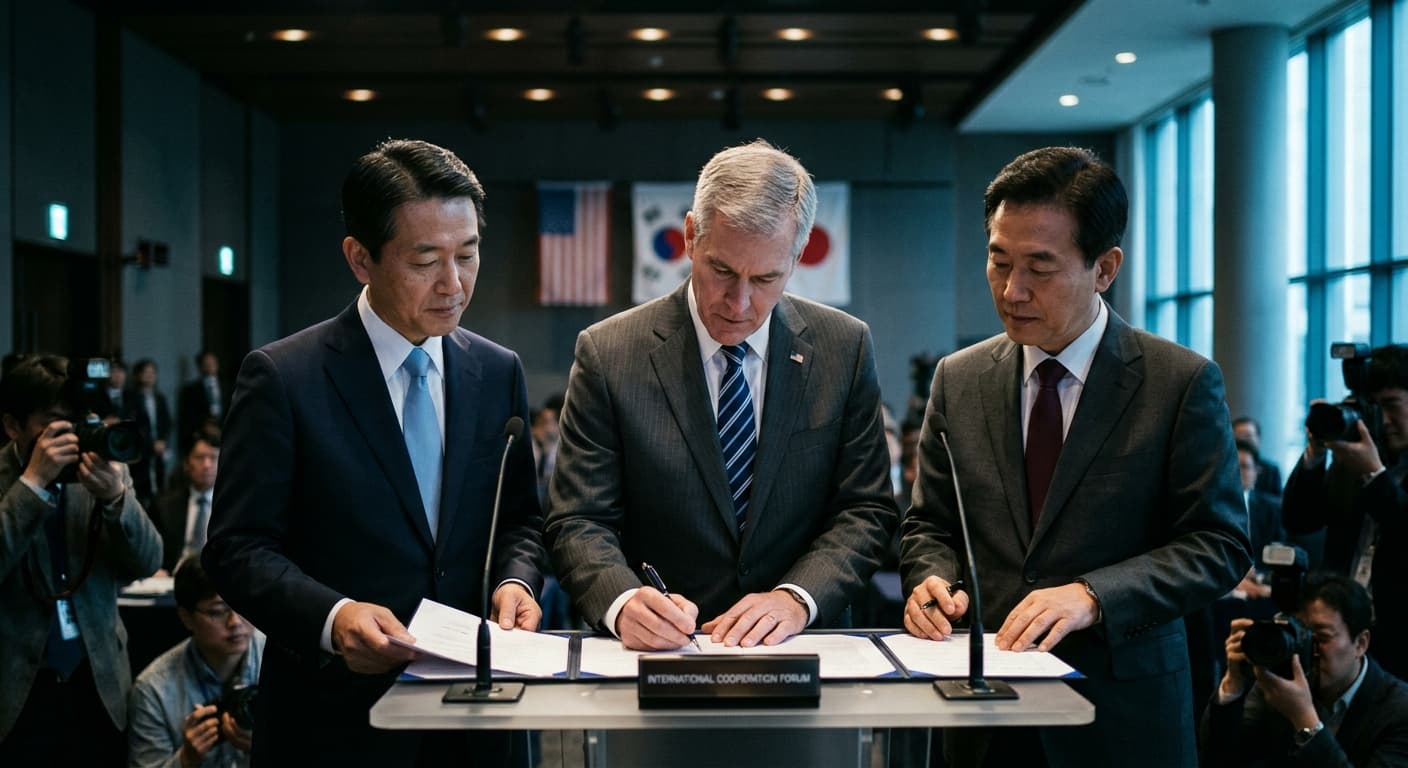
Trilateral SMR pact aims to lock China, Russia out of Indo-Pacific reactor race
South Korea, the US and Japan signed a July 7 memorandum on small modular reactor exports — a bid to seize the Southeast Asian nuclear market from Rosatom and CNNC.
South Korea, the United States and Japan signed a trilateral memorandum in Ankara on July 7, 2026 to jointly export small modular reactors to third countries — a framework whose real target is not North Korean warheads but the Southeast Asian civil-nuclear pipeline currently split between Russia's Rosatom and China's CNNC. Foreign Minister Cho Hyun, Secretary of State Marco Rubio and Foreign Minister Toshimitsu Motegi bolted the SMR pact onto standard trilateral denuclearization language, but the money, the pages and the political capital sit on the export side. The Korean Peninsula denuclearization pledge is boilerplate; the SMR framework is the operative deliverable.
According to The Korea Herald, the memorandum establishes standardized reactor designs, simplified contracting, trilateral industry consortiums, joint financing, capacity building and shared provision of technology, fuel and equipment — the plumbing that lets Korean, American and Japanese vendors bid as a single stack against Rosatom's build-own-operate package. The US State Department added more than $10 million in new funding to its Foundational Infrastructure for Responsible Use of Small Modular Reactor Technology (FIRST) program, plus a regional training hub. That is not a headline number. What matters is the political declaration that Washington will let Seoul sell reactors abroad without the export-control friction that has hobbled KHNP's overseas bids for a decade.
Rubio framed the deal explicitly in energy-security terms at the signing, per the Korea Herald transcript: "One of the most important issues in the world today, as we're reminded of even now with events happening in the Straits of Hormuz and in other places, is energy security... this Memorandum of Understanding between our three nations today allows us to move forward on joint work on small modular reactors, which is going to be in many ways the future of energy generation."
The market the three governments are chasing
Southeast Asia is where the deal will be tested first. Five of eleven ASEAN members — Indonesia, Malaysia, the Philippines, Thailand and Vietnam — are actively planning nuclear generation, together accounting for 89% of the region's power demand, according to the Stimson Center. The International Energy Agency projects the region will absorb a quarter of global electricity-demand growth through 2035 — more than South Korea's entire annual consumption added to the grid over the next decade, per the same
Stimson assessment.
The competition is already positioned. Vietnam is building two Rosatom-backed plants, described by Prime Minister Pham Minh Chinh as "nationally significant, strategic projects," according to the Institute of Strategic and International Studies Malaysia. Indonesia has formal cooperation proposals from Russia and Canada in hand and plans two SMRs by 2034, with a stretch target of 10,000 MW by 2040. The Philippines set a 2032 target and stood up a new nuclear regulator, PhilATOM, in September 2025 — the first Southeast Asian regulator dedicated to nuclear licensing, according to the
Stimson analysis. Thailand slotted 600 MW of SMRs into its 2024 power development plan; Vietnam's revised atomic energy law took effect in January 2026.
The scale of the opportunity — and the risk of losing it — is what pushed a Trump administration otherwise skeptical of alliance-managed frameworks into a multilateral commitment. As RSIS analyst Janet Fung noted, the Philippines and Indonesia were the first two ASEAN states to join the FIRST program precisely because Washington has been "racing to reignite its domestic civil nuclear sector and reclaim technological and export primacy after ceding the field in recent decades to Russia and China." The Ankara MOU is the multilateral pivot in that strategy.
Why Washington is finally letting Seoul sell
The trilateral pact resolves a decade-old irritant in US–Korea nuclear relations. KHNP's APR-1400 and APR-1000 designs derive from Combustion Engineering technology licensed in 1987 and folded into Westinghouse. The 1970s-era business cooperation agreement between the two firms, as the Congressional Research Service has documented, contained "marketing restrictions" with "no expiration," meaning Korean overseas sales of APR-based designs require US consent. That is why KHNP's 2009 UAE Barakah contract had to route through Westinghouse subcontracting, and why Westinghouse sued KHNP over its Czech Dukovany bid.
Analysts at the Center for Strategic and International Studies warned in a 2023 assessment that the litigation would "likely sabotage South Korea's bid to build nuclear reactors in Saudi Arabia... giving China the highest chance to win the bid." That prediction has been overtaken by events. KHNP was named preferred supplier at Dukovany on July 17, 2024; the turnkey EPC contract with Czech utility ČEZ/EDU II was signed on June 4, 2025, per the
European Commission's State-aid filing covering Dukovany units 5 and 6. Those two units will use KHNP's APR-1000, a Generation III+ pressurised water reactor adapted for European nuclear safety regulations, generating up to 15.4 TWh per year.
That contract went ahead only after KHNP and Westinghouse settled their intellectual-property dispute — a settlement without which Tuesday's trilateral framework would be legally unbuildable. The Ankara MOU institutionalizes what the Dukovany settlement piloted: Korean designs, GE Vernova–Hitachi's BWRX-300 and US-designed SMRs like NuScale can now be marketed as a single trilateral offer.
The primary document underpinning the diplomatic architecture is the State Department's own Nuclear Cooperation Memoranda of Understanding framework, launched in January 2025. It confirms NCMOUs are "not legally binding" and cannot themselves authorize nuclear exports — those still require a 123 Agreement — but they provide "high-level political backing" and can "help bridge the gap and quickly help establish the basis for a broader, strategic relationship with the United States." That distinction matters: the Ankara memorandum signals intent, not yet cargo.
The Rosatom moat, and how the trilateral tries to breach it
Rosatom's edge in Southeast Asia has never been technology. It is the vertically integrated "build-own-operate" package that removes spent fuel — an offer the US, Korea and Japan have been unable to match individually, as the Stimson Center has emphasized. According to a
CSIS review published in March 2026, Russia is still building six reactors at home and 20 units under active construction abroad; Rosatom claims to represent nearly 90% of investments in the global nuclear-technology market.
But that pipeline is aging. Analysts at Poland's Centre for Eastern Studies note that Rosatom's ongoing projects "are based on agreements signed a decade ago and the corporation has not concluded a single binding contract for a new venture over the past five years." Uzbekistan pushed its first concrete pour from March 2026 to at least December 2026 over RITM-200 technical readiness and Rosatom's refusal to finance the SMR portion. Kazakhstan, following its selection of Rosatom for a first plant, chose China's CNNC — not Russia — to lead the consortium for two additional projects, according to
CSIS. The Ankara pact arrives at a Rosatom weak point.
China's SMR export ambition, meanwhile, has stalled at the demonstration stage. CSIS's assessment of Beijing's 15th Five-Year Plan notes that despite deploying Linglong One, "the lack of continued manufacturing after the first Linglong One deployment makes near-term global exports unlikely." China's flagship export design remains the large Hualong One, marketed at Argentina, Egypt and Kenya — not the SMR class. That gives the trilateral a narrow window — roughly 2026 to 2030 — in which Southeast Asian buyers must commit reactor technology choices before Chinese SMR offers mature.
Denuclearization: the boilerplate that hides a shift
The Ankara statement's language on North Korea — "commitment to the denuclearization of the Korean Peninsula" preserved "through dialogue and diplomacy" — is close to identical to the October 2025 APEC readout issued by the State Department after Rubio's Gyeongju meeting. That continuity is politically deliberate.
Beneath the language, the goal has moved. South Korean President Lee Jae-myung publicly reframed his objective in September 2025, telling reporters he would accept a "more realistic" goal of freezing Pyongyang's arsenal rather than eliminating it, and describing existing sanctions as having "worsened" the problem, per Al Jazeera. Kim Jong Un, addressing the Supreme People's Assembly the same weekend, said he was open to talks if Washington "drops the absurd obsession with denuclearising us." Trump reportedly told Lee at a G7 dinner in June 2026 that "the time had come to pay attention to the North Korea issue," according to
Al Jazeera, while Lee argued that sanctions were "ineffective" given deepening Russia–North Korea military cooperation.
In June 2026, Kim toured a new uranium-enrichment facility and called for "exponential" expansion of North Korea's arsenal, according to Al Jazeera, with production capacity for weapons-grade material more than double its level five years earlier. Pyongyang's UN envoy told the 11th NPT Review Conference in May 2026 that the DPRK "will not be bound by the Non-Proliferation Treaty under any circumstances whatsoever," per
Al Jazeera.
Brookings scholar Kyung-joo Jeon assessed that the more plausible outcome is "gradual normalization of North Korea as a de facto nuclear state within a tense regional order, shifting the focus from complete denuclearization to nuclear disarmament and risk reduction, albeit without formal recognition." Victor Cha argued in
Foreign Affairs that Kim's March 2026 parliamentary declaration — that Pyongyang "will continue to consolidate our absolutely irreversible status as a nuclear power" — closes the door on the CVID framework that has anchored US strategy across seven administrations. That is the strategic backdrop against which Cho, Rubio and Motegi kept the denuclearization phrase in the communiqué. It is diplomatic maintenance, not a program.
What this changes on the ground
Three second-order effects deserve attention.
First, the SMR framework functions as economic-security ballast for the Seoul–Tokyo relationship. Rubio noted the ties "have grown stronger over the last three to four years," per the Korea Herald, and Motegi flagged critical-mineral supply chain work as the concrete deliverable. Locking Korean and Japanese vendors into shared consortiums makes future political disruption — a return of historical-grievance politics in either capital — commercially expensive. Doosan Škoda Power, owned by Korea's Doosan Enerbility, is already producing turbines for the Dukovany project, per the
Centre for Eastern Studies. Trilateral consortiums extend that industrial interlock into Southeast Asia.
Second, this is Trump-administration industrial policy dressed as alliance management. The White House fact sheet from March 2026 confirmed up to $40 billion from GE Vernova Hitachi to build SMR plants in Tennessee and Alabama under the US–Japan Strategic Trade and Investment Agreement, plus up to $33 billion in gas generation in Pennsylvania and Texas. Ankara's MOU exports that domestic build-out. Korean and Japanese components will flow into US-branded reactors sold to third countries; US export controls become the choke point for who can bid — a leverage point Washington will use to shape ASEAN supplier choices without needing to place its own vendors first.
Third, the reference to the Strait of Hormuz in Rubio's remarks connects the SMR pact to Middle East LNG risk. Southeast Asian buyers dependent on Qatari and Emirati gas have a new reason to accelerate nuclear planning. AI data-center demand — more than 2,000 data centers already in Indonesia, Malaysia, Singapore, Thailand, Vietnam and the Philippines according to Ember, as cited by ISIS Malaysia — sharpens the calculation. Indonesia's BRIN is aiming to train 4,900 nuclear specialists by 2040, per the
RSIS, a workforce commitment that only makes sense if reactors are coming.
Diplomat View
The Ankara MOU is best read as an admission that the trilateral needs a positive-sum project because its original security rationale — denuclearizing North Korea — is politically exhausted. The framework will succeed or fail on whether one Southeast Asian country signs a binding trilateral SMR contract before end-2027; without a demonstration order, Rosatom and CNNC retain the moat. The Philippines is the most probable first customer, given its 2032 target, PhilATOM's regulator stand-up in September 2025, and KHNP's existing Cagayan pre-feasibility study. Vietnam is locked to Russia. Indonesia is drifting toward Moscow and Ottawa; NuScale's West Kalimantan proposal via Perusahaan Listrik Negara is the trilateral's best chance there. Watch three conditions that would revise this forecast: a Philippine tender announcement in late 2026 or early 2027; the European Commission's State-aid ruling on Dukovany 5–6, which would validate or complicate KHNP's export financing model beyond Central Europe; and whether the Trump administration issues a Part 810 authorization allowing Korean-designed SMRs to be marketed in ASEAN under US export controls without further Westinghouse consent. If any of those three moves against the trilateral, expect the MOU to be quietly downgraded to a training-and-standards forum. If all three break its way, the Indo-Pacific reactor market realigns around a Washington–Seoul–Tokyo axis by decade's end.
What to watch next
- Q4 2026: Philippine SMR tender framework expected, following PhilATOM roadmap approval in February 2026.
- December 2026: Uzbekistan's rescheduled first concrete pour for its Rosatom SMR — further delay would signal wider Russian export weakness and open bidding space in Central Asia.
- 2027: European Commission ruling on Czech State aid for Dukovany 5 and 6, following the December 22, 2025 opening of an in-depth investigation reported by the
Commission.
- APEC 2026 (China host year): next scheduled trilateral ministerial; watch for a follow-on MOU naming a specific third-country project.
The Bottom Line
The Ankara memorandum is not about North Korea — it is Washington, Seoul and Tokyo pooling reactor exports to contest an Indo-Pacific market where Russia and China currently field the only operating SMRs. If a binding third-country contract lands before end-2027, the trilateral becomes the region's default nuclear supplier for the 2030s. If it does not, the pact will read in hindsight as a training program with a communiqué attached.
Discover more
US Politics
SNAP Food Assistance Faces Legal Challenges
In 2026, SNAP faces stricter eligibility rules and mounting legal challenges, threatening food assistance for the millions of Americans who rely on the program.
US Politics
U.S. House Passes Alert Act for Aviation
The House passed the ALERT Act 396–10, replacing the ROTOR Act after Pentagon intervention, impacting aviation safety regulations.
US Politics
Congress Targets AI Chatbot Access for Terror
The House passed the Generative AI Terrorism Risk Assessment Act, focusing on AI's role in terrorism and potential surveillance implications.

Economics
Fed's Amex AML order puts correspondent banking on notice
Federal Reserve's Amex AML order requires board-level controls and a 90-day plan; OCC fined the bank $350 million over enterprise-wide deficiencies.