Trans-Saharan Gas Pipeline: Europe's Southern
Algeria revives 4,128-km pipeline to replace Russian gas, but Niger's security is key.
Model Diplomat8 min readSahel
Trans-Saharan Gas Pipeline: Europe's Southern Bet Meets Sahel Instability
The 4,128-km Trans-Saharan Gas Pipeline, revived by Algeria's June 2026 construction launch, could deliver 30 bcm of gas annually to Europe — but its fate depends on securing a transit corridor through jihadist-held Niger, not on European demand.
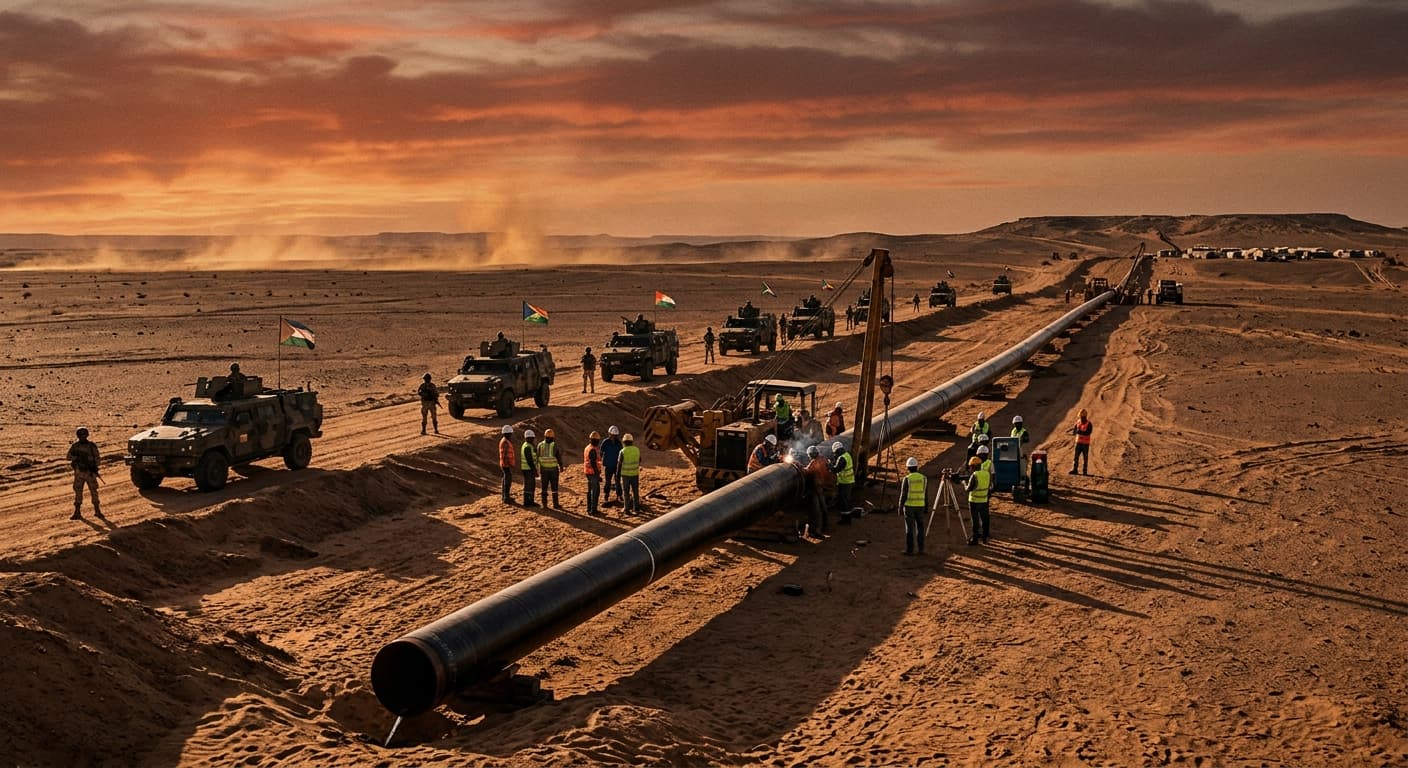
The Trans-Saharan Gas Pipeline broke ground on its Algerian segment in June 2026, reviving a 4,128-kilometer project first mooted in the 1970s and stalled since a 2009 tripartite signing. The pipeline's resurrection is not driven by African energy ambition but by a binding European deadline: the EU's December 2025 agreement to phase out all Russian pipeline gas by November 2027. That cutoff gives Algiers the leverage to revive a project that has failed four times before. The question is no longer whether Europe wants the gas. It is whether Niger's military junta can keep a 1,800-kilometer desert corridor secure enough for $20 billion of steel to traverse jihadist terrain.
The Demand Pull: Europe's Clock
The EU's energy arithmetic has shifted decisively. Russian gas imports fell from 45 percent of EU supply in 2021 to 19 percent in 2024, and the bloc's December 2025 provisional agreement bans short-term pipeline contracts from June 17, 2026, with long-term contracts prohibited by November 2027 (Al Jazeera). Russian LNG faces a parallel phase-out, with long-term contracts banned from January 2027 and short-term deals ending April 25, 2026. The European Commission published its formal roadmap in May 2025, framing the cutoff as a national-security imperative (
BBC).
The gap is roughly 50 billion cubic meters per year of residual Russian pipeline supply that must be replaced, and that is the figure that makes the TSGP's proposed 30 bcm annual capacity meaningful. According to the IMF, the EU still imports more than 50 percent of its energy needs, a ratio broadly unchanged since 1990 despite renewable deployment (IMF). Norway, now the EU's largest gas supplier, is operating near maximum output, and U.S. LNG, which rose from 18.9 bcm in 2021 to 45.1 bcm in 2024, faces political risk under a second Trump term (
Al Jazeera). Europe needs structural diversification, not just spot-market substitution. The CSIS projects EU spot-market LNG procurement growing from 41 bcm in 2026 to approximately 57 bcm annually by 2030, making it the single largest supply source. That leaves pipeline infrastructure, and the countries that control it, as the swing variable (
CSIS).
The Supply Anchor: Algeria's Existing Infrastructure
Algeria is not starting from zero. The pipeline terminates at Hassi R'Mel, one of the world's largest gas fields with estimated recoverable reserves of 2.5 trillion cubic meters, discovered in 1956 and producing since 1961 (Brookings). Algeria became the world's first LNG exporter in 1964 and already operates three major export pipelines: the TransMed to Italy via Tunisia, the Maghreb-Europe pipeline through Morocco to Spain and Portugal, and the direct Medgaz link to Spain.
This existing infrastructure is what makes the TSGP commercially distinct from greenfield LNG projects. Gas arriving at Hassi R'Mel from Nigeria can be piped directly to Italian or Spanish markets, or liquefied at Arzew and Skikda for global shipment. Italy has already moved to deepen this relationship: ENI signed a $4 billion gas deal with Algeria's Sonatrach in 2022, and the Transmed pipeline is being expanded to carry additional volumes to Italian buyers seeking alternatives to Russian supply (Al Jazeera).
But Algeria's internal consumption constrains export growth. Domestic gas use absorbs roughly 70 percent of national production, limiting the surplus available for European buyers. The TSGP solves this problem by injecting Nigerian gas into the Algerian export system, effectively monetizing Nigeria's untapped reserves through Algerian infrastructure. For Algiers, the pipeline is a play to lock in its position as Europe's southern gas anchor before competing projects or competing suppliers fill the post-Russia vacuum.
The Transit Bottleneck: Niger's Security Problem
The pipeline's vulnerability is not at its endpoints. It is the 1,800-kilometer Niger segment that must traverse terrain where jihadist groups operate with increasing reach. In June 2026, an attack on Niamey's Diori Hamani International Airport killed 35 people and was claimed by JNIM, al-Qaeda's Sahel affiliate (BBC). In January 2026, a similar assault on the same base prompted General Abdourahmanane Tchiani to accuse France, Benin, and Ivory Coast of sponsoring the attack while thanking Russian forces for repelling it (
Al Jazeera).
This is the same security environment through which the TSGP must run. Niger's junta expelled French troops in 2023, terminated its defense agreement with the United States in 2024, and welcomed Russian military contractors to replace them (Al Jazeera). Yet Russia's Sahel footprint is contracting. According to Foreign Affairs, Moscow's Africa Corps has delivered "long on theatrics and short on actual resources," and Niger terminated its signals-intelligence partnerships with both Ankara and Moscow in spring 2025, citing poor quality (
Foreign Affairs). China is quietly filling the vacuum, deploying private security contractors to guard energy and mining infrastructure, including Niger's Agadem-Seme oil pipeline, which has been attacked repeatedly by anti-junta rebels.
Niger's transit-fee revenue from the TSGP could reach hundreds of millions of dollars annually — a transformative sum for one of the world's poorest countries. But the junta's diplomatic isolation complicates the financing. ECOWAS imposed sanctions after the July 2023 coup; borders with Nigeria were closed and electricity cut. Niger has since joined the Alliance of Sahel States with Mali and Burkina Faso, withdrawing from ECOWAS entirely. A rapprochement with neighboring Benin in June 2026, when President Romuald Wadagni visited Niamey and both sides agreed to form a committee to reopen their border, signals that Niamey recognizes its economic isolation is unsustainable (BBC).
Algeria's diplomatic re-engagement with the Sahel bloc is the other piece. On July 11, 2026, Algeria and Mali restored diplomatic ties, reinstating ambassadors and reopening airspace closed since April 2025, when AES states withdrew their envoys after Algiers shot down a Malian drone (Al Jazeera). This thaw matters because the pipeline's security corridor depends on Algiers maintaining working relationships with all three AES states, not just Niger.
The Competing Project: Morocco's Atlantic Route
Morocco is advancing a rival pipeline that would run from Nigeria along the Atlantic coast through 13 West and North African countries before linking to Europe via the Strait of Gibraltar. The Nigeria-Morocco Gas Pipeline, estimated at $25 billion, was still awaiting a final investment decision as of April 2026, with a green light expected later this year (BBC).
The Morocco route is longer and more complex, involving extensive offshore segments through the territorial waters of Ghana, Senegal, and Mauritania, but it avoids the Sahel's security crisis entirely. It also aligns with France's strategic reorientation. French Prime Minister Sébastien Lecornu made Morocco his first official foreign visit on July 15–16, 2026, consolidating a reset that began when Emmanuel Macron recognized Moroccan sovereignty over Western Sahara in 2024 (Al Jazeera). France is positioning Morocco as its gateway to Africa; energy infrastructure investment is central to that partnership.
This is the rivalry that gives the TSGP its geopolitical edge. Algeria and Morocco have not had diplomatic relations since 2021, when Algiers severed ties over the Western Sahara dispute. The gas competition is a proxy for that conflict. Algeria has already weaponized gas once: in 2022, it threatened to suspend exports to Spain if Madrid allowed Algerian gas to be diverted to Morocco, and it closed the Maghreb-Europe pipeline that had supplied Moroccan power (Al Jazeera). If both pipelines are built, Europe gains redundancy. If only one proceeds, the winner shapes North African gas architecture for decades.
Historical Parallel: In Amenas and the Pipeline Attack Precedent
The security risk is not theoretical. In 2013, militants attacked the In Amenas gas facility in eastern Algeria, killing 37 foreign workers in a four-day siege. A separate attack on the Ain Chikh pipeline in Djebahia, 120 kilometers east of Algiers and a stronghold of al-Qaeda in the Islamic Maghreb, killed two guards and wounded seven (BBC). The TSGP would cross territory further south and less controlled than either of those targets.
The World Bank's 2020 environmental and social review of the adjacent Trans-Saharan Highway Corridor project — a 4,600-kilometer road running the same Algiers-to-Lagos route — flagged "arms trafficking and human trafficking" along the corridor and noted that the road segment through Niger had been in "very deteriorated condition" for 32 years due to political instability and lack of maintenance (World Bank). If a road cannot be maintained through this corridor, the security calculus for a gas pipeline is orders of magnitude more demanding.
Winners and Losers
Algeria wins most. The TSGP reinforces its existing export infrastructure, gives it first-mover advantage over Morocco's competing route, and deepens its leverage with Italy and Spain at a moment when Europe is structurally short of non-Russian gas.
Niger's junta wins tactically, gaining transit fees and geopolitical relevance, but carries the highest execution risk. If the pipeline is attacked or delayed, Niamey bears the cost of a failed megaproject with no fallback.
Nigeria gains an export outlet for gas it has historically flared. The country exported less than 1 percent of its vast reserves in 2021, and its LNG plant operates at only 72 percent capacity due to upstream constraints (BBC). The TSGP, combined with the domestically funded Ajaokuta-Kaduna-Kano pipeline, gives Abuja a path to monetize stranded reserves.
Morocco loses if the TSGP proceeds first. Rabat's Atlantic-coast pipeline is a longer- timeline project with a larger price tag and more multilateral coordination required. A functioning TSGP undercuts its commercial case.
Russia loses structurally. Every bcm of Algerian or Nigerian gas reaching Europe displaces the residual Russian volumes that Hungary and Slovakia are still contractually receiving — and that Moscow is still monetizing at roughly €1.15 billion per month (Al Jazeera).
What to Watch
- Nigeria's construction start, planned for early 2027. If Abuja breaks ground on schedule, the TSGP has a credible path to first gas by 2030. If delayed — as every previous milestone has been — the project loses its window before the EU's 2027 deadline reshapes demand.
- Morocco-Nigeria pipeline final investment decision, expected late 2026. A positive FID accelerates the rivalry and forces European buyers to choose.
- Niger's security trajectory through 2027. The frequency and severity of JNIM and ISIS-linked attacks on infrastructure in western Niger will determine whether the transit corridor is insurable. Without insurance, there is no financing.
- Algeria's re-engagement with AES states. The July 2026 Mali rapprochement is a start. A similar normalization with Niger — beyond the pipeline MoU — would signal that Algiers is willing to underwrite the security of the corridor politically.
The Bottom Line
The Trans-Saharan Gas Pipeline is not an energy project that happens to have a security problem — it is a security project that happens to carry gas. The EU's binding 2027 deadline gives Algeria the demand-side leverage to build it, but the pipeline's fate will be decided in the Sahel, not in Brussels. If Niger's junta can stabilize the transit corridor — with or without Russian help — Algiers locks in its position as Europe's southern gas anchor for a generation. If it cannot, Morocco's Atlantic route becomes the default, and France's Morocco pivot pays off.
Discover more
US Politics
House Ethics Committee Pushes Sexual Miscond.
The House Ethics Committee has shifted responsibility for sexual harassment settlement records to the Office of Congressional Workplace Rights, complicating disclosure efforts.

US Politics
SNAP Food Assistance Faces Legal Challenges
In 2026, SNAP faces stricter eligibility rules and mounting legal challenges, threatening food assistance for the millions of Americans who rely on the program.

India
BJP's Misunderstanding of Women's Quota Needs
The BJP's linking of the Women Reservation Bill to delimitation risks delaying women's empowerment in India, misreading the aspirations of female voters.

Conflict & Security
Drone Warfare Killing Aid Workers at Unprec
Over 1,000 humanitarian workers killed in three years as cheap armed drones collapse legal protections. Gaza, Sudan, Ukraine, and DRC see deliberate targeting of aid convoys and hospitals with zero prosecutions.