Three Tankers Hit in Strait of Hormuz
US strikes Iran as ceasefire collapses after tanker attacks.
Model Diplomat10 min readMiddle East
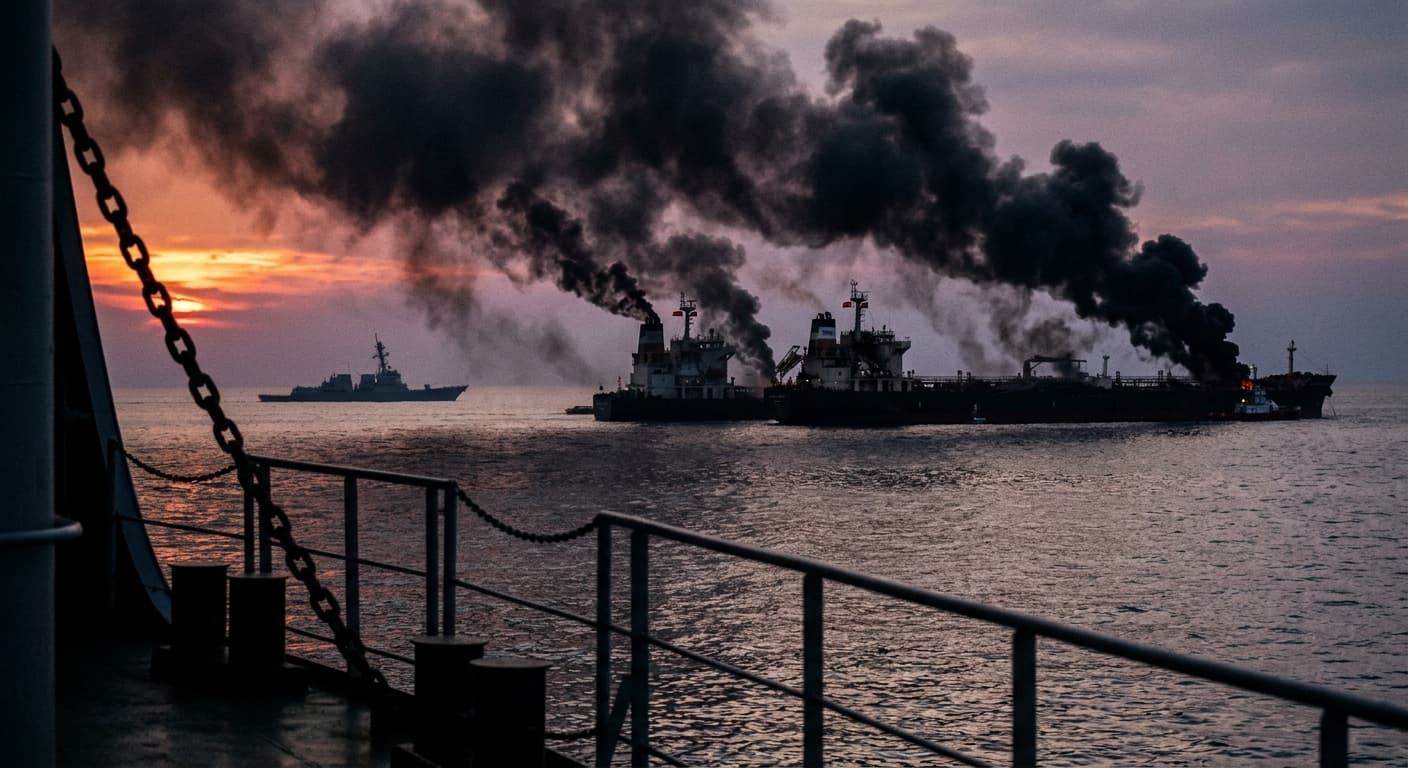
Three Tankers Hit in Strait of Hormuz as US Strikes Iran, MoU Collapses
Three tankers struck within 24 hours near Limah, Oman on July 7, 2026. The US revoked Iran's oil license and launched fresh strikes. Brent jumped 5%.
The three tankers hit in the Strait of Hormuz on July 7, 2026 have effectively killed the three-week-old US–Iran ceasefire: within hours of the attacks, the White House revoked General License U — the sanctions waiver that was Tehran's only real concession under the June 17 memorandum of understanding — and US Central Command launched a new round of "powerful" strikes on Iran. Iran is not attacking ships at random. It is enforcing a coercive tolling regime over the world's most important oil chokepoint, and Washington has now chosen the sanctions snap-back over the negotiation. Brent crude jumped more than 5% in post-market trading toward $76 a barrel, according to Al Jazeera, pricing in what markets had until Monday assumed away: that the memorandum would hold.
What happened, in precise detail
The United Kingdom Maritime Trade Operations centre reported early on Tuesday that a tanker moving southbound roughly 8 nautical miles (15 km) off the coast of Limah, Oman was struck by a projectile on its port side, causing a fire. Two additional vessels were hit within a 24-hour window. According to BBC News, one was Qatar's LNG carrier Al-Rekayyat, whose engine-room fire left it at risk of exploding; the second was the Saudi-flagged VLCC Wedyan, owned by state carrier Bahri. UKMTO reported no casualties and no environmental damage, though it noted that authorities were still investigating.
Qatar's foreign ministry spokesman Majed Al Ansari, in a statement carried by Al Jazeera, called the strike on Al-Rekayyat:
"an unacceptable assault on the security and safety of international navigation and global energy supplies, and a grave and blatant violation of international law … We hold Iran fully legally responsible for this assault and any resulting damages or consequences."
Iran has not claimed the attacks. Foreign ministry spokesman Esmail Baghaei, on Telegram, said only that ships using routes "not coordinated with Iran" risk "collision" and disrupt Tehran's efforts to "facilitate safe transit." US officials, cited by Axios and relayed by Al Jazeera, told reporters the Islamic Revolutionary Guard Corps fired at least two missiles at commercial shipping on Monday night. Tehran-based analyst Hossein Royvaran offered a partial defence, telling Al Jazeera the Al-Rekayyat may have strayed into an active Iranian mine-clearing zone — an implicit admission that Iran's mines remain in the channel a month after the ceasefire.
By evening, CENTCOM confirmed it had struck Iranian targets "to impose heavy costs for targeting and attacking commercial shipping crewed by innocent individuals in an international waterway," according to the BBC. The Navy-led Joint Maritime Information Center raised the transit threat level to "severe" — the first time since June 15.
The angle: Iran is monetising the chokepoint
The pattern of attacks since the June 17 memorandum is not random harassment. Tehran has declared that only IRGC-approved routing through the strait is "safe," and vessels straying toward the Omani shore — the shorter, cheaper track — get hit. During the war, the IRGC reportedly charged up to $2 million per ship for transit clearance, Al Jazeera reported. Iran's ambassador to Beijing this month reiterated that new "environmental or service fees" will be charged despite US objections, promising "special" treatment for "friendly" countries — a phrase that reads as an invitation to a Chinese-underwritten alternative transit regime.
That is the game. Mohsen Milani of the University of South Florida framed it plainly to Al Jazeera: Iran is trying to convert its sovereignty over half of the strait into a permanent tolling right. The tanker strikes are enforcement actions in a shadow tariff regime — not a prelude to closure. Roughly 20% of the world's traded oil and LNG moved through Hormuz in peacetime, and vessel-tracking firm Kpler put verified crossings at just 31 to 43 per day last week versus 120–140 pre-war, Al Jazeera noted.
The historical parallel is not the 2019 Gulf of Oman incidents but the 1984–88 Tanker War, when Iraq and Iran attacked over 450 ships in the Gulf and the US Navy escorted reflagged Kuwaiti tankers in Operation Earnest Will. What is different this time: Iran is the sole aggressor, the tolling logic is explicit rather than incidental, and the escort mission is European, not American. That shift in who guarantees freedom of navigation is the most consequential development below the news line.
Why the MoU just died
The June 17 memorandum was a 14-point framework, obtained by NPR, that gave Iran a 60-day sanctions waiver, a $300 billion notional reconstruction commitment from regional partners, and a path to release of frozen assets. In exchange, Tehran committed to unfettered Hormuz transit and IAEA access. The document was — by the White House's own account — vague on how the strait would be administered day-to-day. That ambiguity was the fatal flaw. As one analyst told
Al Jazeera after the June 26 attack on the Ever Lovely, the MoU was a one-page document "where the ceasefire was the feature and not the details" — every operational question, from mine-clearance to fee schedules, was punted to later technical talks that never converged.
Treasury operationalised the concession on June 22 via General License U, authorising the delivery and sale of Iranian crude loaded on vessels as of March 20, 2026. Congressional Republicans immediately moved to kill it: H.R. 8220, the "NOPE Act," introduced in the House and available on Congress.gov, would have nullified GL U outright and barred any successor waiver, while requiring the State Department to report every 60 days for three years on "the premium earned on Iranian oil as a result of the closure of the Strait of Hormuz." As the
Atlantic Council noted, the waiver had already underperformed: roughly 140 million barrels of Iranian crude sat on the water, but buyers hesitated to touch it without payment mechanisms, and Iran was holding out for higher prices.
The White House pre-empted Congress on July 7. Treasury's notice, per the BBC, sets a wind-down to July 17 for transactions previously authorized under the waiver. In the words of Brett Erickson of Obsidian Risk Advisors, quoted by
Al Jazeera: "It is a complete destruction of the Memorandum of Understanding between the United States and Iran. The oil sanction waivers were the only notable up front concession that Iran received for the joint lifting of blockades in the Strait of Hormuz."
The oil market: from complacency to re-pricing
Until this week, traders had bet the ceasefire would hold. Brent September futures settled at $72 on July 6, Al Jazeera reported — below the $72.48 close on February 27, the eve of the war. OPEC+ had just announced a fifth consecutive monthly production increase of 188,000 barrels per day from August, an implicit vote of confidence that Hormuz would keep reopening.
Total OPEC+ output had collapsed from 42.77 million barrels per day in February to 33.13 million in May under the effective Hormuz closure. Saudi Arabia had "more than doubled its shipping volume since June 17" versus the prior three months combined, analyst Vandana Yip told Al Jazeera, and Iran had pushed close to 50 million barrels to market after the US naval blockade lifted. That flow — not the sanctions waiver — is what actually delivered the pre-war Brent price. Kill the flow, and the price tag on the war's aftermath comes back.
The 5% overnight move on July 7 is small versus April's $126 peak reported by Al Jazeera, but it re-establishes the risk premium the market had priced out. Two second-order effects follow. First, Saudi Arabia's Wedyan getting hit signals that Iran is willing to strike Gulf Cooperation Council flags — not just Western-linked vessels. That widens the diplomatic coalition demanding a response and increases the political cost to Tehran of every subsequent strike. Second, Qatar's LNG cargo puts European gas buyers directly in the line of fire; roughly one-fifth of global LNG transits Hormuz, and the winter contracting season begins in six weeks. Expect European utilities to lock in premium-priced Henry Hub cargoes before autumn.
London and Paris move ahead of Washington
The overlooked actor in this crisis is the Anglo-French mission announced days before the attacks. On July 3, Prime Minister Keir Starmer and President Emmanuel Macron issued a joint statement, posted on GOV.UK, announcing that Oman had agreed to work with the UK and France to secure its territorial waters and that both governments "stand ready to deploy the wider Multinational Military Mission to support freedom of navigation."
At the UN Security Council the day before, UK Chargé d'Affaires James Kariuki told members, per the Foreign Office transcript, that Iran's attacks were "directly contrary to resolution 2817" and called for transit passage "to be fully restored in the Strait of Hormuz in accordance with international law, as reflected in the United Nations Convention on the Law of the Sea." Kariuki went further, insisting the strait must be "free from the threat of violence and any form of tolls or unlawful impediments" — a direct rebuke of Iran's fee proposal, and the first time a P5 government has publicly rejected the tolling scheme by name.
The UNCLOS framing matters. Article 38 of the Convention establishes an unqualified right of transit passage through straits used for international navigation — a right that cannot be suspended, and that legally forecloses Iran's tolling scheme. By anchoring their intervention in UNCLOS and UNSCR 2817, London and Paris are building the legal architecture for a sustained escort mission independent of whatever Washington negotiates bilaterally with Tehran. That is a hedge against Trump cutting a deal that legitimises Iranian fees — which, per multiple analysts cited by Al Jazeera, remains a live risk. It is also a rare instance of European maritime power pre-empting American strategy in the Gulf.
Who benefits, who loses
Iran loses the sanctions waiver but keeps the leverage. GL U had delivered little revenue anyway; buyers were skittish, and the crude was priced at a discount, per the Atlantic Council analysis. Tehran now recovers its principal bargaining chip — the ability to close, or price, the strait — for the next round. The domestic politics under new Supreme Leader Mojtaba Khamenei, who has publicly vowed to keep the strait closed, reward defiance over compromise.
Saudi Arabia and Qatar have been dragged in. Both had stayed carefully out of the shooting phase of the February–April war. With Bahri and QatarEnergy vessels now targeted, both governments are publicly demanding Iranian accountability, and Doha — which mediated the failed indirect talks last week — has lost its neutral broker status. Expect Riyadh and Doha to quietly bankroll the UK–France escort mission and to accelerate pipeline bypass projects.
US shale producers benefit from any sustained premium above $75. European refiners and Asian LNG buyers lose the cheap, reliable Gulf flow they had priced back in through late June. Israel wins tactically. Every day the MoU is in tatters is a day the pathway toward IAEA inspections at Iranian nuclear sites — Israel's least-favourite MoU provision — recedes. Prime Minister Benjamin Netanyahu's government had warned openly that the deal was too generous. Tuesday's collapse does that work for it.
The unexpected loser is Oman. Muscat has traded on quiet neutrality for four decades. Its territorial waters are now the shooting gallery, and its agreement to work with the UK and France, disclosed in the July 3 statement, ends its arms-length posture with Tehran. The Sultanate's mediator role — used most recently to broker the June MoU itself — is dead for the duration.
The wider war
The tanker strikes come inside a war that never fully ended. The US–Israel campaign against Iran began February 28. BBC reporting documented at least 96 US strikes in and around Bandar Abbas before the April 8 ceasefire, per ACLED data, and Iran's new supreme leader Mojtaba Khamenei — son of the deceased Ali Khamenei — has publicly vowed to keep blocking the strait. Iran has also launched attacks on US military assets in Kuwait and Bahrain since June, and Israel remains at war in Lebanon.
Trump, in Oval Office remarks Monday quoted by Al Jazeera, said: "We're either going to make a deal or we're going to finish the job. And it won't be tough to finish the job. I'd rather make a deal, because I don't want to affect 91 million people." Iran's foreign minister Abbas Araghchi replied on X: "Negotiations on final Deal will not commence if threats continue. Honor your signature." That was Monday. Tuesday, the signature was un-honored — by both sides, near-simultaneously.
What to watch
- July 17, 2026 — The Treasury wind-down deadline for transactions previously authorized under General License U. Any cargoes still afloat after that date fall back into full sanctions, and roughly 140 million barrels of Iranian crude on the water become legally untouchable for US persons.
- August 2, 2026 — Next OPEC+ ministerial review; the group has said it will "monitor and assess" whether to continue unwinding production cuts. A sustained Brent move above $80 changes the calculus and could accelerate the phase-out.
- August 16, 2026 — The 60-day MoU window from June 17 expires. Without a permanent deal or an extension, the legal framework for the ceasefire lapses.
- The UK–France mission's rules of engagement, not yet published. Whether escorts will fire back on IRGC fast boats will determine if this becomes a NATO-adjacent shooting confrontation with Tehran, or an armed presence Iran can continue to work around.
The Bottom Line
Iran is not trying to close the Strait of Hormuz — it is trying to charge admission to it, and the July 7 tanker strikes are the enforcement mechanism. Washington's response, revoking General License U and re-launching strikes within hours, ends the pretence that the June 17 memorandum survives. The next moves that matter are not in Tehran or Washington but in London, Paris and Muscat, where the Anglo-French escort mission — grounded in UNCLOS transit rights — is quietly becoming the substitute for a diplomatic settlement neither Trump nor Khamenei can now deliver.
Discover more
Global Politics
US-Iran Tensions Rise
Tensions escalate in the Strait of Hormuz as Iran and the US clash over maritime control, with a ceasefire hinging on a contested MoU paragraph.
US Politics
House Ethics Committee Pushes Sexual Miscond.
The House Ethics Committee has shifted responsibility for sexual harassment settlement records to the Office of Congressional Workplace Rights, complicating disclosure efforts.
US Politics
Virginia's Redistricting Referendum
Virginia's redistricting referendum is drawing a flood of dark money, shaping future elections and the fight for congressional control amid party stakes.

Conflict & Security
Drone Warfare Killing Aid Workers at Unprec
Over 1,000 humanitarian workers killed in three years as cheap armed drones collapse legal protections. Gaza, Sudan, Ukraine, and DRC see deliberate targeting of aid convoys and hospitals with zero prosecutions.