The Trillion-Dollar Company That One Bill in
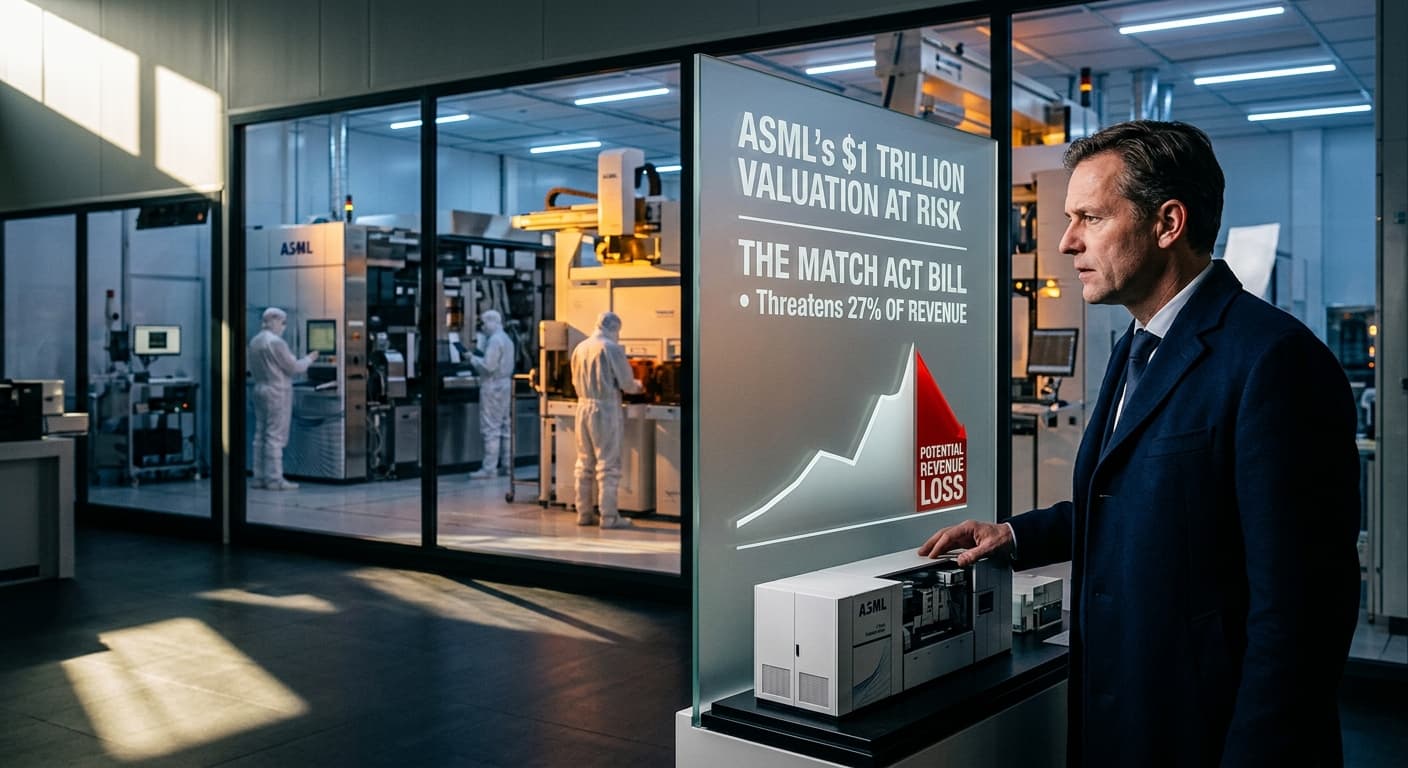
ASML's trillion-dollar race meets a U.S. bill that could cut 27% of its revenue.
Model Diplomat9 min readEurope
The Trillion-Dollar Company That One Bill in Congress Could Break
ASML's race to become Europe's first trillion-dollar company hinges on a fight it cannot control — the MATCH Act, which would sever its largest growth market at the knees.
ASML Holding NV closed on July 20, 2026 with a market capitalization of €597 billion, roughly $683 billion — up 140% in twelve months and about 47% short of the $1 trillion mark that would make it Europe's first member of the club. On July 15, the Dutch company reported second-quarter revenue of €9.3 billion, net profit of €2.9 billion, and a gross margin of 54.0%, handily beating analyst expectations, according to The Economist. It then raised its full-year 2026 revenue forecast for the second time this year, from an initial range of €34–39 billion to a new midpoint of €44 billion, as reported by
Cryptopolitan.
The numbers are extraordinary. But the trillion-dollar thesis — and the argument over whether ASML gets there — has almost nothing to do with AI demand. That demand is not in question. It hinges instead on a piece of legislation introduced in Washington on April 2, 2026 that could vaporize roughly one-quarter of ASML's revenue in a single stroke: the Multilateral Alignment of Technology Controls on Hardware Act — the MATCH Act.
The Only Company That Can Print the Future
To understand why ASML carries a valuation normally reserved for Silicon Valley software platforms, start with physics. There is exactly one company in the world that manufactures extreme ultraviolet (EUV) lithography machines — the tools required to print the most advanced logic chips at 3-nanometer and below. ASML supplies 100% of that market. There is no second source. There will not be one for at least a decade, a timeline ASML CEO Christophe Fouquet has put at "10–15 years" for any competitor, according to research published in the Journal of Cyber Policy.
These are not niche machines. Every leading-edge AI chip — every Nvidia H200, every Google TPU, every custom Amazon Trainium processor — is physically impossible to mass-produce without ASML's EUV systems going into TSMC's, Samsung's, or Intel's fabrication plants first. A single EUV scanner costs roughly €250 million, ships in dozens of freight containers, and takes months to install and calibrate. In 2025, ASML sold approximately 50 of them. In its July 15 report, the company announced it would increase Low-NA EUV annual production capacity from 65 units in 2026 to 85 in 2027, with a further 30% expansion possible by 2028, per Cryptopolitan.
That capacity constraint — not customer demand — has been the single physical bottleneck on global AI compute for the past two years. When ASML expands capacity, it expands the entire industry's ceiling.
The downstream numbers bear this out. Gartner projects global AI-related spending will reach $2.53 trillion in 2026 and $3.33 trillion in 2027, according to Al Jazeera. SEMI, the semiconductor equipment industry association, forecasts global chip equipment sales hitting $165.9 billion in 2026 and $229.5 billion by 2028, driven overwhelmingly by AI investment. ASML sits at the narrowest point of that funnel.
The 27% Problem
The threat is not on the demand side. It is in the U.S. Congress.
The MATCH Act — formally introduced on April 2, 2026 by a bipartisan group of lawmakers — would prohibit the sale and servicing of critical chipmaking tools, including deep ultraviolet (DUV) immersion lithography equipment, to advanced fabrication facilities in China. Its primary targets are Dutch company ASML and Japanese firms Nikon and Canon. Under the bill, if the Netherlands and Japan do not align their export controls with U.S. rules within 150 days of enactment, the Commerce Secretary would be directed to apply the Foreign Direct Product Rule (FDPR) unilaterally — asserting U.S. jurisdiction over any product made anywhere in the world that contains U.S. technology, according to the Center for a New American Security.
The numbers make clear why this matters to the trillion-dollar question. According to an April 2026 analysis by the Center for Strategic and International Studies, ASML derived 27% of its 2025 revenue from China, compared to roughly 16% from the United States. That is approximately €8.8 billion in annual sales that the MATCH Act would make illegal — not just future equipment sales, but also servicing and maintenance of the hundreds of DUV machines already installed in Chinese fabs.
"ASML derived 27 percent of its revenue from China in 2025 (versus roughly 16 percent in the United States)," the CSIS analysis states bluntly.
This is not theoretical. The same CSIS paper notes that China's April 2026 "Regulations on Industrial Chain and Supply Chain Security" created a unified economic statecraft framework explicitly designed to retaliate. China has already demonstrated willingness to escalate: in January 2026, it imposed targeted export controls on Japan that cut rare earth shipments by 78% within two months, according to a separate CSIS analysis. The Dutch government, meanwhile, "prefers not to take that course of action because single-member state controls are generally regarded as ineffective, and unilateral controls contravene the essence of the European single market."
The mismatch in leverage is stark. Washington can unilaterally destroy a quarter of ASML's revenue through the FDPR. The Netherlands cannot stop it. But the Netherlands can — and almost certainly would — resist legislating its own economic self-harm. A Bruegel analysis from May 2026 frames this precisely: "US export controls on lithography tools to China only function with Dutch cooperation." The corollary is equally clear — without Dutch cooperation, the U.S. must choose between watching its controls fail or punishing an ally's flagship company.
The Real Valuation: What the Market Is Pricing In
At €597 billion, ASML trades at a trailing P/E ratio of 58.5 on Euronext Amsterdam, according to Financial Times market data. That is not a hardware multiple — it is a monopoly pricing multiple, and it embeds two large assumptions.
First, that AI demand continues to compound. This is the well-understood side of the trade. ASML's Q4 2025 orders hit a record €13.2 billion, more than half for EUV systems, CEO Christophe Fouquet told investors, declaring customer assessments "notably more positive" on medium-term AI demand, as reported by Al Jazeera. By July 2026, Fouquet characterized orders as "extremely strong," prompting the second upward guidance revision of the year. The installed base alone — servicing the thousands of lithography machines already in operation — generates recurring revenue that grows with every new system shipped.
Second, and far more fragile, that the China revenue stream continues. This is the bet the market may not fully appreciate. If the MATCH Act passes and triggers the FDPR enforcement mechanism, ASML would lose not only future Chinese equipment sales but also the lucrative servicing contracts on its existing installed base. The American Enterprise Institute has argued that without ASML servicing, "China's existing DUVi fleet could remain operational indefinitely, undermining the impact of every other proposed export restriction" — which is precisely why the MATCH Act targets servicing so aggressively. AEI estimates that maintenance is required approximately every six months, and ASML engineers often perform it on-site.
The production roadmap ASML laid out on July 15 is implicitly a bet against the MATCH Act's most extreme scenario. The company plans to raise annual EUV capacity to 85 systems by 2027, expand DUV immersion capacity from 130 to 170 units, and explore a further 30% increase by 2028. Those expansion plans — particularly the DUV targets — are premised on continued access to Chinese customers who have been stockpiling older-generation DUV machines. China imported hundreds of them between 2023 and 2024, equipment that fell below the threshold of earlier controls. Chinese firms, particularly Huawei, have since been running those machines through multi-patterning processes to produce near-frontier chips, albeit with yield rates as low as 20% relative to TSMC, according to AEI.
Who Wins, Who Loses — Beyond ASML
The trillion-dollar question is not just about one Dutch company. It is about who controls the chokepoints of the AI supply chain — and who pays when those chokepoints become weapons.
The immediate beneficiaries of MATCH Act passage would be U.S. chipmakers and equipment firms that compete indirectly with ASML-serviced Chinese fabs. If Huawei's DUV fleet becomes inoperable within a few years — as AEI analysts Ryan Fedasiuk and Craig Singleton argued it would — the global supply of advanced logic chips would tighten at a moment of surging AI demand. That favors TSMC, Samsung, and Intel, all of which operate outside China and all of which are ASML's largest EUV customers. TSMC alone accounts for the overwhelming majority of the world's advanced-node production, and a supply squeeze at the trailing edge — the 7nm to 16nm nodes where Chinese DUV machines compete — would strengthen its pricing power.
The loser most exposed beyond ASML is the Dutch state itself. ASML is not merely a Dutch company; it is the Dutch economy's crown jewel and Europe's most valuable listed entity. According to the Bruegel analysis, Europe's emerging strategy — termed "sovereignty through indispensability" — rests on controlling inputs that no other power can route around. ASML embodies that strategy. The CSIS April 2026 analysis warns bluntly that "U.S. action targeting an individual member state with extraterritorial measures would undercut EU progress on developing a more unified approach to controls while opening the Netherlands to Chinese retaliation." That retaliation, the authors note, would not be confined to the Netherlands alone — "it would directly implicate European technology and consumer goods producers" across the single market.
The wildcard is China's domestic lithography program. CSIS research published in March 2026 identified that Chinese scientists at a secure Shenzhen laboratory have reportedly built a prototype EUV machine using parts from older ASML equipment obtained in secondary markets, with one observer noting that "as the semiconductor dream has become a national security issue, I would not underestimate China's ambition, and its all-in approach to reverse engineering EUV machines." Separately, in December 2025, China introduced its "50 percent rule," mandating that fabs source at least half of their equipment domestically by decade's end, explicitly targeting Shanghai Micro Electronics Equipment (SMEE) as the beneficiary. For now, domestic lithography accounts for approximately 1% of China's needs.
The Timeline That Matters
The MATCH Act was one of a slate of export-control bills scheduled for markup by the House Foreign Affairs Committee in April 2026. Alongside companion legislation — including the STRIDE Act, the Deterring American AI Theft Act, and the Interagency Coordination and Export Control Act — it represents what CSIS called "the biggest export control action since the Export Control Reform Act of 2018." Its 150-day alignment clock would begin ticking on enactment, putting a decision point in late 2026 or early 2027 — precisely when ASML would be ramping toward its 85-EUV-unit target.
The bill's passage is not assured. It collides with two countervailing forces. First, the Trump administration's own posture: CSIS notes that the MATCH Act's statutory mandate "could complicate negotiations as the United States seeks to maintain its economic détente with China ahead of a May meeting between President Donald Trump and President Xi Jinping." Second, European resistance: the Netherlands and Japan have already imposed significant restrictions voluntarily — the Dutch government's June 2023 regulation on advanced semiconductor equipment invoked Article 9 of EU Regulation 2021/821 to impose unilateral national-security controls, according to CSIS — but codifying those into a U.S.-mandated framework is "very different from ongoing diplomatic alignment."
The CSET research group at Georgetown concluded as early as 2022 that "coordinated export controls on China by the United States, the Netherlands, and Japan for EUV and ArF immersion photolithography tools would have complex positive and negative effects." The CSIS April 2026 analysis updated that assessment: "Every blunt instrument accelerates Chinese indigenization, strains allied relationships, and narrows the window in which Western equipment advantages persist."
What to Watch Next
- House Foreign Affairs Committee markup of the MATCH Act: No firm date has been set since the April 2026 introduction, but CSIS flagged the April slate as the largest export-control package since ECRA 2018. A markup announcement would be the first concrete signal of legislative momentum.
- Trump-Xi meeting (tentatively May 2026, now past): The meeting reportedly occurred. Any concessions on semiconductor access — or their conspicuous absence — will signal whether chip export controls remain a legislative priority or become a diplomatic bargaining chip.
- ASML's Q3 2026 earnings (expected October): The company's China revenue share in the second half, and any executive commentary on the MATCH Act's potential impact, will be the clearest indicator of how management is pricing the legislative risk.
The bottom line: ASML's path to a trillion-dollar valuation runs through a single committee room in Washington — and the company has no seat at that table.
Discover more
Tech Policy
US Restarts China Export Controls With 52-Ent
US Commerce Department adds 52 Chinese entities to Entity List and tightens controls on five-axis CNC machine tools, ending eight-month enforcement pause after Trump-Xi Busan truce.

Tech Policy
EU AI Office Gains Powers Amid US AI Leverage
EU AI Office gains powers to fine AI firms up to 3% of global turnover on August 2, 2026, but US export controls on Anthropic's Mythos model show Washington can revoke AI access, raising questions about enforcement against American labs.

Tech Policy
EU AI Act's High-Risk Rules Activate Amid US
The EU AI Act's high-risk rules activate August 2, 2026, but the enforcement body is outgunned 10,000-to-1 by industry, and the US just showed it can cut off Europe's AI access overnight.
Tech Policy
Trump's AI Gatekeeping: White House Controls
Trump administration launches Gold Eagle AI clearinghouse, converting voluntary access into de facto licensing of frontier models, as China's open-source Kimi K3 matches U.S. performance.