Tariffs on Brazil May Boost China’s Market
U.S. tariffs could shift market share to China, experts warn.
Model Diplomat7 min readAmericas
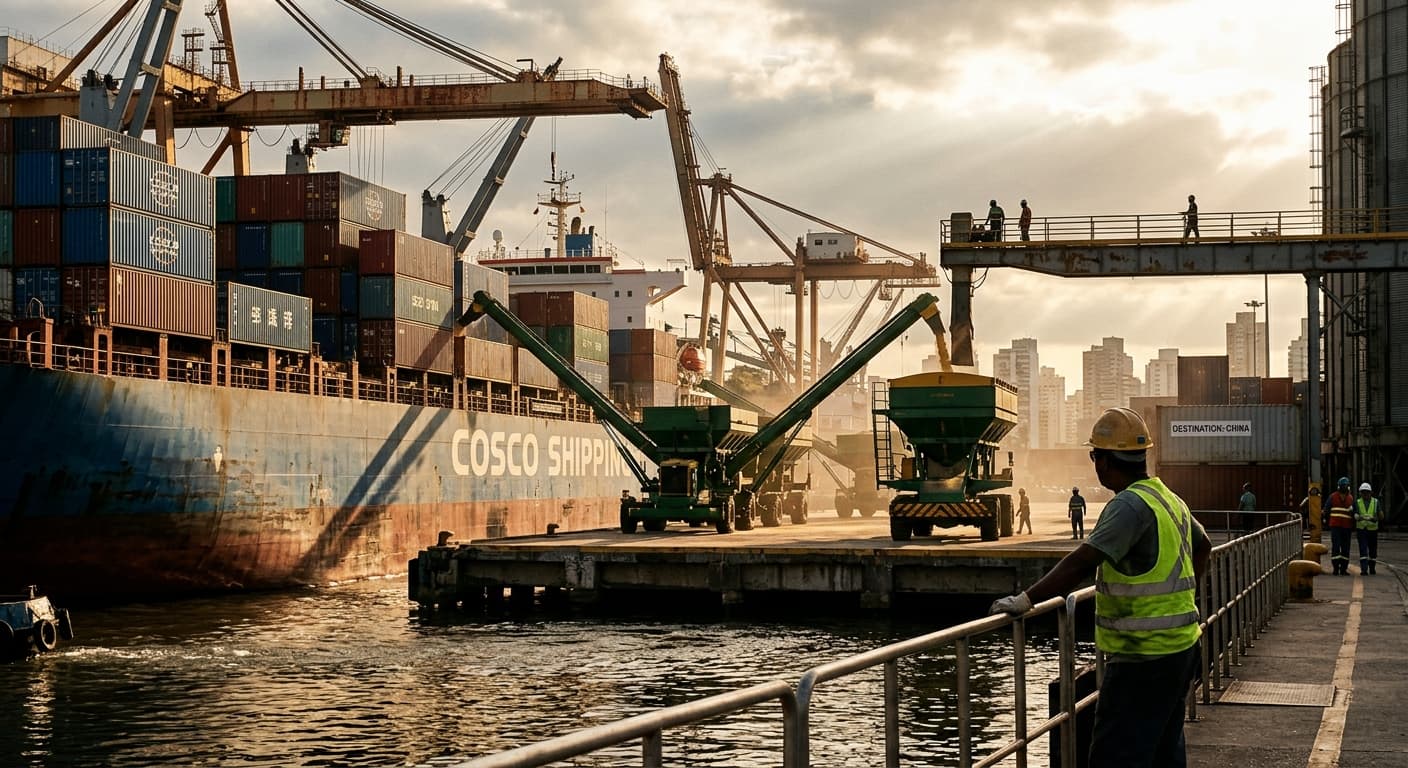
Tariffs on Brazil May Hand China the U.S. Market, Firms Tell USTR
Brazilian exporters told the USTR on July 7, 2026 that a 25% tariff on Brazil would deepen U.S. dependence on China in footwear, machinery and coffee — the opposite of the diversification Washington claims to want.
The U.S. Trade Representative's proposed 25% tariff on Brazilian goods, due July 15, would hand market share to China in the very sectors Washington has spent five years trying to diversify away from Beijing — a conclusion delivered under oath by Brazilian industry witnesses at the USITC this week that undercuts the strategic logic of the Section 301 case itself. The tariff is meant to punish Brazil's digital-payments rules, ethanol restrictions and deforestation record. On the evidence entered into the USTR docket, its first-order effect would be to concentrate U.S. supply chains in China, not to loosen them.
The hearing that flipped the script
The USTR held two days of hearings on July 6–7 at the USITC on 500 E Street SW, on the "proposed responsive action" flowing from its June 1 determination that Brazil's practices are "unreasonable" and actionable under Section 301(b) of the Trade Act, according to USTR's press office. Ambassador Jamieson Greer set the July 15 statutory deadline for Washington's next move.
Over 40 associations testified. The through-line was blunt: taxing Brazil out of the U.S. market does not send production to Ohio. It sends it to Guangdong.
Patrícia Gomes, foreign-markets director at Abimaq, the Brazilian machinery association, told the panel that "taxing Brazil on machinery and equipment could displace the country and that China could be the one to occupy" the space, Valor Internacional reported. In some sub-sectors, Gomes said, only China has the scale to replace Brazilian supply; in others, India and South Korea could step in. None of those is the U.S.
Abimaq's structural point is the one policymakers should read twice: 82% of Brazilian machinery and equipment exports in 2024 were intra-company transfers between subsidiaries of the same multinational straddling both countries. A Section 301 tariff on those flows is not a tariff on a foreign competitor. It is a tax on Caterpillar, Deere, WEG and Embraer moving parts between their own plants. The U.S. runs a $1.2 billion surplus in machinery and equipment trade with Brazil, Gomes noted.
The footwear math that makes Beijing the winner
The clearest illustration came from Abicalçados, the Brazilian footwear industry group. The United States consumes more than 2 billion pairs of shoes a year and produces roughly 20 million — about 1% of demand, according to the association's testimony. China supplies 48% of that volume. Brazil is one of only a handful of non-Asian sources with the industrial base to matter at scale.
Layer a 25% Section 301 tariff onto Brazilian footwear and the math is arithmetic, not ideology. Vietnam already faces punitive duties; Indonesian capacity is limited; Mexico has no footwear industry to speak of. "An additional tariff would tend to increase costs, reduce supply diversity, and reinforce the concentration of U.S. supply sources in already dominant origins, running counter to U.S. interests in diversification," Abicalçados relationship manager Letícia Sperb Masselli told the panel.
The Council on Foreign Relations reached the same conclusion in its April 2025 analysis: with 99% of U.S. footwear imported and 85% of that historically Chinese, per Footwear Distributors & Retailers of America and World Integrated Trade Solution data, Brazil is one of the few viable pressure valves. Tax it out and China's share grows by arithmetic.
The soybean precedent nobody in Washington wants to relive
The strongest evidence that this backfires is empirical. It already happened.
When President Trump slapped Section 301 tariffs on China in 2018, Beijing retaliated on U.S. soybeans and Brazil moved into the void. In the first eleven months of 2024, China sourced 74% of its soybeans from Brazil and 18% from the United States, up from 46% and down from 40% respectively in 2016, according to Chinese customs data reported by Reuters. The Busan summit deal in November 2025 was supposed to reverse this. It did not. U.S. soybean exports to China totaled $3.1 billion in 2025 — a $9.6 billion collapse from 2024,
CSIS calculated, with Brazil having filled most of the harvest gap before the deal was signed.
Brazil learned that lesson. So did China. The Atlantic Council's US-Brazil trade dashboard shows that in October 2025 — three months after Trump's 50% Brazil tariff took effect — the U.S. share of Brazil's export market fell 5.3 percentage points year-over-year while China's rose 5.2 points, per the Council's tracker. The substitution is now measured, not hypothetical.
What the case is actually about
Read the Congressional Research Service brief and the Section 301 investigation's stated grievances are strikingly domestic-political: Brazilian court orders taking down U.S. social-media accounts (read: X, Rumble, Truth Social); Pix, Brazil's central-bank instant-payments system, disadvantaging U.S. card networks; deforestation enforcement; ethanol tariffs; and IP protection. The June 1 USTR determination
quotes at length from Brazilian court proceedings against U.S. platforms.
That framing matters. It means the tariff's target is Brazil's regulatory posture, not a manufactured-goods surplus — the U.S. has a $7.4 billion goods surplus and a $33.5 billion total trade surplus with Brazil through Q3 2025, Atlantic Council data show. The instrument (goods tariffs) is mismatched to the grievance (digital and regulatory). And that mismatch is where China walks in.
Brookings scholars Maricarmen Barron Esper and Christopher Sands flagged the mechanism directly in a March 2026 analysis of the administration's Section 301 pivot after the Supreme Court's February 2026 ruling invalidated IEEPA tariffs. Section 301 requires a paper trail — comments, hearings, a defensible administrative record. The Brazilian industry testimony is now part of that record and, more usefully for future litigants, it is public.
CNAS senior fellow Emily Kilcrease made the second-order point at a separate USTR hearing in May, in written testimony: U.S. tariffs on China "succeeded primarily in pushing the burden of China's excess capacity to other markets." Brazil is one of those markets. Tariffing Brazil closes the last relief valve.
Who wins, who loses
The winners are precise. Chinese footwear giants Huajian and Feng Tay, both major suppliers to U.S. brands, gain pricing power in a market where their only non-Asian competitor just got taxed. Chinese machinery makers — Sany, Zoomlion, XCMG — inherit customized industrial orders that Brazilian firms currently deliver to U.S. subsidiaries. And BYD, already selling seven of every ten electric vehicles in Brazil, per Al Jazeera reporting, gains a further foothold in a market its rivals cannot cheaply reach.
The losers are American. U.S. multinationals with Brazilian subsidiaries — the 82% of intra-company machinery flows Abimaq described — face internal-transfer duties. U.S. retailers of everyday footwear face higher landed costs on the only Western Hemisphere alternative to China. And U.S. instant-coffee buyers, who source 22% from Brazil at prices roughly two-thirds of Mexican levels according to Abics director Fabio Sato, face a duty that shifts share to a more expensive supplier or forces a price increase downstream — Kraft-Heinz, Nestlé and Starbucks are the industrial buyers.
Brazil itself is not a passive loser. Lula's government has spent 2026 accelerating what Beijing calls the "China-Brazil community with a shared future" — a phrase Chinese Foreign Minister Wang Yi used in an August 2025 call with Brazilian counterpart Mauro Vieira. Chinese investment in Brazil has topped $73 billion since 2007, per CEBC data. Every Section 301 escalation is a marketing document for Beijing.
Diplomat View
The likely outcome by July 15 is that Greer imposes the tariff at or near 25%, with sector exclusions for coffee, beef, aircraft parts and rare earths already telegraphed by the administration. The Brazilian side is negotiating for a broader exemption list, not for the tariff to disappear; a person present at the hearing told Valor the industry expects USTR to "correct some things we pointed out, but the overall conclusion will probably be the same."
The falsifiable call: within 12 months of the tariff taking effect, U.S. footwear import data will show China's share rising above 50% by volume, and Chinese machinery exports to the United States in HTS chapters 84–85 will accelerate faster than the pre-tariff trend line. If instead U.S. domestic footwear production doubles from 1% to 2% of consumption, or Vietnam and Indonesia absorb the Brazilian share without further concentration in China, this analysis is wrong. Watch the November 2026 U.S. Census Bureau trade release for the first clean read.
What would change the forecast: a Bolsonaro-family-brokered 180-day delay past Brazil's October election; a WTO panel ruling — Brazil requested consultations in August 2025 — that binds U.S. hands before implementation; or a bilateral deal on Pix and platform-content rules that resolves the underlying
Section 301 grievances. None looks likely on the current timeline.
What to watch
- July 15, 2026 — Statutory deadline for USTR responsive action under Section 304 of the Trade Act. Tariff level, product scope, and exclusions all crystallize.
- October 4, 2026 — First round of Brazil's presidential election. A Lula loss weakens Brasília's negotiating posture; a Lula win entrenches the China tilt.
- Q4 2026 U.S. footwear and machinery import data — First clean measurement of whether Chinese share expands as Abicalçados and Abimaq predicted, or whether third-country substitution absorbs the Brazilian gap.
The Bottom Line
The Brazil Section 301 tariff is a digital-trade grievance dressed as a goods duty, and the transcript from this week's USTR hearing is now the clearest public evidence that its dominant effect will be to concentrate U.S. imports in China — the outcome five years of American industrial policy has been designed to prevent. If Greer signs the order on July 15, Beijing will be the largest beneficiary of a U.S. trade action aimed at punishing Brazilian regulators — and the USTR hearing record will be the evidence.
Discover more

US Politics
White House Pressures Congress for Crypto Leg
The Trump administration's push for the CLARITY Act aims to reshape crypto regulation, impacting trillions in market value and the Trump family's wealth.
Global Politics
U.S. Maritime Pressure on Iran
Washington escalates maritime security operations and sanctions on Iran, disrupting Gulf shipping and reshaping global energy flows in a major strategy shift.

International Relations
Pakistan's Key Role in US-Israel-Iran Meddle
Pakistan is seeking to mediate the US-Israel-Iran conflict, balancing high-stakes diplomacy against severe economic pressures and steep regional challenges.

Conflict & Security
Drone Warfare Killing Aid Workers at Unprec
Over 1,000 humanitarian workers killed in three years as cheap armed drones collapse legal protections. Gaza, Sudan, Ukraine, and DRC see deliberate targeting of aid convoys and hospitals with zero prosecutions.