Tanzania Hikes Rates to 6.25% Amid Hormuz War
Bank of Tanzania raises rates to combat inflation from global shocks.
Model Diplomat7 min readAfrica
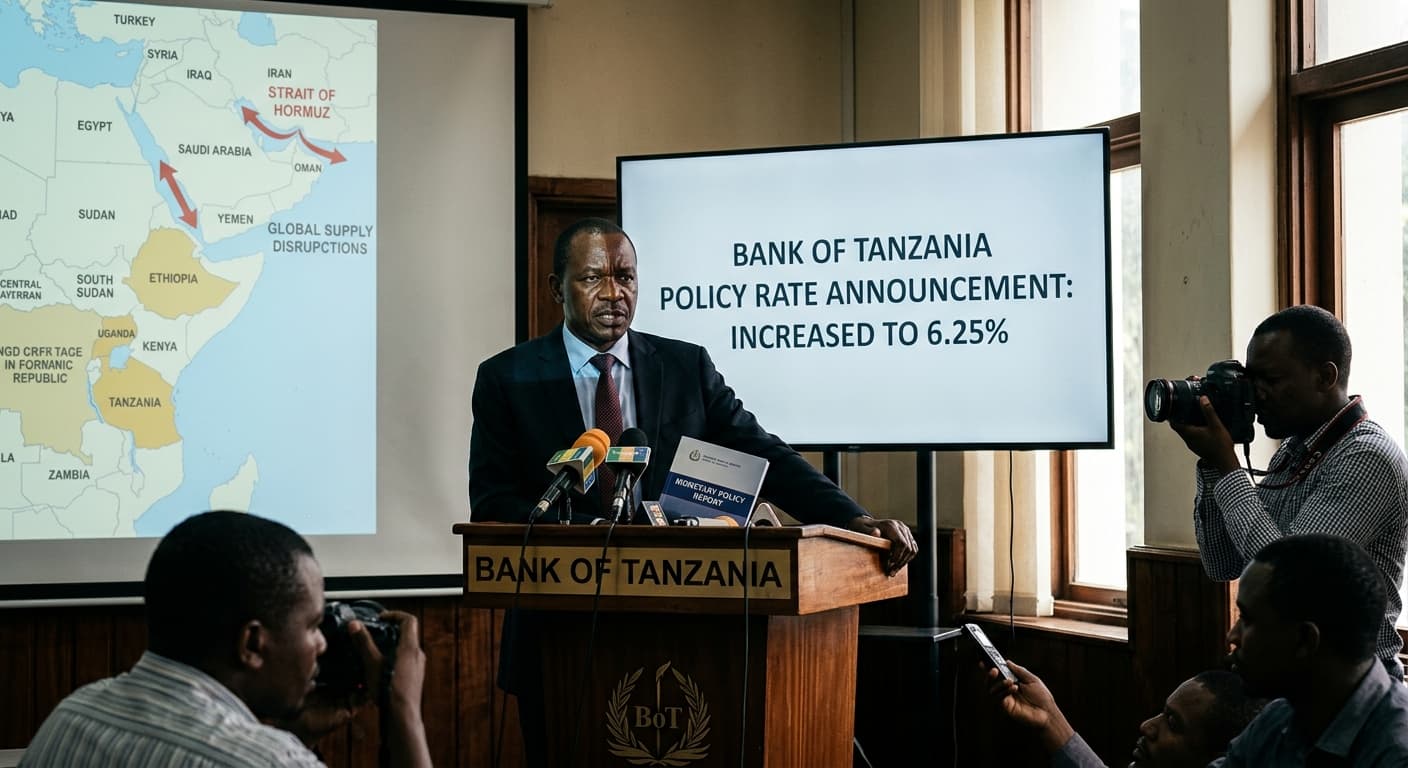
Tanzania Hikes Rates to 6.25% as Hormuz Shock Tests Africa's Best Story
Bank of Tanzania raises its policy rate to 6.25% for Q3 2026, defending a 3–5% inflation target as the Iran war lifts oil, fertilizer and freight costs across East Africa.
The Bank of Tanzania's 50-basis-point move on 2 July 2026 is the loudest signal yet that Africa's most resilient macro story is finally absorbing the Hormuz shock — and it is doing so from a position of strength that almost no peer in the region can match. Governor Emmanuel Tutuba's Monetary Policy Committee lifted the Central Bank Rate from 5.75% to 6.25% explicitly to contain imported inflation from "high energy, fertilizer, and transportation costs in the world market, caused by the geopolitical conflict in the Middle East," while forecasting real GDP growth of about 6% in the first half of 2026 for the mainland and 6.6% for Zanzibar. The thesis: Tanzania is buying insurance, not fighting a fire — and the hike matters less for what it does to Tanzanian prices than for what it says about which African economies can still afford orthodox policy after four months of war.
A pre-emptive hike, not a panic move
Read the MPC statement carefully and the tone is almost defiant. Headline inflation in Mainland Tanzania rose to 4.2% in May 2026 from 3.2% in March, according to the Bank of Tanzania — still inside the 3–5% target band. Zanzibar's 5.5% print marginally overshoots its 5% target, but is being driven by imported fuel and food, not domestic overheating. Private-sector credit is growing at 24% year-on-year, non-performing loans sit at 2.9% against a 5% tolerance threshold, and foreign reserves hover around USD 6 billion — enough for 4.3 months of imports.
That is not a distressed central bank. It is a central bank tightening while it still has the option to. Compare Kenya, where the energy regulator raised diesel by 40 shillings a litre to about $1.60 despite a VAT cut from 16% to 13%, according to the BBC — a fiscal cushion the Kenyan Treasury cannot afford to keep past July. Tanzania ran a fuel subsidy in May and June 2026 as well, but the MPC now judges the subsidy plus tighter money is enough to keep the pass-through contained without depleting the exchequer.
The Peterson Institute's Warwick McKibbin and Marcus Noland argue that emerging economies are being hit harder than advanced ones in this cycle because fertilizer costs cascade into their larger agricultural sectors. Tanzania's decision to lean against that channel now — rather than after inflation crosses 5% — is a bet that credibility is cheaper to defend than to rebuild.
Why Tanzania can hike when Kenya cannot
The comparative arithmetic is unforgiving. Tanzania's current-account deficit was 2.4% of GDP in the year to June 2026, projected to hold there, per the Bank of Tanzania's own MPC statement. Domestic revenues are estimated to reach 16.8% of GDP in FY2025/26, up from 15.6%. Reserves are being topped up through a domestic gold purchase programme that requires miners and traders to sell 20% of output to the central bank,
Al Jazeera reported in June. With gold prices at multi-year highs and Tanzanian bullion the country's top export — 20% of merchandise shipments and a major share of foreign exchange, according to a
WTO trade-impacts brief — the war's mineral windfall partially offsets the war's energy tax.
Kenya has no such offset. The Institute for Security Studies has warned that Kenya, Ethiopia and DR Congo face the sharpest food-inflation risk because Gulf fertilizer flows through Hormuz have collapsed. Kenyan fiscal space is thinner heading into a 2027 election, and Bloomberg has reported the government exploring a World Bank loan of up to $600 million to cushion the shock, according to
Al Jazeera. Uganda and South Africa have held rates. Only Tanzania has actually hiked.
The IMF's ambivalent nod
Tanzania's decision runs against the IMF's May 2026 staff-level advice. The Fund's staff-level agreement, published on 12 May 2026, explicitly stated that "a mildly stimulatory monetary policy stance remains appropriate as long as price stability is preserved." That statement projected 2026 growth of 5.9%, inflation at 4.7%, and the current-account deficit widening to 2.9% of GDP on Middle East spillovers. The BoT's own July print — inflation at 4.2%, growth tracking 6%, deficit at 2.4% — is better than the Fund expected, which is precisely why Tutuba can tighten without triggering a program off-ramp.
There is a subtler signal here. The IMF's April 2026 Regional Economic Outlook argued that Sub-Saharan Africa's "hard-won gains" from the 2023–25 disinflation are now under threat, with commodity importers facing the worst of the shock. Tanzania is technically a commodity importer for oil, but a heavyweight exporter of gold, cashew and coffee — a hybrid profile that lets it treat the shock as manageable rather than existential. The World Bank's April
Commodity Markets Outlook sees Brent averaging $86/bbl in 2026, up from $69 in 2025, with a downside scenario at $115/bbl if hostilities escalate. In that downside, the 6.25% CBR looks conservative rather than aggressive.
The exchange-rate bet under the hike
The MPC statement's most consequential sentence is quiet: "the pass-through effect of exchange rate to inflation is expected to be minimal due to high export earnings from gold, tourism, and agricultural commodities in the second half of 2026." Translation — the BoT does not believe it needs to burn reserves defending the shilling because gold and tourism will do that job for it.
That is a departure from the pre-2024 playbook, when the BoT routinely intervened to smother volatility. The IMF's 2025 Article IV chided Tanzania for exactly that habit, urging "greater exchange rate flexibility" as a shock absorber. The Fund noted the BoT sold $109 million between March and mid-May 2025 to prop up liquidity. Governor Tutuba has since told the
BBC Swahili service that the shilling depreciated 3.6% over the twelve months to March 2025 — a controlled slide, and modest compared with regional peers.
The gamble is that letting the shilling absorb some depreciation, while raising the domestic anchor rate, will contain second-round effects without draining reserves the country will need if Hormuz stays throttled through year-end. The Africa Finance Corporation, cited by Al Jazeera, estimates Africa imports over 70% of its refined fuel — meaning every currency wobble transmits directly into the pump price and the maize bag.
Who wins from this
Three constituencies benefit from a 6.25% CBR and cannot say so publicly.
The Ministry of Finance wins because a credible monetary anchor lets Dodoma keep borrowing domestically at manageable spreads. Private-sector credit growing at 24% would normally worry a central bank, but the Tanzania Economic Update notes credit is flowing to productive sectors — construction, manufacturing, agribusiness — that support the government's Vision 2050 push. Choke that off with a bigger hike and the growth story dies.
Gold miners win because the BoT's domestic purchase programme locks in dollar-denominated revenue at record prices, giving the balance of payments its cleanest cushion in a decade. According to research published in the African Journal of Economic Review, mining now contributes roughly 10% of Tanzanian GDP, up from 1% in 1997 — a structural shift that makes the country more resilient to oil shocks than it was during the Ukraine war.
Tourism wins because tightening cools inflation on inputs Zanzibar's hoteliers cannot control — imported diesel, imported food, imported building materials. Zanzibar's estimated 6.6% growth rate and a current-account surplus underline how load-bearing tourism has become for the archipelago's dollar liquidity.
The losers are Tanzanian households facing costlier mortgages and SME loans, and marginal borrowers who will find banks — quite reasonably — passing on the 50 bps as monetary transmission bites. A recent IMF working paper on Uganda using credit registry data found that a 100-basis-point hike lifts household loan rates by 55–65 bps within two quarters and disproportionately squeezes low-liquidity banks — the same asymmetric transmission Tanzania's smaller lenders are about to feel.
What to watch
- 8 October 2026. The next MPC decision. If Brent has retreated toward $86 and Tanzanian CPI is drifting back toward 4%, expect Tutuba to signal a pause. If Hormuz remains throttled and CPI approaches 5%, another 25–50 bps is on the table.
- IMF Executive Board vote on final ECF/RSF reviews. Approval unlocks about $375.5 million and closes out a program that has anchored Tanzania's reform credibility since 2022, per the
IMF's May 2026 statement.
- Zanzibar inflation prints for June and July. A break above 6% would force the BoT to consider region-specific liquidity tools, since a single policy rate cannot fully address an inflation gap between the mainland and the islands.
Diplomat View
Tanzania's 50-basis-point hike is a bet — a defensible one — that credibility purchased cheaply in July 2026 will cost far less than credibility rebuilt in 2027. The move will be vindicated if Brent averages under $95, if the shilling stays inside a 5% depreciation band through Q4, and if gold and tourism receipts hold above 2025 levels. It will look premature if the Fed cuts twice before year-end and global energy prices retreat faster than the World Bank's baseline. The forecast to revise: Tanzania's 2026 growth ceiling. At 6% with tightening, real GDP is already outperforming the IMF's 5.9% projection and the BoT's own 6.3% published in its 2026/27 Monetary Policy Statement. If the current-account deficit stays below 2.5% of GDP into Q4 — with the fiscal surplus tracking to 16.8% domestic revenue — Tanzania will become the East Africa case study for how a frontier economy runs orthodox monetary policy through a great-power war without breaking. The clearest signal that the thesis is wrong: a second hike in October. That would mean the pass-through is deeper than the MPC advertised, and the "minimal" exchange-rate channel is anything but.
Discover more

US Politics
SNAP Food Assistance Faces Legal Challenges
In 2026, SNAP faces stricter eligibility rules and mounting legal challenges, threatening food assistance for the millions of Americans who rely on the program.

India
CPI(M) Calls to Decouple Quota from Delimita
CPI(M) advocates for a 33% women's quota in Lok Sabha by 2029, removing the need for delimitation and census linkage.

India
BJP's Misunderstanding of Women's Quota Needs
The BJP's linking of the Women Reservation Bill to delimitation risks delaying women's empowerment in India, misreading the aspirations of female voters.

Conflict & Security
Drone Warfare Killing Aid Workers at Unprec
Over 1,000 humanitarian workers killed in three years as cheap armed drones collapse legal protections. Gaza, Sudan, Ukraine, and DRC see deliberate targeting of aid convoys and hospitals with zero prosecutions.