Tamil Nadu's Drone Corridor with Taiwan
Chennai, Hosur, Coimbatore to host decentralized drone production.
Model Diplomat4 min readAsia
Tamil Nadu's Blueprint: Chennai, Hosur, Coimbatore
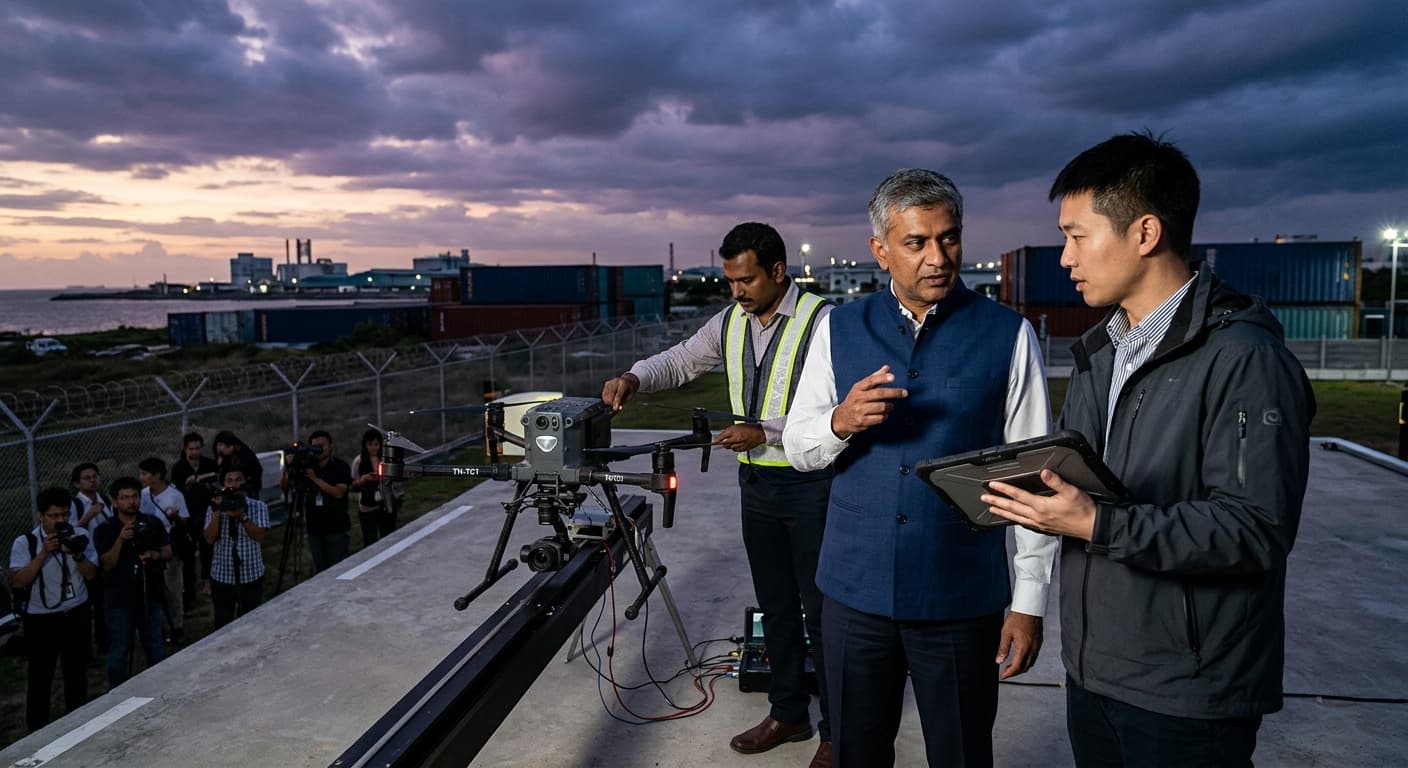
The architecture for this partnership was laid out in granular detail at the Taiwan-India Investment Partnership Forum in Taipei on June 2, 2026. Gaurav Daga, senior vice president of the Tamil Nadu Investment Promotion Agency, presented a blueprint for a decentralized drone production ecosystem across three southern Indian cities — each with a distinct specialization.
Chennai, the state capital and already home to several Taiwanese electronics firms, is being developed as a hub for avionics and electronics production. Hosur, on the Karnataka-Tamil Nadu border, is emerging as India's primary base for mass production of drone airframes. Coimbatore, a long-established precision-engineering city, is building expertise in advanced machinery and heavy tooling components. Taipei Times
This geographic logic matters. Tamil Nadu has one of India's two designated Defence Industrial Corridors — the other is in Uttar Pradesh — and has attracted investment commitments exceeding ₹9,000 crore with 29 signed MoUs as of October 2025. Press Information Bureau, Government of India The state already anchors a significant share of India's electronics manufacturing ecosystem, hosting Foxconn facilities and semiconductor design centers. The drone-corridor proposal piggybacks on infrastructure that already exists.
The regulatory framework, however, imposes a clear constraint: under DGFT Notification No. 54/2015-2020, India prohibits the import of fully assembled drones in CBU/CKD/SKD form, with exceptions only for R&D, defense, and security purposes. Drone components can be imported freely. WTO Import Licensing Portal This means a traditional export model — finished Taiwanese drones shipped to India — is legally impossible. The only viable path is joint-venture integration, with Taiwanese component makers embedding directly into Indian assembly lines.
That constraint is, perversely, the proposal's greatest political asset. It forces the kind of deep industrial integration that makes the arrangement genuinely blockade-proof. Taiwanese firms cannot simply ship product; they must build facilities, train Indian workers, and transfer process knowledge. The result is not a supply line that can be severed at a chokepoint but distributed production capacity on Indian soil — geographically remote from the Taiwan Strait and shielded by India's nuclear deterrent.
The Political Calculus: Strategic Autonomy Meets the Double-12
The relationship between India and Taiwan has been deepening on a trajectory that, while unofficial, is no longer deniable. In 2024, Taiwan opened a new Taipei Economic and Cultural Center in Mumbai — its third representative office in India after New Delhi and Chennai. In May 2026, a cross-party delegation of Indian MPs visited Taiwan for a formal six-day program. CSIS
Taiwan's "Double-12 Initiative," launched in 2025, explicitly identified India as one of 12 non-diplomatic-partner nations critical to its future. Bilateral trade reached a historic high of US$12.5 billion in 2025. CSIS Taiwan has also been India's quiet partner in semiconductor development — Tata Electronics' US$11 billion fabrication plant in Dholera is being built with technology from Taiwan's Powerchip Semiconductor Manufacturing Corporation (PSMC).
Al Jazeera
But the critical political signal came in 2025. After Chinese Foreign Minister Wang Yi visited New Delhi, a Chinese readout claimed India had agreed that "Taiwan is a part of China." India's Ministry of External Affairs swiftly and publicly contradicted the claim, refusing to endorse the One China Principle — a position New Delhi has now maintained for over a decade. CSIS As Brookings scholar Tanvi Madan observed, India's restraint on Taiwan is "unlikely to be reciprocated by China on territories that India considers its own, such as Kashmir."
Brookings
This is the strategic logic that makes the drone corridor viable. India is not being asked to become a treaty ally of Taiwan — a step that would violate its foundational doctrine of strategic autonomy. It is being asked to accept Taiwanese commercial investment in a dual-use manufacturing sector, framed as supply-chain de-risking and "Make in India" industrial policy. GPS modules, AI chips, and autopilot sensors are industrial tech, not weapons systems. The arrangement respects India's diplomatic red lines while serving both parties' security interests.
Why Taiwan Cannot Build the Hornet's Nest Alone
Taipei's domestic drone ambitions are real but constrained by politics and geography. President William Lai Ching-te has called the drone build-up "a national defence project that is a race against time." Al Jazeera His government proposed a NT$210 billion (US$6.59 billion) drone procurement package through 2031, targeting surveillance, coastal-attack, and small unmanned surface drones.
Al Jazeera
Yet Taiwan's opposition-controlled legislature — the Kuomintang (KMT) holds a majority — has repeatedly constrained the government's spending. In May 2026, parliament passed only two-thirds of Lai's proposed US$40 billion special defense budget, and specifically struck domestic drone production from the budget, preserving funds only for US weapons systems. Al Jazeera As former general David Petraeus wrote in Foreign Affairs, "Taiwan's legislature struck domestic drone production from the government's special defense budget earlier this year... dramatically reducing new domestic procurement of unmanned systems."
Foreign Affairs
At the same time, the United States — still Taiwan's primary arms supplier — put a US$14 billion arms sale on hold in May 2026 to preserve munitions for its own conflict with Iran. Al Jazeera The American security umbrella, long treated as a given, is showing strain on multiple fronts simultaneously.
The operational problem is even more fundamental. Even if Taiwan's legislature fully funded domestic drone production, the island's geography imposes hard limits. A wartime blockade would sever imported-component supply chains within days. On-island production facilities would be priority targets. The "hornet's nest" metaphor — thousands of cheap, attritable drones swarming an invading force — requires production volume and depth that a single-island economy cannot sustain under fire.
Ukraine demonstrated this. Its drone industry survived Russian bombardment because production was distributed across the country and backed by components flowing through Poland's land border. Taiwan has no land border.
India is not Poland. But India offers something Poland cannot: a manufacturing base located 4,000 kilometers from the Taiwan Strait, inside a nuclear-armed state with its own territorial dispute against China along a 3,488-kilometer border where 20 Indian soldiers died in 2020.
Discover more
Global Politics
Xi Jinping Calls China-Russia Ties 'Precious'
Xi Jinping's description of China-Russia ties as 'precious' reflects a strategic imbalance, with Beijing dictating terms in the partnership.

India
Yamini Aiyar on Modi's Federalism Shift
Yamini Aiyar critiques Modi's shift from equity-based to performance-based federalism, highlighting implications for India's political landscape.
US Politics
House Ethics Committee Pushes Sexual Miscond.
The House Ethics Committee has shifted responsibility for sexual harassment settlement records to the Office of Congressional Workplace Rights, complicating disclosure efforts.

Conflict & Security
Drone Warfare Killing Aid Workers at Unprec
Over 1,000 humanitarian workers killed in three years as cheap armed drones collapse legal protections. Gaza, Sudan, Ukraine, and DRC see deliberate targeting of aid convoys and hospitals with zero prosecutions.