Taiwan's New Maritime Doctrine Against China
Taipei sets legal thresholds for maritime responses to Beijing.
Model Diplomat10 min readAsia
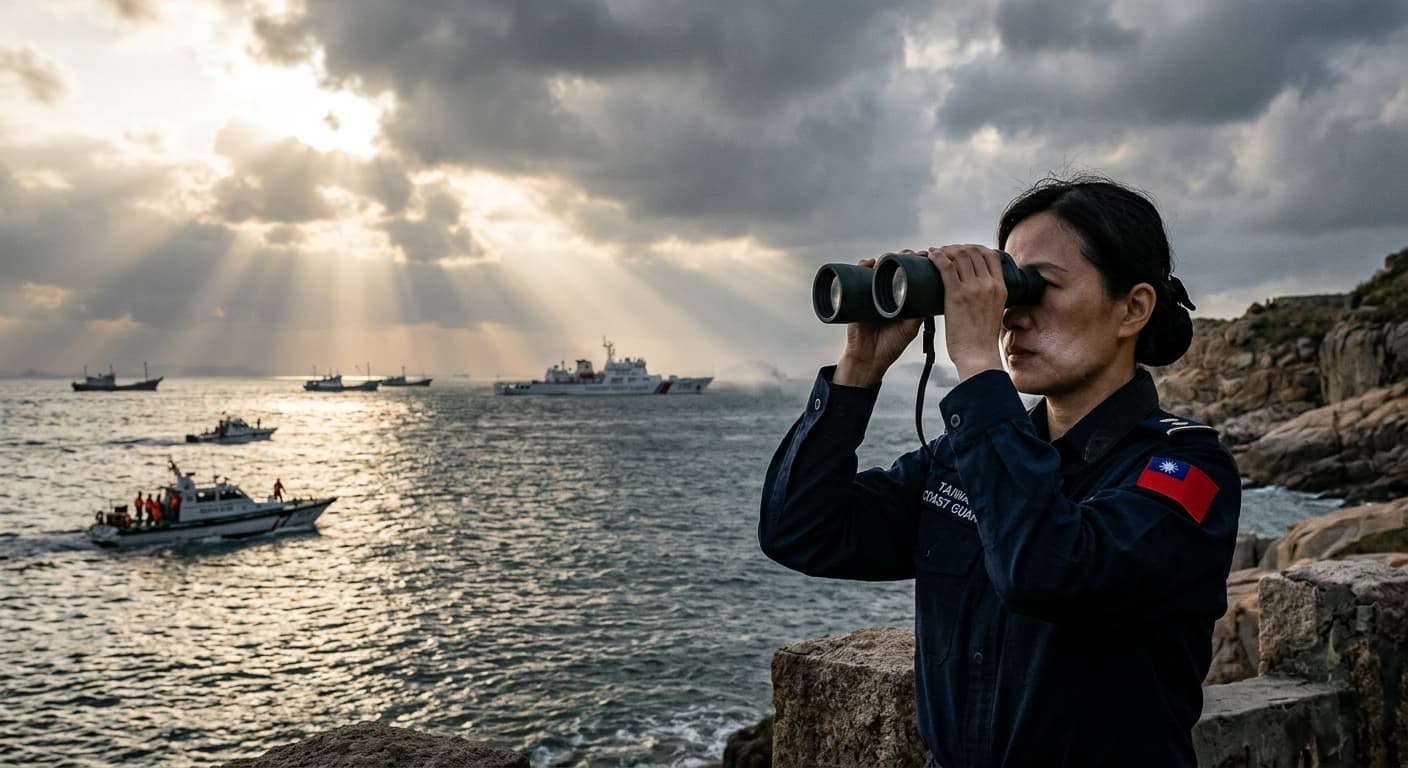
Taiwan Draws Maritime "Yellow and Red Lines" as China Encircles
Taipei's 2026 Ocean Forum turns Beijing's gray-zone playbook — from severed cables to a Pacific missile test — into a coalition test case for UNCLOS.
Taiwan's government on July 8, 2026, told visiting parliamentarians from 15 countries that it will draft explicit "yellow line" and "red line" thresholds for responding to Chinese maritime coercion — a doctrinal shift that reframes gray-zone harassment as a legal question rather than a military one, and hands allied capitals a template to act on before an incident escalates. The move, announced at the 2026 Taiwan Ocean International Forum, lands 48 hours after China fired a submarine-launched ballistic missile from the South China Sea into the South Pacific and weeks into a continuous China Coast Guard (CCG) presence east of Taiwan. The bet: that codifying tripwires, backed by UNCLOS and G7 language, is more usable deterrence than scrambling frigates.
What Taipei announced, and why now
At the forum organized by the Ocean Affairs Council (OAC), Minister Kuan Bi-ling said Taiwan needs "clear yellow/red line" criteria to judge gray-zone intrusions and cue proportional responses, according to the Liberty Times. National Security Council Deputy Secretary-General Li Wen framed the effort as a coalition play — Taiwan working with "friendly allies" to keep sea lanes open under the UN Convention on the Law of the Sea. OAC Deputy Minister Sung Cheng-en, in a separate briefing the same day, characterized Beijing's expanded coast guard patrols as "illegal expansion in the form of harassment" and rejected China's implicit claim of "long-arm jurisdiction" over waters east of the island, per the
Liberty Times.
The audience mattered. Jan Paternotte, Dutch co-chair of the Inter-Parliamentary Alliance on China (IPAC), told President Lai Ching-te on July 7 that IPAC's 300-plus legislators from 45 countries would use the forum to advance the group's "MIST" action plan and its "Resolution 2758 initiative" — the campaign to deny Beijing's claim that the 1971 UN seating resolution settled Taiwan's status. President Lai, in the Presidential Office readout, called for a "free, open and safe ocean," specifically thanked the G7 for its June 2026 restatement of the same formula, and disclosed that the "gray-zone intrusion" and "high-intensity maritime coercion" scenarios had already been run as tabletop exercises inside his Whole-of-Society Defense Resilience Committee. That is the sequencing to note: the doctrine is being announced only after it has been war-gamed inside the Presidential Office.
The doctrine shift: from scramble to sanction
Taipei's "yellow/red line" language is not rhetorical. It is an answer to a specific critique that Brookings scholars Ryan Hass and Stephen Tan set out in March 2026: that Taiwan has been "responding to gray zone coercion in counterproductive ways" — scrambling F-16s and frigates at each CCG intrusion, exhausting readiness while Beijing pays no cost. Their prescription: shift to asymmetric, pre-authorised responses — sanctions, entity-list designations, unmanned surveillance — triggered when China crosses defined lines. Brookings notes that China "violated Taiwan's territorial airspace with a military drone for the first time in January 2026," a benchmark that under the old posture required a manned fighter response and under the new doctrine would trigger a cheaper, pre-planned answer instead.
Kuan's yellow/red framework operationalizes exactly that logic. It also mirrors CSIS's Geometry of Coercion study, which found that between January 2020 and December 2025 the daily average of distinct CCG vessels in Taiwan's near waters rose more than 500 percent, and daily incursions into Taiwan's second maritime security ring more than quadrupled. CSIS recommends "preauthorized response options" tied to spatial-temporal thresholds — the same grammar Taipei is now adopting. A companion
CSIS Futures Lab study narrowed 11,895 vessels transiting near Taiwan in 2024 down to 128 likely gray-zone actors — a data-driven whittling that gives Taiwan's yellow line an evidentiary spine rather than a political one.
The domestic scoreboard is starker still. The CSIS overview of PLA activity recorded 3,075 PLA aircraft sorties into Taiwan's ADIZ in 2024 — an 81 percent jump on 2023 — and the IISS
Taiwan lawfare tracker found PLA aircraft crossed the median line an average of 122 times per month in 2024, with 256 ADIZ intrusions per month on average. The CSIS 2025
white-paper analysis added a Kinmen–Matsu number that clarifies the political stakes: 679 documented unauthorized CCG transits of restricted waters around Kinmen and Matsu in 2024, described by Beijing as "normalized law enforcement operations." Taipei's task is to break precisely that "normalization."
The legal scaffolding was already tested. On June 12, 2025, the Tainan District Court sentenced the Chinese captain of the Togolese-flagged Hong Tai 58 to three years for severing the Taiwan-Penghu No. 3 subsea cable, according to the BBC. The Taiwan High Court Tainan Branch upheld the sentence on August 29, 2025 — Taiwan's first cable-sabotage conviction, delivered under Article 72(1) of the Telecommunications Management Act. As the
Prospect Foundation's Huang-Chih Chiang noted, the court grounded jurisdiction in UNCLOS Articles 2, 7 and 8, treating the Penghu Channel as Taiwan's internal waters. That precedent is what Taipei now wants to generalise: turn each gray-zone act into a triable offence at a defined threshold, rather than an ambiguous provocation. The Italian
IAI analysis tracked eleven cable-damage cases around Taiwan since 2023 — with only the Hong Tai 58 producing a conviction, and even that one failing to satisfy the "intent to endanger national security" bar under Article 72(2). The evidentiary gap between what Taipei can prove and what it wants to deter is exactly the space the new thresholds are designed to close.
The trigger: a missile, an EEZ dispute, and a coast guard "operation"
Three converging events explain why the doctrine is being unveiled this week.
First, on July 6, China launched a JL-2 or JL-3 SLBM from the South China Sea into the South Pacific Nuclear Free Zone — the first time it has done so, according to CSIS. The 7,300-km trajectory likely overflew the Philippines. Beijing gave "mere hours" of pre-notice to the U.S. and Japan and 23 hours to Australia, in violation of the Hague Code of Conduct against Ballistic Missile Proliferation, which China has not ratified. Australia, New Zealand and Japan issued rebukes,
Al Jazeera reported; the launch coincided with Canberra's new security pact with Fiji, prompting the
United States Studies Centre to call it explicit "intimidation" of Pacific island signatories. CSIS emphasises that this was Beijing's "first time" advertising a strategic nuclear deterrent launched from a nuclear-powered submarine into the Indo-Pacific — a signalling escalation directed at the same G7 capitals whose maritime language Taipei is now trying to convert into operational commitments.
Second, Japan and the Philippines opened maritime-delimitation talks for their overlapping EEZs east of Taiwan. Beijing declared the negotiations a "severe violation" of its rights and, per the June 29 MFA briefing cited by Chinese state media, launched a "special maritime traffic law-enforcement operation" east of Taiwan on June 6–10. As the American Enterprise Institute's
China–Taiwan Update documented, PRC coast guard vessels have patrolled east of Taiwan almost continuously since June 1, and the Ministry of Natural Resources deployed the Xiang Yang Hong 22 research ship for a June 16–18 "environmental survey" — the pattern China used before formalising claims in the South China Sea. AEI's assessment is blunt about the operational payoff: expanding CCG jurisdiction east of Taiwan would "free up PLA Navy assets for other missions in the Pacific," letting Beijing normalise a permanent presence beyond the first island chain during a blockade contingency.
Third, Beijing is now treating the waters east of Taiwan as an extension of its own EEZ. Foreign Ministry spokesperson Guo Jiakun on June 29 declared that "China enjoys exclusive economic zone and continental shelf rights in the waters east of Taiwan Island," a claim Taipei's OAC calls "illegal expansion by harassment." India's MP-IDSA noted this development directly targets Taiwan's pre-existing fisheries agreements with Tokyo and Manila, and reported that a CCG ship and a survey vessel carried out their "first coordinated operation" in the South China Sea against Taiwan-held territory on June 6, 2026 — a template being road-tested at Pratas as much as east of the main island. The Observer Research Foundation's July 6
analysis frames Pratas as the CCG's "next Scarborough" — geographically isolated, symbolically valuable, and easier to encircle without triggering U.S. treaty obligations.
The coalition play — and why it is fragile
Li Wen's pitch to IPAC is that thresholds only deter if partners share them. That is a live experiment. The June 17, 2026 G7 leaders' statement explicitly opposed "unilateral attempts to change the status quo, in particular by force or coercion, in the East and South China Seas and across the Taiwan Strait." The
G7 Foreign Ministers' Declaration on Maritime Security and Prosperity, adopted March 14, 2025 in Charlevoix, went further:
"We share a growing concern at recent, unjustifiable efforts to restrict such freedom and to expand jurisdiction through use of force and other forms of coercion, including across the Taiwan Strait ... We condemn China's illicit, provocative, coercive and dangerous actions that seek unilaterally to alter the status quo."
The Charlevoix text also reaffirms the 2016 South China Sea arbitral award as "legally binding" — the 10-year anniversary of which falls this week, a fact Paternotte flagged in Taipei. That anniversary is not decorative: it is the strongest existing precedent for a UNCLOS tribunal ruling against Chinese maritime claims, and IPAC intends to use the week to keep it politically alive. The Niagara G7 foreign ministers' statement went further still, endorsing G7 coordination against "hybrid threats, including activity against critical undersea infrastructure" — a phrasing tailored to the Hong Tai 58 case.
Operationally, the U.S. NDAA for FY2026 authorises deepened U.S. Coast Guard training with Taiwan's Coast Guard Administration, and a joint program to co-develop uncrewed and counter-uncrewed capabilities, according to the INDSR Defense Security Brief. Congress is also moving S. 2222, the
Critical Undersea Infrastructure Resilience Initiative Act, which names the Hong Tai 58 and Shunxin 39 incidents in its findings and directs U.S. cooperation with Taiwan on cable protection. The Atlantic Council
proposes modelling joint U.S.–Taiwan coast guard patrols on the U.S.–Palau agreement — inside Taiwan's 24-nautical-mile contiguous zone — which would answer the CCG's expansion east of the island with a physical Western presence, not just a communiqué.
The fragility is Manila and Africa. Kenya's June 2026 deportation of Taiwanese scholars headed to the UN Our Ocean Conference — an incident Al Jazeera reported drew Kuan's condemnation as "barbaric obstruction" — was a demonstration effect: Beijing can still shrink Taiwan's diplomatic space through third-country pressure, even as G7 statements harden. Philippine Defence Secretary Gilberto Teodoro's Shangri-La remark that Manila was "collaborating with Taiwan in non-taboo areas outside of diplomatic recognition" drew immediate Chinese demand that the Philippines "rein in" its officials, per
MP-IDSA. Whether the "yellow line" doctrine survives contact with a hesitant Filipino or Japanese partner in a real incident is the open question.
There is a second-order effect worth naming. The CSIS Futures Lab framework proposes an allied "Coalition Joint-Maritime Anomaly Cell" — a shared ISR fusion node — that would publish suspect-vessel alerts in near-real time. If Kuan's yellow line thresholds map to that cell's anomaly feed, Taiwan's doctrine effectively becomes the operational trigger for U.S., Japanese and Philippine intelligence-sharing. That reverses the usual pattern in which Taipei is the recipient of allied intelligence: for the first time, Taipei's legal categories would set the tempo for allied response.
Diplomat View
Taipei's yellow/red line doctrine is the most consequential shift in Taiwan's maritime posture since the 2018 coast guard buildup. Not because it changes the correlation of forces — Taiwan's coast guard remains outnumbered by a CCG that is now the world's largest, and CSIS notes that Beijing could stage a selective quarantine that international law struggles to answer — but because it moves the response ladder from military discretion to codified policy, and pulls in allied enforcement mechanisms designed for Russia's shadow fleet.
The forecast: if Kuan's OAC publishes concrete thresholds before the October 2026 Legislative Yuan session, and if at least one of the U.S., Japan or the Philippines mirrors them with pre-authorised joint patrols or sanctions triggers, Taiwan will have shifted the cost curve for at least one class of gray-zone action — likely cable sabotage and CCG boarding of Taiwanese fishing vessels. If the thresholds remain rhetorical, or if Manila declines to co-sign, Beijing's EEZ claim east of Taiwan will harden into a fait accompli by mid-2027, mirroring the Scarborough Shoal pattern of 2012–2016. What would revise the forecast: a public U.S.–Taiwan joint coast guard exercise inside Taiwan's contiguous zone, of the type the Atlantic Council's Palau-modeled proposal has advocated. That would signal Washington has bought the doctrine.
What to watch
- July 9, 2026 — Day two of the Ocean Forum: whether the OAC releases a written yellow/red line framework or defers to a later white-paper update.
- July 12, 2026 — Tenth anniversary of the South China Sea arbitral award; IPAC's "Resolution 2758 initiative" launch event in Taipei is a key marker of parliamentary support.
- August–September 2026 — Watch for a follow-on China Coast Guard "law-enforcement operation" east of Taiwan; the AEI tracking suggests a monthly pattern is forming.
- Q4 2026 — U.S. Senate floor action on S. 2222 (Critical Undersea Infrastructure Resilience Initiative Act) and any Taiwan-specific implementation of the FY2026 NDAA coast guard training authority.
The Bottom Line
Taiwan's yellow/red line doctrine is a legal weapon dressed as a policy paper: it converts each Chinese gray-zone act into a defined, sanctionable event and hands the G7 and IPAC a menu of pre-agreed responses. Taipei is betting that codified tripwires — anchored in UNCLOS, the Hong Tai 58 precedent, and G7 maritime security language — will deter what scrambled fighters cannot. If Washington, Tokyo and Manila synchronise their thresholds with Taipei's before the next cable is cut, the doctrine holds. If they do not, Beijing's next "law-enforcement operation" east of Taiwan will be treated as the new status quo.
Discover more

US Politics
White House Pressures Congress for Crypto Leg
The Trump administration's push for the CLARITY Act aims to reshape crypto regulation, impacting trillions in market value and the Trump family's wealth.
Global Politics
Xi Jinping Calls China-Russia Ties 'Precious'
Xi Jinping's description of China-Russia ties as 'precious' reflects a strategic imbalance, with Beijing dictating terms in the partnership.

US Politics
House Ethics Committee Pushes Sexual Miscond.
The House Ethics Committee has shifted responsibility for sexual harassment settlement records to the Office of Congressional Workplace Rights, complicating disclosure efforts.

Economics
Fed's Amex AML order puts correspondent banking on notice
Federal Reserve's Amex AML order requires board-level controls and a 90-day plan; OCC fined the bank $350 million over enterprise-wide deficiencies.