Taiwan's GB300 Bust and US AI Chip Controls
Taiwan enforces US semiconductor export controls amid smuggling case.
Model Diplomat8 min readAsia
Taiwan's GB300 Bust Exposes the Hole in US AI Chip Controls
Taipei's investigation of 50 smuggled Nvidia GB300 AI servers routed to China via Japan and Hong Kong has made Taiwan — not Washington — the frontline enforcer of US semiconductor export controls.
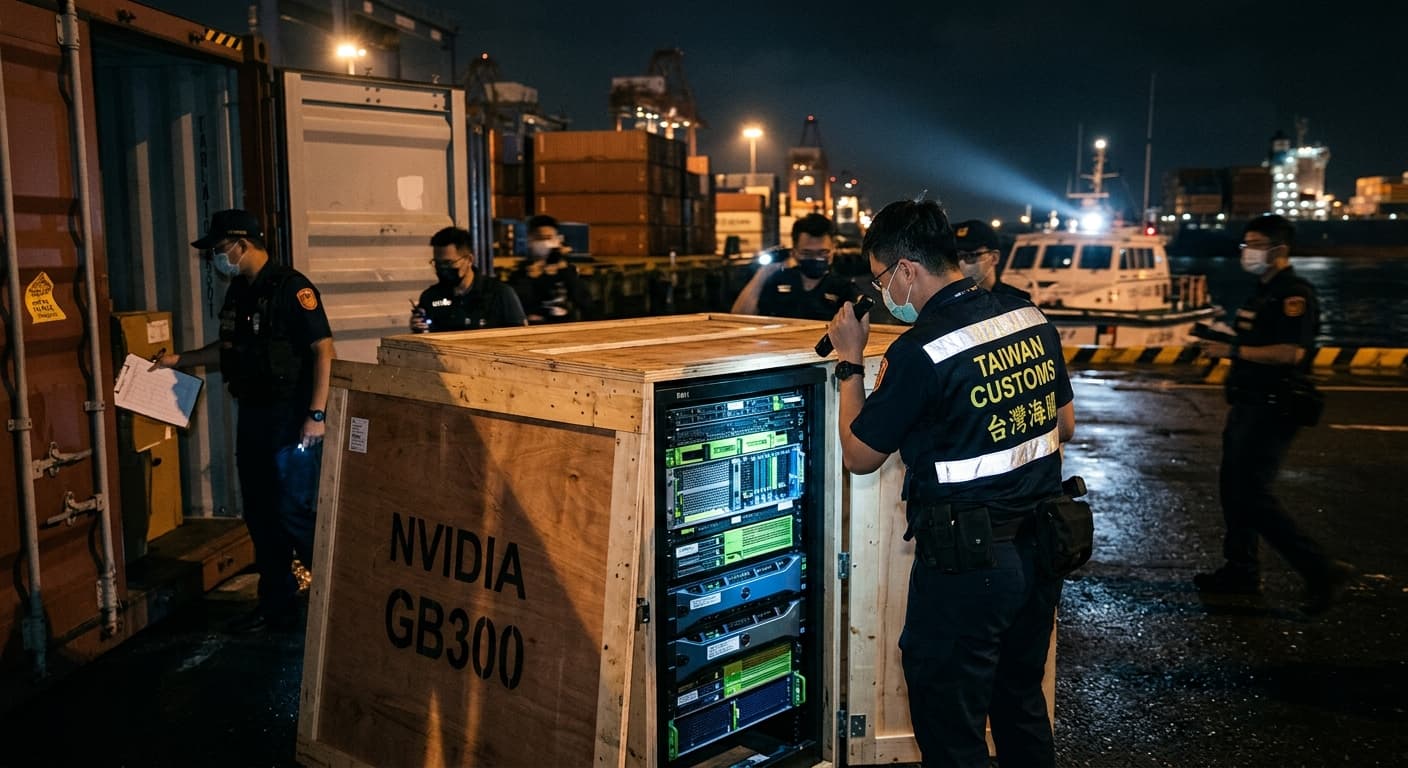
Taiwanese prosecutors seized 50 Nvidia GB300-equipped AI servers worth NT$700 million (about US$24 million) from a Keelung warehouse on May 20, 2026, and by July had detained three executives — including the general manager of Nvidia distributor Aaeon Technology — on charges of forging documents to divert Blackwell-generation systems through Japan and Hong Kong into mainland China. The bust is the most concrete evidence to date that Taiwan has quietly become the enforcement backbone of the US AI export-control regime, filling a gap Washington opened when it began licensing lower-tier Nvidia chips to Beijing in exchange for a revenue cut while leaving the top-end Blackwell family formally banned. The GB300 is precisely the chip the Trump administration refuses to sell to China. It is also the chip Chinese buyers most need — and the one Taipei is now prosecuting its own citizens to keep out of Chinese hands.
What the Keelung file actually shows
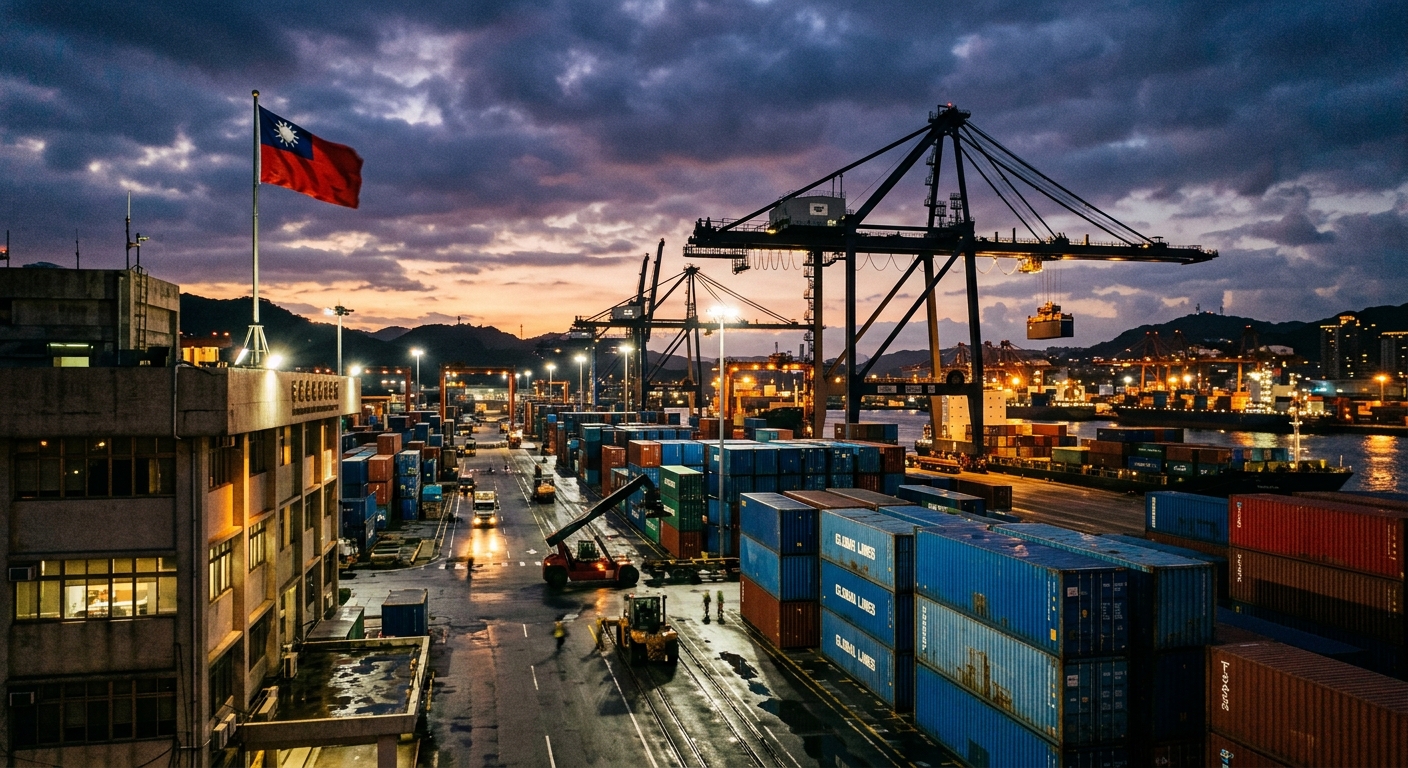
The Keelung District Prosecutors' Office moved in two waves. On May 20, investigators executed search warrants at 12 locations tied to three suspects — surnamed Yu, Wang and Chen — and recovered the 50 GB300 servers plus more than NT$9 million (about US$310,000) in cash, according to Vision Times, which reconstructed the case from Liberty Times and Taipei Times reporting. Prosecutors believe at least one shipment already reached the mainland via a Keelung–Japan–Hong Kong routing before the seizure.
On June 29, the Financial Times reported that Coast Guard investigators raided Super Micro's Asia-Pacific headquarters in New Taipei City, along with the offices of Aaeon Technology — a Nvidia-authorised Supermicro distributor — and telecom-services firm Chief Telecom. Aaeon's general manager, Lu Yang-kai, and two Super Micro sales staff were ordered into pretrial detention without visitation. Super Micro confirmed to Reuters, republished by
WHTC, that two of its Taiwan employees had been detained and two others released on bail.
The charges under review are document forgery and breach of trust under Taiwan's Criminal Code — but the operative statute in the background is Article 13 of the Foreign Trade Act, which prohibits unlicensed export of Strategic High-Tech Commodities and gives the Ministry of Economic Affairs authority to block transshipment through Taiwanese ports, transit zones and bonded warehouses. Taiwan added Huawei and SMIC to its own SHTC entity list on June 10, 2025, a move Taipei's Institute for National Defense and Security Research characterises as deliberate alignment with US policy.
Why the GB300 is the tell
The chip at the centre of this case is not a legacy H100 or a downclocked H20. The GB300 is the flagship of Nvidia's Blackwell Ultra generation — a server-scale system that pairs Grace CPUs with two B300 GPUs, delivering roughly an order-of-magnitude jump over the H100 for large-model training. A Council on Foreign Relations analysis notes that 35,000 GB300 chips alone — the volume the United States plans to sell to the UAE in 2025 — is equivalent in AI processing power to half of all Huawei AI chips produced in China this year.
Blackwell exports to China are banned outright. Al Jazeera reported on June 1 that the Bureau of Industry and Security formally extended that ban to PRC-headquartered companies operating outside China — closing what former State Department official Chris McGuire had publicly called a "loophole" for offshore Chinese entities.
That is why the Keelung 50 matter. Fifty GB300 servers in one warehouse in one Taiwanese port town represent the compute of roughly 400 H100-class GPUs and cannot be replaced by anything China currently manufactures at scale. Each server is not a chip; it is a rack-scale AI system. This is not petty diversion — it is precisely the tier of hardware US controls are designed to block.
Washington's policy contradiction — and Taipei's fix
The uncomfortable subtext of the Taiwan case is that US policy has become internally incoherent, and Taipei is doing the enforcement heavy lifting to compensate.
In August 2025, BIS approved sales of Nvidia's H20 and AMD's MI308 chips to China under an arrangement giving the US government 15% of proceeds, according to a January 2026 Congressional Research Service report. In December 2025, President Trump extended that approach to the more powerful H200. On January 15, 2026, BIS promulgated a new case-by-case license rule for H200-class chips, and the White House proclamation imposed a
25% Section 232 tariff on those exports. A CRS legal sidebar flagged that the arrangement may
conflict with 50 U.S.C. §4815(c), which prohibits BIS from collecting fees "in connection with" export licences, and with Article I, Section 9 of the Constitution barring export duties.
Blackwell and GB300, however, remain fully controlled. The result is a two-tier regime that a June 2026 MIT Center for International Studies analysis argues is impossible to police without allied enforcement: the US collects tariffs on legal H200 flows to China while the illegal Blackwell market — where margins are highest — runs on document forgery and transshipment.
The Government Accountability Office, in its 2025 report GAO-25-107386, documented compliance challenges BIS itself acknowledges — including limited visibility into re-export chains once controlled items leave US soil. A
Center for a New American Security estimate concluded that smuggled chips likely made up between 1% and 30% of the compute China acquired for AI inference in 2024, with a median estimate of 6%. BIS's fiscal 2025 enforcement budget was US$191 million — less than the profits from a single reported smuggling case.
Taiwan has filled that gap. The Keelung Coast Guard Investigation Unit, coordinating with the Ministry of Economic Affairs, has moved with a speed and specificity that Washington's own indictments have not matched. Where the US Department of Justice case against Super Micro co-founder Wally Liaw took nearly two years to build and still leaves one defendant a fugitive, Taiwan's prosecutors seized the goods in transit and had a distributor's general manager in custody within six weeks.
Who benefits, who loses
The clearest winner is Nvidia's compliance narrative. Jensen Huang has spent 2025 and 2026 lobbying to sell more chips to China legally, arguing — as he told the BBC after the H200 approval — that keeping Chinese labs on American silicon is the best defence of US technological leadership. Every Taiwanese prosecution of a diversion ring lets Nvidia say, credibly, that the illicit path is closing and that licensed sales are the only viable route. An Nvidia spokesperson told
Al Jazeera in March that "unlawful diversion of controlled US computers to China is a losing proposition across the board."
Losers are more numerous. Super Micro shares dropped roughly 8% on the June 29 raids, per the FT, after having already fallen 33% on the March indictment. Aaeon Technology hit limit-down for two consecutive sessions and its general manager was suspended. Chief Telecom faces reputational exposure despite its statement that operations continue normally. And Taiwan's mid-tier server distributors — the ecosystem that grew fastest during the 2023–2025 AI capex boom — now face a compliance regime where a single forged end-user certificate can end a career.
Beijing loses optionality. The CSIS AI Policy Podcast noted in March that Chinese buyers had until recently treated Taiwan as a soft transit route relative to Singapore, where police in October 2025
seized a US$42.5 million mansion linked to a US$390 million Nvidia-server fraud. Taipei's willingness to prosecute its own executives closes the last convenient transshipment corridor in East Asia.
The parallel case that reframes this one
The Keelung investigation is not isolated — it is the Asian mirror of the New York indictment. In March 2026, the US Attorney for the Southern District of New York, Jay Clayton, unsealed charges alleging that a Super Micro co-founder, a Taiwan-based sales manager, and a contractor moved US$2.5 billion of AI servers to China through a Southeast Asian pass-through firm, using hair dryers to swap serial-number labels between real and dummy machines to defeat audits. The BBC reported that Ting-Wei Sun and Wally Liaw were arrested in California; a third defendant remains a fugitive.
Read together, the two cases suggest a persistent, professionalised diversion architecture built around Super Micro's Taiwan supply chain. The same New Taipei City address the Coast Guard raided in June is where the DOJ's Company-1 counterparties are believed to operate. That is not coincidence — it is the operational geography of the Blackwell black market.
Diplomat View
Taiwan's Nvidia investigation should be read as a strategic act, not a criminal one. Taipei is demonstrating, in ways Washington increasingly cannot, that it will enforce US export controls even at the cost of humiliating its own listed companies. This buys leverage in three places: with a Trump administration mulling further chip-tariff carve-outs; with a Congress that wields the CHIPS Act appropriations; and with Beijing, which now has clear evidence Taipei will criminalise Chinese-bound diversion in real time. The forecast: expect the Keelung case to produce indictments under Article 13 of the Foreign Trade Act within 90 days, and expect BIS to cite Taiwanese enforcement as justification when it resists calls to loosen Blackwell controls in the next US–China trade round. What would change this call: any signal from Taipei's incoming economics minister that SHTC penalties will be reduced, or a Trump executive order authorising licensed GB300 sales to China. Absent either, Taiwan is now the binding constraint on China's access to frontier AI compute — a role Washington did not assign, and cannot easily revoke.
What to watch next
- Late July 2026: Keelung District Court decisions on continued detention of Aaeon GM Lu Yang-kai and the two Super Micro sales staff; formal indictment under Foreign Trade Act Article 13 would signal escalation beyond ordinary fraud charges.
- August 4, 2026: Next Singapore court hearing in the Aperia Group / Alan Wei money-laundering case; a conviction of corporate entities under fraud statutes would set precedent across the region.
- September 2026: BIS scheduled review of H200 export licences and possible Blackwell-tier decisions; watch whether Taipei's enforcement record is invoked as grounds to maintain the GB300 ban.
The Bottom Line
Taiwan's prosecution of 50 smuggled Nvidia GB300 servers is not a local corruption case — it is the moment Taipei formally took over the enforcement of America's most consequential technology-control regime. As long as the Trump administration keeps loosening rules on H200-class chips while banning Blackwell, the Keelung District Prosecutors' Office, not the Bureau of Industry and Security, is the agency deciding how much frontier AI compute reaches China.
Discover more

US Politics
US Launches $166B Tariff Refund Portal
The US is launching a $166 billion tariff refund portal to aid importers hit by Trump-era tariffs, with major implications for trade and supply costs.

US Politics
House Ethics Committee Pushes Sexual Miscond.
The House Ethics Committee has shifted responsibility for sexual harassment settlement records to the Office of Congressional Workplace Rights, complicating disclosure efforts.
India
Congress Accuses Modi of Stalling Women's Law
Congress accuses Modi of stalling women's reservation law by linking it to delimitation, revealing a deeper electoral strategy.

Economics
Fed's Amex AML order puts correspondent banking on notice
Federal Reserve's Amex AML order requires board-level controls and a 90-day plan; OCC fined the bank $350 million over enterprise-wide deficiencies.