Taiwan's Drone Gap: The 435-Ship Problem
Taiwan's push for drones faces funding cuts amid rising Chinese naval power.
Model Diplomat9 min readAsia
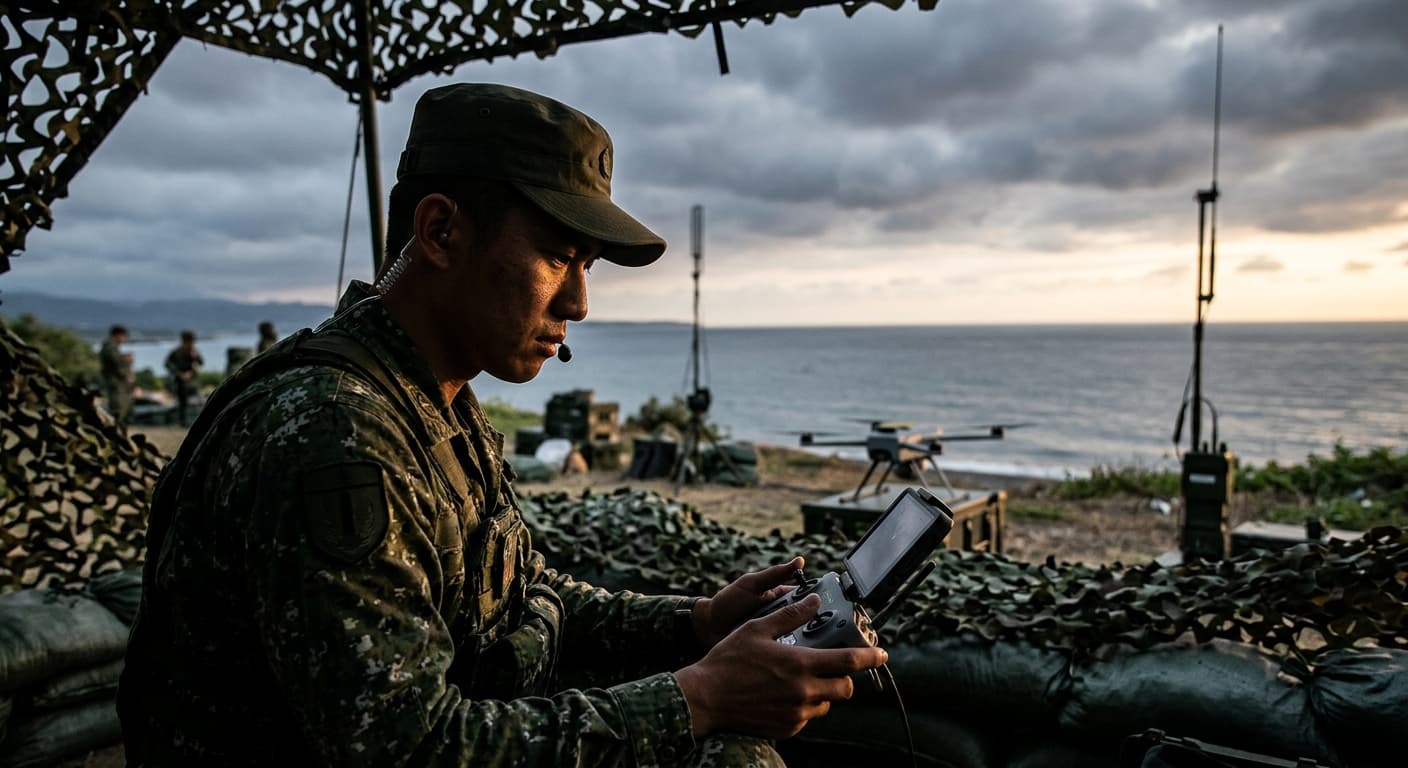
Taiwan's Drone Gap: The 435-Ship Problem Behind Taipei's Uncrewed Push
Taiwan's analysts want a drone-first answer to China's 435-ship navy by 2030. Its own legislature just cut the money. Here's what breaks next.
Taiwan's coast guard fields 167 patrol vessels to police the waters around Kinmen, Matsu, the Pratas and Itu Aba — against a China Coast Guard that already deploys more than 150 thousand-tonne-plus cutters and a People's Liberation Army Navy projected to grow from roughly 370 combatants today to 435 by 2030. That arithmetic, laid out by analyst Cathy Fang at the July 9 Taiwan International Ocean Forum in Taipei and reported by the Taipei Times, is why security researchers spent this week telling President Lai Ching-te's government to stop trying to match Beijing hull-for-hull and instead build an integrated fleet of uncrewed surveillance drones, surface craft and undersea vehicles. The awkward part: Taiwan's own Legislative Yuan spent the first half of 2026 stripping drone funding from the special defense budget that would have paid for exactly that.
The forum's message, in other words, was less a policy proposal than a public rebuke of Taipei's fiscal politics — delivered as Washington moves in the opposite direction, writing co-production of uncrewed systems with Taiwan directly into the FY2026 National Defense Authorization Act. For Taiwan, the gap between what its analysts recommend and what its legislature funds is now the single most consequential variable in Indo-Pacific deterrence.
The 435-ship problem
The numerical mismatch is the reason asymmetric doctrine exists. According to CSIS's ChinaPower project, PLA aircraft conducted 3,764 ADIZ incursions in 2025, up 22.4% year-on-year, while PLA Navy vessels averaged 221 sightings per month around Taiwan from May 2024 onward — a 42% jump over the 2022–24 baseline. A commentary published in the U.S. Department of Defense's Indo-Pacific journal documented that PLA warships around Taiwan
climbed from 112 in January 2023 to 200 in January 2025, with median-line sortie crossings hitting an all-time monthly high of 248.
The Ocean Affairs Council's own coast guard captain, Arthur Yang of the Sixth Offshore Flotilla, told the forum that China's ostensibly civilian research and survey vessels carry a military motive — mapping the seabed east of Taiwan to prepare anti-access denial against foreign navies steaming to Taiwan's aid. In other words, the pressure Fang described is not just a numbers game at the surface: it is layered reconnaissance designed to shape a future kill chain.
That pressure is now permanent. A CSIS Futures Lab report published earlier this year found that between 2020 and 2025, the daily average of distinct China Coast Guard vessels entering Taiwan's near waters rose by more than 500%, and incursions into Taiwan's second maritime security ring more than quadrupled. The Japan Institute of International Affairs added granular data on the Dongsha model: 18 Chinese vessels intruded in
77 separate incidents near Pratas in just the first quarter of 2025, up from 17 incidents in all of 2023.
| Category | China (PRC) | Taiwan (ROC) |
|---|---|---|
| Navy combatants, 2026 | ~370 | ~26 principal surface combatants |
| Navy combatants, 2030 | ~435 | n/a |
| Coast guard (1,000t+) | 150+ | 167 (all sizes) |
| ADIZ incursions, 2025 | 3,764 | — |
| Avg. PLAN vessels/month, May 2024–Dec 2025 | 221 | — |
Fang's argument was that trying to keep pace one-for-one is a losing game — and an expensive one. Instead, Taiwan should deploy uncrewed aerial vehicles for detection and evidence collection, uncrewed surface vessels for security cordons, and autonomous underwater vehicles to monitor undersea cables, reserving crewed ships for enforcement. The logic is Ukrainian: raise the cost of Beijing's presence per contact, not per ship. Fellow panelist Benjamin Blandin of Taiwan's Institute for National Defense and Security Research argued that while the PLA has unveiled experimental arsenal ships, electronic-warfare barges and even a 3,500m-diving cable-cutting UUV, "most of these platforms remain in an experimental phase and possess more propaganda value than military utility" — a rare downward revision of Chinese capability from within Taipei's defense establishment.
The Ukraine template — and the doctrinal gap
The forum's recommendations sit on top of a doctrinal shift Taipei began after watching Ukrainian Magura V5 drone boats hunt Russian corvettes in the Black Sea. According to a Hudson Institute assessment by Can Kasapoglu, Taiwan is now building more than 1,300 uncrewed naval platforms from a Kuaiqi USV baseline developed by Lungteh Shipbuilding, plus a separate Endeavor Manta program from state-owned CSBC Corporation that pairs AI-assisted targeting with swarm control from a single station. Al Jazeera's reporting from the Su'ao Bay drone expo put the aerial-drone target at
15,000 dual-use units per month by 2028, with a 47,000-drone procurement window and a $21 billion backlog of U.S. orders that — per figures from Taiwan's DSET — would sustain "just four to five volleys" against the PLA in the opening phase of hostilities.
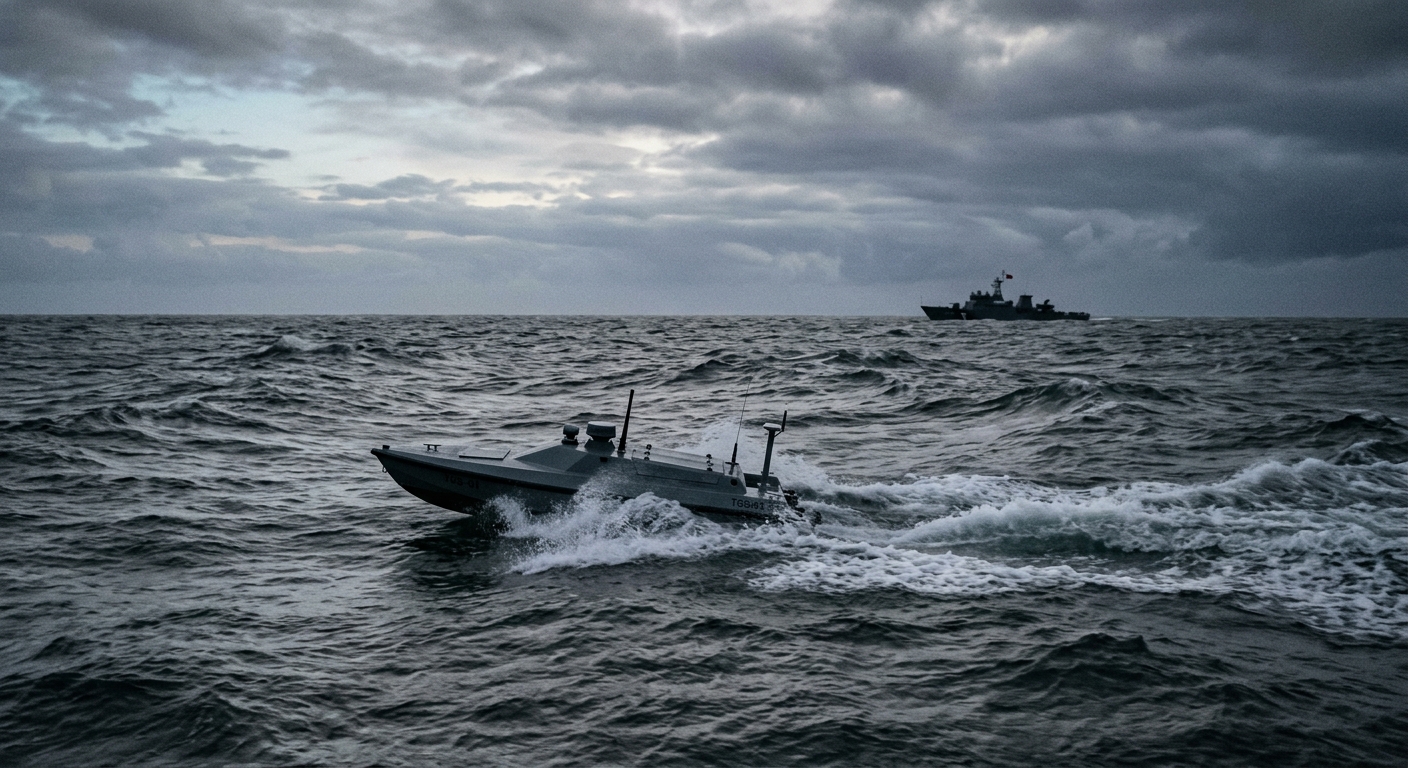
Those numbers still leave a gap that former CIA Director and retired General David Petraeus, in a Foreign Affairs essay this month, called the "Ukraine lesson Taiwan keeps missing." Petraeus noted that Ukraine produced roughly 4 million drones in 2025 alone — an order of magnitude beyond Taiwan's total planned inventory through 2028 — and that Taiwan's military has "not yet settled on a new doctrine for defense and deterrence that recognizes the contributions that unmanned systems could make." His verdict was harsher than the forum's: organizational structure, training pipelines, procurement and personnel policy remain calibrated for expensive manned platforms, meaning even the drones Taipei does buy will be poorly integrated when they arrive.
The Center for a New American Security's "Hellscape for Taiwan" report frames the operational concept in layers: long-range aerial, sea and undersea drones engaging PLA amphibious forces at 80 km out, then sea mines and one-way attack drones between 40 and 5 km, then short-range FPV drones inside the visual-range envelope. As CNAS argues, this is a Taiwanese concept, not an American one — U.S. forces would need longer-range, more expensive drones to compensate for basing distance, while Taiwan can exploit its jagged coastline to launch cheap systems from coves and small ports. RAND estimated in 2023 that Taiwan could procure
1,000 Ukrainian-style explosive USVs for roughly the cost of three F-35s — a rounding error against the annual defense budget.
There is a demographic argument buried underneath the operational one. Taiwan's Institute for National Defense and Security Research warned in its June 2026 Defense Security Brief that Taiwan entered "super-aged society" status in early 2026, shrinking its conscription-age pool at the exact moment Beijing is scaling for volume. Uncrewed systems are not a luxury layered on top of manpower — they are the workaround for manpower Taiwan will not have.
The money Taipei will not spend
Here is where the forum's exhortations collide with fiscal reality. On November 25, 2025, President Lai announced a US$40 billion, eight-year special defense budget that would have raised defense spending to 3.3% of GDP in 2026 and 5% by 2030. The plan bundled funding for 200,000 unmanned systems, domestic drone industry investment, and Lai's "T-Dome" integrated air and missile defense concept, according to Brookings' analysis by Craig Kafura.
The opposition-controlled Legislative Yuan blocked the bill at least eight times between December 2025 and February 2026. On February 1, the Kuomintang and Taiwan People's Party pushed through a slimmed alternative capped at roughly US$12.7 billion — a 70% cut to the original, stripping out T-Dome and much of the domestic drone procurement. AEI's Dan Blumenthal, tracking the March 23–26 joint committee hearings, concluded that opposition versions "only fund conventional procurements and
omit funding for large-scale drone procurement and IAMD systems." NPR reported in January that KMT caucus whip Fu Kun-chi framed the Lai plan as a "blanket authorization"
without adequate legislative oversight — a fiscal-discipline argument that, whatever its merits, doubles as a political brake on the DPP's flagship defense program.
In June, Al Jazeera reported that Taiwan's defense ministry was proposing a fresh NT$210 billion (US$6.64 billion) package specifically for surveillance and small unmanned surface drones — a bid to route around the February cuts using a narrower, harder-to-block bill.
The political fight has an external audience. Raymond Greene, director of the American Institute in Taiwan and Washington's de facto ambassador, publicly told Taipei on July 2 that it needed to become a "hornet's nest" of drones — an unusually direct intervention timed a week before the Ocean Forum. Washington's read is that legislative delay signals a lack of resolve — and threatens the co-production architecture the U.S. just signed into law.
What the NDAA actually locks in
Section 1237 of the FY2026 NDAA, passed by the Senate as S.2296, directs the Department of War to "engage with Taiwan to develop a joint program to co-develop and co-produce uncrewed and counter-uncrewed systems capabilities." A parallel provision authorizes deepened U.S. Coast Guard training with Taiwan's Coast Guard Administration on maritime security and law enforcement, per the
Senate Armed Services Committee summary. Section 1243 adds an invitation for Taiwan to observe RIMPAC; Section 1242 establishes a "strategic partnership on defense industrial priorities" that lawyers on both sides read as the legal shell for supply-chain integration.
"Directs the Department of Defense to engage with Taiwan to develop a joint program to co-develop and co-produce uncrewed and counter-uncrewed [systems]." — Senate Armed Services Committee, FY2026 NDAA Executive Summary
This is the primary document the Ocean Forum's recommendations effectively lean on. Washington is offering Taipei industrial co-production of exactly the systems the forum wants deployed — and Taipei's opposition legislature has cut the appropriations that would fund the Taiwan side of the co-production. The named winners so far are U.S. software firms Auterion and Shield AI, which signed MOUs with NCSIST in mid-2025 to embed autonomy software into up to 25,000 Thunder Tiger FPV drones. The named loser is Taiwan's own drone-manufacturing base, which — as Petraeus observed — cannot scale for a customer that will not commit to buying its products.
RSIS scholar Janet Fung has argued that Beijing already views Taiwan's drone expansion — particularly integration of the four MQ-9B SeaGuardian maritime surveillance drones due to begin arriving in 2026 — as crossing a strategic red line, prompting intensified PLA electronic-warfare drills and swarm-jamming exercises. The second-order effect: every month Taipei delays its own uncrewed procurement, Beijing gets another month to close the counter-drone gap without paying a strategic cost.
Diplomat View
The forum's real news is not that Taiwan's analysts want more drones — they have said so since 2022. It is that they are now saying so publicly, from within government-adjacent institutions, while the DPP's flagship defense budget lies in pieces on the Legislative Yuan floor and Washington's ambassador openly frets about Taipei's resolve. The most likely near-term outcome is Lai's June NT$210 billion drone-only supplemental bill: narrower, harder to demagogue, and structured to give the KMT political cover to vote yes. The falsifying condition for this forecast is a fresh PLA blockade drill in Q3 2026 large enough to collapse the opposition's fiscal-discipline framing — at which point a compromise on the full T-Dome package becomes plausible.
The deeper bet is that Taiwan can compress in three years the industrial learning curve Ukraine walked in four years of active war. On current evidence — 1,320 planned USVs against Ukraine's 4 million drones a year — it cannot. Uncrewed systems will not close the 435-ship gap by 2030. What they can do is make each Chinese hull cost more per day of coercion, and buy Taipei enough time for U.S. co-production under NDAA Section 1237 to matter. That is the whole strategy. Everything else is politics.
What to watch next
- Q3 2026: Legislative Yuan vote on the MND's NT$210 billion drone-focused supplemental. Passage signals the KMT has absorbed Washington's pressure; another block signals the opposition is willing to run the risk.
- Late 2026: First MQ-9B SeaGuardian deliveries to Taiwan's east coast — Beijing's declared red line. Watch for a corresponding PLA counter-drone exercise, likely in the Bashi Channel.
- FY2027 NDAA markup (spring 2027): Whether Congress attaches appropriations — not just authorization — to Section 1237 co-production. Authorization without money is a press release.
The Bottom Line
Taiwan's analysts have converged on the right doctrine — integrated uncrewed surveillance and interdiction, crewed enforcement, Ukrainian tempo — but Taipei's own legislature has defunded the industrial base needed to execute it, even as Washington writes co-production into U.S. law. The 435-ship problem cannot be solved by matching hulls; it can only be raised in cost per Chinese contact. Whether Taiwan pays that bill in 2026 or waits for a PLA drill to force the vote is now the single most consequential question in Indo-Pacific deterrence.
Discover more
Global Politics
Xi Jinping Calls China-Russia Ties 'Precious'
Xi Jinping's description of China-Russia ties as 'precious' reflects a strategic imbalance, with Beijing dictating terms in the partnership.

US Politics
US Launches $166B Tariff Refund Portal
The US is launching a $166 billion tariff refund portal to aid importers hit by Trump-era tariffs, with major implications for trade and supply costs.

India
Women’s Reservation in India
India's 33% women's reservation law is enacted but won't take effect until after 2029 due to political setbacks and census delays.

Economics
Fed's Amex AML order puts correspondent banking on notice
Federal Reserve's Amex AML order requires board-level controls and a 90-day plan; OCC fined the bank $350 million over enterprise-wide deficiencies.