Taiwan's Diplomatic Strategy
Taipei shifts from defense to proactive global engagement.
Model Diplomat8 min readEast Asia
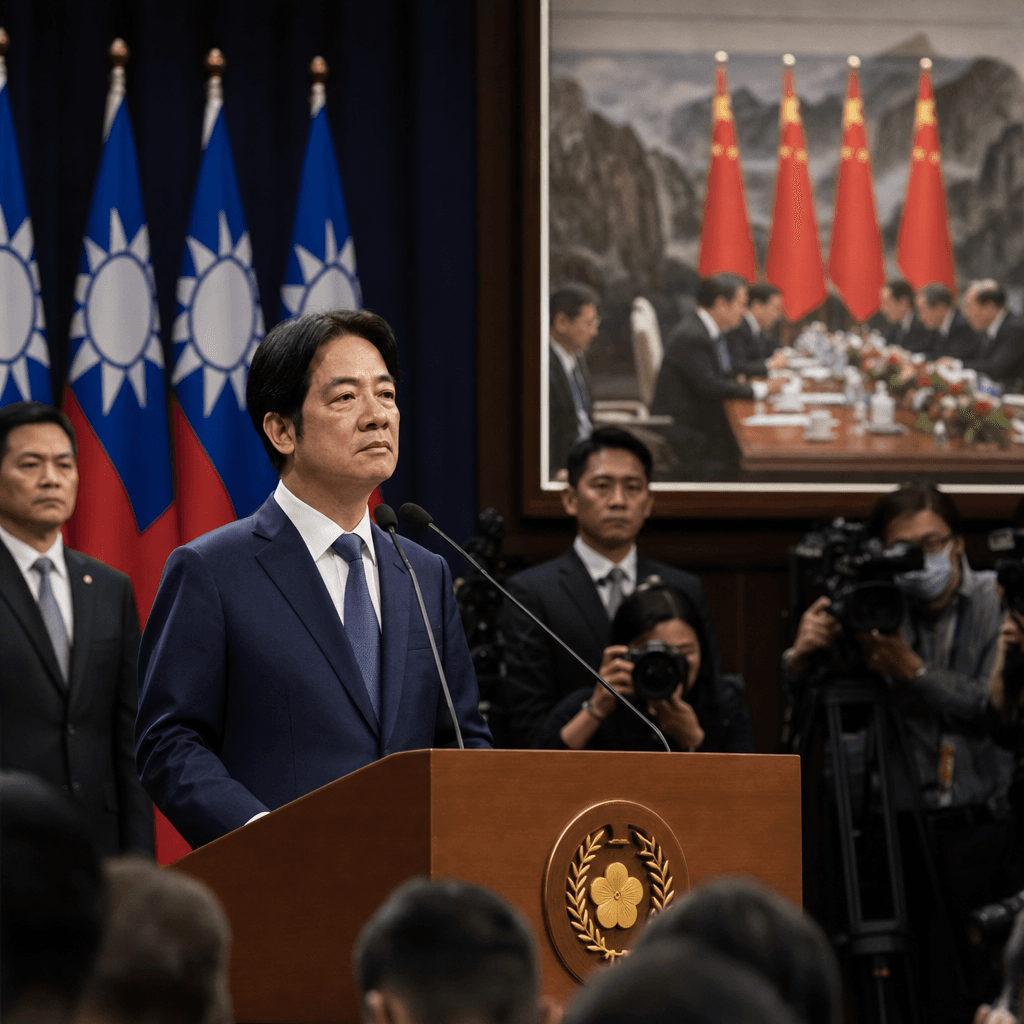
Taiwan's Diplomatic Strategy: From Holding the Line to Going on Offense
Under Lai Ching-te and Lin Chia-lung, Taipei has stopped defending its 12 allies and started buying influence in Europe, Africa and Southeast Asia. Here's what "integrated diplomacy" really means.
Taiwan lost 10 formal diplomatic partners in the eight years to 2024. In the 26 months since President Lai Ching-te took office, it has lost none — and the reason is that Taipei has quietly abandoned the strategy of defending its shrinking allied list and replaced it with something more ambitious: a values-and-supply-chain diplomacy aimed at Europe, Southeast Asia and Africa's grey zones, backed by an $11.1 billion US arms package announced on December 17, 2025. The bet is that unofficial ties with big democracies now buy more deterrence than official ties with small ones — and Beijing's May 2026 attempt to ground Lai's plane over three African states suggests China agrees.
The Lin doctrine: "every citizen a diplomat"
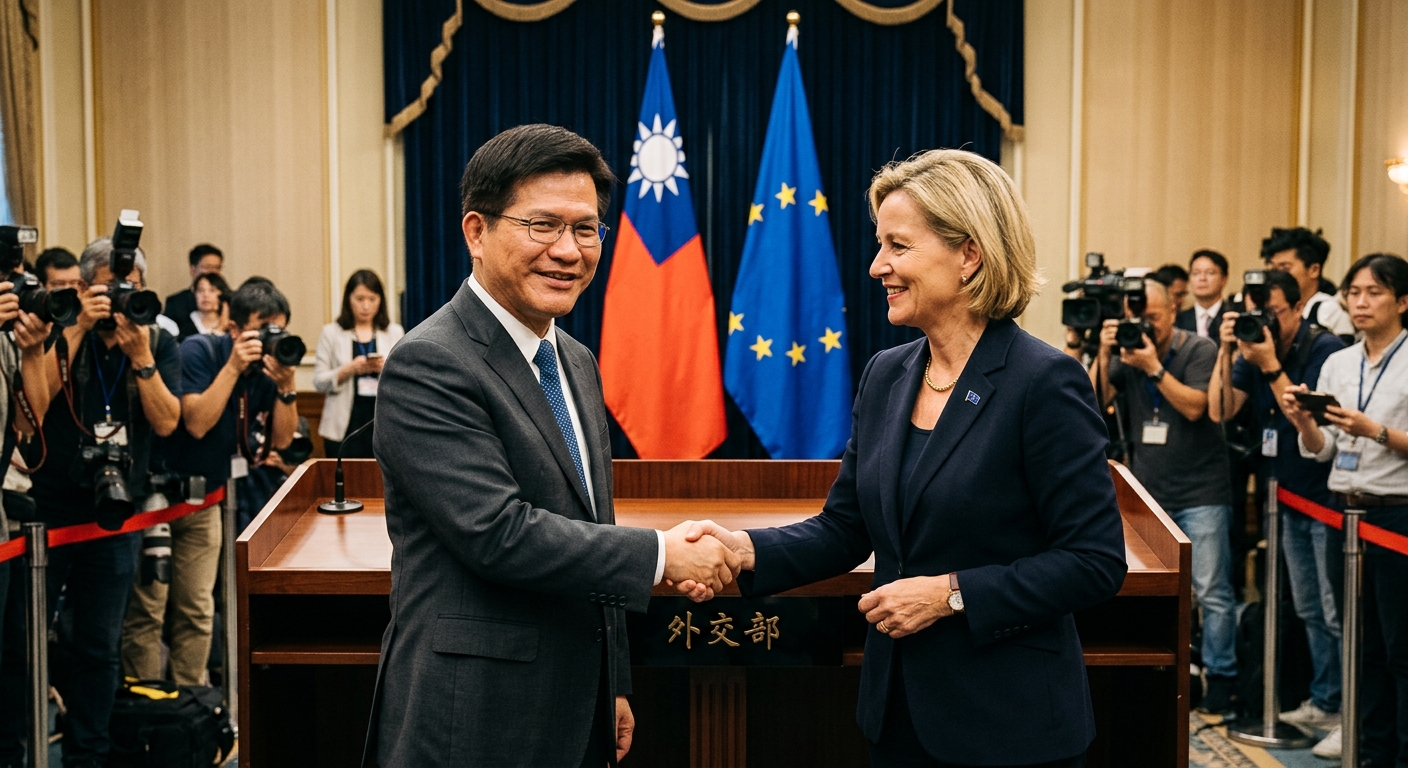
The architect is Foreign Minister Lin Chia-lung. Shortly after taking office in May 2024, Lin branded Taiwan's new posture "integrated diplomacy" (總合外交), described by CSIS as a whole-of-society strategy resting on three pillars — values, alliances and economics — and animated by the slogan that "every citizen will be a diplomat and every ministry will be a foreign ministry," according to a CSIS analysis published June 16, 2026.
In a December 2025 interview flagged by the Taipei Times, Lin said Taipei would "pursue and expand ties with like-minded countries to counter Beijing's poaching, rather than reactively defending existing relationships," per Taipei Times reporting. The phrasing matters. Taiwan's Ministry of Foreign Affairs has now formalised it in a signed English-language essay by Lin titled "Chip in with Taiwan," which describes integrated diplomacy as a "smart power approach" leveraging "diplomatic, defense, technological, and economic strengths," per the
Taiwan MOFA portal.
In Brookings' account of the emerging Lai grand strategy, Richard C. Bush notes Lin has "eschewed efforts to compete with Beijing for diplomatic allies through bribes or preferential financing" — a direct break from the chequebook diplomacy of the Chen and even Tsai years, according to Brookings. Instead, Lin is trying to trade Taiwan's position in the global semiconductor and ICT value chain for political access. In Foreign Affairs in early 2026, Lin argued Taiwan had moved "beyond values-based diplomacy… to prioritize value-added diplomacy," pointing to the December 2025 arms deal and a bilateral trade package involving $250 billion in Taiwanese semiconductor investment and $250 billion in credit guarantees to the United States, per
Foreign Affairs.
The 12 that remain — and why Beijing still cares
Taiwan retains formal ties with 12 states: the Holy See; Eswatini; Belize, Guatemala, Haiti and Paraguay in Latin America; Saint Kitts and Nevis, Saint Lucia and Saint Vincent and the Grenadines in the Caribbean; and Marshall Islands, Palau and Tuvalu in the Pacific. Combined, these countries have less than half the GDP of a single Taiwanese chip company. Yet Beijing has spent 2026 hunting them with unusual intensity.
On April 22, 2026, Seychelles, Mauritius and Madagascar simultaneously revoked overflight permits for President Lai's charter aircraft — the first time in Taiwan's history that a president has had a foreign trip cancelled by third-country airspace pressure, per BBC News. Taipei blamed "intense pressure and economic coercion" from Beijing. Ten days later, Lai reached Eswatini by an undisclosed route, met King Mswati III, signed a customs agreement, and framed the trip as proof that "Taiwan will never be deterred by external pressures," according to
Al Jazeera. China's foreign ministry called it a "stowaway-style escape farce." On May 2, Beijing scrapped tariffs for every African country except Eswatini — a punitive signal aimed less at Mbabane than at any capital tempted to follow it.
The Atlantic Council's Wen-Ti Sung argues Beijing's poaching campaign is a deterrence issue, not a bookkeeping one: "Beijing does not execute a global diplomatic campaign without a purpose. It is systematically targeting Taiwan's partners in a bid to isolate the island and provide more manoeuvring room for potential future Chinese coercion," according to the Atlantic Council. That framing explains why Taipei still fights for a Vatican or a Tuvalu whose economies are rounding errors.
The 2758 offensive: turning the UN's own resolution against Beijing
The most consequential shift in Taiwan's diplomacy is not in Eswatini or Paraguay. It is in the legal war over UN General Assembly Resolution 2758 — the 1971 text that seated the People's Republic of China at the UN and expelled "the representatives of Chiang Kai-shek."
Beijing has for two decades cited Resolution 2758 as proof that the international community accepts its sovereignty claim over Taiwan. Taipei's counter-campaign, run through the Inter-Parliamentary Alliance on China (IPAC) and coordinated with US and European partners, has now produced binding pushback in seven parliaments. On October 24, 2024, the European Parliament formally resolved that "UN Resolution 2758 takes no position on Taiwan" and rejected the PRC's "attempts to distort history and international rules," per the European Parliament. The Australian Senate, the Dutch House of Representatives, the UK House of Commons, the Canadian House of Commons, the Czech Senate and the Belgian federal parliament have passed similar motions.
In the US Congress, S.Res. 86 in the 119th Congress states that Resolution 2758 "does not take a position on Taiwan's ultimate political status" and that the PRC's "One China Principle" is not equivalent to the US "one China policy," per Congress.gov. A Congressional Research Service brief from 2025 records that a State Department spokesperson formally declared in March 2025 that Resolution 2758 "puts no limits on any country's sovereign choice to engage substantively with Taiwan," per the
CRS.
This is the concrete return on Lin's "alliance diplomacy" pillar: a coordinated legal-narrative campaign that, without recognising Taiwan, denies Beijing the diplomatic monopoly Resolution 2758 was long assumed to grant it. Taiwan's own MOFA press office now routinely refers to European visits as advancing "democratic resilience" via integrated diplomacy — language mirrored back in Brussels-drafted communiqués.
New Southbound 2.0: the trade half of the strategy
The economic pillar has been rebranded. On March 16, 2026, at the Yushan Forum in Taipei, Lai unveiled "NSP+", extending the 2016 New Southbound Policy from an economic diversification programme into what The Diplomat called "a broader Indo-Pacific strategy linking trade realignment, technological cooperation, [and] democratic resilience," per The Diplomat. The Habibie Center in Jakarta describes NSP+ as consolidating three pillars — development, people, partnerships — around six thematic "corridors" including semiconductors, medical technology and disaster resilience, per its
2026 report.
The numbers behind the shift are stark. According to Brookings, Taiwan's outbound investment share going to China has collapsed from 83.8% in 2010 to under 12% by 2023. That capital is now being routed back home or into ASEAN, India and — increasingly — Central and Eastern Europe. The MOFA closed the standalone "New Southbound Information Platform" in March 2026 and stood up a new "Friendly Nations Economic and Trade Office" under Lin, signalling that the policy is now folded into a wider Indo-Pacific framework, per the Prospect Foundation's 2026 analysis.
Europe is where the shift is most visible. The Prospect Foundation notes that autumn 2025 saw Vice President Hsiao Bi-khim address IPAC on the floor of the European Parliament — a first — followed by a chain of Lin visits to Prague, Vilnius, Warsaw and Berlin, per Prospect Foundation. A November 2025 European Parliament Research Service briefing records that 16 EU member states now maintain representative offices in Taipei and that the EU is Taiwan's fourth-largest trading partner and largest foreign investor, per the
EPRS.
Where the strategy is thinnest
Two weaknesses stalk the Lin doctrine.
First, Southeast Asia. The Prospect Foundation's Chen Shangmao warns that most ASEAN states face a "political ceiling" with Taipei that reduces NSP+ to economic and educational exchange; only the Philippines is comfortable with a security-flavoured framing, per Prospect Foundation. CSIS urges Taipei to "double down on India" via the 2024 labour MoU and Taiwan's Double-12 industrial framework, but concedes momentum "cannot be taken for granted."
Second, the private sector. Brookings' Bush notes that the whole "value-added diplomacy" edifice depends on companies like TSMC agreeing to route investment through Taiwan's foreign policy priorities — and those firms "protect their corporate independence and take a long-term and strategic view on major capital expenditures." The $250 billion US investment commitment inside the December 2025 trade deal was cheered in Washington but has produced quiet unease in Taipei about whether Taiwan is over-mortgaging its main deterrent — its indispensability to the global chip supply — to a single partner.
There is also the Trump problem. AEI's May 29, 2026 update flags that President Trump has publicly said the United States does not support Taiwan independence and has hedged on future arms packages, and that KMT-aligned outlets in Taiwan have amplified the doubt, per AEI. Integrated diplomacy assumes a reliable American backstop that Lai's administration cannot fully guarantee.
What to watch
- Next diplomatic switch attempt. Paraguay's Peña government faces domestic pressure from soy exporters shut out of the Chinese market; the next flashpoint is likely in Asunción, not Africa.
- EU–Taiwan trade text. Lai's November 2024 request for an EU–Taiwan economic partnership agreement remains stuck in the European Commission. A negotiating mandate in the second half of 2026 would validate the Lin doctrine; further delay will fuel the "expectation fatigue" the Prospect Foundation warns about.
- The 2026 World Health Assembly aftermath. Beijing blocked Taiwan for a tenth consecutive year in May 2026 but simultaneously accepted a Taiwanese minister at APEC senior officials meetings, per AEI/ISW. That asymmetry is where the next test of the 2758 pushback plays out.
Diplomat View
Integrated diplomacy is not, as its critics claim, values-based signalling dressed up as strategy. It is a bet that Taiwan's deterrence rests on being economically indispensable to 20 large democracies rather than politically recognised by 12 small ones — and that the UN legal architecture Beijing has used since 1971 can be eroded from the outside without ever being challenged from within. On current evidence, the bet is holding: zero allies lost, seven parliaments on record against China's reading of Resolution 2758, a record US arms package, and NSP+ moving from trade sub-strategy to Indo-Pacific brand.
The forecast: Taiwan will end 2026 with the same 12 formal allies and a materially expanded unofficial network in Europe and the Indo-Pacific. Two conditions would force a revision — a Trump-era pivot that suspends the December 2025 arms package, or a switch by Paraguay, whose $45 billion economy is the only ally whose loss would carry systemic weight. Watch Asunción and Washington. The allies in the Vatican, Tuvalu and Eswatini are the symbol. Paraguay and the US are the strategy.
The Bottom Line
Taiwan's diplomatic strategy under Lai has quietly inverted a decade of assumptions: it now treats formal recognition as a defensive perimeter and unofficial partnerships as the offensive line. The test is not whether Taipei keeps its 12 allies — it is whether Brussels, Delhi and Washington keep buying Lin Chia-lung's argument that a democracy that makes 90% of the world's advanced chips is worth defending on values and interest. If they do, Beijing's poaching game becomes strategically obsolete. If they don't, none of the 12 will be enough to save it.
Discover more

International Relations
Pakistan's Key Role in US-Israel-Iran Meddle
Pakistan is seeking to mediate the US-Israel-Iran conflict, balancing high-stakes diplomacy against severe economic pressures and steep regional challenges.

Conflict & Security
Drone Warfare Killing Aid Workers at Unprec
Over 1,000 humanitarian workers killed in three years as cheap armed drones collapse legal protections. Gaza, Sudan, Ukraine, and DRC see deliberate targeting of aid convoys and hospitals with zero prosecutions.

Global
World Normalises Taliban as Afghan Women Eras
UN data shows Afghan women erased from public life as Russia recognises the Taliban, EU hosts officials in Brussels, and ICC warrants for gender persecution go unenforced.
Conflict & Security
West Africa Food Crisis: Three Shocks in 2026
Conflict, climate extremes, and the Strait of Hormuz closure drive a severe food crisis in West and Central Africa, with fertilizer prices surging 80% and millions displaced.