Taiwan's Coast Guard Patrol with Foreign MPs
International lawmakers join Taiwan's maritime defense efforts
Model Diplomat8 min readAsia
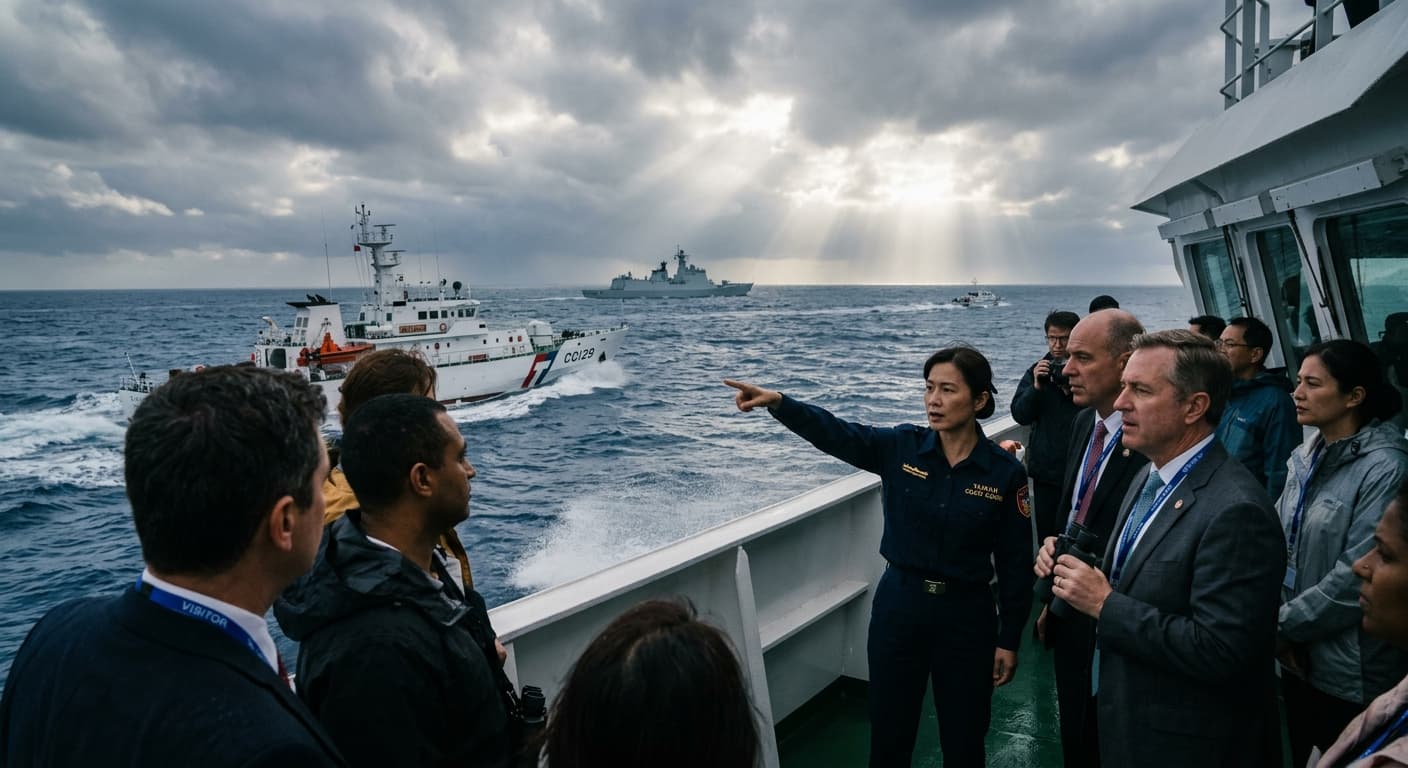
IPAC Kinmen patrol: parliaments join Taiwan's gray-zone frontline
Seven foreign lawmakers boarded a Taiwan Coast Guard cutter off Kinmen on July 9, 2026 — the first such parliamentary patrol, and a bid to internationalize a maritime pressure campaign that has grown 500% since 2020.
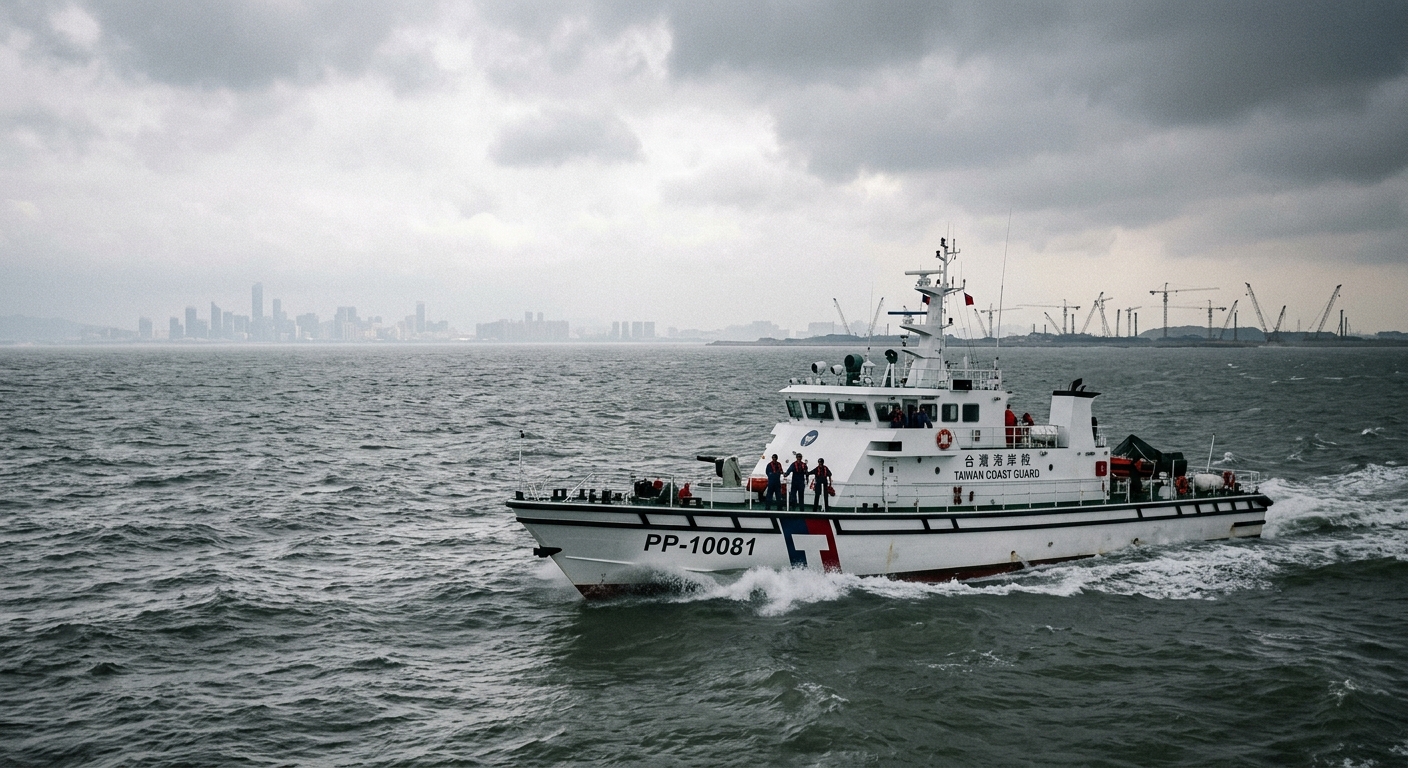
Taiwan put seven foreign parliamentarians aboard the 100-ton patrol vessel PP-10081 off Kinmen on July 9, 2026, in what the Inter-Parliamentary Alliance on China billed as the first international legislative delegation ever to join a Taiwanese Coast Guard patrol — a stunt engineered to fuse two files Beijing has worked hard to keep separate: the "gray-zone" harassment of Kinmen and the broader Western debate about deterrence in the Taiwan Strait. The bet is that if Chinese coercion around Kinmen looks like a domestic Chinese law-enforcement matter to foreign capitals, Beijing wins by attrition; if it looks like the Second Thomas Shoal of the Taiwan Strait, Taipei wins the narrative. The event, confirmed by Focus Taiwan, lands at a moment when the underlying data on Chinese maritime pressure has moved decisively in Taipei's rhetorical favor.
What actually happened on PP-10081
The delegation sailed from Shuitou Port around 10 a.m., traced the Kinmen Bridge and the archipelago's northern edge, and terminated at Liaoluo — a clockwise arc that put the Xiamen skyline and the reclamation cranes for Xiamen Xiang'an International Airport in clear view. According to Focus Taiwan, Coast Guard Administration (CGA) officers briefed the group on the airport's flight-safety implications and on the pattern of Chinese coast guard incursions near the islands. No PRC vessels were logged during the tour, a point CGA officers attributed to Typhoon Bavi driving Chinese cutters back to port; Taiwan's Coast Guard nonetheless said a CCG foray into Kinmen waters had occurred the previous day,
Reuters reported from on board.
The optics were tightly controlled. PP-10081 sailed without deck weapons and with an unarmed crew — a deliberate contrast to a Chinese Coast Guard that has been reorganized under the Central Military Commission and now regularly deploys four cutters at a time, each mounted with autocannons, around disputed features, according to CSIS ChinaPower's 2025 tracking. British Conservative Tom Tugendhat, a former security minister, told Reuters on the bridge: "I'm in Taiwan. I'm in Taiwanese waters. This has nothing to do with Beijing." Ukrainian MP Yulia Sirko delivered the parallel Taipei most wants amplified in European capitals — "if you want peace, start preparing for war" —
per Reuters.
The numbers that make this more than theater
Kinmen has functioned as Beijing's gray-zone laboratory since February 14, 2024, when two Chinese fishermen drowned fleeing a CGA pursuit inside Kinmen's prohibited waters — the incident Beijing has used to justify what its state media dubbed the "Kinmen Model" of maritime patrols. In an analysis by the CSIS Asia Maritime Transparency Initiative, AIS data logged 156 unique CCG vessels making 2,012 entrances into the restricted and prohibited waters around Kinmen and Matsu between May 2020 and September 2024, with the Kinmen curve peaking in March 2024 and averaging 13 CCG entries per week that year — more than triple the 2022 baseline.
The wider trend is starker still. In a June 2026 report, the CSIS Futures Lab found that the daily average of distinct CCG vessels entering Taiwan's near waters rose by more than 500% between January 2020 and December 2025, while daily incursions into Taiwan's second maritime security ring more than quadrupled. The
ChinaPower Project's 2025 review recorded a monthly average of roughly 24 CCG vessels reported by Taiwan's Ministry of National Defense in both 2024 and 2025 — and, crucially, a shift from single-ship to armed four-ship formations around disputed features. The IPAC delegation was briefed on precisely this pattern.
That is the load-bearing point of the visit: PRC state-affiliated commentary has explicitly argued that the "Kinmen model" of coast guard patrols could be "applied to Matsu, Penghu, and the entire Taiwan Strait," according to the IISS lawfare chronology. Beijing is treating Kinmen as a precedent factory. The parliamentarians on PP-10081 were, in effect, being invited to certify that precedent as coercion rather than housekeeping.
Xiang'an: the airport that reads like an operational plan
The single most consequential thing the delegation saw was not a Chinese ship but a construction site. Xiamen's new Xiang'an International Airport, being built on reclaimed land off Dadeng Island, sits roughly six miles from Kinmen's Shangyi Airport and shares an estimated 70% of its airspace, according to an American Enterprise Institute study of PRC short-of-war options against Kinmen. AEI's analysts note that PRC land reclamation has halved the distance between mainland territory and Kinmen's main island to under three kilometers.
Xiang'an is not merely an aviation project. Beijing has bundled it with a unilaterally started Xiamen–Kinmen bridge and a Fujian "cross-strait integration demonstration zone," pitched under the "one-city life circle" branding first codified in the State Council's 21 Measures of September 2023. The Institute for International Strategic Studies has documented how the plan pulls in eight State Council ministerial departments, the Supreme People's Procuratorate and Court, and 38 Fujian pilot projects establishing 119 new "cross-strait common standards" — the machinery of a soft annexation.
Taiwanese security analysts have been blunt about the second-order effect. Kinmen's Institute for National Defense and Security Research (INDSR) has warned that a completed Xiamen–Kinmen bridge would function like the Crimean bridge before 2022: an infrastructure asset that, in a crisis, becomes a PLA logistics artery and turns Kinmen's ports and airport into potential forward bases. That is the strategic pitch Fan Yun and Chen Gau-tzu were selling on the deck of PP-10081.
Why parliamentarians, and why now
Executive-branch demarches on Taiwan carry sovereignty freight most governments will not pay. Parliamentarians do not. IPAC, founded in 2020, now claims 250 members from 40 countries and has become the primary vehicle for extraterritorial pressure on Beijing that governments can quietly encourage without formally sanctioning, per an AEI account of IPAC's July 2024 Taipei summit. The July 9 delegation is the logical escalation of that model — from summits and audiences with the president to physically boarding a coast guard vessel in disputed waters.
Beijing understands the leverage. China has already sanctioned members of the delegation's home caucuses; in a first, the PRC banned four New Zealand MPs for a year over a Taiwan visit, as the BBC reported, and the Chinese embassy in London previously accused UK MPs of "gross interference" for a comparable trip,
also per the BBC. Yet the deterrent value of those sanctions is depreciating: participation is rising, not falling. The three UK legislators on PP-10081 spanned both the Conservative and Labour benches, signalling that a UK China-policy consensus survived the change of government.
The Ukrainian participation is the most novel signal. Kyiv sending a serving MP to a Taiwan Coast Guard patrol is the clearest yet public statement that Ukraine sees the two theaters as linked — and it dovetails with a US Senate delegation to Taipei two weeks earlier, which in its joint statement on June 25, 2026 urged Taiwan to advance a $25 billion special defense budget and pressed the Trump administration to move on $14 billion in previously approved arms sales.
Who benefits, who loses
The immediate winner is President Lai Ching-te. Beijing refuses to speak to him, brands him a "separatist," and has spent 2026 tightening Taiwan's diplomatic space — including financially coercing three African states to close their airspace to his state visit to Eswatini, according to AEI's May 29, 2026 update. A televised parliamentary delegation to Kinmen — Taiwan's most legible symbol of frontline democracy — resets the frame and hands Lai a legislative surrogate for the diplomatic recognition he cannot obtain.
The secondary winner is Taiwan's Coast Guard itself. The CGA is stretched thin against the CCG's numerical superiority — AMTI describes the CGA as "forced to stretch [its] resources" to maintain the prohibited/restricted waters regime — and Lai's proposed special defense budget, pegged by the US Senate delegation at $25 billion and by the Curtis-Shaheen delegation at $40 billion over eight years, is now stuck in a divided Legislative Yuan. Every televised international endorsement makes the KMT's procedural obstruction more expensive politically.
The clearest loser is Beijing's "Kinmen Model" narrative. PRC state-affiliated commentary has argued that CCG patrols effectively erased "restricted and prohibited waters" as concepts, as AEI documented in July 2024. That claim is easier to sustain when foreign publics never see the waters in question. It becomes harder once a Ukrainian MP is filmed on the bridge saying the quiet part out loud.
A secondary loser is the KMT. The party sat out the 2024 IPAC Taipei summit — reportedly under joint TAO and United Front Work Department pressure, denied by KMT officials but reported by Taiwan's Up Media as summarized by AEI. With a TPP legislator now co-chairing IPAC's Taiwan chapter alongside the DPP, and with cross-party US delegations meeting Speaker Han Kuo-yu, the KMT's abstention is starting to look like isolation rather than statesmanship.
What to watch next
- Xiang'an Airport opening, expected in 2026: any formal PRC assertion of shared airspace with Kinmen's Shangyi Airport would force ICAO-level questions Taipei will push into Western capitals.
- Special defense budget vote in the Legislative Yuan: the $25–40 billion package that both IPAC and the US Senate delegation have publicly endorsed is the near-term test of whether international pressure translates into Taiwanese money.
- PRC response to the delegation: China's foreign ministry did not comment on July 9,
per Reuters. Watch for individual sanctions on UK, Czech, Ukrainian and Indian participants — the volume and specificity of that list will indicate how seriously Beijing rates the tactic.
- East-coast CCG patrols: the extension of "law enforcement" activity beyond the Strait to Taiwan's Pacific-facing coast, first reported in June 2026, is the next escalatory rung and the one most likely to draw a Quad-adjacent response.
Diplomat View
The IPAC boat tour matters less for what it saw than for the category error it forces on Beijing. China has spent two years painting the Kinmen patrols as sovereign policing — a "Kinmen model" that its own state media has advertised as a template for the entire Taiwan Strait. That framing survives only in silence. Once foreign legislators are physically on a CGA hull in those same waters, the patrols become, by definition, a bilateral maritime dispute with international witnesses. The forecast: expect at least one European parliament to formally sanction the "Kinmen model" language by year-end, and expect Beijing to retaliate with individualized travel bans on the seven lawmakers rather than a systemic response — a sign the tactic worked. The call would revise if the Legislative Yuan fails to pass a substantive defense budget by Q1 2027, or if a live incident between the CCG and CGA produces casualties before international observation architecture is in place. Either would return the "Kinmen model" to the terrain Beijing prefers: a quiet, technical, deniable annexation of maritime space.
Discover more
US Politics
House Ethics Committee Pushes Sexual Miscond.
The House Ethics Committee has shifted responsibility for sexual harassment settlement records to the Office of Congressional Workplace Rights, complicating disclosure efforts.
India
Congress Accuses Modi of Stalling Women's Law
Congress accuses Modi of stalling women's reservation law by linking it to delimitation, revealing a deeper electoral strategy.
US Politics
SNAP Food Assistance Faces Legal Challenges
In 2026, SNAP faces stricter eligibility rules and mounting legal challenges, threatening food assistance for the millions of Americans who rely on the program.

Economics
Fed's Amex AML order puts correspondent banking on notice
Federal Reserve's Amex AML order requires board-level controls and a 90-day plan; OCC fined the bank $350 million over enterprise-wide deficiencies.