Taiwan's 40% Export Surge Turns AI Boom
Taiwan's exports surge, reshaping Indo-Pacific power dynamics.
Model Diplomat7 min readAsia
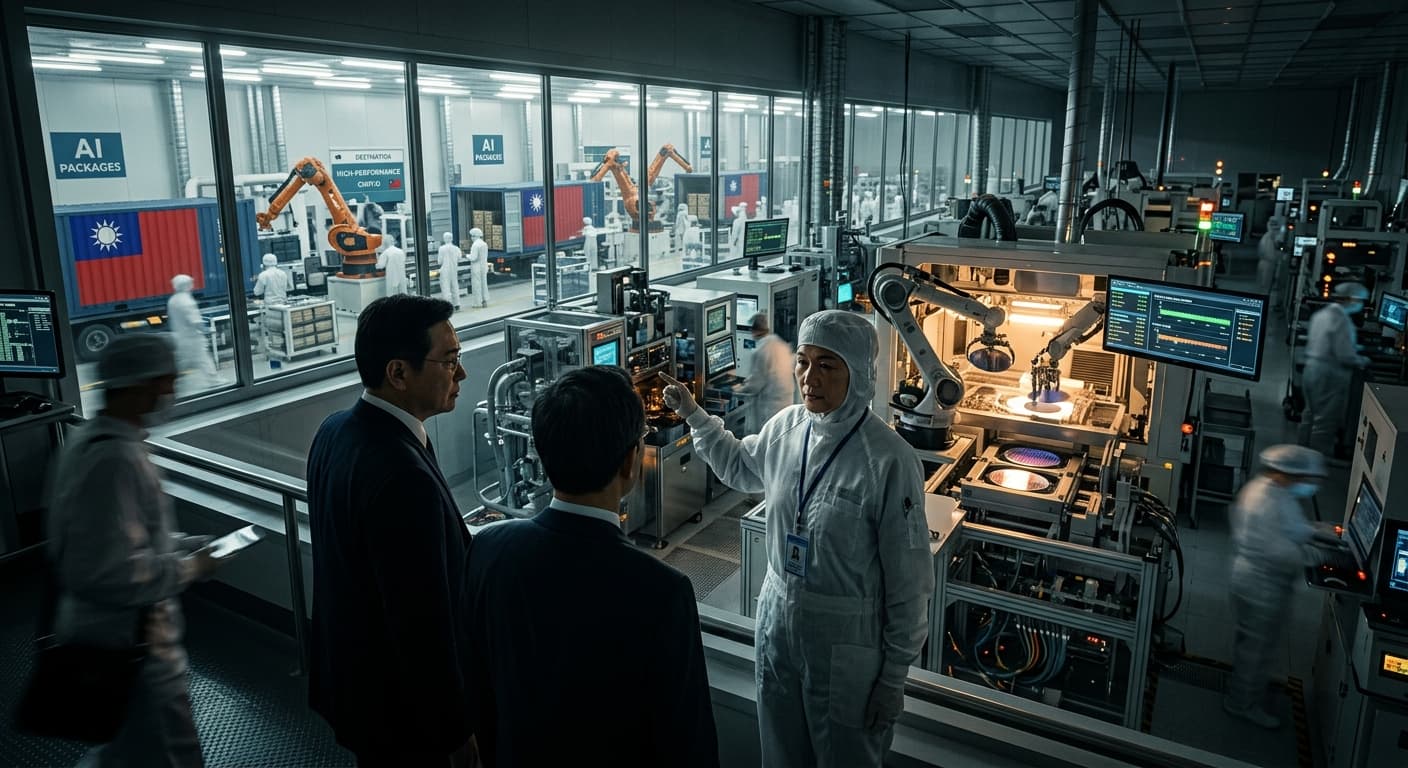
Taiwan's 40% Export Surge Turns AI Boom Into Strategic Leverage
Taiwan's exports jumped 40.3% in June 2026 and nearly 50% across H1, hardening its role as the load-bearing node of the AI economy — and reshaping Indo-Pacific power.
Taiwan's Ministry of Finance said on July 9, 2026 that June shipments reached US$74.83 billion, up 40.3% from a year earlier, the third-highest monthly total on record and a 32nd straight month of year-on-year growth, according to Focus Taiwan. Stacked against a 51.7% surge in May, first-half exports are running near 50% ahead of last year — a boom that has done more than fatten the trade surplus. It has quietly turned President Lai Ching-te's "AI island" slogan into hard strategic leverage: over Washington on tariffs, over Beijing on deterrence, and over regional partners now scrambling for a place inside the AI hardware stack that runs through Hsinchu, Tainan and Kaohsiung. The paradox is that the same surge deepens the concentration risk that makes the Taiwan Strait the most combustible economic corridor on earth.
The number behind the number
The headline growth is impressive, but the composition is the story. Shipments to the United States rose 34.8% in June from a year earlier and exports to China and Hong Kong climbed 22.2%, Taipei Times reported, citing the Ministry of Finance. Electronic components and information-and-communications-technology (ICT) products — the categories that capture AI servers, GPUs and advanced packaging — did the heavy lifting.
Taiwan's central bank has already re-rated the economy around it. In its June 18, 2026 monetary policy statement, the Central Bank of the Republic of China revised the 2026 GDP growth forecast to 9.45%, citing "robust growth in exports and steady expansion in private investment on the back of strong demand for AI and other emerging technology applications." The Q1 outlook projected real export growth of 12.85% for the year, per the CBC's official document. For context, Taiwan's Directorate-General of Budget, Accounting and Statistics had pegged 2026 GDP growth at 2.81% as recently as
August 2025. The upward revision — more than six percentage points in under a year — is one of the largest single-year recalibrations by an advanced-economy statistics office this decade.
The concentration is even sharper on the U.S. side. Taiwan's goods exports to the United States grew 341% between 2018 and 2025, and Taiwan was America's fourth-largest trading partner in 2025, according to a Congressional Research Service brief. Al Jazeera reported that full-year 2025 exports hit a record
US$640.75 billion, with more than two-thirds tech-related. Taiwan Semiconductor Manufacturing Company (TSMC) now supplies roughly 90% of the world's most advanced logic chips and accounts for more than 40% of the Taiwan Stock Exchange's market value, per the same reporting.
The 'AI island' doctrine, hard-wired
Lai has spent his first two years converting rhetoric into statute and treaty. In his May 20, 2024 inauguration address, he called on Taiwan to reimagine itself as "not just a silicon island, but an AI island," as recorded in commentary published by The Prospect Foundation. Since then, three moves have hardened the doctrine.
First, the AI Basic Act. Taiwan's Legislative Yuan passed the 20-clause law on December 23, 2025, and Lai promulgated it on January 14, 2026 — establishing a legal scaffold for "human-centric" AI research, industry incentives and fundamental-rights protections, according to Stanford's Center on Democracy, Development and the Rule of Law. The authors argue the statute is now the most fully-formed AI legal framework in Asia, ahead of Japan's and South Korea's.
Second, the U.S.-Taiwan Reciprocal Trade Agreement. Signed in January 2026, the deal cuts the U.S. reciprocal tariff on Taiwanese goods to 15% in exchange for $250 billion in Taiwanese investment in the U.S. semiconductor supply chain plus another $250 billion in credit guarantees, per the Council on Foreign Relations. Under Section 232, Taiwanese semiconductor exports receive preferential treatment tied to those investment pledges, the CBC noted in its 2026 Q1 outlook.
Third, sovereign AI. Taiwan's central bank explicitly frames "sovereign AI" — national governments building their own AI stacks — as a demand driver for the island's hardware. The June 18 CBC statement said "the ongoing broadening of the adoption of emerging technology applications" would sustain export growth through year-end; Taiwan's DGBAS notes that "cloud service providers, computing-capacity leasing firms, and several national governments" are all accelerating build-outs.

The concentration trap Beijing is watching
The surge does not close Taiwan's security gap — in some ways it widens it. Chinese exercises around the island have escalated in tempo and scale, culminating in the late-December 2025 "Justice Mission 2025" drills, in which the People's Liberation Army rehearsed a blockade and Taiwan's defense ministry detected 130 aircraft and 22 vessels within 24 hours, NPR reported at the time. The
BBC noted the drills followed an $11 billion U.S. arms package and coincided with a sharp deterioration in China-Japan relations after Prime Minister Sanae Takaichi suggested Japan's Self-Defense Forces could intervene if Beijing moved on Taiwan.
The classical "silicon shield" thesis holds that Taiwan's centrality to the chip supply chain deters a Chinese attack because the blast radius would rip through the global economy. That logic is now under stress from both ends. Brookings' Ryan Hass writes in a February 2026 analysis that "there is no path for America to realize its AI ambitions without a strong and close relationship with Taiwan" — which strengthens deterrence in the short run. But the same essay notes that the 2026 U.S. National Defense Strategy omits any direct mention of Taiwan, instead invoking a "denial-based defense along the First Island Chain."
The Stimson Center's Jennifer Lind and Kate Logan argue that TSMC's $165 billion Arizona commitment — pushed up under Trump-administration tariff threat — has made Taiwanese policymakers newly anxious that the shield is being ground down from the inside. Commerce Secretary Howard Lutnick has said the administration wants to relocate 40% of Taiwan's semiconductor supply chain to the United States. Taiwan's National Science and Technology Council head Wu Cheng-wen has publicly rejected any "hollowing out."
That is the frame in which the July 9 data lands. The higher Taiwan's export dependence on AI hardware climbs, the more indispensable it becomes to Washington in the short term — but the more urgently Beijing must act before U.S. reshoring, allied diversification through Japan, South Korea and India, and Taiwan's own energy ceiling change the equation. The CBC's own outlook flags energy stability as a live risk; Institut Montaigne's interview with Nikkei Asia's Cheng Ting-Fang describes a "looming energy crunch" as fabs and data centers strain the grid.
Who wins, who loses
The clearest winners are TSMC, its suppliers (from ASE in packaging to Delta Electronics in power components) and Taiwanese equity holders — the TWSE more than doubled between 2019 and 2025 to $2.2 trillion, Al Jazeera reported. The unambiguous losers are Taiwan's traditional industries — machinery, plastics, textiles — squeezed simultaneously by an appreciating New Taiwan dollar, Chinese overcapacity and U.S. tariffs on non-semiconductor goods. Central Bank Governor Yang Chin-lung has warned publicly of a "K-shaped economy."
Politically, the surge cuts across Taiwan's divided legislature. Lai's DPP holds only 51 of 113 seats in the Legislative Yuan, and the KMT-led opposition has stalled a proposed $40 billion defense spending increase, per Al Jazeera. A record-breaking export year gives Lai fiscal room to route AI-linked revenues into defense, coast guard modernization and civil resilience — precisely the categories the KMT has resisted funding.
Regionally, the beneficiaries fan out. Japan, whose METI is co-financing Rapidus and TSMC's Kumamoto fabs, gains a hedge. South Korea, whose memory-chip firms sit downstream of Taiwanese logic, gains volume. India, positioned via the U.S.-India semiconductor MoU, gains an entry point. The loser is ASEAN traditional manufacturing, which the CBC's own Q1 note explicitly flagged as being crowded out by "Chinese dumping" as Beijing redirects surplus capacity.
What to watch
- Q3 2026 export prints (August 8 and September 8, MOF releases). A single-digit decline would signal that the AI capex cycle is peaking; another 40%-plus print will force further currency-management scrutiny by the U.S. Treasury.
- U.S. Section 232 semiconductor tariff decision, expected H2 2026. Any move to remove Taiwan's preferential status would blow up the January trade deal and, per CBC modelling, could shave 1.5–2 percentage points off 2027 GDP.
- TSMC's 2-nanometer ramp in Hsinchu and Kaohsiung, on schedule for late-2026 mass production. If the domestic ramp outpaces the Arizona timeline, the "silicon shield" hardens; if it slips, the erosion argument strengthens in Washington.
- The next PLA large-scale exercise. Six major drills have occurred since 2022; the seventh, if it materializes in the second half of 2026, will be the first test of whether the Reciprocal Trade Agreement has changed U.S. deterrence signalling.
Diplomat View
Taiwan's 40% export surge is not a victory lap — it is a countdown. The AI boom has bought Lai leverage he did not have in 2024: a $250 billion pledge to Washington that stapled the U.S. tariff regime to Taiwanese equipment; an AI Basic Act that gives the island first-mover regulatory credibility in Asia; and a GDP trajectory that funds a defense build-out his opposition cannot fully block. But the same surge concentrates strategic risk into a shorter window. Beijing's calculation is no longer whether Taiwan matters enough to invite global mobilization — it is whether Taiwan will still be irreplaceable in 2028, when TSMC's Arizona 2nm line comes on stream. Our call: the "AI island" doctrine will hold through 2026 and deter kinetic action, but the deterrent decays with every fab that opens outside Taiwan. Revision trigger: a Trump-administration move to strip Section 232 preferential treatment, or a TSMC decision to relocate 2nm R&D — either would invert the leverage inside twelve months.
The Bottom Line
Taiwan's near-50% first-half export surge is the clearest signal yet that the global AI stack runs on Taiwanese hardware — and that Lai has, for now, turned that dependence into diplomatic capital in Washington and deterrent capital against Beijing. The question is no longer whether the "AI island" strategy is working. It is how long the window stays open before reshoring, energy constraints and Chinese pressure narrow it again.
Discover more
India
Modi's Women’s Convention in Varanasi
Modi's Varanasi rally frames women's reservation as a national mission, targeting the 2027 Uttar Pradesh elections with a strategic narrative.
India
Rajnath Singh's Durga Squad for 2026 Polls
Rajnath Singh's Durga Squad promised women's safety in Bengal but has since disappeared from the agenda, revealing BJP's true priorities.
India
Women’s Reservation Bill 2026
The Constitution (131st Amendment) Bill, 2026 was defeated in Lok Sabha, revealing deeper political conflicts over women's reservation and delimitation.

Economics
Fed's Amex AML order puts correspondent banking on notice
Federal Reserve's Amex AML order requires board-level controls and a 90-day plan; OCC fined the bank $350 million over enterprise-wide deficiencies.