Taiwan Strait's Economic Impact Surges
Examining the strategic shift in maritime trade routes
Model Diplomat7 min readAsia-Pacific
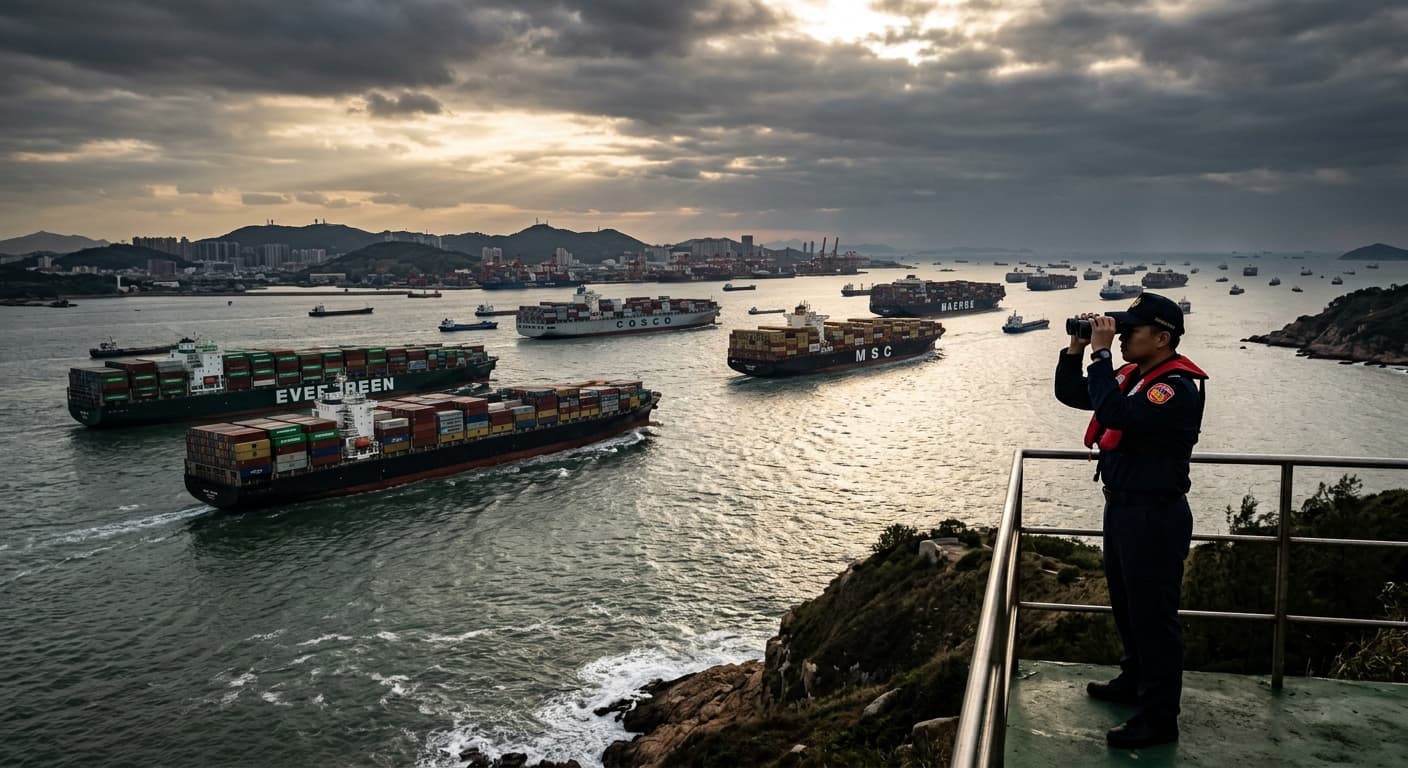
Troubled Straits: Why the Taiwan Strait Now Outranks Hormuz
The Taiwan Strait moved $2.4 trillion in goods in 2024 — and China is more exposed to its own coercive threats than the West is. Here's what changed in July 2026.
The most consequential number in Asia-Pacific security this week is not a warship count or a missile range. It is 33 percent — the share of China's own imports that transited the Taiwan Strait in 2024, according to a new Center for Strategic and International Studies brief published July 1, 2026. That figure quietly rewrites the strategic map: any Chinese action that closes the Taiwan Strait — a quarantine, a blockade, a war — would hit Beijing's economy harder than the "Malacca dilemma" its planners have obsessed over for two decades. With Iran's closure of Hormuz since March 2026 as a live demonstration of chokepoint power, the South China Sea's eight straits are no longer a background risk. They are the arena in which the next global recession, or the next great-power war, gets priced in.
The chokepoint math no longer favors Beijing
CSIS analysts Brian Hart, Matthew Funaiole and Jasper Verschuur, working with Bonny Lin's China team, put granular numbers on flows that were previously guessed at. Their July 1, 2026 Troubled Straits brief finds that $6.4 trillion of goods crossed the eight major South China Sea straits in 2024, with the Malacca and Taiwan Straits each carrying roughly $2.4 trillion — about 21 percent of global maritime trade apiece. Taiwan Strait volumes alone dwarf Hormuz.
The reframing matters because Chinese strategy has been organized around the wrong chokepoint. Hu Jintao coined the "Malacca dilemma" in 2003 to describe Beijing's exposure to a US Navy interdiction of oil imports from the Gulf. CSIS's new data shows the sharper vulnerability lies closer to home: about $1.3 trillion of Chinese trade — 33 percent of imports and 16 percent of exports — moves through the Taiwan Strait, versus roughly $963 billion through Malacca. Any Chinese military action that shuts the Taiwan Strait therefore inflicts self-harm at a scale the Malacca scenario never approached.
That is the "Taiwan Strait dilemma" — and it is the load-bearing constraint on any decision by Xi Jinping to move against Taipei short of a full commitment to war.
What the Iran precedent taught Beijing — and Washington
The Strait of Hormuz closure that began in March 2026, after US and Israeli strikes on Iran, cut roughly one-fifth of global oil and LNG traffic. The Center for Maritime Strategy documents the inflationary shock — fertilizer, chemicals, refined product prices all rose — and Chatham House writes that the IMF has warned of a
possible global recession if the war does not abate. The Council on Foreign Relations reports that Indonesia's finance minister, Purbaya Yudhi Sadewa, floated in April the idea of
tolling the Strait of Malacca — a trial balloon Jakarta walked back within days, but which is already lifting insurance costs on transiting vessels.
The takeaway inside Zhongnanhai is not the toll idea itself. It is that a mid-sized state successfully weaponized a chokepoint without inviting decisive military response. That precedent lowers the perceived cost of Chinese coercion around Taiwan.
The takeaway in Washington and Brussels is different. Bloomberg Economics has estimated the price tag of a US-China war over Taiwan at roughly $10 trillion, or 10 percent of global GDP, with a blockade alone shaving 5 percent — comparable to 2008–09 or COVID-19. The German Marshall Fund's January 2026 report If China Attacks Taiwan argues that even a "limited" scenario would cost China itself $2–3 trillion under conservative assumptions, and Rhodium's earlier work reached similar orders of magnitude. Taiwan's 90-plus percent share of leading-edge semiconductor fabrication turns any interruption into an immediate supply-chain event for every advanced economy.
The new escalation: China pushes east of Taiwan
Since late May 2026, the tactical picture has shifted in a way that few outside the region have priced in. Taiwan's National Security Council secretary-general Joseph Wu, on May 26, said the PLA had run a second "joint combat readiness patrol" in a week and had deployed more than 100 vessels along the first island chain, according to Al Jazeera. In early June, the China Coast Guard's Meishan flotilla began "law enforcement inspections" east of Taiwan — the Pacific side — with BBC Chinese
reporting transits covering more than 1,030 nautical miles and boardings-by-hail of 198 vessels between June 6 and June 10. The Financial Times reported on July 3, 2026 that Beijing was
formalizing claims over waters east of Taiwan.
The move is not symbolic. It is a "coastal governance" model — the same civilian-agency, gray-zone toolkit Beijing perfected around Scarborough Shoal — applied to the Pacific side of the first island chain. It normalizes CCG jurisdiction over waters Taipei considers its EEZ and Japan's Yonaguni-adjacent waters treats as sensitive. CSIS's ChinaPower project counted 163 recorded PLA operations in the South China Sea in 2025, a record, with the highest number of live-fire drills yet.
Manila is absorbing the parallel pressure. On April 13, 2026, the Philippine National Security Council accused Chinese fishermen of dumping cyanide at Second Thomas Shoal, describing it as sabotage. On June 11, Beijing banned Defense Secretary Gilberto Teodoro and his family from Chinese territory, an unusually personalized escalation reported by
Al Jazeera. Both moves ignore the 2016 Permanent Court of Arbitration award — the
PCA press release issued on July 12, 2016 found "no legal basis" for China's nine-dash-line historic-rights claim under UNCLOS. That ruling turns 10 next week. Beijing has never accepted it; the Philippines is now the one operationalizing it, with expanded US, Australian, Japanese and French participation in the Balikatan exercises.
The Korean flank and the trade geometry
The choke-point story does not stop at Luzon. On July 1, 2026, Kim Jong Un cabled Xi Jinping to hail an "unshakeable will" to develop ties, per Al Jazeera. Brookings analyst Andrew Yeo writes that Pyongyang's
northern turn, formalized at the Ninth Party Congress in February 2026, is reshaping the peninsula around a China-Russia-DPRK axis while Seoul's Lee administration pursues quiet engagement. North Korea has begun serial testing of long-range precision strike warheads aimed at "airfields, ports and power facilities," according to KCNA reporting relayed by
Al Jazeera — a menu of targets that maps directly onto the logistical spine of any US-Japan-Korea response to a Taiwan contingency.
That geometry is what makes the CSIS chokepoint data politically explosive. Japan, South Korea and the Philippines together shipped $755 billion of goods through the Taiwan Strait in 2024 and $474 billion through Malacca — an aggregate exposure roughly equivalent to India's entire annual goods trade. By contrast, only 3–4 percent of US trade transits either strait. Deterrence in the western Pacific is therefore an alliance-management problem far more than a US supply-line problem: the states with the most to lose from a Taiwan Strait closure are precisely those Washington needs to bring forward in a crisis.
The rerouting fiction
The comforting analytic reflex — "ships can always reroute around Indonesia" — deserves cold examination. The RAND Corporation modeled in a 2013 study what happens when Malacca, Sunda and Lombok are simultaneously blocked: shipping is forced south of Australia, adding thousands of nautical miles and multiplying voyage times. Even under milder assumptions, the Hague Centre for Strategic Studies'
Cost of Conflict study warns that container insurance suspensions during a Taiwan crisis would cascade through European supply chains within weeks. The Takshashila Institution's
December 2025 workshop report concludes bluntly that semiconductor stockpiling is not a viable hedge — chip generations turn over faster than inventories.
Malacca itself already carries about 23 million barrels per day of oil, more than Hormuz did at its recent peak, per artoftruth.org citing US Energy Information Administration flows. Tolling talk in Jakarta has already lifted premiums, according to the Council on Foreign Relations. Thailand is quietly re-marketing its 90-kilometer "land bridge" project across the Kra Isthmus as insurance against the Malacca choke. None of this scales fast enough to matter in a 2027–2028 window.
Diplomat View
The next 18 months are the window in which Beijing tests whether coastal-governance coercion east of Taiwan can substitute for the invasion Xi Jinping cannot yet afford. The July 3, 2026 FT report on China's eastward jurisdictional push is the tell: it is a gray-zone extension into the Western Pacific that lowers the political cost of a future quarantine while leaving the Malacca oil artery — and China's own $1.3 trillion Taiwan Strait exposure — intact. Our call: the modal 2027 scenario is not invasion. It is a graduated CCG-led customs quarantine of Taiwan-bound shipping, timed to a domestic Taiwanese political trigger (a US high-level visit, a defense-package announcement) and designed to force insurers, not warships, to do Beijing's coercive work. We would revise this forecast if (a) the PLA Rocket Force conducts a live-fire zone over shipping lanes east of Taiwan for more than 72 hours, or (b) TSMC issues a force-majeure notice to major customers — either would signal the quarantine has moved from theory to execution.
What to watch next
- July 12, 2026 — 10th anniversary of the PCA South China Sea award; Manila and Tokyo expected to issue coordinated statements, watch for European co-signatories.
- Han Kuang 42 (summer 2026) — Taiwan's next iteration of the exercise it expanded to 22,000 reservists in 2025; scope and US HIMARS role will signal Lai Ching-te's deterrence posture.
- Q4 2026 — Indonesian budget cycle; if Jakarta revisits Malacca tolling formally, expect a step-change in war-risk premiums across Southeast Asian routes.
The Bottom Line
The Taiwan Strait, not the Malacca Strait, is now the pivot of the global economy — and it is Beijing, not Washington, that is most exposed to its closure. The July 2026 CSIS data has flipped the strategic script that guided Chinese planning since 2003: the "Malacca dilemma" was the wrong problem. What China does east of Taiwan over the next 18 months will tell us whether Xi has understood the new math, or whether the coercion machine now runs faster than the caution it should induce.
Related: International.
Discover more

US Politics
White House Pressures Congress for Crypto Leg
The Trump administration's push for the CLARITY Act aims to reshape crypto regulation, impacting trillions in market value and the Trump family's wealth.
Global Politics
Xi Jinping Calls China-Russia Ties 'Precious'
Xi Jinping's description of China-Russia ties as 'precious' reflects a strategic imbalance, with Beijing dictating terms in the partnership.

India
Women’s Reservation in India
India's 33% women's reservation law is enacted but won't take effect until after 2029 due to political setbacks and census delays.

Conflict & Security
Drone Warfare Killing Aid Workers at Unprec
Over 1,000 humanitarian workers killed in three years as cheap armed drones collapse legal protections. Gaza, Sudan, Ukraine, and DRC see deliberate targeting of aid convoys and hospitals with zero prosecutions.

