Syria's property crisis blocks refugee return
Property rights, not security, now block refugee return from Lebanon
Model Diplomat9 min readMiddle East and North Africa
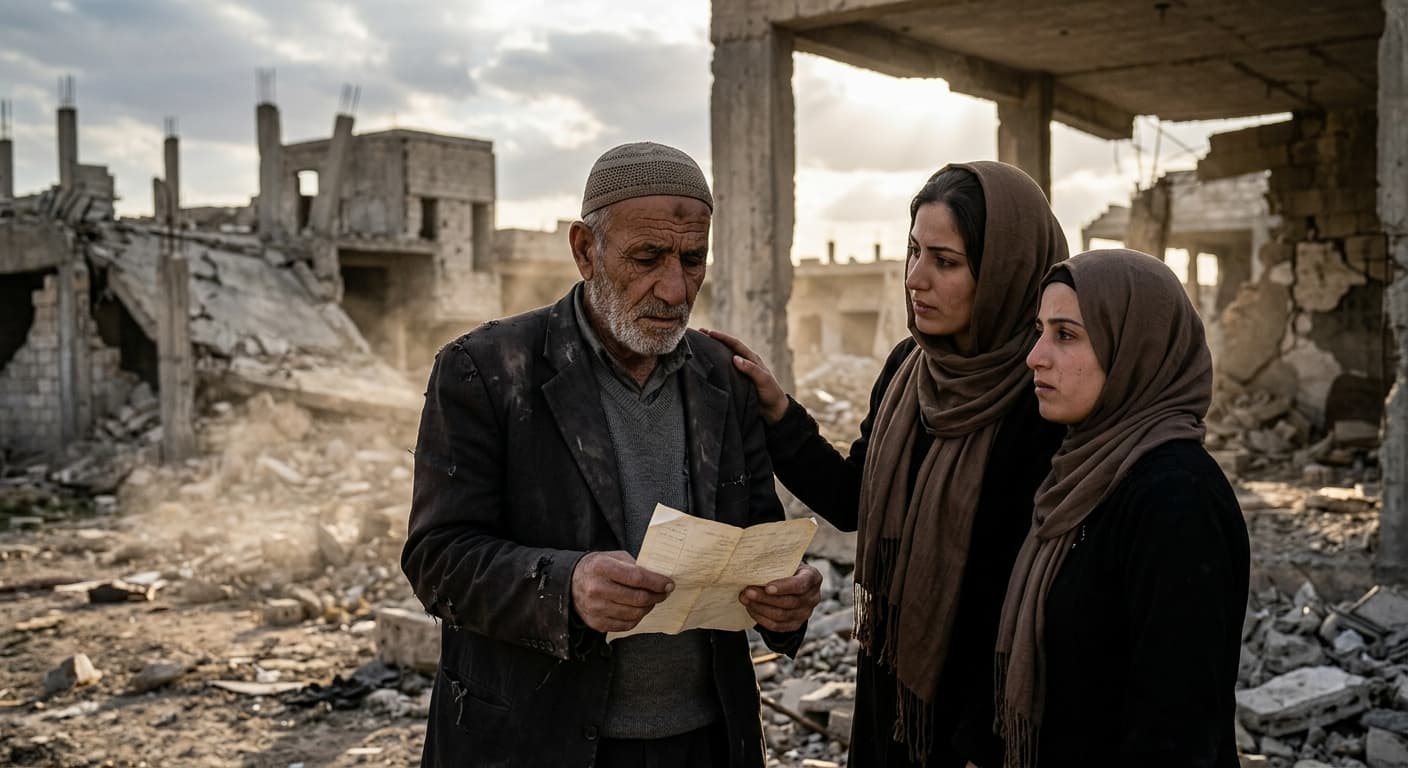
Syria's property puzzle: why refugee return hinges on deeds, not just peace
A July 2026 UN assessment finds nearly half of Syrian refugees' homes in Syria are completely destroyed and two-thirds lack any ownership documents — making housing, land and property rights the binding constraint on returns from Lebanon, not security alone.
Syria's transitional government has been in power for nineteen months. More than 2.6 million Syrians have returned, according to the International Organization for Migration. The single largest obstacle to durable return is no longer the regime — it is a piece of paper. A joint assessment by UN-Habitat, IOM and the Norwegian Refugee Council, published via
ReliefWeb, finds that housing, land and property (HLP) rights now function as the structural gatekeeper on repatriation from Lebanon. Nearly half of surveyed Syrian households report their properties completely destroyed, two-thirds hold no ownership documentation of any kind, and more than 40 percent expect to face HLP obstacles if they go back. Mass return without a credible property restitution mechanism will not close the refugee file — it will reopen it, because the actors who benefit from legal ambiguity have no incentive to resolve it, and those who lose have no mechanism to contest.
A legal architecture built to confiscate
The Assad-era legal framework for property was not neutral wartime bureaucracy. It was an instrument of demographic engineering. Decree 66 of 2012 and Law No. 10 of 2018 empowered the state to designate "redevelopment" or "terrorism-affected" zones, voiding titles of those who could not prove ownership within deadlines that displaced people could not meet, according to analysis by PAX for Peace. The
Restitution Law Review characterizes this as a deliberate strategy to consolidate control over land and reshape demographics in recaptured areas — not an incidental byproduct of conflict.
The Assyrian Council for Human Rights argued in a January 2026 position paper that these laws institutionalized property confiscation under pretexts of public safety and mandatory service, punishing opponents while rewarding loyalists. Properties were often registered in the names of male relatives, creating gendered barriers that persist into the post-Assad period.
Since the fall of Damascus in December 2024, the transitional administration has begun halting some property transfers and creating restitution committees in Homs, Aleppo and Hama. But Syria Report finds these bodies are fragmented, lack judicial powers, and apply no unified standards. The precautionary seizures, security approvals and anti-terrorism court rulings that the previous regime used to strip ownership remain on the books with little dismantling of the underlying legal framework.
A draft Transitional Justice Law now before the People's Assembly proposes a Compensation Fund under a National Transitional Justice Commission, earmarked for victims of HLP violations, according to Syria Report. The fund would be financed by state allocations, recovered looted assets and external support, with pilot programs before full rollout. But the criteria, timelines and administrative independence are unresolved. A draft law is not a restitution system.
What the survey found: three layers of dispossession
The UN-Habitat/IOM/NRC assessment surveyed Syrian households across Lebanon, representing different areas of origin. The findings describe a population caught between three overlapping layers of dispossession — and each layer compounds the others.
Destruction. Nearly half of properties are completely destroyed; another third severely damaged. For these households, the cost of reconstruction is the most pressing obstacle to return — not fear of violence or political persecution. Among households whose homes were completely destroyed, fewer than one in four hold any HLP document at all. The destruction is geographically concentrated in governorates that saw the heaviest fighting: Homs and Aleppo, which also received the largest share of returnees — 134,000 and 170,000 respectively over the past year, according to IOM data cited by Al Jazeera.
Documentation collapse. Two-thirds of surveyed households have neither formal nor informal proof of ownership. The gap is geographically concentrated: more than three-quarters of households from Al-Hasakeh, Ar-Raqqa, Hama and Deir-ez-Zor report no HLP papers. Around 10 percent have lost formal property documents — deeds, sale contracts, inheritance papers — and a further 15 percent have lost civil documents such as identity records. Without civil identity, proving ownership is not merely difficult; it is procedurally impossible.
Contested tenure. Even among the 70 percent of owners who possess some form of legal title, many are not registered in cadastral records. Nearly one in five properties remain subject to unresolved inheritance proceedings. A small but critical share of properties are informally or non-consensually occupied, and these cases tend to overlap with households already facing disputed ownership or legal challenges. The assessment describes these as among the strongest deterrents to return.

The gendered arithmetic of exclusion
Property ownership among surveyed households is overwhelmingly concentrated among male-headed households, which account for more than four in five property owners. This is not a statistical artifact — it reflects a legal and social system in which women's property rights exist on paper but are systematically eroded in practice.
The Norwegian Refugee Council documented in August 2024 that Syrian law formally recognizes women's HLP rights, but customary practices, family pressure, stigma and violence push women to relinquish claims to male relatives. Women who assert property rights risk exclusion from support networks and social ostracism. The
UN Women gender analysis of returns to Syria found that female-headed households face compounded HLP challenges due to limited property rights, discrimination in restitution processes, and heightened protection risks including mobility restrictions and inability to travel alone to claim documents.
The assessment notes that for women, HLP challenges are compounded by fears of harassment and the practical impossibility of traveling to Syria to inspect or reclaim property without male accompaniment. In households where male relatives are dead, missing, or themselves undocumented, the barrier becomes structural. A widow from Deir-ez-Zor whose husband's deed was never registered in the cadastre, who lost her civil identity papers during flight, and whose property is now occupied by a secondary claimant has no pathway through the current system. She is not a hard case. She is the median case in the most destroyed governorates.
Who benefits from the status quo
The HLP vacuum is not an absence of interests. It is a redistribution of leverage.
Regime-aligned networks and local power holders who acquired or were awarded properties under the Assad-era legal framework retain possession unless a credible restitution process reverses those transfers. The Syria Report documents that new HLP violations have continued post-2024, targeting Alawite, Druze and social-housing residents on sectarian or political grounds — signaling that the tools of dispossession are being repurposed, not retired.
Reconstruction contractors and developers benefit from ambiguous title because it allows state or state-aligned actors to consolidate land for redevelopment projects under the existing Decree 66 and Law No. 10 frameworks, which the transitional administration has not fully repealed. Where ownership cannot be proven, the state retains planning authority.
Urban landlords in Syrian cities benefit from housing shortages driven by destruction. The IOM data shows 19 percent of returnees are now renting, and rents in Damascus and Aleppo have skyrocketed. Returnees who cannot reclaim their original homes become a captive rental market.
The losers are precisely those the system was designed to exclude: female-headed households, families from heavily destroyed governorates, undocumented refugees, and anyone whose property was seized, forged, or re-registered under the previous regime's legal instruments.
The coercive environment in Lebanon
The pressure to return is not generated by conditions in Syria alone. Lebanon hosts an estimated 1.5 million Syrian refugees — the highest per-capita concentration in the world — and 80 percent lack legal residency, according to UNHCR data cited by the BBC. Nine out of 10 live in extreme poverty. The Lebanese parliament set a one-year deadline in 2024 for the government to ensure the return of Syrians residing illegally, and the army has conducted wave after wave of raids and summary deportations.
The CSIS analysis documents that the Lebanese government pushed forward a roadmap to deport all Syrians not registered with UNHCR, offering exceptions only for those whose lives the agency determined to be at risk. The UN described all returnees as "particularly vulnerable," noting they have faced arbitrary detention, forced conscription, torture and sexual violence.
A Chatham House analysis by Carmen Geha reports that approximately 67 percent of verified returns in 2025 occurred under duress rather than because of genuine improvements in conditions inside Syria. Landmark October 2024 judgments from the Court of Justice of the European Union and the European Court of Human Rights rejected Lebanon's designation as a "safe third country" and warned that returns risk indirect refoulement and inhuman treatment. These rulings have not stopped the deportations. More than 16,000 refugees have had their UNHCR status "inactivated" following brief returns to Syria — illustrating, as Geha notes, the failure of non-durable repatriation.
The result is a pincer: coercive pressure from Lebanon pushes refugees toward a Syria where the legal infrastructure to receive them does not exist.
Second-order effects: the return that generates displacement
The historical record is unambiguous on what happens when mass returns precede property resolution.
In Bosnia, property restitution took years and required sustained international pressure through the Property Law Implementation Plan. Even then, many returnees found their homes occupied by other displaced families, generating secondary disputes that lasted well into the 2000s. In Iraq, post-2003 property claims became entangled with sectarian dynamics, as displaced populations sought to reclaim homes in areas where the demographic balance had shifted. In Cyprus, property disputes remain unresolved more than five decades after displacement, functioning as a permanent obstacle to reconciliation.
Syria's trajectory shows early signs of the same pattern. The assessment finds that a small but significant share of properties are informally or non-consensentially occupied. Where returnees discover their homes occupied — often by other displaced families or by those who acquired properties under forged or seized titles — the result is either displacement into informal settlements, reliance on expensive rental markets, or direct confrontation. The PAX for Peace report warns that without a coherent HLP framework, large-scale returns could trigger widespread disputes over titles, expropriation decrees and unequal compensation — potentially destabilizing communities rather than stabilizing them.
The ACHR position paper makes the point more directly: without robust HLP safeguards, returns could spur renewed displacement, social tensions and injustice — undermining accountability efforts for post-conflict Syria. The second-order effect is not hypothetical. It is the mechanism by which a refugee crisis that appeared to be resolving itself generates a new wave of displacement within two to three years of return.
The donor geometry
The EU pledged over $1 billion to Lebanon in May 2024, widely seen in Beirut as a payment to keep Syrian refugees on Lebanese soil by cracking down on irregular migration toward Europe, according to BBC reporting. The
CSIS analysis argues that donor governments should temper expectations of rapid return, formulate a comprehensive strategy for safe return, and provide sufficient funding to facilitate an orderly process. UNHCR targeted 1.5 million returns for 2025 but fell short due to funding gaps, according to the
Chatham House analysis.
The missing piece in donor strategy is HLP-specific conditionality. EU and US reconstruction funding inside Syria is not currently tied to credible, rights-based property restitution mechanisms. Without that conditionality, reconstruction aid risks entrenching the very dispossession that blocks durable return — subsidizing construction on land whose ownership is contested, channeling resources through institutions that have not resolved the legal status of the people they are supposed to serve.
The draft Transitional Justice Law's Compensation Fund, if operationalized with genuine administrative independence and gender-responsive criteria, could provide a partial pathway. But it remains a draft, and its pilot programs have not begun.
What to watch
- People's Assembly vote on the draft Transitional Justice Law. No date has been set. If passed, the Compensation Fund's implementing regulations will determine whether it functions as a genuine restitution mechanism or a political instrument. Watch for the eligibility criteria and whether they include holders of unregistered titles and female-headed households.
- The Lebanese government's one-year deadline for returns, set in 2024, has technically expired. The next phase of enforcement — whether Lebanon escalates deportations or formalizes a bilateral return framework with Damascus — will determine whether the coercive environment intensifies.
- UNHCR's 2026 return target and funding gap. The agency's monitoring capacity has been diminished by budget constraints, according to
Chatham House. If monitoring collapses further, returns will proceed without independent verification of safety or property access — making the HLP problem invisible by design.
The bottom line
Syria's property crisis is not a humanitarian footnote to post-conflict recovery — it is the load-bearing wall. Nearly half of returning refugees' homes no longer exist, two-thirds cannot prove they ever did, and the legal framework to resolve either problem is a draft law stuck in parliament. The actors who hold leverage over Syria's land — local power brokers, redevelopment authorities, urban landlords — have no incentive to resolve a system that works in their favor. Unless donor governments tie reconstruction funding to credible, rights-based property restitution with gender-responsive enforcement, the returns now underway will generate the next displacement crisis within a single fiscal cycle.
Discover more

India
BJP's Misunderstanding of Women's Quota Needs
The BJP's linking of the Women Reservation Bill to delimitation risks delaying women's empowerment in India, misreading the aspirations of female voters.
US Politics
SNAP Food Assistance Faces Legal Challenges
In 2026, SNAP faces stricter eligibility rules and mounting legal challenges, threatening food assistance for the millions of Americans who rely on the program.

Global Politics
US Seizes Iranian Ship, Tensions Surge
The US seizure of the Iranian ship Touska highlights a shift in control over the Strait of Hormuz, favoring Iran's strategic position.

Conflict & Security
Drone Warfare Killing Aid Workers at Unprec
Over 1,000 humanitarian workers killed in three years as cheap armed drones collapse legal protections. Gaza, Sudan, Ukraine, and DRC see deliberate targeting of aid convoys and hospitals with zero prosecutions.