Supreme Court's Slaughter Ruling Shakes Banks
Court decision reshapes U.S. bank regulation landscape
Model Diplomat7 min readNorth America
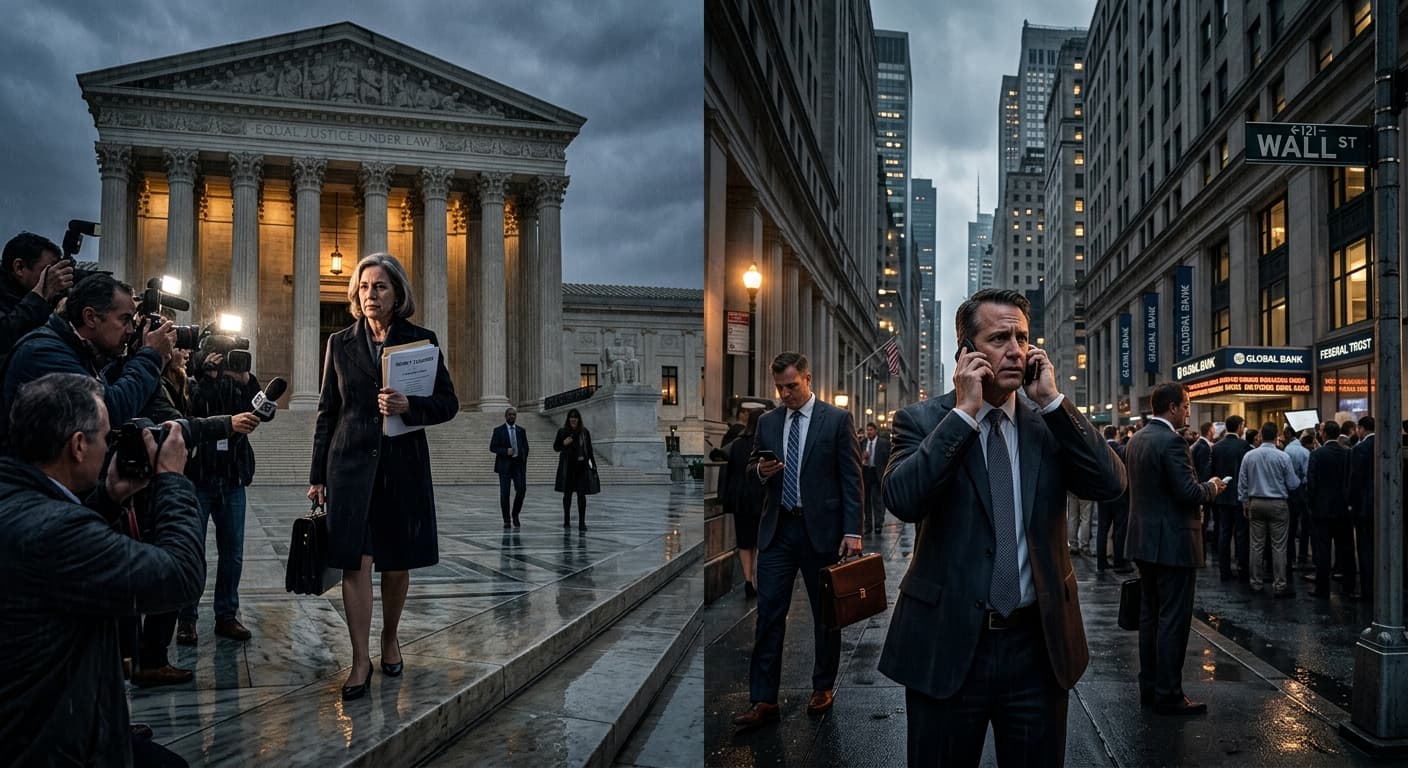
Slaughter Ruling Ends 91-Year Bank Regulator Firewall
The Supreme Court's 6-3 Trump v. Slaughter decision overturns Humphrey's Executor, handing the White House direct control over the FDIC, SEC, CFTC and NCUA — and scholars are calling it a "Brexit moment" for U.S. economic governance.
The Supreme Court's June 29 ruling in Trump v. Slaughter strips for-cause removal protection from members of the Federal Trade Commission and, by direct extension, the boards that write and enforce most U.S. bank regulation — a structural break that scholars are comparing to Britain's exit from the European Union because, like Brexit, it does not merely change a policy but forecloses a whole architecture Congress had spent nine decades assembling. The decision leaves the Federal Reserve as the last statutorily independent financial regulator in Washington, and even that exception is narrow, contested and probably doctrinally unstable. The bet the Court has just placed on the American economy is that presidential control of bank supervision will produce better regulation than bipartisan insulation did — and no one advising banks believes that bet is safe.
What the Court actually did
The 6-3 majority overruled Humphrey's Executor v. United States, the 1935 unanimous decision that had upheld Congress's power to insulate FTC commissioners from at-will presidential removal under 15 U.S.C. § 41. The syllabus of the government's brief to the Court framed the ask plainly: "The Court should repudiate anything that remains of Humphrey's Executor and ensure that the President, not multimember agency heads, controls the executive power that Article II vests in him alone," according to the petitioner's reply brief filed with the Supreme Court. The majority accepted that framing.
In dissent, Justice Elena Kagan warned that the emergency-docket path leading to this outcome — a series of stay orders in Wilcox, Boyle and now Slaughter — had already "handed full control of all those agencies to the President," writing that the Court "should never be used, as it has been this year, to permit what our own precedent bars," according to her opinion posted by the Legal Information Institute.
On the same day, in Trump v. Cook, a 5-4 majority blocked the President's attempt to fire Federal Reserve Governor Lisa Cook, carving out what Chief Justice John Roberts described as a historical exception tracing to the First and Second Banks of the United States. The Fed is now the outlier. Every other bipartisan financial commission is not.
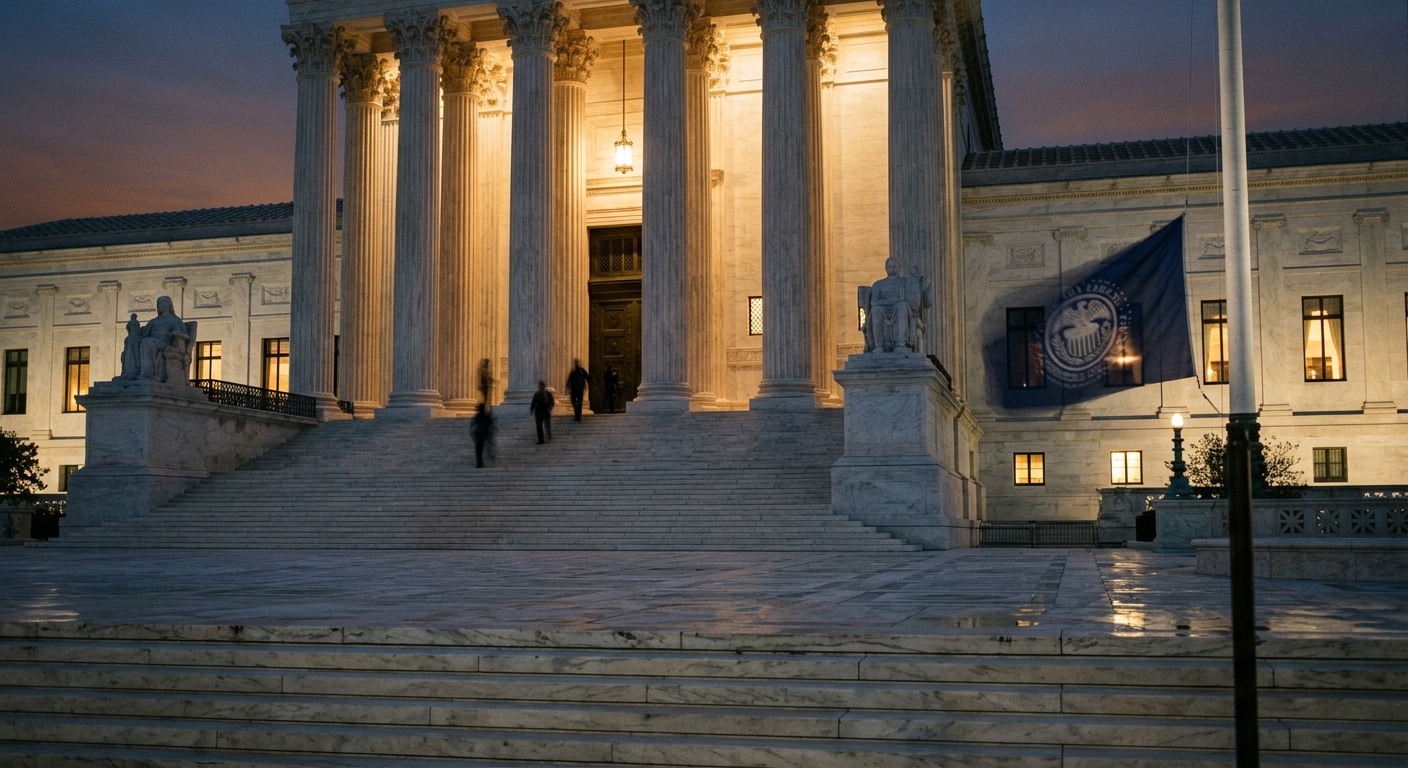
Why bank regulators are the real target
The FTC does not supervise a single bank. But the removal doctrine the case establishes maps precisely onto the boards that do. According to the Congressional Research Service, Congress has used the "fixed term plus for-cause" template for members of the FDIC, the SEC, the CFTC and — following its 1978 restructuring — the National Credit Union Administration, deliberately modeled on the Fed and FDIC. Under Slaughter's reasoning, only the Fed's uniquely deep historical pedigree saves it. Every other financial commissioner now serves, functionally, at the White House's pleasure.
The NCUA is already the test case. President Trump removed Board Members Todd Harper and Tanya Otsuka in early 2025 without cause; their complaint filed in the District of Columbia argued that the removals "paralyzed the NCUA Board, depriving it of a quorum," a warning about the systemic risks of at-will removal at agencies that insure over $2 trillion in credit-union deposits. After Slaughter, that constitutional argument is effectively foreclosed.
Todd Baker of Columbia's Richman Center told American Banker that "if I were a bank today, I would be very worried about the staying power of any regulatory policy not specifically required by law beyond the end of a presidential term." He pointed to the Comptroller's office as a preview: fintech and crypto charter policies have flipped three times in six years as acting comptrollers rotated with the White House. The FDIC and SEC will now flip on the same clock.
The "Brexit moment," decoded
Jeffrey N. Gordon, the Richard Paul Richman Professor of Law at Columbia, coined the parallel that gives the story its shape. "The decision in Trump v. Slaughter is a Brexit moment for the U.S., meaning a structural break in an economic governance system that will have long-run negative effects," Gordon wrote in an email quoted by American Banker. His load-bearing claim is not about ideology but about the loss of governance options themselves: "The decision has sharply limited the governance structures available to Congress to address various modern complexities, since Congress is unlikely to grant unconstrained authority to a President on many important questions."
Read against Britain's post-2016 experience, the analogy is precise. Brexit did not just change UK trade policy; it removed a whole institutional layer — the EU regulatory acquis — that had absorbed political volatility and made long-run commitments credible. In its absence, as academic literature published in Sage's Politics & Policy documents, executive power grew relative to Parliament and devolved institutions, and regulatory continuity became a function of who held Downing Street. Slaughter removes an analogous American layer: the bipartisan expert commission designed, in the words of the Court's 1935 unanimous opinion, to "maintain an attitude of independence" against a president's will.
Two second-order effects follow. First, the states will step forward. New York, California, Massachusetts and Illinois already run active state bank supervisors and state attorney-general enforcement pipelines. As the Supreme Court reaffirmed in Cantero v. Bank of America in 2024, Dodd-Frank narrowed the preemption doctrine that national banks had used to shield themselves from state consumer laws. Gordon's warning that "the states will step into the regulatory vacuum" is not speculative — it is the direction the case law was already moving.
Second, the recruitment channel will change. Independent-agency service is compensated in prestige and in the freedom to disagree with the White House. Strip both and, as Gordon argues, "agency appointees will face removal if they do not satisfy the administration," which will filter who accepts the job. That, more than any single rulemaking, is what banks and their counsel should track.
The Fed exception is narrower than it looks
The Cook carve-out is not a firewall. In an October 2025 Brookings paper, former Fed Governor Daniel Tarullo warned that the Court's logic risks "splitting the Fed in two" — protecting monetary policy but exposing bank supervision to presidential control, because supervision fits the Court's definition of "executive power" almost too neatly. Executive Order 14215, issued in February 2025, already applies the White House's regulatory-review apparatus to the Fed's supervisory functions while exempting the FOMC's monetary work.
If a future president fires a governor over a supervisory disagreement and frames it as "cause," the Court will have to distinguish that firing from a monetary-policy disagreement — a line Tarullo argues is "doctrinally unworkable." The moment a Fed governor is removed over Basel III implementation or a merger vote, the exception collapses into the rule.
Who wins, who loses
The immediate beneficiary is the sitting president and any successor of either party willing to use the tool. According to the Bloomberg Law analysis of the ruling, the decision "boosted the power of incoming presidents to reset leadership across the administrative state" — a power that, as Justice Brett Kavanaugh noted during the Cook oral argument reported by
NPR, cuts both ways: "what goes around comes around. All the current president's appointees would likely be removed for cause on Jan. 20, 2029, if there's a Democratic president."
The losers are the entities that priced U.S. regulatory stability into their business model. Baker's assessment to American Banker is worth quoting in full: "One of America's greatest economic advantages since the end of the second world war has been a transparent legal and regulatory system that did its best to deliver predictability for businesses and investors. America's competitive advantage as an investment and business destination was built on a foundation of predictability. When that foundation is undermined, the advantage disappears quickly."
Foreign capital that treated U.S. financial regulation as effectively technocratic — the way it treats German or Swiss supervision — now must price in a four-year political cycle. The banks that gain are the largest, which can absorb compliance whiplash; the banks that lose are mid-sized regionals and fintechs whose charter economics depend on predictable rules.
Combined with the Court's 2024 decision in Loper Bright ending Chevron deference, regulators now face White House political direction on the front end and closer judicial scrutiny on the back end — a squeeze that will slow rulemaking and generate more litigation. See also
Global Politics.
What to watch
- NCUA reinstatement appeal (D.C. Circuit). The Harper–Otsuka case is the first live vehicle for testing whether Slaughter's logic extends automatically to bank-side financial commissions or whether courts will insist on agency-by-agency analysis.
- SEC and CFTC crypto rulemakings. Both agencies are drafting rules that industry expected to survive administration change. Post-Slaughter, those rules can be reversed by a single presidential appointment cycle.
- The next Fed removal attempt. A presidential firing of a Fed governor over a supervisory disagreement, framed as "cause," would force the Court to defend the Cook exception or watch it collapse.
- State attorney-general filings. Watch New York and California for the first major post-Slaughter consumer-finance enforcement actions premised on the argument that federal supervision can no longer be trusted to run stably.
The Bottom Line
Trump v. Slaughter did not just fire Rebecca Slaughter. It removed the bipartisan commission — the governance form Congress has used since 1914 to run U.S. bank and market regulation — from the constitutional menu. Every regulator except the Fed now runs on the presidential clock, and the Fed's exemption is one contested firing away from being tested to destruction. The predictability that made American capital markets the world's default is, as of June 29, 2026, a policy choice rather than a structural feature.
Discover more
US Politics
Congress Targets AI Chatbot Access for Terror
The House passed the Generative AI Terrorism Risk Assessment Act, focusing on AI's role in terrorism and potential surveillance implications.
US Politics
House Ethics Committee Pushes Sexual Miscond.
The House Ethics Committee has shifted responsibility for sexual harassment settlement records to the Office of Congressional Workplace Rights, complicating disclosure efforts.

International Relations
Economist Impact Sustainability Week 2026
Economist Impact Sustainability Week 2026 spotlights the energy transition, AI in clean technology, and supply chain resilience as themes for global leaders.

Conflict & Security
Drone Warfare Killing Aid Workers at Unprec
Over 1,000 humanitarian workers killed in three years as cheap armed drones collapse legal protections. Gaza, Sudan, Ukraine, and DRC see deliberate targeting of aid convoys and hospitals with zero prosecutions.