Supreme Court's NRSC v. FEC Ruling Impact
Court decision reshapes Senate fundraising rules
Model Diplomat7 min readNorth America
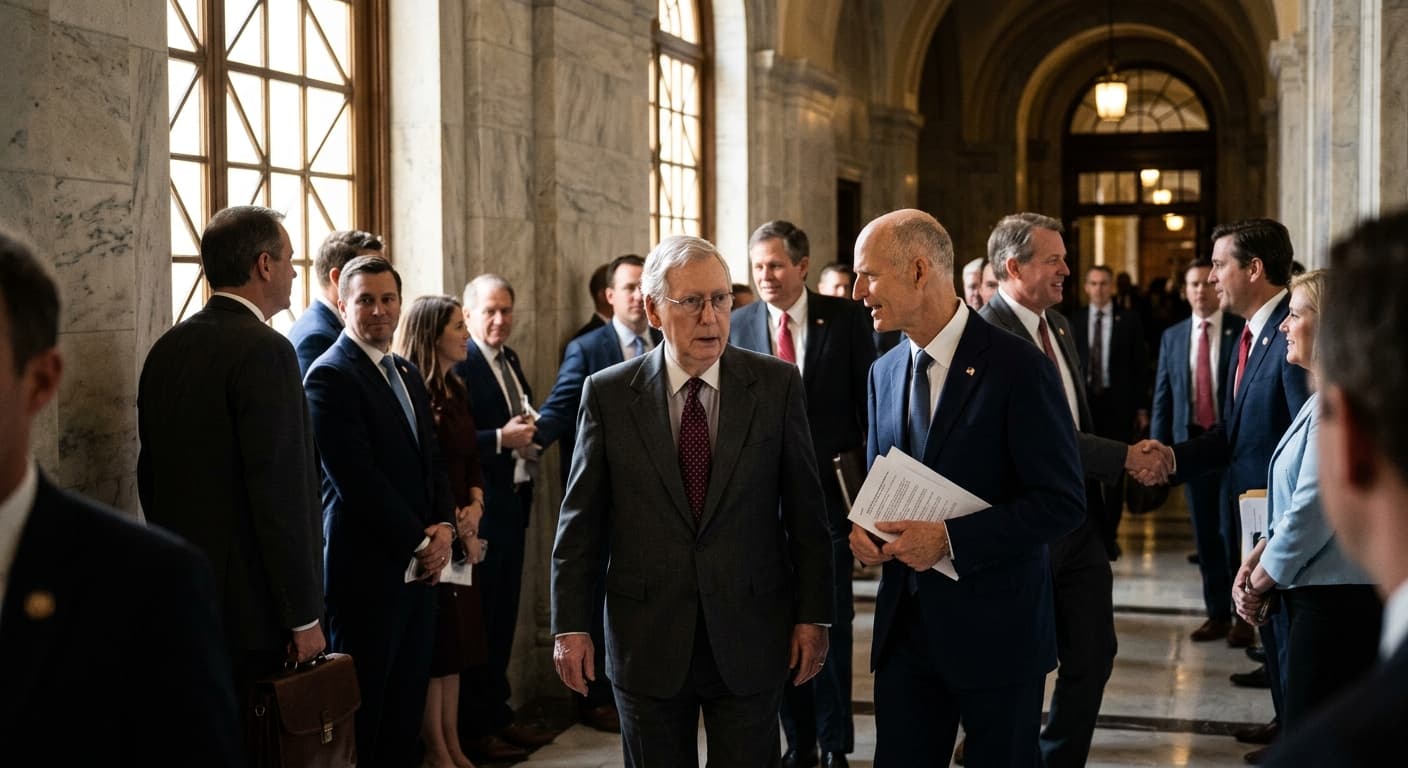
NRSC v. FEC: How the Court Rewrote Senate Money Rules
The Supreme Court's 6-3 NRSC v. FEC ruling on June 30, 2026 struck down coordinated party spending caps — reshaping fundraising in every competitive 2026 Senate race.
On June 30, 2026, a 6-3 Supreme Court majority in National Republican Senatorial Committee v. Federal Election Commission struck down the 1974 caps on how much a national party can spend in direct coordination with its own candidate — a ruling that arrives four months before the midterms and hands the party with the deeper wallet, the Republicans, a mechanical advantage in the six Senate seats that will decide the chamber. The thesis is narrower than the headlines: the decision does not create new money, but it unlocks the money the GOP already has, letting the Republican National Committee route its roughly $125 million cash pile through campaigns that are, in most battlegrounds, currently being out-raised by their Democratic challengers.
What the Court actually did
Writing for the majority, Justice Brett Kavanaugh held that 52 U.S.C. § 30116(d)'s ceiling on "coordinated party expenditures" burdens core political speech and cannot survive even the "closely drawn" scrutiny the Court applies to contribution limits. The opinion overrules FEC v. Colorado Republican Federal Campaign Committee (Colorado II), the 2001 precedent that had upheld the caps 5-4 as a legitimate anti-circumvention measure, according to NPR's coverage of the decision.
Kavanaugh framed the ruling as neutrality: "all political parties and candidates going forward can compete equally under the same rules regarding coordinated expenditures," he wrote, as NPR reported. The petitioners — the NRSC, the National Republican Congressional Committee, and then-Senate candidate J.D. Vance, now Vice President — argued in their
merits brief filed with the Court that the limits were "dead on arrival under this Court's recent campaign-finance precedents," pointing to Citizens United (2010), McCutcheon (2014), and FEC v. Cruz (2022) as the trajectory.
Justice Elena Kagan's dissent, joined by Justices Sotomayor and Jackson, put the objection plainly:
"With no limits on coordinated expenditures, the party can serve as the candidate's checking account… a legal regime increasingly unable to stop political corruption, and thus to preserve our institutions' democratic legitimacy."
The Trump-era FEC declined to defend the statute; the Court appointed attorney Roman Martinez to argue in support of the Sixth Circuit judgment below, per the Cornell Legal Information Institute case bulletin. That posture — an executive branch agency conceding the merits — is itself a feature of the story, not a footnote.
The numbers the ruling erases
Before Tuesday, the caps were real money, indexed annually for inflation. The Federal Election Commission's 2026 adjustments, published in 91 FR 10393, set the Senate coordinated-expenditure ceiling at $4.07 million in California, roughly $2.48 million in Texas, $1.37 million in Pennsylvania, $1.15 million in Georgia, and a floor of $130,600 in the smallest states. A Congressional Research Service brief circulated in the run-up to argument had flagged that the 2025 range ran from $127,200 to $3,946,100 for Senate candidates,
according to the CRS Legal Sidebar.
Every one of those numbers is now a floor of zero and a ceiling of infinity — subject only to the individual contribution limits that still cap what a single donor can give the party itself ($44,300 per year to a national committee in 2025-26).
That distinction is where the real mechanics live. As the Democratic Party intervenors argued and CRS summarized, coordinated buys purchase television advertising at the candidate rate — often 30 to 50 percent cheaper than the political rate paid by super PACs — and let the party place, script, and time the ads in lock-step with the campaign. The rule change, in practice, is less about volume than about efficiency: the same dollar buys more reach and more message discipline than a super PAC dollar ever could.
Who benefits — and it is not who the headlines say
The reflexive read is that Republicans win because they have more money. That is partly right and mostly wrong for 2026 specifically.
The RNC entered July with roughly $125 million in the bank against a DNC that is carrying net debt, per the Council on Foreign Relations' July 3 analysis by James M. Lindsay. Adding Trump's MAGA Inc. super PAC, the Republican universe holds close to $850 million in cash for the cycle,
NPR reported on April 23, 2026. Trump himself declared the ruling "A BIG WIN FOR REPUBLICANS,"
as CFR noted.
But at the candidate level the picture flips. Democratic Senate candidates outraised Republicans in seven GOP-held seats — Maine, North Carolina, Ohio, Alaska, Florida, Iowa and Texas — in the last reporting quarter, according to NPR's fundraising analysis. Texas Democratic nominee James Talarico posted $27 million in Q1 alone; Georgia's Jon Ossoff, $14 million; North Carolina's Roy Cooper, roughly $9 million in his primary account plus more in a joint fundraising committee.
The ruling's operative effect is to let the RNC's institutional pile subsidize a Republican candidate universe that has been consistently under-raising its Democratic opponents. It is a cash-transfer mechanism, not a fundraising boost. The party account becomes what Kagan called it: a checking account.
That is the non-obvious point. In the states where Democrats have banked personal war chests — Cooper in North Carolina, Ossoff in Georgia, Graham Platner in Maine — the ruling narrows a gap that Democrats had opened through small-dollar and mid-dollar fundraising. It does not create new Republican donor enthusiasm; it converts existing party cash into direct campaign firepower at a fraction of the cost.
The historical parallel the Court would rather you forget
Twenty-four years ago, in Colorado II, Justice David Souter wrote for a 5-4 majority that coordinated party expenditures have "no significant functional difference" from direct contributions to a candidate, and that treating them as contributions was constitutional precisely because parties act "as agents for spending on behalf of those who seek to produce obligated officeholders," a construction summarized in a Brookings analysis of the party expenditure regime.
Kavanaugh's majority discards that logic. The through-line from Buckley (1976) to Citizens United (2010) to McCutcheon (2014) to Cruz (2022) and now NRSC is a single doctrinal move: only quid-pro-quo corruption — bag-of-cash, explicit-exchange corruption — counts as a state interest strong enough to justify limiting political money. Everything the earlier Court called "circumvention" or "undue influence" has been read out of the First Amendment.
The odd historical wrinkle: this is the position Brookings scholars Thomas Mann and Anthony Corrado themselves reached in 2014, when they urged Congress to repeal the coordinated expenditure limit legislatively on the grounds that forcing parties to spend "independently" of their own nominees was, as Mann put it, "preposterous." The reformers wanted the caps gone through statute, with disclosure and hard-money limits intact. The Court has now gone the other way — striking the caps through the First Amendment, which forecloses Congress from restoring them.
What happens next: the sequencing problem
The practical implementation runs through three pinch points before November 3.
First, the FEC must decide whether to formally rescind 11 C.F.R. § 109.32 — the regulation implementing § 30116(d) — or leave it dormant on the books. A three-Republican, one-Democrat commission under a president who declined to defend the statute is not going to slow-walk that call.
Second, party committees will need to renegotiate the "coordinated spending authority" assignment mechanism at 11 C.F.R. § 109.33, under which the RNC has historically delegated its cap to the NRSC and state parties. With no cap, the mechanism becomes a routing question, not a rationing one — and the NRSC becomes the operational spending vehicle for Senate races overnight.
Third, and most immediately, campaigns will begin booking fall television inventory in July and August. Broadcasters offer candidates the "lowest unit rate"; parties buying in coordination now get access to that rate on unlimited volume. Expect the first observable effect to be a spike in party-branded, candidate-approved television buys in North Carolina, Georgia, Maine, and Ohio starting in late summer.
The bigger structural implication sits on the horizon. Kagan's dissent flagged the base contribution limits to parties — $44,300 to a national committee — as the last statutory wall between coordinated party spending and pure candidate-controlled money. Those limits were upheld in McConnell v. FEC (2003). The next challenge, already telegraphed in Senator McConnell's amicus brief in NRSC, will test whether that wall survives the Roberts Court's fifth pass at the doctrine.
What to watch
- FEC rulemaking: Whether the Commission issues an interpretive rule or opens a rulemaking to withdraw 11 C.F.R. § 109.32. First quarterly meeting after the ruling is the tell.
- Q3 FEC filings (October 15, 2026): The first hard data on whether the RNC has actually drawn down its $125 million cash pile into coordinated Senate buys, and where.
- North Carolina Senate race: With Cooper personally outraising Whatley and the RNC now able to spend unlimited amounts in coordination, this is the cleanest test of whether the ruling neutralizes candidate-level Democratic fundraising advantages.
- McConnell-style follow-on litigation: The next challenge is almost certainly the party base contribution limit itself. Watch for a test-case filing before year-end.
The Bottom Line
NRSC v. FEC does not create new Republican money — it unlocks the $125 million the RNC already had and turns it into direct, discounted, candidate-coordinated advertising in the six Senate seats that decide the chamber. The ruling's real target is not this election but the last statutory guardrail left standing: the base contribution limit to national parties. If that falls next, the American political party will legally become what Justice Kagan called it on June 30 — a candidate's checking account.
Discover more
US Politics
Congress Targets AI Chatbot Access for Terror
The House passed the Generative AI Terrorism Risk Assessment Act, focusing on AI's role in terrorism and potential surveillance implications.
US Politics
SNAP Food Assistance Faces Legal Challenges
In 2026, SNAP faces stricter eligibility rules and mounting legal challenges, threatening food assistance for the millions of Americans who rely on the program.

Global Politics
US Seizes Iranian Ship, Tensions Surge
The US seizure of the Iranian ship Touska highlights a shift in control over the Strait of Hormuz, favoring Iran's strategic position.

Economics
Fed's Amex AML order puts correspondent banking on notice
Federal Reserve's Amex AML order requires board-level controls and a 90-day plan; OCC fined the bank $350 million over enterprise-wide deficiencies.