Supreme Court's 2026 Term: Executive Power Sh
Key rulings reshape presidential authority and tariffs
Model Diplomat7 min readNorth America
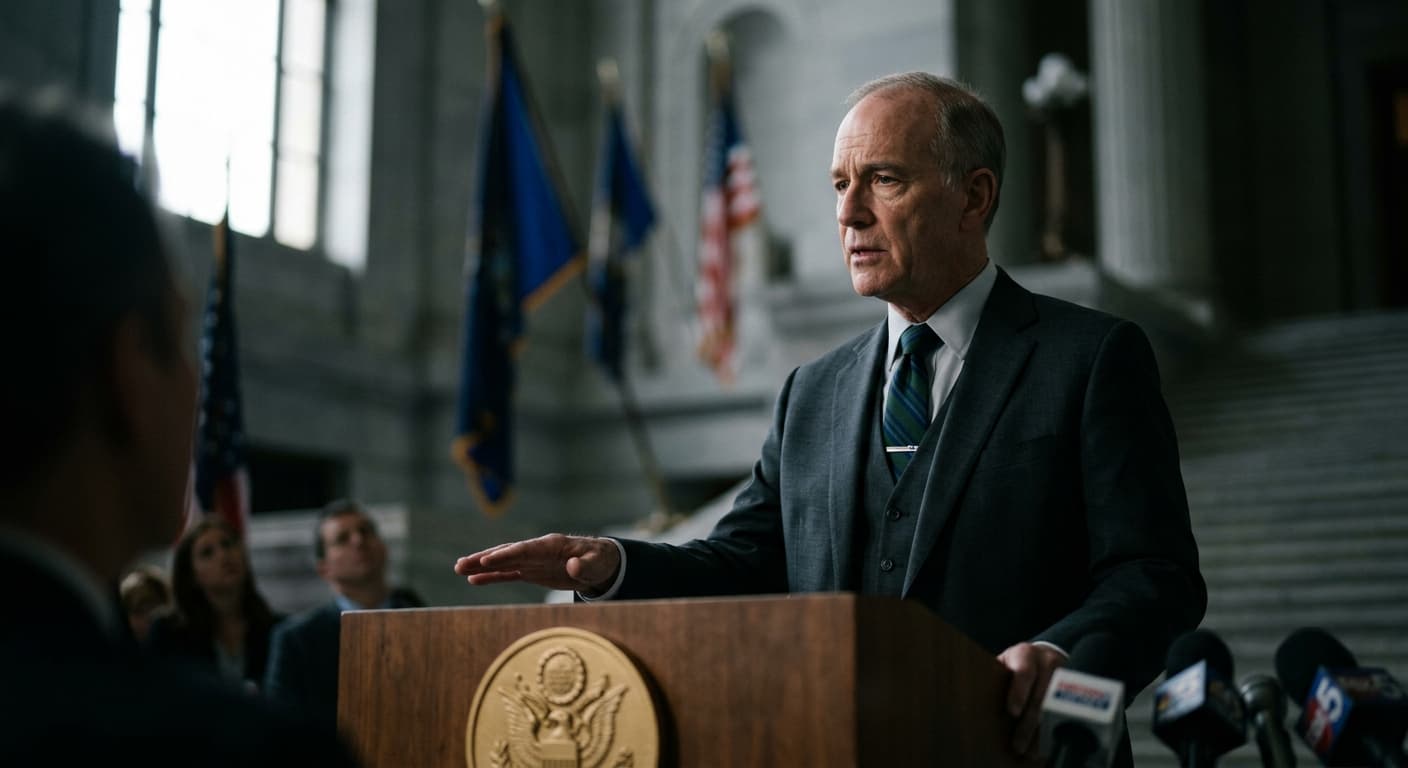
Supreme Court's 2026 term: unitary executive wins, tariff power lost
The Roberts Court overruled Humphrey's Executor, killed Trump's IEEPA tariffs, and shielded the Fed — recasting the presidency at home and abroad.
The Supreme Court's 2025–26 term ended on June 30, 2026, with a ledger that will define the second Trump presidency: a 6–3 ruling overturning a 91-year-old precedent that had protected independent agencies from at-will firing, a 6–3 ruling stripping the president of his signature tariff authority, a 5–4 ruling shielding the Federal Reserve, and a 6–3 rejection of the executive order narrowing birthright citizenship. The unifying logic across those four decisions is the argument of this piece: the Roberts Court accepted the unitary executive theory at home while denying it the two levers Trump wanted most abroad — unilateral tariffs and the power to bend the central bank. That trade-off is not neutral for international law and governance. It concentrates the U.S. administrative state under one office while forcing American economic statecraft back through statutory process — and, potentially, back to Congress.
The doctrinal turn: Humphrey's Executor is gone
The most consequential ruling of the term was Trump v. Slaughter, decided June 29, 2026. In a 6–3 opinion authored by Chief Justice John Roberts, the Court held that Congress cannot insulate the heads of executive agencies like the Federal Trade Commission from at-will presidential removal. According to the majority opinion published by Cornell's Legal Information Institute, Roberts wrote that "independent agencies are not 'independent' in the sense that they are free of the President," and that placing enforcement power in officials shielded from removal "does not deliver us to a promised land of technocratic governance."
The formal target was Humphrey's Executor v. United States, the 1935 case that had authorized Congress to create bipartisan, expert commissions insulated from the White House. In the official slip opinion, Justice Elena Kagan wrote in dissent that the majority had transferred "government authority from Congress to the President, and thus … reshape[d] the Nation's separation of powers." That is not rhetoric. Rebecca Slaughter, whom Trump fired from the FTC in March 2025 with an email saying her service was "inconsistent with [the] administration's priorities," is now one of dozens of commissioners at the FTC, NLRB, MSPB, EEOC and Consumer Product Safety Commission whose removal protections are effectively void.
The reach is domestic — but the second-order effects run through international regulation. The FTC negotiates cross-border competition and privacy frameworks with the European Commission. The SEC coordinates with IOSCO on securities standards. The FCC represents the U.S. at the ITU. Each of those bodies now sits under direct presidential control in a way it did not on January 20, 2025. As the Cambridge journal PS: Political Science & Politics noted in a 2026 analysis of "Trump 47," the unitary executive theory as endorsed in Slaughter "untethers executive power from Congress." Foreign counterparts negotiating with U.S. regulators must now assume the White House can revoke any deal by replacing the negotiator.
The Fed exception — and why it matters globally
On the same day Slaughter came down, the Court blocked Trump's attempt to fire Federal Reserve Governor Lisa Cook. The 5–4 ruling in Trump v. Cook, in which Chief Justice Roberts and Justice Brett Kavanaugh joined the three liberals, was narrower — grounded in due process — but the majority went out of its way to protect the Fed on structural grounds. According to a Brookings explainer by former Fed governor Daniel Tarullo, Roberts quoted Alexander Hamilton to argue that "not only the fact of independence, but also the appearance of independence is key to the Federal Reserve's design."
Kavanaugh's concurrence was blunter. He wrote that after Slaughter, "there is a clear choice: Either the Federal Reserve may remain independent … or it may not," and that any ambiguity "could spark political upheaval, including … turmoil in the U.S. and world economies." Former Fed chairs Ben Bernanke, Alan Greenspan and Janet Yellen filed an amicus brief warning that removing Cook — appointed by Joe Biden in 2022 with a term running to 2038 — would "erode public confidence" and jeopardize U.S. monetary policy credibility. That brief, by design, was addressed as much to foreign central-bank counterparts and sovereign holders of U.S. debt as to the justices.
The Cook ruling is the international law and governance story hiding in plain sight. The dollar-based global financial system depends on the credible independence of the Federal Reserve. In carving out an explicit exception to the Slaughter rule for the Fed alone, the majority signaled to markets — and to the ECB, the BoE, the BoJ and the PBoC — that the U.S. central bank remains outside the unitary executive. It is a doctrinally awkward line. But as Cook said in a statement quoted by the BBC, the case "was never about mortgage documents" — it was about whether monetary policy could be politically disciplined. The Court said no.
The tariff ruling: economic statecraft, narrowed
The February 20, 2026 decision in Learning Resources, Inc. v. Trump struck down the reciprocal and "fentanyl-emergency" tariffs Trump had imposed under the International Emergency Economic Powers Act. According to NPR's coverage, Chief Justice Roberts wrote for a 6–3 majority — including Trump appointees Amy Coney Barrett and Neil Gorsuch — that "when Congress grants the power to impose tariffs, it does so clearly and with careful constraints. It did neither here."
The stakes are large. As of December 2025, the U.S. Treasury had collected over $130 billion under the IEEPA tariffs; the Atlantic Council pegged total exposure at roughly $175 billion when refund claims are counted. In dissent, Justice Kavanaugh warned:
"The United States may be required to refund billions of dollars to importers who paid the IEEPA tariffs, even though some importers may have already passed on costs to consumers or others."
The ruling's international significance is not that it ends tariffs — Trump reimposed a 10% global rate under Section 122 of the Trade Act of 1974 hours later — but that it narrows the president's foreign economic emergency toolkit. As the Council on Foreign Relations noted in a February 2026 analysis, the decision "reaffirms the separation of powers … and upholds the basic right granted to Congress by Article I of the Constitution over the imposition of taxes, tariffs, and foreign commerce." Critically, IEEPA's sanctions, asset-freeze and embargo authorities were left intact — the ruling turned on the word "tariffs," not on the emergency-powers architecture. Sanctions regimes against Iran, Russia and designated non-state actors are undisturbed.
A companion CFR piece argued the ruling "professionalizes" U.S.-China economic conflict: Beijing gains time, because Washington can no longer escalate at the speed of a Truth Social post. A
Peterson Institute policy brief by Alan Wm. Wolff concluded that "the era of unlimited presidential tariffing may be coming to an end" — but only if the Court is equally firm in interpreting Sections 232, 301 and 122.
The European Union, according to a
Brookings roundtable, has extended suspension of retaliatory measures through August 2026, treating the Section 122 replacement as temporary. That is the diplomatic tell: allies read Learning Resources as a durable ruling on the tariff instrument, not the tariff policy.
The birthright citizenship ruling: a floor under 14th Amendment law
The term's final major case, Trump v. Barbara, decided June 30, 2026, rejected the executive order Trump signed on his first day back in office denying citizenship to children born in the U.S. to undocumented or temporarily present parents. According to a Brookings analysis by David Barker, Roberts's five-justice constitutional majority held that both English common law and the 14th Amendment's text "affirmed the long-held proposition that being born on American soil is a sufficient condition for citizenship."
Three justices — Clarence Thomas, Neil Gorsuch, and Samuel Alito — dissented, with Thomas producing a 91-page historical argument that domicile was required for jurisdiction. Justice Kavanaugh concurred separately on statutory grounds. As the BBC reported, White House Deputy Chief of Staff Stephen Miller called the decision "one of the most destructive and outrageous decisions" in the Court's history. Trump has since called on Congress to legislate. But as constitutional scholars quoted by
Al Jazeera noted, the ruling forecloses statutory workarounds; the only route is a constitutional amendment.
The international governance implication is understated but real. Jus soli citizenship is one of the areas where U.S. practice diverges from most of Europe. In upholding it, the Court reaffirmed a rule that governs the status of hundreds of thousands of children born annually to non-citizen parents — and effectively removed the birthright question from the toolkit of executive-order governance.
What to watch
- Tariff refund litigation at the Court of International Trade. The Supreme Court did not order refunds of the IEEPA duties. Importers' claims — potentially $175 billion in exposure — are working through CIT and will return to the justices.
- The Section 122 clock. Trump's replacement 10% global tariff expires 150 days after February 24, 2026 unless Congress extends it. With midterms approaching, expect the White House to pivot to Section 232 and 301 investigations before the deadline.
- Post-Slaughter firings. Members of the NLRB, MSPB, EEOC and CPSC are now removable at will. Watch for the first challenges arguing that ancillary statutory protections — bipartisanship requirements, staggered terms — survive Slaughter's logic.
- The Cook remand. Lisa Cook's case returns to the D.C. district court for a due-process hearing on the mortgage-fraud allegations. If she prevails, the Fed's for-cause protection is fully secure. If she does not, Kavanaugh's warning about presidential pretext will get its first test.
The Bottom Line
The Roberts Court's 2025–26 term consolidated presidential control of the domestic administrative state while denying the president the two international levers he most wanted: unilateral tariffs and a compliant Federal Reserve. The message to foreign counterparts is that U.S. economic statecraft must now travel through statute and procedure, not emergency decree — but the message to career civil servants and independent regulators is the opposite. This is not a Court reining in the presidency; it is a Court redrawing where presidential power runs unchecked and where the Constitution still binds it. For the international system that depends on both U.S. regulatory credibility and Fed independence, the Cook ruling matters more than any of the others.
Discover more
US Politics
SNAP Food Assistance Faces Legal Challenges
In 2026, SNAP faces stricter eligibility rules and mounting legal challenges, threatening food assistance for the millions of Americans who rely on the program.
US Politics
House Ethics Committee Pushes Sexual Miscond.
The House Ethics Committee has shifted responsibility for sexual harassment settlement records to the Office of Congressional Workplace Rights, complicating disclosure efforts.
US Politics
Congress Targets AI Chatbot Access for Terror
The House passed the Generative AI Terrorism Risk Assessment Act, focusing on AI's role in terrorism and potential surveillance implications.

Economics
Fed's Amex AML order puts correspondent banking on notice
Federal Reserve's Amex AML order requires board-level controls and a 90-day plan; OCC fined the bank $350 million over enterprise-wide deficiencies.