Supreme Court Ruling Preserves Fed's Status
Court's decisions reshape agency independence landscape
Model Diplomat8 min readNorth America
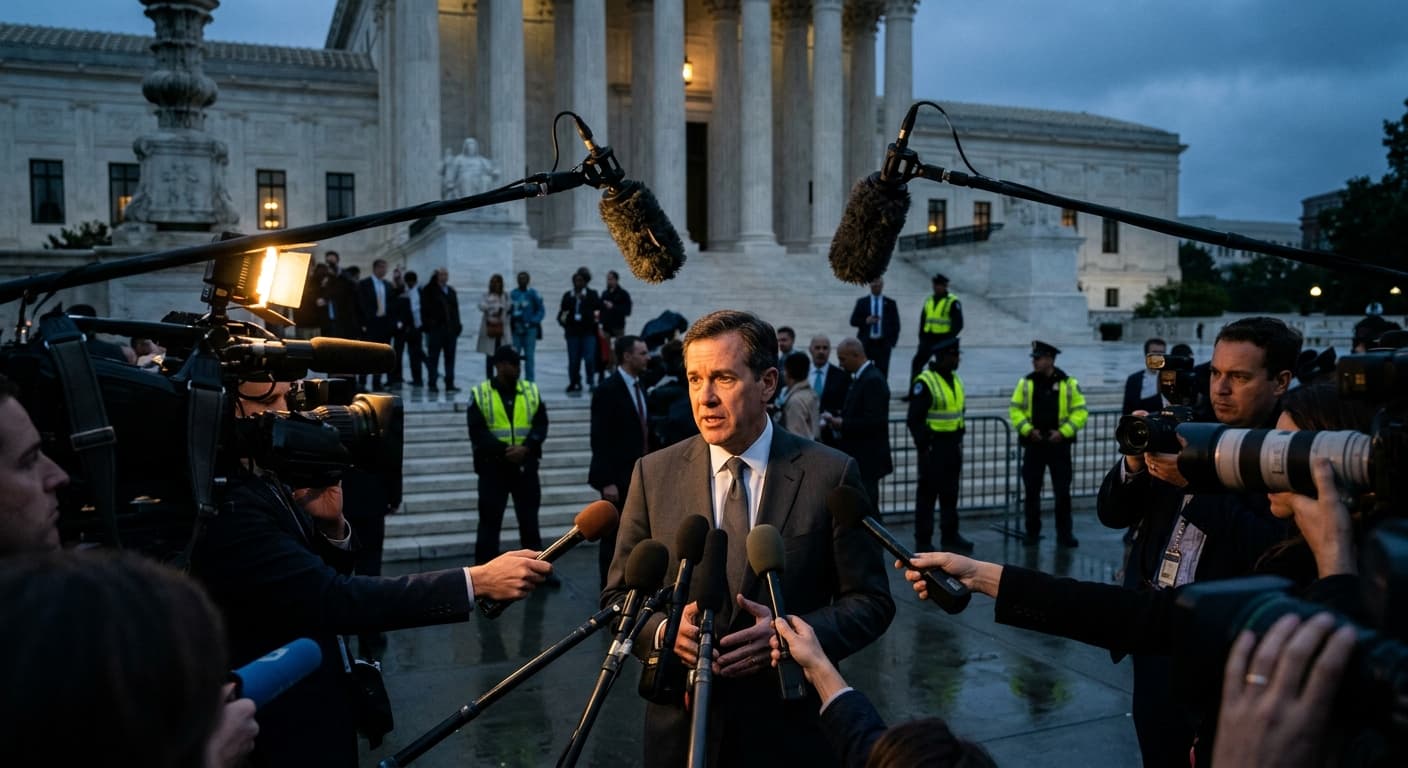
Supreme Court Buries Humphrey's Executor, Spares the Fed
The Supreme Court's 6–3 ruling in Trump v. Slaughter ends 91 years of agency independence. A companion 5–4 decision preserves the Federal Reserve — for now.
The U.S. Supreme Court on June 29, 2026 issued the most consequential rewrite of American administrative law in a generation — and its most important audience is not in Washington but in the world's foreign-exchange dealing rooms. In a 6–3 decision in Trump v. Slaughter, the Court overruled Humphrey's Executor v. United States (1935) and stripped Federal Trade Commission commissioners of their for-cause removal protection. In a companion 5–4 opinion in Trump v. Cook, the same Court blocked President Donald Trump from firing Federal Reserve Governor Lisa Cook, ring-fencing the central bank as a "uniquely structured, quasi-private entity." The signal to markets and to foreign capitals is that the dollar's institutional anchor now rests on a single Supreme Court sentence — and on a 5–4 majority that could shift.
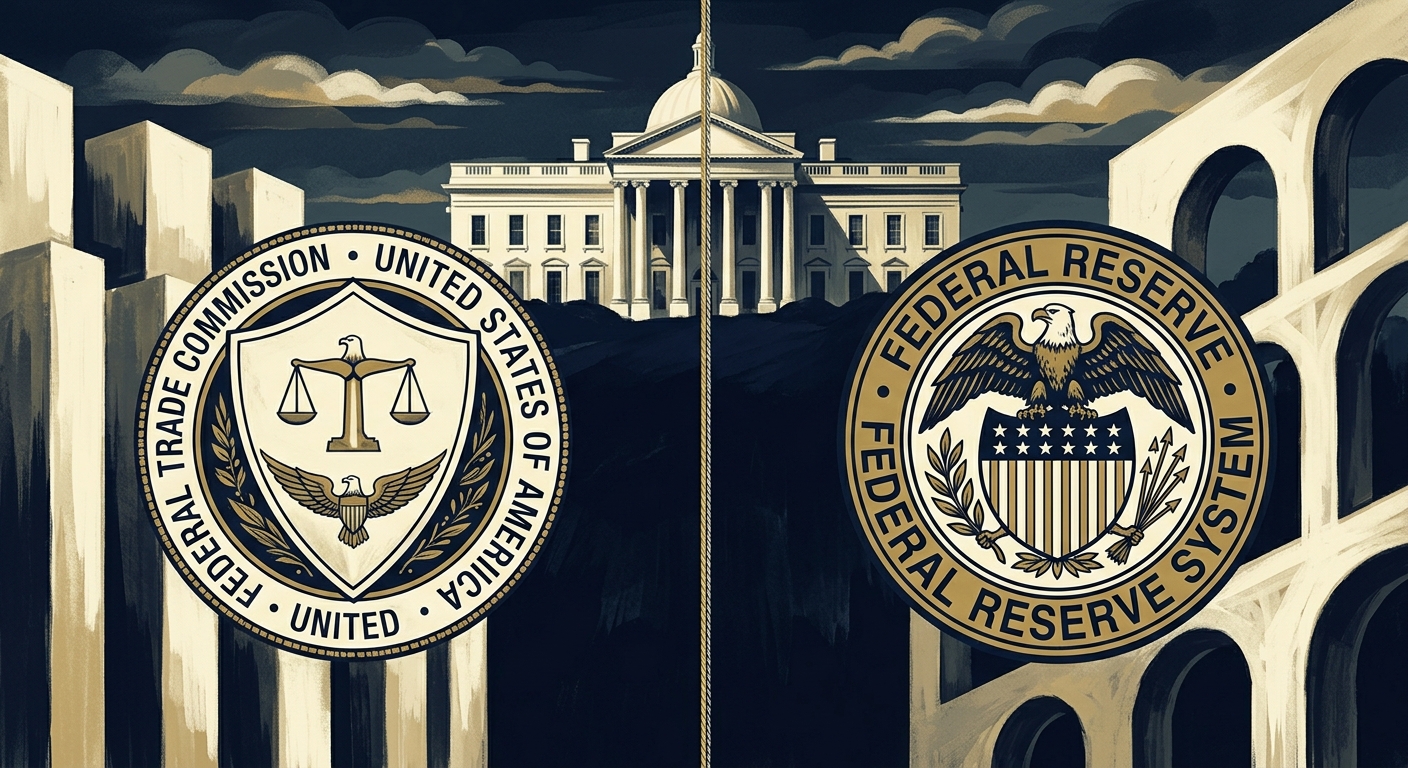
What the Court actually held
Chief Justice John Roberts, writing for the majority, framed the case as a return to first principles. The FTC "has accumulated vast rulemaking, enforcement, and adjudicatory powers," the syllabus notes, and its commissioners are therefore executive officers who "must be removable by the President" to satisfy Article II's Vesting Clause, according to the Cornell Legal Information Institute publication of the opinion. The ruling reversed the D.C. District Court, which had held that Trump's March 2025 firing of Commissioners Rebecca Slaughter and Alvaro Bedoya was "ultra vires" because the President invoked no statutory cause and instead cited only that their "continued service on the FTC [was] inconsistent with [his] Administration's priorities."
The Solicitor General's brief had asked the Court to bury the 1935 precedent outright, calling Humphrey's an "indefensible outlier" and a "decaying husk" whose reasoning "has not withstood the test of time," in language that the Supreme Court reply brief borrowed from Seila Law. Justice Sonia Sotomayor's dissent, joined by Justices Kagan and Jackson, warned that the majority was "asking us to destroy the structure of government" — a line she had road-tested at oral argument in December 2025 and that the
BBC captured verbatim.
The companion ruling in Trump v. Cook is the more consequential half of the diptych. By 5–4, the Court blocked the President's August 2025 attempt to dismiss Fed Governor Cook over unproven allegations of mortgage fraud. Chief Justice Roberts, writing again for the majority, invoked Hamilton directly:
"It is the Federal Reserve's independence that allows it to pursue its mandate of 'maximum employment, stable prices, and moderate long-term interest rates,' goals that may be thwarted if … 'suspicion' arose that its operations were 'at the disposal of the Government.'"
Roberts's opinion, reproduced in a Brookings analysis by former Fed governor Daniel Tarullo, treated Cook as a due-process case: the President could not remove her without notice and an opportunity to contest the alleged cause. But Justice Brett Kavanaugh's concurrence, which Tarullo also excerpts, went further, warning that leaving the Fed's structural status "open" would "spark political upheaval … as well as turmoil in the U.S. and world economies."
Why global markets treat this as a monetary-policy story
The order the Court struck down is the same institutional grammar most G20 central banks use. The IMF's 2024 index of de jure central bank independence, authored by Tobias Adrian, Ashraf Khan and Lev Menand, treats the "status of the chief executive" — appointment, tenure and removal — as one of only ten weighted metrics of independence. A European Central Bank working paper covering 155 countries from 1972 to 2023 finds that reforms strengthening independence deliver "monetary discipline and credibility" with the "strongest impact in democratic countries" and "amplified" effects "when public debt-to-GDP ratios are high," according to a paper by Jung, Romelli and Farvaque published in the
ECB Working Paper series. The U.S. debt-to-GDP ratio sits above 120%. That is precisely the environment in which the empirical literature says an independence shock is most damaging.
Foreign officials moved on the signal, not on the text. When Trump ordered Cook's removal in August 2025, "the US dollar dropped against major world currencies" before recovering, the BBC reported at the time. An amicus brief from former Fed Chairs Ben Bernanke, Alan Greenspan and Janet Yellen — cited approvingly in the Roberts majority — warned that removing Cook "would expose the Federal Reserve to political influences, thereby eroding public confidence in the Fed's independence and jeopardizing the credibility and efficacy of U.S. monetary policy," the
Brookings analysis records. The Council on Foreign Relations wrote that eroding trust in Fed autonomy "threatens the role of the dollar as the world's reserve currency and the ability of the United States to service the national debt," in a September 2025
CFR analysis written before the ruling came down.
The unresolved question: what "quasi-private" really means
Kavanaugh's concurrence identifies the fault line the ruling did not close. As he put it in text quoted by Brookings, "After Slaughter, there is a clear choice: Either the Federal Reserve may remain independent (with the Governors removable for cause, not at will), or it may not." The majority chose the first option — but on grounds that a future case can narrow. Roberts's rationale, following the reasoning the Court telegraphed in the May 2025 Trump v. Wilcox stay order, rests on the Fed being "a uniquely structured, quasi-private entity that follows in the distinct historical tradition of the First and Second Banks of the United States," as AEI's Adam White summarized in
an analysis of the Wilcox reasoning.
That historical-exception theory is unstable in two directions. First, it invites litigation over which parts of the Fed qualify. Trump's White House has already issued an executive order asserting Office of Management and Budget oversight of the Fed's supervisory functions while carving out monetary policy, a bifurcation that Tarullo — a former Fed governor — has called "unworkable" in a companion Brookings piece because courts cannot cleanly separate a firing motivated by regulatory disputes from one motivated by rate-setting disagreements. Second, "quasi-private" is a doctrinal category with no obvious limiting principle. The Federal Deposit Insurance Corporation, the Office of the Comptroller of the Currency, and the regional Reserve Banks all have colorable claims to the same pedigree — and just as many claims against it.
The domestic reach: SEC, FCC, NLRB, and the sanctions machinery
The Slaughter rationale sweeps beyond the FTC. Because the majority focused on whether an agency "exercise[s] considerable executive power" — the phrase used in the Wilcox stay order — every multimember commission that issues subpoenas, imposes injunctions, or adjudicates enforcement actions is now presumptively exposed. That includes the Securities and Exchange Commission, the Federal Communications Commission, the National Labor Relations Board, and the Consumer Product Safety Commission. NPR's Nina Totenberg noted that Justices Kavanaugh, Gorsuch, Thomas and Alito had all publicly criticized Humphrey's before joining the Court, giving the majority an ideologically stable four-vote core well before Roberts and Barrett joined it.
The foreign-policy machinery is a quieter beneficiary. The Treasury's Office of Foreign Assets Control (OFAC) already sits inside a Cabinet department and takes direction from the President, so Slaughter does not change its structural position. But the SEC's role in enforcing the Foreign Corrupt Practices Act, and the FCC's authority over foreign ownership of U.S. broadcast and telecom assets — including its Team Telecom equities review of Chinese and Russian carriers — now run through commissioners who serve at presidential pleasure. That is a material shift in how Washington's economic-statecraft toolkit will be operated across administrations, and it removes the political-insulation argument that the U.S. government has used for decades to defend the credibility of its enforcement postures to allies.
The Heritage Foundation's Zack Smith welcomed the outcome as ending "bad precedent dating back to the New Deal era" that had "handicapped Presidents of both political parties," in a Heritage press statement on the day of the ruling. AEI's Peter Wallison, writing before the decision, took the opposite view: the unitary-executive reading "would essentially [end] the separation of powers as the underlying principle of the US Constitution," he argued in an
AEI op-ed. Both sides agree on the direction of travel; they disagree on whether it is arrival or collapse.
The historical parallel that reframes the ruling
The closer parallel is not to Myers v. United States (1926) but to the 1789 "Decision of the First Congress" — the debate over whether the President could remove the Secretary of Foreign Affairs without Senate consent. Harvard Law Review authors Aditya Bamzai and Saikrishna Prakash argue in their 2023 article that the First Congress "endorsed" a presidential removal power grounded in Article II, and the Roberts majority leaned on that reading. The response from critics — including a rebuttal in the
Harvard Law Review Forum — is that no such consensus existed and that "the judicialization of the separation of powers is a modern invention." The Court has now planted a flag in that scholarly fight and imported it into constitutional doctrine.
What to watch next
- Fed litigation, September 2026 term. Cook's case returns to the D.C. District Court on the merits of the "for cause" question. Kavanaugh's concurrence signals a majority uncomfortable with the ambiguity; a full-throated ruling extending Slaughter's logic to the Fed remains possible if the case reaches the Court again.
- The next FOMC meeting. With Cook back on the Board and Fed Chair Jerome Powell's term ending May 2026, the composition of the Federal Open Market Committee is the immediate battleground. Markets will read any personnel move as a test of the Cook precedent's staying power.
- SEC and FCC personnel decisions. Watch whether Trump moves against Democratic commissioners at either agency in the second half of 2026. Litigation is now effectively pre-decided; the political question is whether the administration wants the fights.
- Foreign central-bank statements. The ECB, the Bank of England and the Bank of Japan have said nothing on the record about Cook. Any coordinated statement on central-bank independence — the way G7 finance ministers spoke after Trump's August 2025 letter — will be the clearest signal that allies are pricing in a further U.S. institutional shift.
The Bottom Line
The bottom line: Trump v. Slaughter did not just kill a 1935 precedent — it converted the Federal Reserve's independence from a statutory guarantee into a discretionary carve-out that survives on a 5–4 vote and a historical footnote. Foreign holders of $8 trillion in U.S. Treasuries are now hedging against a doctrinal category — "quasi-private, uniquely structured" — that no one, including the Court, has yet defined. That is the shift the ruling actually made, and the one every finance ministry from Frankfurt to Tokyo is now modelling.
Discover more

US Politics
SNAP Food Assistance Faces Legal Challenges
In 2026, SNAP faces stricter eligibility rules and mounting legal challenges, threatening food assistance for the millions of Americans who rely on the program.
US Politics
Congress Targets AI Chatbot Access for Terror
The House passed the Generative AI Terrorism Risk Assessment Act, focusing on AI's role in terrorism and potential surveillance implications.

India
Delhi CM Rekha Gupta Blasts Opposition's Delm
Delhi CM Rekha Gupta's remarks on women's quota defeat reveal BJP's strategy for the 2029 Lok Sabha elections, focusing on delimitation.

Economics
Fed's Amex AML order puts correspondent banking on notice
Federal Reserve's Amex AML order requires board-level controls and a 90-day plan; OCC fined the bank $350 million over enterprise-wide deficiencies.