Supreme Court Examines Election Commission's
Court examines law affecting Election Commission appointments
Model Diplomat3 min readAsia
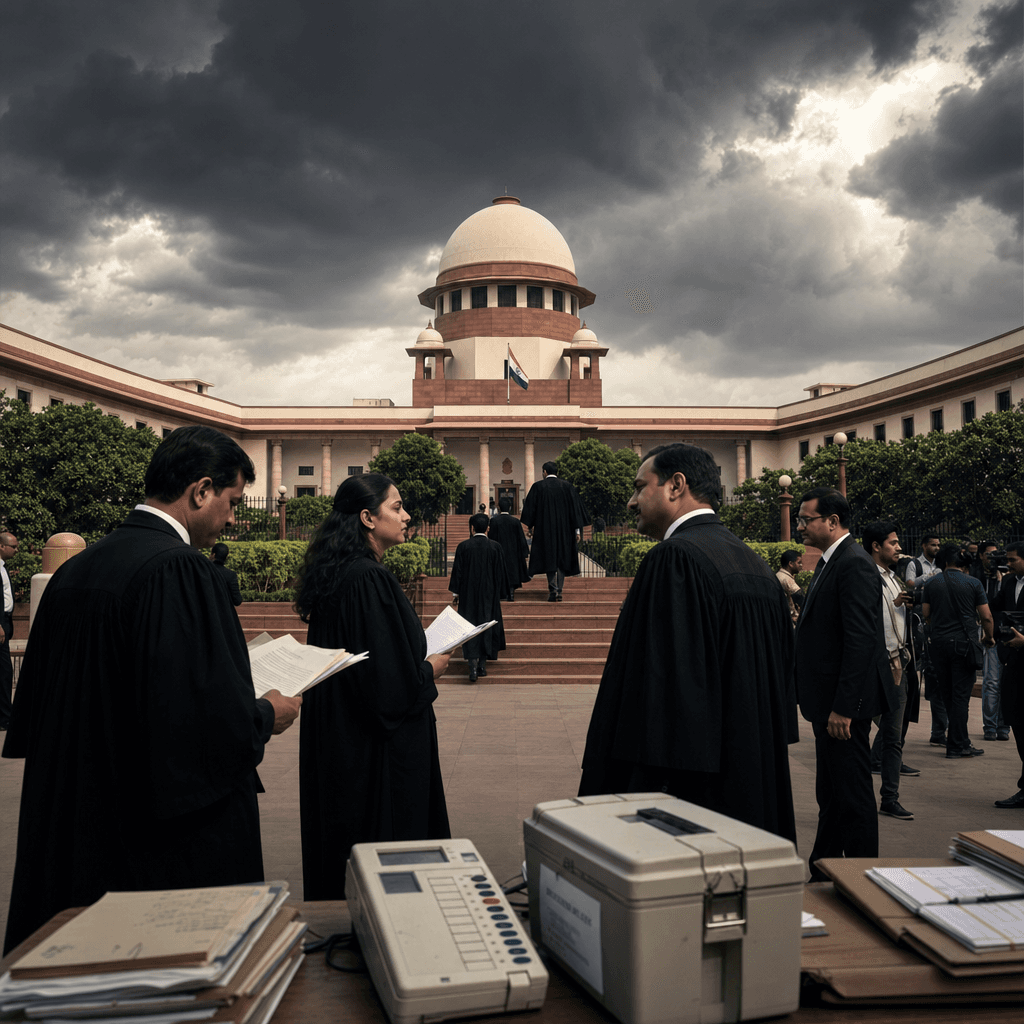
Supreme Court Tests Government Grip on EC Appointments
The court is deciding whether Parliament fixed Election Commission appointments or simply restored executive control, with the referee of India’s elections at stake.
The Supreme Court on Thursday sharpened its attack on the 2023 law governing the appointment of the chief election commissioner and election commissioners, calling Parliament’s delay in legislating after the Anoop Baranwal ruling “tyranny of the elected” during a hearing on the law’s validity, The Indian Express. The bench also pressed petitioners on why the earlier judgment had not been read as a temporary fix, not a permanent constitutional mandate, while lawyers for Congress leader Jaya Thakur and the Association for Democratic Reforms argued that the new law keeps appointment power too close to the government,
The Times of India.
Why the bench is probing the delay
The immediate power dynamic is clear: the Union government wants to keep Parliament’s 2023 law intact; the petitioners want the court to preserve a non-executive check on who runs the Election Commission. In Anoop Baranwal in 2023, the Supreme Court held that appointments should, until a law was made, be decided by a committee of the Prime Minister, the Leader of Opposition and the CJI, The Hindu. Parliament then passed the Chief Election Commissioner and Other Election Commissioners (Appointment, Conditions of Service and Term of Office) Act, 2023, replacing the CJI with a Union Cabinet minister and giving the executive two of the three seats on the committee,
The Hindu.
That is why the court’s language matters. Justice Dipankar Datta’s “tyranny of the elected” remark is not a throwaway line; it signals unease with a system where the ruling party can shape the institution that oversees its own elections, The Indian Express. Petitioners are making the stronger structural argument: even if Parliament had the power to legislate, it could not simply erase the core principle behind Anoop Baranwal — that the Election Commission should not be picked under exclusive executive control,
The Times of India.
The real fight is over institutional leverage
This is not about one appointment. It is about who gets to control the electoral referee before a national election cycle. As The Hindu has noted, the old system left the President acting on the advice of the Prime Minister and council of ministers; the 2023 law kept the selection process inside a government-dominated channel, just with a legislative wrapper, The Hindu. For the government, that preserves administrative control and avoids a court-imposed selection model. For the petitioners, it institutionalises the very dependency the 2023 judgment was designed to break.
That is why this case sits squarely inside the larger India debate over whether constitutional bodies are being insulated from or absorbed by the executive. The Election Commission’s legitimacy depends less on rhetoric about neutrality than on whether losing parties believe the appointment process is genuinely independent.
What to watch next
The next decision point is whether the bench treats Anoop Baranwal as a stop-gap ruling or as a constitutional baseline that Parliament had to respect. If the court leans toward the petitioners, it could force a rewrite of the 2023 framework or send the issue back to Parliament with a clearer independence requirement. If it backs the government, the present two-to-one committee remains, and the executive keeps the upper hand over the appointments that matter most to its own re-election prospects. The immediate watch item is the next hearing session, when the bench will signal whether it is prepared to cut back Parliament’s law or leave the current model in place.
Discover more
India
CPI(M) Calls to Decouple Quota from Delimita
CPI(M) demands the Indian government to separate quota policies from delimitation to enhance representation for marginalized communities.
Global Politics
Iran Releases $12B Frozen Assets Deal
Iran secures $12 billion in frozen assets as US lifts oil sanctions under new deal.

India
India-UK Trade Pact Removes Tariffs on 99%
India's trade pact with the UK eliminates tariffs on 99% of exports, but execution risks loom.
International Relations
US Releases $12 Billion in Frozen Iranian Aid
The US releases $12 billion in frozen Iranian assets, signaling a shift in negotiations.