Sudan's 4.35 Million Refugees Threaten Region
Sudan's refugee crisis is a growing regional security issue.
Model Diplomat8 min readAfrica
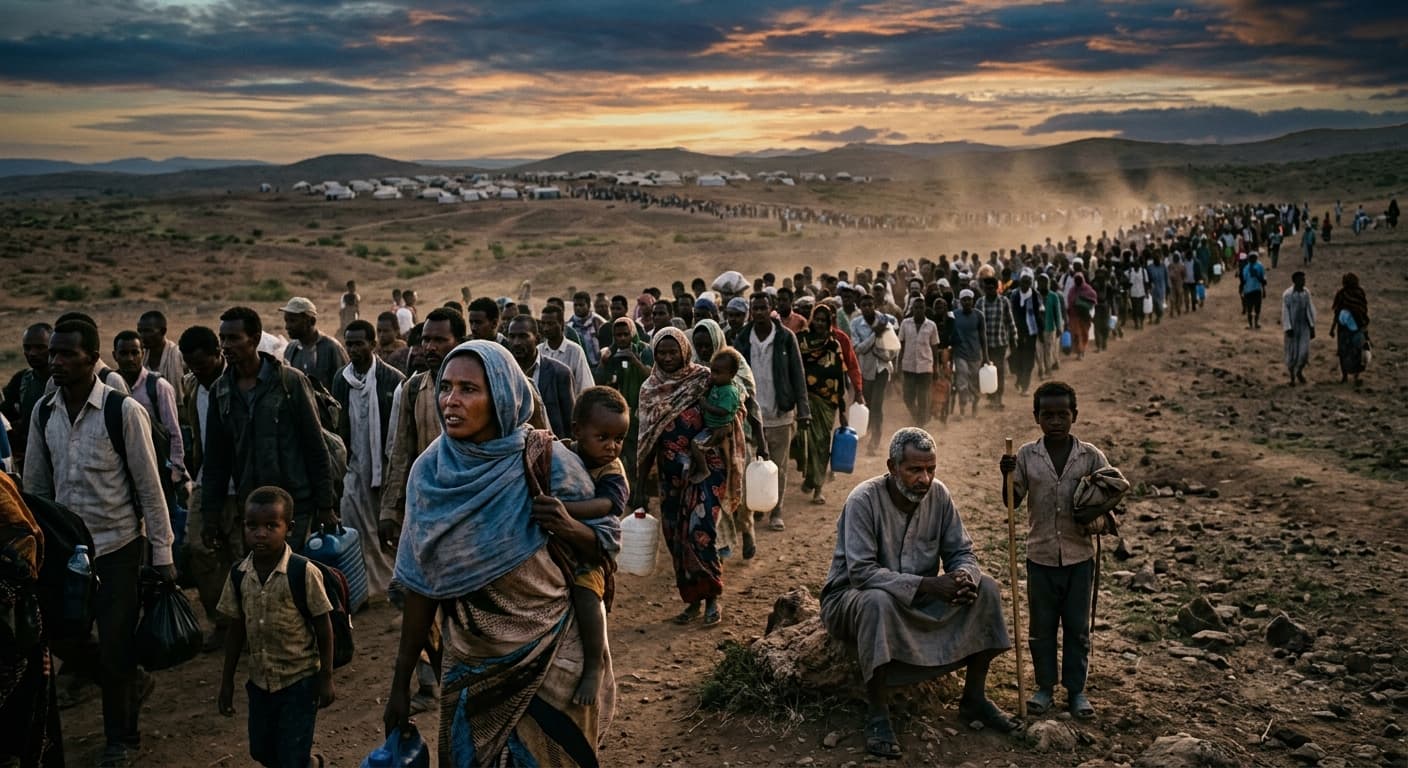
Sudan's 4.35 Million Refugees Are Becoming a Regional Security Problem
As of May 31, 2026, UNHCR counts 4,349,768 Sudanese refugees across seven neighbouring states — a caseload now large enough to bend the politics of Chad, Egypt, and South Sudan.
Sudan's civil war has produced the world's largest displacement crisis — and by the UNHCR's May 31, 2026 accounting, it has also produced a regional security problem that no neighbour can absorb alone. The UN Refugee Agency records 4,349,768 Sudanese refugees across the Central African Republic, Chad, Egypt, Ethiopia, Libya, South Sudan and Uganda, with a 2026 Regional Refugee Response Plan (RRP) that asks donors for USD 1.6 billion. As of February 2026, the Institute for Security Studies reports the wider Sudan humanitarian appeal was funded at just 13 percent. That gap — between what host states are absorbing and what donors are paying — is now the operative variable in the crisis. It is what turns a Sudanese war into a Sahel-to-Red-Sea instability zone.
What the numbers show
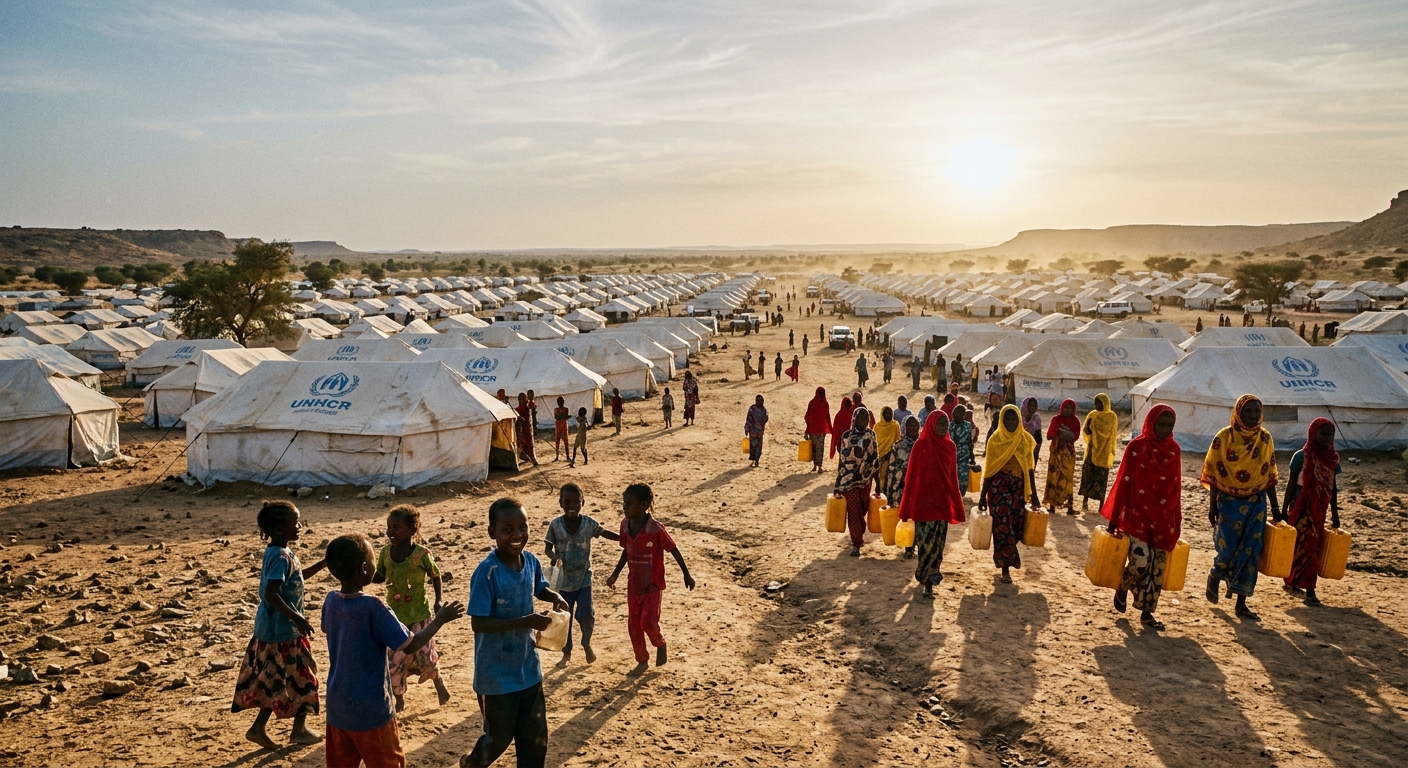
UNHCR's 2026 planning figures, published in its Regional Refugee Response Plan, place two host states in the front line. Egypt hosts 1,560,779 Sudanese refugees — the largest single caseload, roughly 36 percent of the regional total. Chad hosts 1,312,633, with the population having "more than tripled" since April 2023, according to a UNHCR
briefing note. South Sudan hosts 711,497 Sudanese while itself grappling with 2 million internally displaced people. Libya, whose figures are the least verifiable, holds an estimated 538,000. Ethiopia, Uganda and the Central African Republic together host under 230,000.
The distribution matters because it is not evenly stressful. UNHCR is asking for USD 567.7 million for Chad alone in 2026 — over a third of the entire regional appeal — because eastern Chad is where the marginal refugee arrives and where the marginal dollar is missing. In its May 2026 dashboard, UNHCR reported that Sudanese refugees in eastern Chad were receiving "5 litres of water per person per day, well below the international standard of 15 to 20 litres."
The 4.35 million figure is the floor, not the ceiling. UNHCR projects that by end-2026, the population in Chad alone will reach 1.48 million; the seven-country total is projected at just over 4 million refugees plus 1.8 million assisted host-community members. In its own words the agency warned in May 2025:
"Four million people have now fled Sudan into neighbouring countries since the start of the war… If the conflict continues, thousands more people will continue to flee, putting regional and global stability at stake."
The spillover has stopped being hypothetical
Through most of 2024 the "regional stability" framing was a warning. In 2026 it is an event log.
On March 19, 2026, a drone attack launched from Sudan killed 17 people in the Chadian border town of Tine, according to Al Jazeera's reporting citing the Chadian government. President Mahamat Idriss Déby ordered the army to "retaliate starting from tonight to any attack coming from Sudan" and Chad publicly reserved the right to conduct operations inside Sudanese territory. The strike came a month after Chad closed its 1,400-kilometre eastern border and after RSF forces seized Tina — the Sudanese town separated from Tine only by a dry streambed.
The Chad exposure is now structural, not incidental. Foreign Affairs' Alex de Waal argued in January 2026 that RSF supply lines "run through Chad, Libya, Somalia, and South Sudan — and may yet involve Ethiopia and Kenya," while cattle-herding Arab groups have crossed from the CAR and Chad "aiming to seize the newly vacated lands" in Darfur since El Fasher fell in October 2025. The war is producing a demographic and armed reordering along a 3,000-kilometre arc.
South Sudan is the next pressure point. According to Foreign Affairs, when the Sudanese Armed Forces withdrew from the Heglig oil field in December 2025 under RSF attacks, Juba "decided to cooperate with the incoming RSF" — a hedge that keeps its oil pipeline open but exposes President Salva Kiir to Egyptian and Saudi retaliation. Egypt, host to over 1.5 million Sudanese refugees, is simultaneously bombing RSF supply convoys from a remote airstrip near its southwestern border, per investigations by The New York Times and Reuters cited by the BBC. The refugee-hosting states and the belligerent states are, in three cases, the same states.
The funding collapse is a policy decision
The refugee population is rising into a donor environment that is deliberately smaller.
In 2025, only 38 percent of the UN humanitarian appeal for Sudan was funded, according to the Institute for Security Studies. As of February 2026, the corresponding figure was 13 percent. The Stimson Center
reported that the 2026 Humanitarian Needs and Response Plan requires USD 9 billion and had received under 16 percent of that as of April 2026. The Council on Foreign Relations, in its
June 2026 explainer, pegged the coordinated in-country appeal at USD 2.8 billion, 17 percent funded, and attributed part of the shortfall to "the Trump administration's cuts to the U.S. Agency for International Development."
Amnesty International, in its April 15, 2026 statement marking the war's third anniversary, noted that US funding for Sudan's coordinated plan "halved between 2024 and 2025, and in 2025 less than 40% of the plan was financed by all donors." The Berlin donor conference of April 15, 2026 — the flagship diplomatic event of the year on Sudan — produced no material change in the funding trajectory, according to CFR's post-conference assessment.
The under-financing has an operational signature. In Chad, UNHCR reports that "only 14 per cent of current needs" for shelter are being met, and roughly 290,000 refugees remain stranded at the border. Médecins Sans Frontières recorded that 25 of 212 children admitted with meningitis to its eastern Chad facilities between March and April 2026 died, per Reuters reporting cited by CFR. The Farchana refugee settlement, established in 2004, was warning in December 2025 that malnutrition-programme funding would expire by the end of that year, Al Jazeera reported.
The refoulement problem inside Egypt
The refugee crisis is starting to produce refugee-law crises inside host states. In December 2025, according to ISS, Egypt — which hosts 36.6 percent of Sudan's refugee population — "ramped up deportations, forcing many back home." Deportations from a state party to the 1951 Refugee Convention and its 1967 Protocol into an active conflict zone are, on their face, at odds with the non-refoulement obligation in Article 33.
UNHCR's own 2026 planning document notes the pressure candidly: returnees, it says, "find widespread destruction, insecurity, and at times open conflict… Many returnees are forced to flee again, whether internally or across international borders." The agency's May 31, 2026 returns dashboard records approximately 680,000 returns from Egypt to Sudan since 2024 — the largest single-country return flow, larger than the flows from South Sudan (59,000) and Chad — and it flags that a substantial share of these movements are pendular or coerced, not durable.
Why this matters beyond the humanitarian frame
There are three second-order effects that policymakers in Cairo, N'Djamena, Nairobi and Brussels are already pricing in.
First, the war is producing a permanent Chad-Darfur security membrane. UNHCR reports "an average of 1,400 people crossing the border daily" during the peak El Fasher displacement in May 2025, into a country where the government has already ordered cross-border retaliation. Any future RSF-linked strike inside Chad will now be met with a Chadian military response — and Chad, unlike Sudan's other neighbours, is a European counter-migration and counter-terrorism partner. A Chad-Sudan military exchange in 2026 would draw in French, EU and possibly US posture decisions that were not on the table in 2023.
Second, the demographics of eastern Chad are being rewritten in a single conflict cycle. Chad's total refugee population — Sudanese and other — is now roughly 1.3 million, in a country of about 18 million. Sudanese refugees alone exceed 7 percent of the Chadian population. In eastern Chad's Wadi Fira and Ouaddaï provinces, the ratio is far higher. The Institute for Security Studies argues this makes an ad hoc bilateral response insufficient: a "coherent, enforceable and predictable regional protection framework" is needed, with formal burden-sharing across IGAD member states. Sudan's decision in February 2026 to rejoin IGAD — after freezing its membership in 2024 over IGAD's engagement with RSF leader Mohamed Hamdan Dagalo — is the only real diplomatic movement on that front.
Third, the war is on the cusp of producing another El Fasher. RSF forces are besieging El-Obeid, capital of North Kordofan, with roughly 500,000 civilians and 105,000 already-displaced people trapped, Al Jazeera reported on July 6, 2026. If El-Obeid falls, UNHCR's 2026 refugee projection — 4 million by year-end — is a floor that will not hold. The RRP baseline assumes conflict continues; it does not assume a second El Fasher-scale atrocity.
The regional response is behind the curve
Neither the "Quad" mediation track — the United States, Saudi Arabia, Egypt, and the United Arab Emirates — nor the Berlin donor conference has translated into either a ceasefire or a funded response. The RSF has "verbally accepted a Quad roadmap for peace beginning with a humanitarian truce," the BBC reported, "but neither side has formally responded and fighting has accelerated rather than abated." CFR's Michelle Gavin, writing on June 23, 2026, characterised the international posture as another "failure to act."
The UNHCR Sudan dashboard as of 31 May 2026 — the primary document behind this story — quantifies the resulting bill for the neighbours: 4.35 million refugees, USD 1.6 billion of unfunded protection needs, and a projected caseload growth of roughly 300,000 by year-end even under the war's current tempo.
What to watch
- El-Obeid, July–August 2026. The UN's Office of the High Commissioner for Human Rights has warned of a "catastrophe" if RSF and SAF forces engage inside the city. A fall would trigger a new displacement wave into Kordofan-adjacent host areas and potentially into South Sudan; UNHCR's projection ceiling assumes El-Obeid holds.
- The next UN Security Council session on Sudan. The US has repeatedly called for authorisation of cross-border aid deliveries through Chad; a formal Chapter VII vote would test Russian and Chinese positions on the Adre corridor, which Sudan extended to September 30, 2026.
- Chad-Sudan military exchanges. President Déby's March 19, 2026 authorisation to retaliate is standing. Any subsequent RSF- or SAF-linked strike into Chadian territory would activate it, with immediate implications for the EU's Sahel posture and for the 1.3 million refugees inside the country.
- The mid-year 2026 RRP funding update. UNHCR's next quarterly funding tracker will show whether the 13 percent floor has held or slipped further; below 10 percent, aid agencies have said publicly, entire sectors — shelter, education, GBV response — will be shut down in Chad and South Sudan.
The Bottom Line
Sudan's refugee crisis has crossed the threshold at which it is no longer a humanitarian file — it is a regional security file, running through the borders of Chad, Egypt, South Sudan and Libya. With 4.35 million refugees regionally and the 2026 UN appeal 13 percent funded, the burden has been transferred, by default, to the host states least able to carry it. The next El Fasher is being decided in El-Obeid, and the international system's answer, so far, is a Regional Refugee Response Plan without the money to execute it.
Discover more

US Politics
SNAP Food Assistance Faces Legal Challenges
In 2026, SNAP faces stricter eligibility rules and mounting legal challenges, threatening food assistance for the millions of Americans who rely on the program.

US Politics
House Ethics Committee Pushes Sexual Miscond.
The House Ethics Committee has shifted responsibility for sexual harassment settlement records to the Office of Congressional Workplace Rights, complicating disclosure efforts.
International Relations
Economist Impact Sustainability Week 2026
Economist Impact Sustainability Week 2026 spotlights the energy transition, AI in clean technology, and supply chain resilience as themes for global leaders.

Conflict & Security
Drone Warfare Killing Aid Workers at Unprec
Over 1,000 humanitarian workers killed in three years as cheap armed drones collapse legal protections. Gaza, Sudan, Ukraine, and DRC see deliberate targeting of aid convoys and hospitals with zero prosecutions.