Sudan Army Retakes Kurmuk, Cuts RSF Supply
Sudan's army regains control of Kurmuk, impacting RSF's operations.
Model Diplomat6 min readAfrica
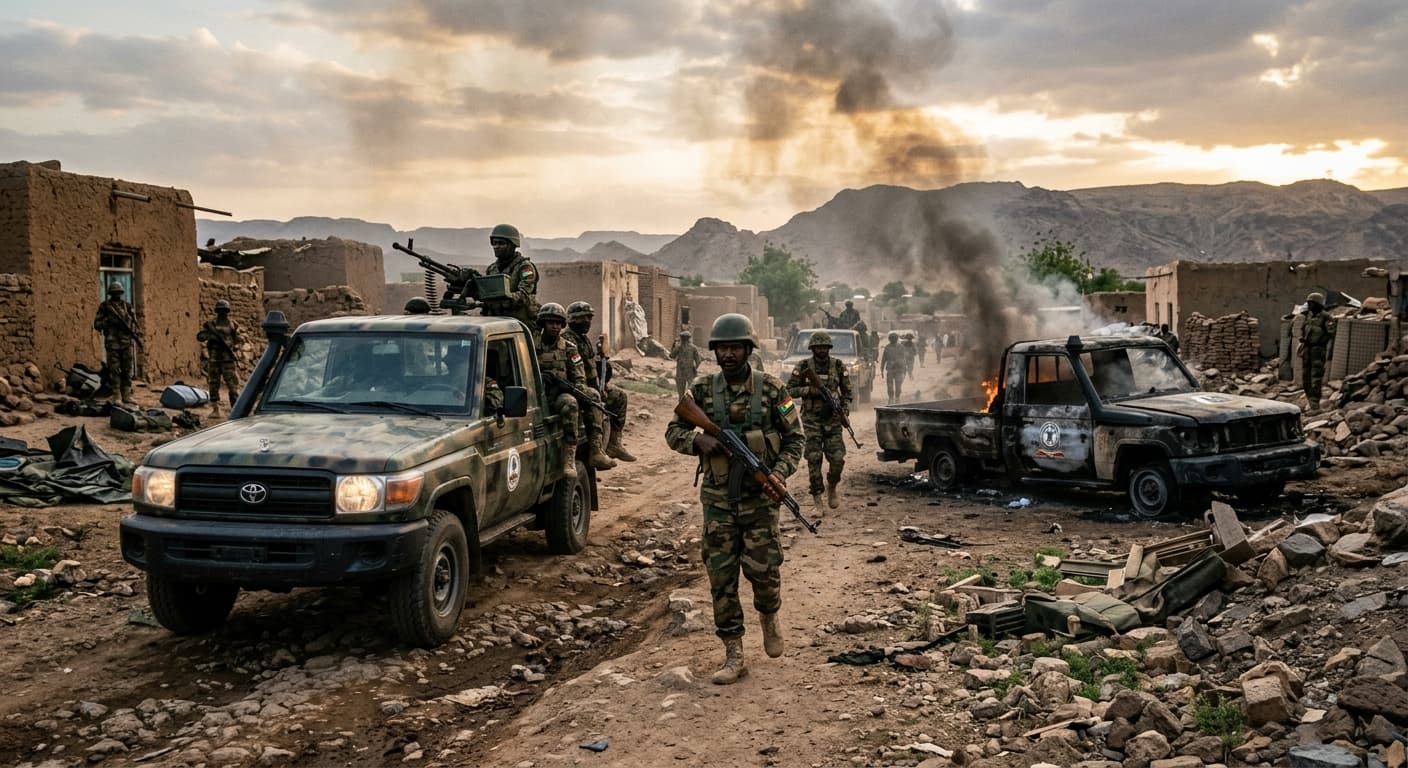
Sudan army retakes Kurmuk, closing RSF's Ethiopia lifeline
Sudan's army recaptured the border town of Kurmuk on July 8, 2026, cutting the RSF's Blue Nile front and its cross-border supply line from Ethiopia.
The Sudanese Armed Forces retook Kurmuk on July 8, 2026, ending 106 days of Rapid Support Forces control over the Ethiopian-border town — and with it, the paramilitary's most promising route to reopen the war on Khartoum's flank. The recapture matters less for the ground it restores than for what it denies the RSF: a garrison within artillery range of the Roseires Dam, a resupply channel from Ethiopia, and the political prize its alliance with the SPLM-N was built to secure. Kurmuk was the RSF's Ethiopian gateway, and the SAF has just slammed it shut — for now.
According to a statement carried by Xinhua, the SAF said its forces "with allied support" inflicted casualties and captured weapons and vehicles, and would now focus on "protecting civilians and restoring basic services." Security sources told
Sudans Post that army units advanced south from Sali along the Damazin–Kurmuk road, entering the town after RSF fighters withdrew. Thousands celebrated in Damazin, Blue Nile's capital, as officials toured streets in convoys,
Middle East Monitor reported.
Why Kurmuk was worth the war
Kurmuk is a small town with outsized geometry. It sits on the Ethiopian border in Blue Nile — a thin strip of Sudanese territory wedged between Ethiopia and South Sudan — astride the road network that connects the Nile valley to the Ethiopian highlands. When the RSF and the al-Hilu faction of the Sudan People's Liberation Movement–North (SPLM-N) captured it on March 24, Al Jazeera called the town a "garrison" the RSF used as a "launchpad to seize more territory," giving the paramilitaries their first foothold on the country's south-eastern frontier.
Two features made it a strategic prize. First, the Al-Roseires Dam — Sudan's 280-megawatt hydropower plant and the head of the Gezira irrigation scheme — lies roughly 110km downstream on the Blue Nile. Whoever holds Kurmuk holds the approaches to that dam. Second, the town anchors a cross-border trade and smuggling network that has quietly fed the war economy on both sides of the frontier, as
Chatham House documented in its Ethiopia–Sudan border study.
The Ethiopia problem the SAF just solved — for now
The Kurmuk fight is the closest the Sudanese war has come to a formal proxy engagement with a neighbouring state. In an unusually direct assessment, The Economist argued in April that the RSF's March capture of Kurmuk could "rank among the most consequential" battles of the war, because it appeared to show, "for the first time," that the RSF had "staged an offensive from deep within the territory of one of Sudan's neighbours."
The International Crisis Group has been more explicit still. In an April 2026 briefing, Divided Sudan, Elusive Peace, the group warned that "Ethiopia [is] seemingly weighing in more heavily on the RSF's side against the army, which is backed by Ethiopia's main adversaries, Egypt and Eritrea," and cited February 2026
Reuters reporting that Ethiopia had built a secret camp to train RSF fighters — an allegation Addis Ababa denies. The BBC noted separately that the UAE, the RSF's principal external backer, has also denied
funding an RSF training camp in Ethiopia.
Reclaiming Kurmuk severs the operational logic of that arrangement. RSF units in Blue Nile can no longer rotate across the border to rest and rearm without traversing SAF-held ground, and the SPLM-N (al-Hilu) faction — which had provided most of the local infantry — loses its most valuable joint operating base. It does not resolve the underlying regional alignment. But it removes the immediate battlefield lever Addis Ababa was accused of pulling.
What the army buys with this victory
The tactical dividend is narrower than the celebrations suggest. SAF now controls the Damazin–Kurmuk axis and can plausibly stabilise the eastern half of Blue Nile before the rains peak in August. That protects the Roseires reservoir, secures the Gezira irrigation system that feeds much of central Sudan, and denies the RSF a second axis of advance toward the Nile valley just as the paramilitaries are being ground down in Kordofan.
The bigger dividend is political. On the same day it retook Kurmuk, the army-aligned transitional government's deputy chair — Malik Agar, leader of the rival, SAF-aligned faction of the SPLM-N — circulated a plan calling for "restoring the state's monopoly on arms and dissolving non-state armed groups" as a route to elections, Al Jazeera reported. The proposal, obtained by the network, is designed to peel civilian legitimacy away from the RSF-led Tasis coalition in Nyala. The timing is not accidental: a military win against al-Hilu's fighters strengthens Agar's hand against al-Hilu, both men claiming to speak for the same aggrieved Nuba and Blue Nile constituencies.
The humanitarian ledger
The retaking of Kurmuk arrives on top of a displacement crisis the fighting itself created. According to the IOM Displacement Tracking Matrix, 59,742 people were newly displaced across Blue Nile state between January 11 and May 21, 2026, with more than half — 30,025 people — driven from Al Kurmuk locality itself. Fifty per cent of those forced to move were children.
Cross-border flows are larger still. In its most recent weekly bulletin, the UN Office for the Coordination of Humanitarian Affairs reported that more than 205,000 people have fled South Kordofan and Blue Nile into South Sudan and Ethiopia. OCHA's
March–April update had warned in May that "escalating violence in Blue Nile displaces thousands, strains services and heightens protection risks, especially for women." The UN's
2026 Sudan Humanitarian Needs and Response Plan, meanwhile, catalogues 9.3 million internally displaced and 4.4 million refugees — still, in its words, "the world's largest displacement crisis."
Kurmuk's governor said preparations are underway for residents to return and for the rebuilding of infrastructure destroyed during the RSF occupation. Damazin, 250km to the north, is now hosting some 31,000 of them, according to IOM.
The war's changing geometry
Zoom out and Kurmuk fits a pattern. Since retaking Khartoum in March 2025, the SAF has methodically peeled back RSF gains along the peripheries: Wad Madani in January 2025, el-Obeid in February, Kadugli and Dilling by February 2026, Bara in March, Khor Hassan in May, and now Kurmuk. In each case, the army has traded speed for logistics, using drone strikes and combined-arms assaults to break RSF strongpoints on supply routes.
The RSF's answer has been to shift westward and — in the Kordofans — southward, in alliance with SPLM-N (al-Hilu). Al Jazeera reported in October that the loss of Bara "spells a serious deterioration in the RSF's power in the Kordofans," cutting supply and reinforcement lines to Darfur. The Council on Foreign Relations'
Global Conflict Tracker puts it plainly: mediation "has stalled as top officials in both warring camps refuse to halt their violence," even as UN monitors document industrial-scale sexual violence and hundreds of children killed by drone strikes.
Two things follow. First, the war's centre of gravity is now in western and southern Sudan — el-Obeid, currently under RSF drone bombardment as the BBC has documented, will decide who controls the Kordofan corridor next. Second, the Blue Nile front, which briefly looked like the RSF's route back into central Sudan, has been narrowed to a border strip that Ethiopia's calculations no longer materially reshape.
What to watch
- August rains. The SAF must hold Kurmuk through the wet season, when roads flood and resupply from Damazin becomes difficult. If the RSF/SPLM-N can counter-attack in September, the recapture is provisional.
- El-Obeid. UN humanitarian chief Tom Fletcher warned via
UN News on June 26 that "the window is closing" to prevent a wider escalation around North Kordofan's capital. Save the Children says 11,000 people, including 5,500 children, have already fled the area, per
Al Jazeera.
- The Agar track. Whether the Agar peace framework, published July 8, attracts any defections from SPLM-N (al-Hilu) commanders in the Nuba Mountains — the alliance most damaged by Kurmuk's fall.
- The Quad. The US-led mediation grouping (US, Egypt, Saudi Arabia, UAE) has yet to secure a truce; watch for a renewed initiative under UN Envoy Pekka Haavisto, whom
Chatham House flags as the likeliest bridge between military and civilian tracks.
The Bottom Line
The bottom line: Kurmuk's recapture is not the end of Sudan's war, but it ends the RSF's most dangerous adaptation — the attempt to open a second front on the Ethiopian border while its western positions collapse. What the army has bought is time and geography; what the paramilitaries have lost is the one lever that made a neighbouring state a party to the conflict. The next test is whether Khartoum can convert battlefield momentum into a political settlement before the rains, or whether the war simply migrates west again to el-Obeid and the Kordofans.
Discover more

US Politics
House Ethics Committee Pushes Sexual Miscond.
The House Ethics Committee has shifted responsibility for sexual harassment settlement records to the Office of Congressional Workplace Rights, complicating disclosure efforts.

Global Politics
U.S. Naval Blockade Heightens Iran Tensions
The U.S. naval blockade of Iran collapsed oil exports, creating a new maritime regime in Hormuz that favors Tehran.

US Politics
SNAP Food Assistance Faces Legal Challenges
In 2026, SNAP faces stricter eligibility rules and mounting legal challenges, threatening food assistance for the millions of Americans who rely on the program.

Economics
Fed's Amex AML order puts correspondent banking on notice
Federal Reserve's Amex AML order requires board-level controls and a 90-day plan; OCC fined the bank $350 million over enterprise-wide deficiencies.