Sudan Army Retakes Al-Kurmuk: RSF Supply Line
Sudanese forces capture strategic town from RSF
Model Diplomat7 min readAfrica
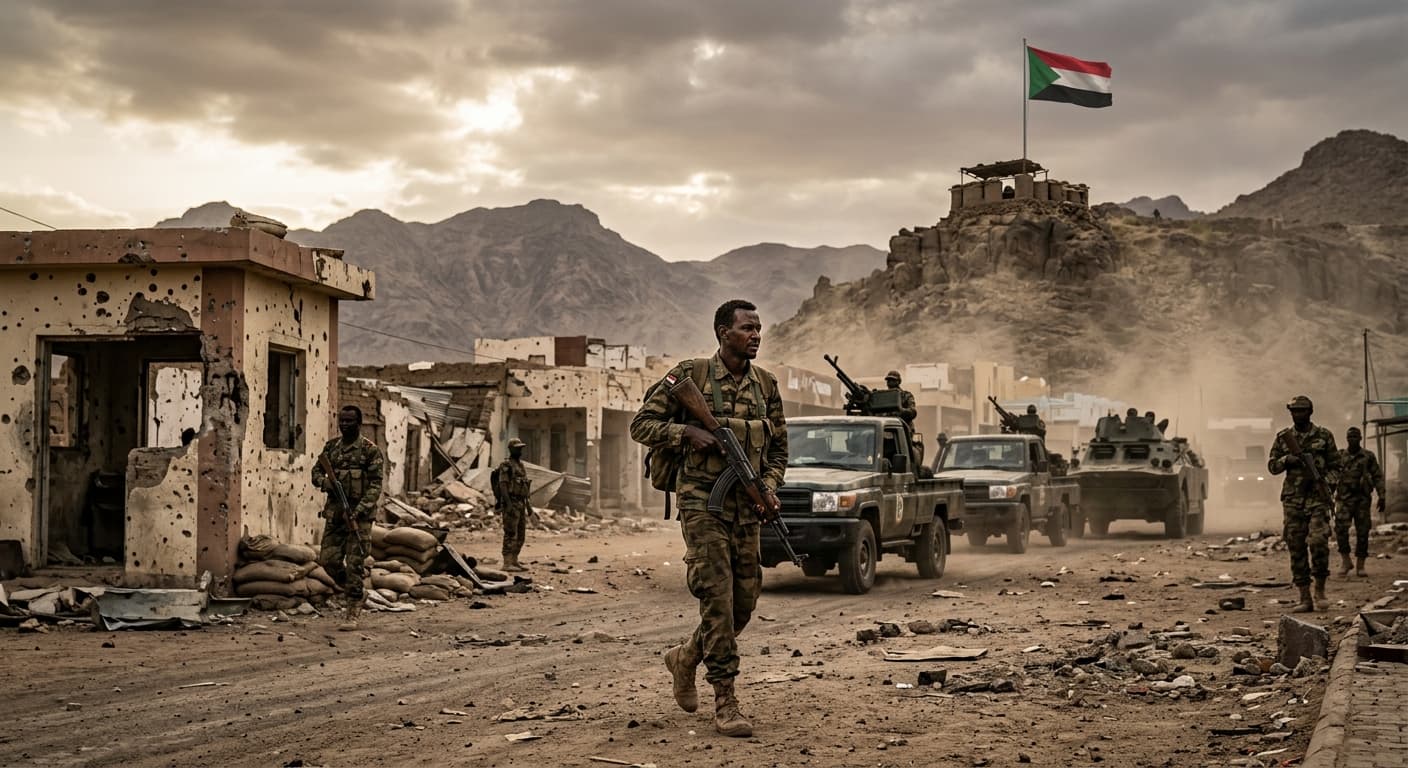
Sudan army retakes Al-Kurmuk: RSF's Ethiopia supply line under threat
Sudanese Armed Forces recaptured Al-Kurmuk in Blue Nile State on July 8, 2026, severing a key RSF cross-border supply corridor to Ethiopia.
The Sudanese Armed Forces on July 8, 2026 announced they had retaken Al-Kurmuk, a garrison town on the Ethiopian border that the Rapid Support Forces (RSF) and its allies had held since March 2025 — closing, for now, the paramilitary group's eastern-most resupply lane and pulling the war back toward a single front in Kordofan, where UN investigators warn the RSF is staging a second El-Fasher around El-Obeid. The strategic prize is not the town itself but the corridor: whoever controls Kurmuk controls RSF access to the Grand Ethiopian Renaissance Dam's hinterland, the Roseires reservoir, and the Emirati-linked logistics chain that has kept the paramilitary fighting for three years.
What happened, and why Kurmuk
Sudan's government confirmed the capture in a Facebook statement, saying the SAF and "supporting forces succeeded today in liberating the city of Al-Kurmuk in Blue Nile State through force and determination, following fierce battles," per The Eastleigh Voice. Khartoum claimed the RSF suffered heavy losses in personnel and equipment before retreating. The RSF has not commented.
The town matters for three concrete reasons. Kurmuk sits on the road linking Sudan to Ethiopia's Benishangul-Gumuz region and, through it, to South Sudan — the same triangle that has hosted a surge of suspected UAE-linked weapons shipments and mercenary flows since late 2025, as the American Enterprise Institute documented. It is 110 kilometres from the Roseires Dam, Sudan's largest hydroelectric facility, which RSF drones first struck in March 2025, per
Al Jazeera. And Blue Nile State contains substantial gold deposits — the commodity that, as
Foreign Affairs has detailed, has financed the RSF war effort primarily through smuggling routes ending in the UAE.
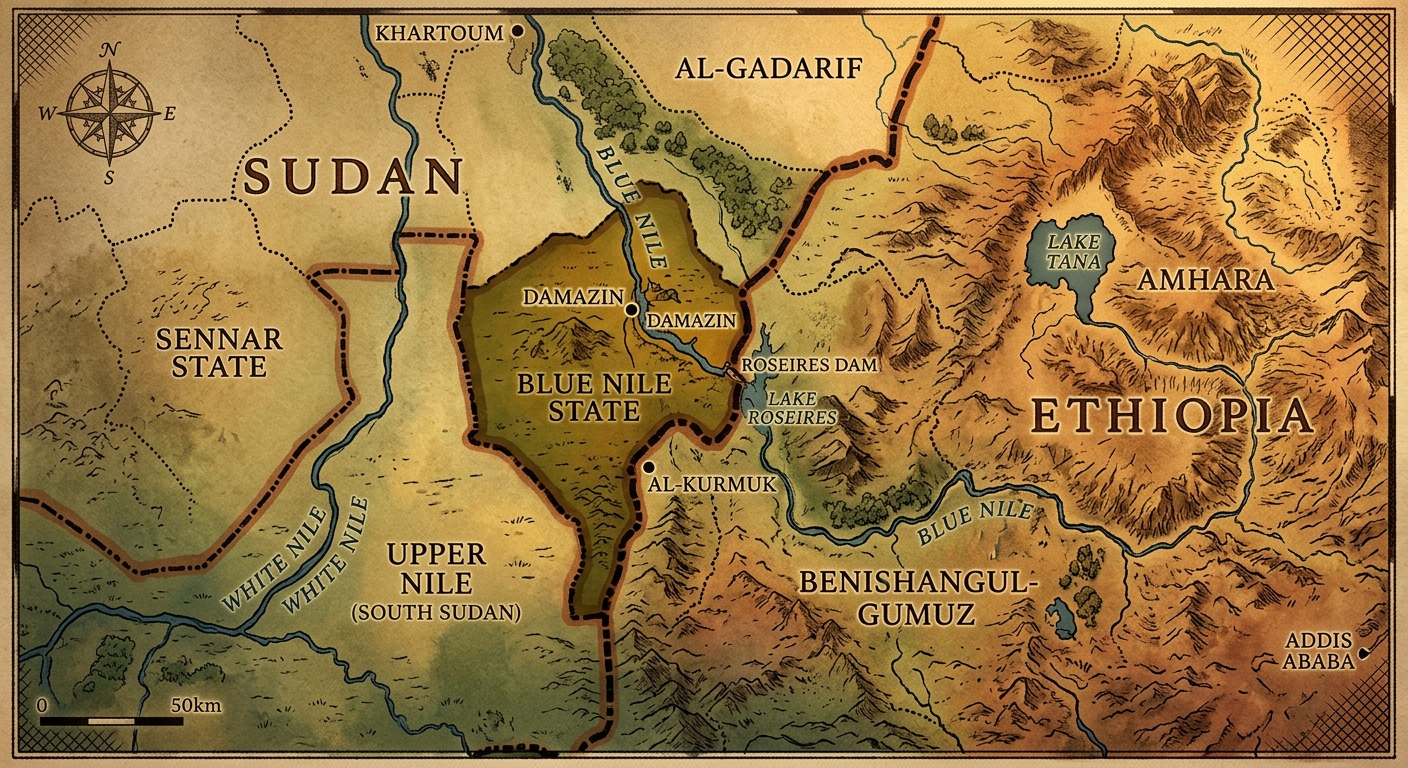
The capture follows a two-month campaign. On May 16, 2026, SAF took the town of Khor Hassan and stated openly, via the Sudan Tribune, that the operation's purpose was to encircle Kurmuk, Al Jazeera reported. The RSF had seized Kurmuk itself in March 2025 with the
Sudan People's Liberation Movement-North (SPLM-N) — an alliance formalised days after the SAF took Khartoum, and one that gave the RSF a second axis of pressure on the capital from the southeast.
The regional power play
The Blue Nile front has never really been a Sudanese-only fight. It is where Gulf, Nile-basin and Horn rivalries collide, and where SAF's victory in Kurmuk changes the leverage of at least three foreign patrons.
The primary loser is the United Arab Emirates. A March 2026 SWP assessment — from Germany's federally-funded foreign policy institute, the Stiftung Wissenschaft und Politik — reported that Abu Dhabi set up an RSF training camp in Ethiopia's Benishangul-Gumuz region in autumn 2025, routing military equipment via Berbera in Somaliland through an Ethiopian armed forces base. Losing Kurmuk means that channel can no longer feed the front directly into Blue Nile; whatever the UAE puts into Ethiopia must now travel further, more visibly, and through more contested terrain. Sudan's own military spokesperson, Brigadier General Asim Awad Abdelwahab, told a May 2026 news conference that four drone attacks since March had originated from Ethiopia's Bahir Dar airport using UAE-supplied drones,
according to Al Jazeera.
The secondary loser is Ethiopia — specifically, the studied ambiguity Addis Ababa has cultivated. The Observer Research Foundation warned in April 2026 that Sudan's war was migrating eastward and risked becoming "the fault line of Northeast Africa," entangling Nile water politics with Gulf competition. Kurmuk sits inside that fault. If SAF holds the town, Ethiopia's official denial of RSF logistics is easier to sustain; if the RSF counterattacks and re-enters, it becomes politically explosive for Prime Minister Abiy Ahmed. Abiy's government already faces a separate embarrassment: Ethiopian state media report that Tigrayan youth are allegedly being forcibly recruited to fight in Sudan, per the Addis Standard summary carried by
The Eastleigh Voice.
The winner, quietly, is Saudi Arabia. As ISPI documented in a March 2026 analysis, Riyadh has spent the past year actively disrupting Emirati resupply — refusing overflight permission to UAE cargo aircraft, brokering a reported $1.5 billion Pakistani arms package for the SAF, and pressuring Libya's Khalifa Haftar to close the Kufrah air base that had funnelled Emirati flights to Darfur. Every SAF gain on the border consolidates that strategy.
The humanitarian catch: what Kurmuk does not solve
Kurmuk's recapture does not touch the more dangerous single-city crisis 700 kilometres to the west. On July 8, 2026 — the same day Khartoum announced Kurmuk's recapture — the UN Independent International Fact-Finding Mission for Sudan issued a fresh report warning that the RSF is deploying against El-Obeid the same tactics used at El-Fasher: "encirclement, attacks on civilian infrastructure, restrictions on humanitarian access, and widespread abuses against civilians," according to UN News. Mission member Mona Rishmawi's statement was blunt:
"The international community still has a window of opportunity to prevent further atrocity crimes. El Obeid must not become the next crime scene."
The Fact-Finding Mission's February 2026 report found that RSF forces killed more than 6,000 people in three days when El-Fasher fell in October 2025, executing civilians door-to-door and targeting them by ethnicity. UN human rights chief Volker Türk warned on July 3, 2026 that El-Obeid — a city of half a million hosting nearly 100,000 displaced people — had endured "siege-like conditions for 18 months," with 45 civilians killed in 15 verified drone strikes over three weeks in June alone,
per UN News.
Nathaniel Raymond, executive director of Yale's Humanitarian Research Lab, told the BBC that El-Obeid is strategically decisive: "If you control el-Obeid, you control the road to the capital, Khartoum and Omdurman, and so the army has to defend el-Obeid." Satellite imagery shows at least eight fuel stations damaged by bombardment between late May and late June 2026, per Yale's Humanitarian Research Lab.
The arithmetic is bleak: Kurmuk removes one RSF axis, but the paramilitary retains the resources, the drones, and the strategic imperative to strike El-Obeid before SAF can reinforce it. The International Organization for Migration reported on July 3, 2026 that displacement is again rising sharply in Kordofan, and its Displacement Tracking Matrix records approximately 28,020 people newly displaced from Blue Nile State between January and March 2026 alone.
For civilians in Blue Nile: relief with an asterisk
For the immediate population of Kurmuk and its hinterland, SAF control is likely to reduce active fighting in the short term — the historical pattern from the 2011 iteration of the same battle, when BBC News reported the SPLM-North withdrew "for strategic reasons" rather than fight street to street. The SAF statement pledged that "protecting civilians, working to restore essential services, and creating the conditions necessary for the return of normal life are priorities for the coming phase."
Two cautions apply. First, the same UN Fact-Finding Mission has documented arbitrary detention, torture and enforced disappearances by both warring parties; SAF re-entry after RSF/SPLM-N occupation typically brings screening operations that punish those suspected of collaboration. Second, holding Kurmuk requires that SAF fend off a counter-offensive that will likely come — the SPLM-N under Abdelaziz al-Hilu retains its Nuba Mountains stronghold in South Kordofan, and the
Council on Foreign Relations Global Conflict Tracker notes that Blue Nile has become one of three states where fighting is increasingly concentrated.
What to watch
- El-Obeid, next 30 days. UN Human Rights Council adopted a resolution on July 6, 2026 authorising the Fact-Finding Mission to investigate El-Obeid; the next test is whether Security Council members follow through on Türk's call for "urgent" action. ACLED recorded 27 drone strikes on the city in June, the highest monthly total of the war.
- RSF response in Blue Nile. Watch for drone attacks on Damazin, Blue Nile's state capital, and on the Roseires Dam — the RSF used both as targets in March 2025 and retains the range to hit them again from Ethiopian territory.
- Ethiopia's next move. Sudan recalled its ambassador from Addis Ababa in May 2026. If Prime Minister Abiy Ahmed does not visibly close down alleged UAE staging at Bahir Dar, expect an SAF strike inside Ethiopia — an escalation ORF warned would drag Egypt in via the GERD file.
- Pakistan-Saudi arms package. ISPI-reported deliveries of aircraft and anti-air systems to SAF are the pivot. If they arrive on schedule in Q3 2026, the RSF's window to take El-Obeid closes.
The Bottom Line
Al-Kurmuk's recapture is less a Sudanese military victory than a Gulf logistics defeat: the UAE's Blue Nile corridor into RSF territory just got harder to run, and Saudi Arabia's slower squeeze on Emirati air supply is starting to work. But the paramilitary's decisive move is still ahead, and it is aimed at El-Obeid — where UN investigators have already published, on the day of Khartoum's Kurmuk announcement, the warning that they were ignored over El-Fasher and are determined not to be ignored again. The question is no longer whether Sudan's war is regionalising. It is whether it can be de-regionalised before another city becomes a crime scene.
Discover more

US Politics
House Ethics Committee Pushes Sexual Miscond.
The House Ethics Committee has shifted responsibility for sexual harassment settlement records to the Office of Congressional Workplace Rights, complicating disclosure efforts.

Global Politics
U.S. Naval Blockade Heightens Iran Tensions
The U.S. naval blockade of Iran collapsed oil exports, creating a new maritime regime in Hormuz that favors Tehran.
US Politics
SNAP Food Assistance Faces Legal Challenges
In 2026, SNAP faces stricter eligibility rules and mounting legal challenges, threatening food assistance for the millions of Americans who rely on the program.

Conflict & Security
Drone Warfare Killing Aid Workers at Unprec
Over 1,000 humanitarian workers killed in three years as cheap armed drones collapse legal protections. Gaza, Sudan, Ukraine, and DRC see deliberate targeting of aid convoys and hospitals with zero prosecutions.