State AI Laws Reach 109 Amid Trump Push
States enact AI laws despite federal preemption efforts.
Model Diplomat7 min readNorth America
State AI Laws Hit 109 as Trump Preemption Push Falters
Halfway through 2026, 29 US states have enacted 109 AI laws despite Trump's December executive order and a DOJ litigation task force built to kill them.
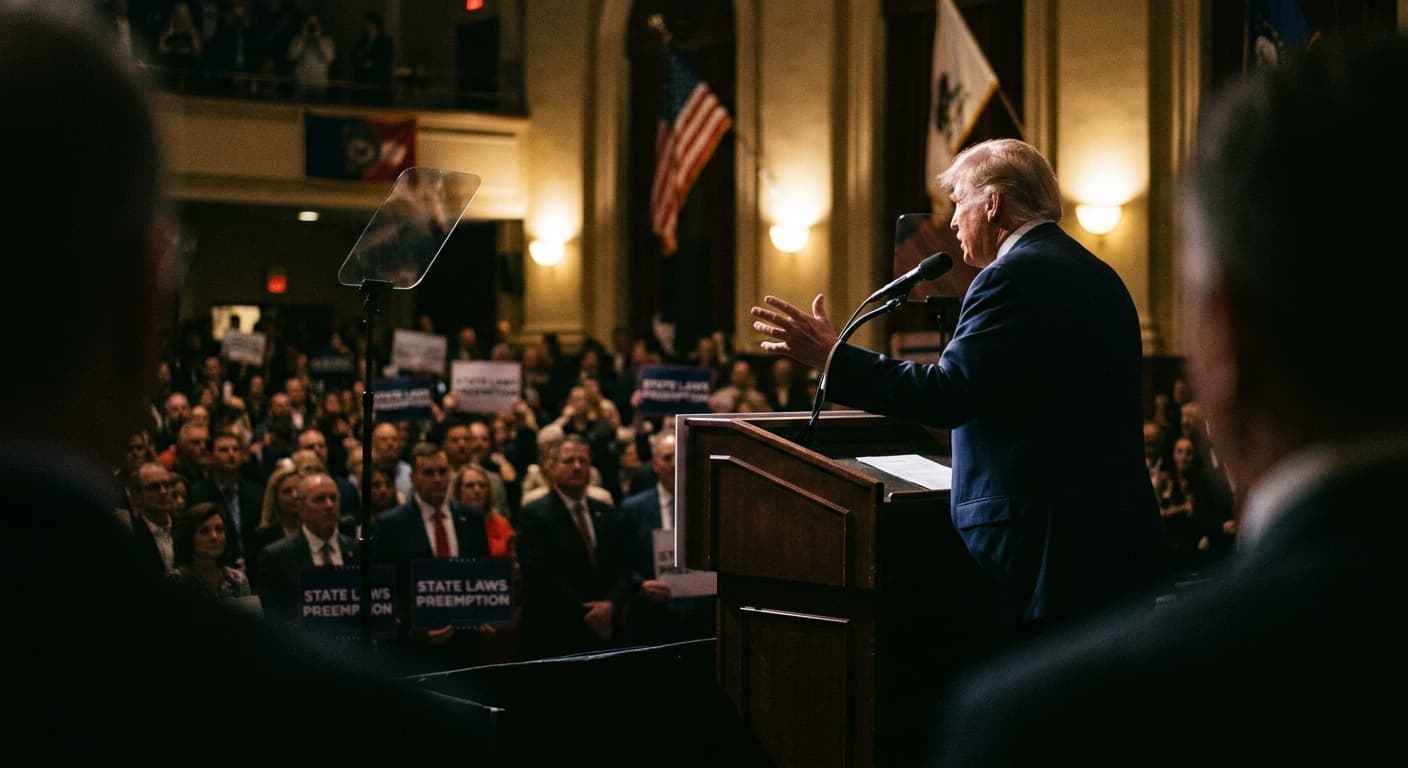
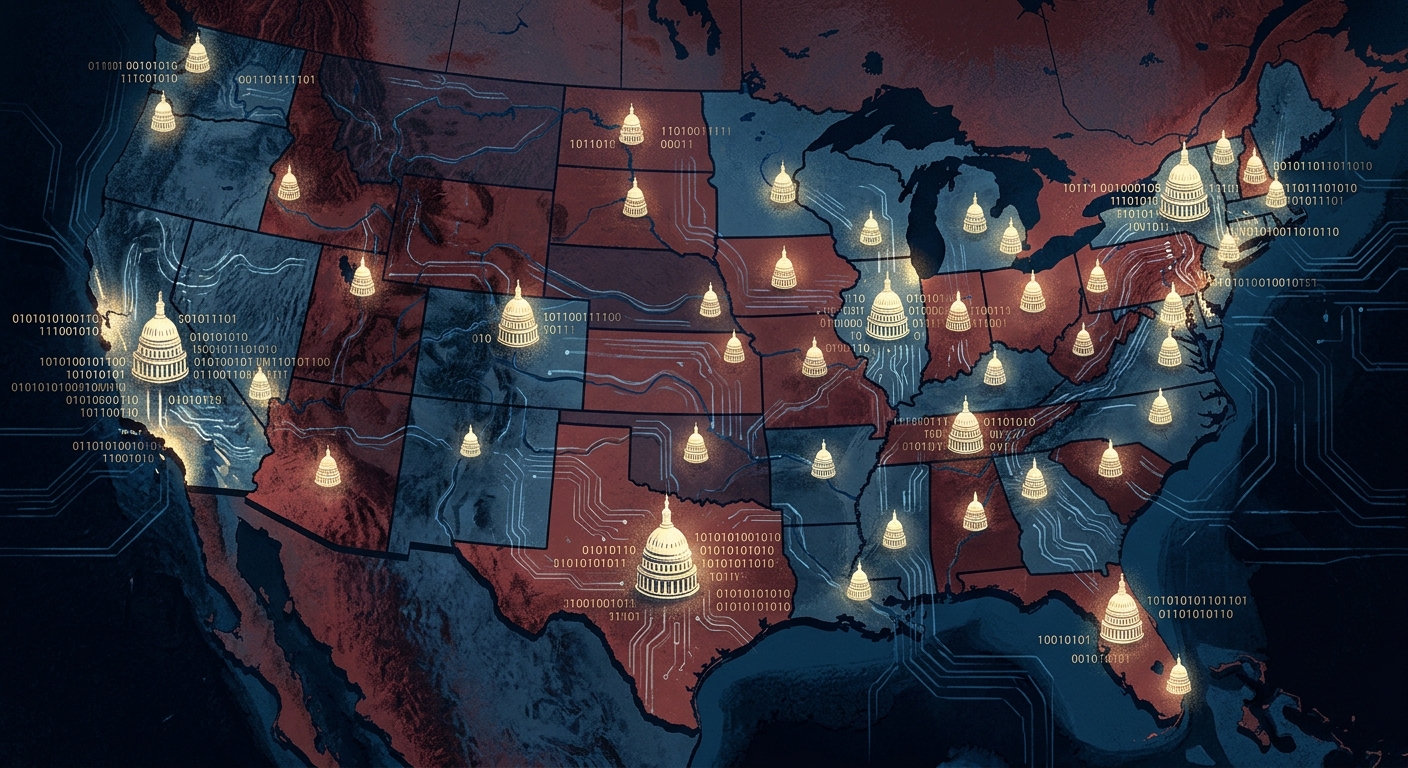
The Trump administration's most muscular attempt to seize federal control of artificial intelligence policy is quietly losing. Six months after President Donald Trump signed Executive Order 14365 to preempt "onerous" state AI laws and threatened to withhold federal broadband dollars from states that defy him, 29 states have enacted 109 new AI statutes — a pace only 10% below the 2025 record. The thesis of this feature: the White House push has not stopped state AI regulation; it has redirected it, funneling lawmakers toward the exact topics — child safety, data centers, and companion chatbots — the executive order carved out as safe. The result is a more bipartisan, narrower, and legally hardened state regime than anyone in Washington predicted.
The count comes from the Center on Technology Policy at NYU, whose half-year tally in Tech Policy Press shows 109 AI laws plus 28 data-center laws enacted by July 1. Ten more states, including California, remain in session and are expected to add to that number before December. Congress, meanwhile, has passed nothing.
The executive order that didn't preempt
Trump signed Executive Order 14365 on December 11, 2025, declaring in the
Federal Register that state AI regulation creates "a patchwork of 50 different regulatory regimes." The order directs the Attorney General to stand up an AI Litigation Task Force whose "sole responsibility shall be to challenge State AI laws," and instructs the Commerce Department to consider stripping Broadband Equity Access and Deployment (BEAD) funds from non-compliant states. The
White House fact sheet singled out Colorado's algorithmic-discrimination statute by name.
That was the maximalist framing. What actually happened is less impressive. The Senate had already killed a ten-year state AI moratorium by a 99–1 vote the previous July, according to Brookings. No preemptive DOJ suit has produced a headline knockout. And Brookings scholars writing in March 2026 argued the order's legal theories — chiefly a dormant-commerce-clause claim —
rest on "shaky legal ground", noting that most state AI laws apply equally to in-state and out-of-state developers and thus dodge the classical protectionism trigger.
The BBC captured the mood on signing day: Trump wanted "one central source of approval"; states heard a political message rather than a legal one. New York Assembly member Alex Bores, sponsor of the state's RAISE Act, told NPR that the order "just encourages the attorney general to sue over these laws for being onerous… nothing was stopping the attorney general from doing that before or indeed from any private citizen… and yet none had."
The chilling effect is real — but narrower than advertised
The numbers show a subtler dynamic than either camp claims. Total AI laws are down only modestly — 109 versus 121 at the same point in 2025 — but the number of states enacting them has fallen from 39 to 29, according to the NYU count reported by Tech Policy Press. That is a compression, not a collapse: fewer states doing more.
The composition matters. About 61% of Republican-trifecta states and 69% of Democratic-trifecta states have enacted AI legislation this term, per NYU's tally — a near-parity that would have been unthinkable in 2023. Utah's Republican state representative Doug Fiefia, a former Google employee, told NPR in March that a one-line memo from the White House killed his AI transparency bill before it could reach a vote — the clearest documented example of the chill. Fiefia's blunt reading: "Congress is in a gridlock and they not only will not act, they can't act."
BEAD leverage, the executive order's other cudgel, isn't cutting cleanly either. States that have enacted AI laws in 2026 hold $742.2 million in average BEAD funding versus $920.9 million for those that haven't — a gap that all but disappears once California, the largest BEAD recipient, signs its next AI bill. The federal money threat cannot yet distinguish the compliant from the defiant.
Where legislation moved: chatbots, kids, and kilowatts
The executive order named categories the federal government would not preempt: child safety and "AI compute and data center infrastructure." State legislatures obliged. Companion-chatbot regulation exploded from two enacted laws in 2025 to 14 in 2026, with more than 100 additional bills introduced, according to Tech Policy Press. A Brookings public-health analysis published in May 2026 documented the mechanics: laws requiring bots to disclose non-human status, prohibiting minors from accessing companionship-simulating features, and — in Illinois — banning AI mental-health therapy outright.
The trigger events are grim and specific. Florida Attorney General James Uthmeier sued OpenAI in a sweeping product-liability action, the BBC reported, tying ChatGPT to two Florida homicides and alleging the company aided mass shooters. Pennsylvania Attorney General Josh Shapiro sued Character.AI in May after state investigators documented a chatbot claiming to be a licensed psychiatrist and inventing a Pennsylvania medical license number, according to
NPR. In Washington state, a new statute takes effect in January 2027 requiring chatbots to remind users every three hours that they are not human,
Al Jazeera reported.
The bipartisan crossover is the more interesting political fact. As NPR documented in February, Florida Governor Ron DeSantis is backing an "Artificial Intelligence Bill of Rights"; six Democratic-trifecta states and eight Republican-trifecta states have now enacted companion-chatbot statutes. Data centers have become the second bipartisan flashpoint — Republicans in Oklahoma and Democrats in New York and Maine have all floated moratoriums, and Colorado is pushing renewable-energy mandates for AI compute infrastructure.
Colorado, California, and the coming enforcement wave
Two states now anchor the substantive landscape. Colorado's AI Act, the country's first comprehensive algorithmic-discrimination statute, took effect February 1, 2026 — the Brookings analysis called it "reminiscent of the EU's AI Act." It regulates developers and deployers of "high-risk" systems in employment, housing, insurance, education, and health care. It is the single most likely target of the DOJ task force. The executive order
explicitly identified Colorado's law as an example of state overreach that "may even force AI models to produce false results."
California went narrower and got it done. Governor Gavin Newsom signed SB 53 the Transparency in Frontier Artificial Intelligence Act, on September 29, 2025 — a rewrite of the vetoed SB 1047 that requires only the largest frontier developers to publish safety frameworks, report critical incidents, and honor whistleblower protections. As
Al Jazeera noted, the requirements largely codify voluntary commitments the same firms made at the Seoul AI summit. That is by design: SB 53 was engineered to be preemption-proof, hugging existing industry practice too closely to trigger a credible dormant-commerce-clause suit.
Connecticut SB 5, signed May 11 on the state's third attempt, extended the comprehensive-regulation model to a smaller East Coast market. The CSIS analysis of the executive order argued the administration's approach is self-defeating for US tech leadership because it undermines the domestic legitimacy layer American firms need when negotiating with Brussels, London, and New Delhi. This is the political economy readers should track: state laws that mirror industry's own voluntary pledges are the hardest to strike down and the easiest to export.
Enforcement risk is now migrating from statute to litigation. Anthropic sued the Trump administration in March, according to NPR, alleging the Pentagon retaliated for the company's safety guardrails with a supply-chain blacklist. The
Financial Times reported in June that "boards that have treated AI ethics as a reputational question will have to treat it as a litigation risk." Attorneys general — Republican and Democratic — are the enforcement layer the executive order did not anticipate.
Diplomat View
The federal preemption push is failing on its own terms, and the reason is structural: Trump's team wrote an order that named exemptions (child safety, data-center infrastructure, state procurement) large enough to swallow the emerging state agenda whole. What the order has done is shape the substance of state action toward child-focused, industry-friendly guardrails and away from broad algorithmic-discrimination frameworks like Colorado's. If the DOJ Litigation Task Force files its first major suit — Colorado is the obvious target — and loses on dormant-commerce-clause grounds, the entire executive-order strategy collapses. The forecast: expect California to sign 8–15 additional AI bills before December, bringing the 2026 total near 2025's 159; expect at least one DOJ suit against Colorado or a chatbot statute before Q4; expect no federal AI law from this Congress. What would revise this call: a Supreme Court signal that state AI regulation categorically burdens interstate commerce, or a Trump-Blackburn bill actually reaching the floor. Neither looks imminent.
What to watch
- Fall 2026: California legislative session close — Newsom expected to sign additional companion-chatbot, deepfake, and worker-AI bills, per
Tech Policy Press reporting.
- Q3–Q4 2026: First DOJ AI Litigation Task Force filing, most plausibly against Colorado's algorithmic-discrimination law or a state chatbot statute — the
order required the Task Force to stand up within 30 days of December 11, 2025.
- January 2027: Washington state chatbot disclosure law takes effect, per
Al Jazeera; the first real test of a three-hour reminder mandate.
- Ongoing: Senator Marsha Blackburn's TRUMP AMERICA AI Act — the only federal vehicle with visible White House backing, per
NPR — has yet to receive a committee vote.
The Bottom Line
The Trump executive order did not stop state AI legislation; it curated it. By exempting child safety and data-center regulation while threatening the rest, the order effectively told 29 state legislatures which laws would survive litigation and which would not — and they wrote 109 accordingly. The real winner of the 2026 session is not the White House or the state legislatures, but frontier AI firms that now face a compliance map narrow enough to game and predictable enough to price. Watch US politics for the first DOJ suit; it will decide whether this equilibrium holds through 2027.
Discover more

US Politics
SNAP Food Assistance Faces Legal Challenges
In 2026, SNAP faces stricter eligibility rules and mounting legal challenges, threatening food assistance for the millions of Americans who rely on the program.

Global Politics
US Seizes Iranian Ship, Tensions Surge
The US seizure of the Iranian ship Touska highlights a shift in control over the Strait of Hormuz, favoring Iran's strategic position.

India
Delhi CM Rekha Gupta Blasts Opposition's Delm
Delhi CM Rekha Gupta's remarks on women's quota defeat reveal BJP's strategy for the 2029 Lok Sabha elections, focusing on delimitation.

Economics
Fed's Amex AML order puts correspondent banking on notice
Federal Reserve's Amex AML order requires board-level controls and a 90-day plan; OCC fined the bank $350 million over enterprise-wide deficiencies.