State AI Laws Mid-2026: Trump's Push
AI regulation evolves amid federal pressure.
Model Diplomat8 min readNorth America
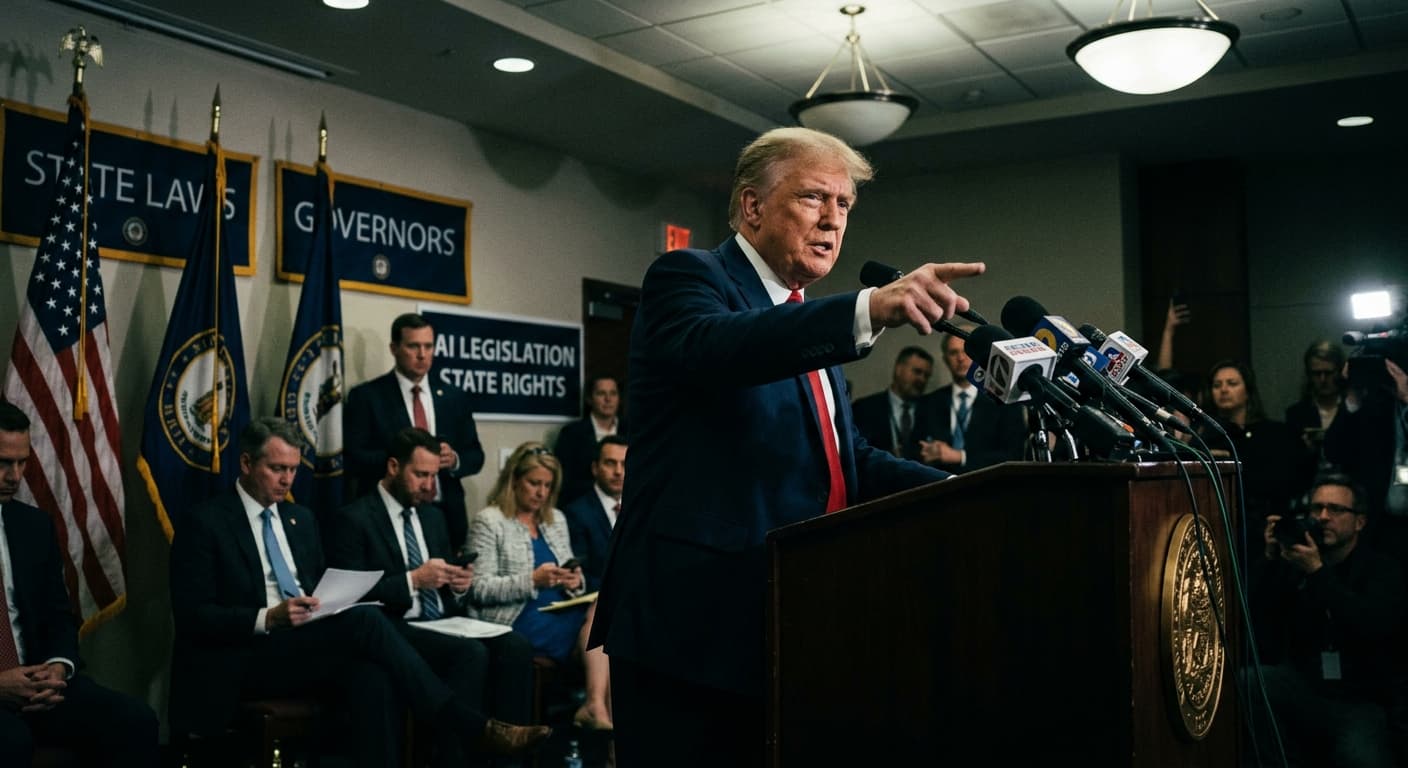
State AI Laws at Mid-2026: Trump's Preemption Push Bends, But Doesn't Break the Patchwork
Half-year tally: 109 state AI laws in 29 states despite Trump's Dec. 2025 executive order. The federalism fight over AI regulation is reshaping — not stopping — what gets passed.
Six months into 2026, US states have enacted 109 artificial-intelligence laws and 28 data-center statutes despite a December 2025 executive order that created a federal task force to sue them, according to a July 6 count by New York University's Center on Technology Policy published in Tech Policy Press. The White House campaign has not killed state AI regulation. It has changed its shape: fewer states are legislating (29, down from 39 at this point in 2025), but the ones that do are converging on child-safety, data-center, and consumer-protection bills — precisely the categories the Trump order explicitly declined to preempt. The tell is that federal pressure isn't crushing state action; it is steering it, producing an emerging cross-partisan floor of AI rules the White House itself has signalled it will tolerate.
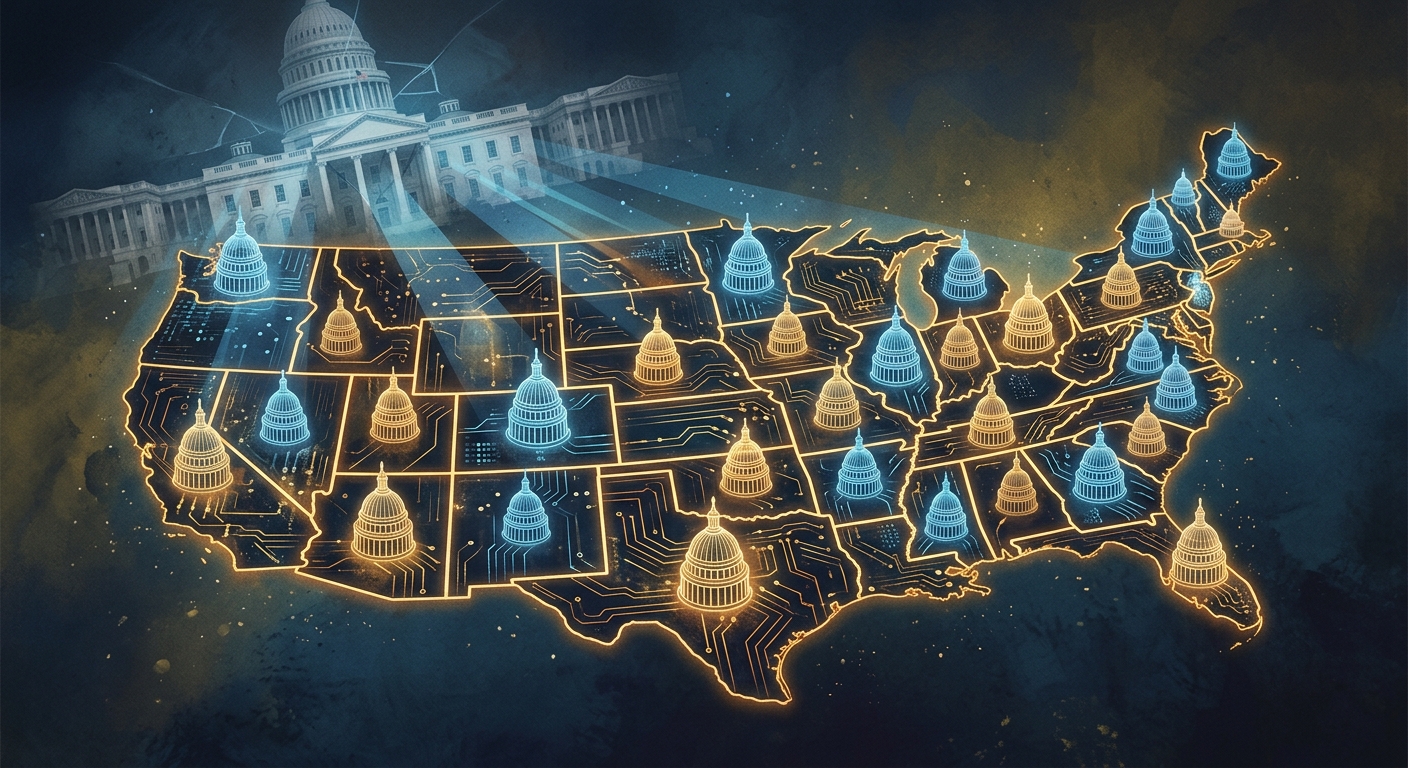
The federal squeeze: what the order actually does
On December 11, 2025, President Trump signed Executive Order 14365, titled "Ensuring a National Policy Framework for Artificial Intelligence." Its operative text, published in the Federal Register, does three things: it directs the Attorney General to stand up an "AI Litigation Task Force" whose "sole responsibility shall be to challenge State AI laws"; it orders the Commerce Department to publish a policy notice conditioning Broadband Equity, Access and Deployment (BEAD) non-deployment funds on states not enforcing "onerous" AI laws; and it directs an inventory of state statutes ripe for preemption on First Amendment or dormant-commerce-clause grounds.
The order quotes its own reasoning bluntly:
State-by-State regulation by definition creates a patchwork of 50 different regulatory regimes that makes compliance more challenging, particularly for start-ups… State laws are increasingly responsible for requiring entities to embed ideological bias within models.
The BBC reported Trump's Oval Office framing — "We want to have one central source of approval" — alongside AI adviser David Sacks's caveat that the government "will not oppose AI regulations around children's safety." That carve-out is the load-bearing political concession, and it is now visible in the legislative data.
The order arrived after Congress had already refused to preempt. The Senate stripped a 10-year state AI moratorium from the reconciliation bill in July 2025 by a 99–1 vote, NPR reported; a second attempt to slip preemption into the FY2026 National Defense Authorization Act failed in early December. The executive order is what happens when Congress won't move — and it is, as
Brookings put it, an instrument that "merely directs agencies to take actions that might eventually create pathways for preemption. Each pathway faces serious legal obstacles."
What states did anyway
The most consequential state law of the cycle was signed before the executive order. California SB 53, the Transparency in Frontier Artificial Intelligence Act, was signed by Governor Gavin Newsom on September 29, 2025, Brookings analysts noted. It requires developers of the largest frontier models to publish safety and security protocols, report critical incidents including large-scale cyberattacks and mass-casualty events, and protects whistleblowers.
Al Jazeera described it as "light touch" — a bill the Wadhwani AI Center's Laura Caroli found "affects just the top few tech companies" and largely codifies commitments already made at last year's Seoul AI summit. It is, in other words, exactly the kind of statute the Trump order was engineered to preempt — and Sacramento signed it anyway.
Colorado's SB24-205, signed in May 2024, took effect February 1, 2026 as the first comprehensive US high-risk AI regime, borrowing structure from the EU AI Act on algorithmic discrimination in employment, housing, credit and health. The Trump order names Colorado's statute by name as an example of "State laws… responsible for requiring entities to embed ideological bias within models." Governor Jared Polis has ordered a task force to soften the rules; Attorney General Phil Weiser has said enforcement will begin regardless.
Connecticut's SB 5, signed by Governor Ned Lamont on May 11, 2026, was the year's flagship comprehensive bill — passed on its third attempt after two prior years of vetoes. New York's RAISE Act, sponsored by Assembly Member Alex Bores, passed both chambers and is being finalized with Governor Kathy Hochul; Bores told NPR it "was largely based on voluntary commitments that all the companies had already made," a framing designed to survive a federal challenge.
Then there is the pattern the Tech Policy Press analysis flags as new: bipartisan alignment on companion chatbots. Fourteen states enacted companion-chatbot laws in 2026 — six with Democratic trifectas, eight with Republican trifectas — versus two states (California and New York) in 2025. Florida Governor Ron DeSantis is backing an "Artificial Intelligence Bill of Rights" requiring parental consent for minors' chatbot use, NPR reported. Washington signed a bill requiring chatbots to remind users every three hours that they are not human. Pennsylvania Attorney General Josh Shapiro
sued Character.AI in May 2026 after state investigators documented a bot claiming to be a licensed psychiatrist and producing a fake Pennsylvania medical license number. Florida's attorney general filed a separate suit against OpenAI. These are enforcement actions the December executive order cannot preempt because they are grounded in traditional state police powers over consumer protection and medical licensing — a fact the White House's own
March 2026 legislative framework explicitly concedes.
The BEAD lever, deconstructed
The order's most tangible enforcement mechanism is money. Section 5 directs the Secretary of Commerce, through the Assistant Secretary for Communications and Information, to issue a policy notice making states with "onerous AI laws" ineligible for BEAD non-deployment funds. The subtext: the National Telecommunications and Information Administration (NTIA) already restructured BEAD in June 2025, and Commerce Secretary Howard Lutnick controls roughly $42.45 billion in as-yet-unreleased state allocations. The March 11, 2026 deadline for BEAD guidance slipped; AEI's Daniel Lyons
reported in late June that Lutnick said guidance was still "a month or two away."
That delay matters. NYU's data shows the correlation between BEAD dollars and AI legislation is essentially noise. As of July 1, states without AI laws averaged $920.9 million in BEAD allocations, versus $742.2 million for states with them — a gap that flips once California (widely expected to enact more AI laws before year-end) is counted. As Tech Policy Press's Scott Babwah Brennen concluded, "we can not yet see a simple partisan or BEAD-driven pattern as to which states are most impacted." The stick, so far, is rhetorical.
Where the White House will lose in court — and where it may win
The legal architecture of EO 14365 is fragile. Brookings scholars Brooke Tanner, Josie Stewart and Nicol Turner Lee argue the dormant-commerce-clause theory the DOJ is expected to press "primarily bars economic protectionism," and "most state AI laws apply equally to in-state and out-of-state developers." A Supreme Court fractured on the Pike balancing test — with three conservative justices hostile to weighing economic burdens against non-economic harms — is an unpromising forum for the administration's case. The 2023 National Pork Producers Council v. Ross decision, which upheld California's ability to regulate pork sold in-state even when the effects reached other states, is the precedent Public Knowledge's John Bergmayer flagged to NPR as fatal to the White House theory.
The FTC and FCC pathways are worse. Neither agency has statutory authority to preempt state AI laws by fiat — the Center for Strategic and International Studies called the strategy "highly problematic" and warned it "hinges on uncertain legal interpretations that raise constitutional issues."
Where the administration can win is politics, not law. The March 2026 White House framework — signed by OSTP and endorsed by Senator Marsha Blackburn's TRUMP AMERICA AI Act — explicitly protects state authority over child safety, zoning of AI infrastructure, and state-agency AI use, NPR reported. Tennessee Attorney General Jonathan Skrmetti, no ideological ally of Democratic AGs, told NPR the framework was "a move in the positive direction" — because it dropped the 10-year moratorium in favor of targeted preemption of algorithmic-discrimination and frontier-safety rules. That is the actual White House play: not to eliminate state AI law, but to prune it back to child-safety and data-center statutes while gutting the algorithmic-accountability regimes that Colorado and (eventually) New York represent.
Diplomat View
The Trump preemption push is failing at its stated goal and succeeding at its unstated one. Aggregate state AI law-making continues; the specific regulatory experiments that industry most fears — Colorado's high-risk regime, New York's RAISE Act, California's frontier-transparency law — remain live. But the White House has effectively negotiated a de facto national scope: states may freely legislate on companion chatbots, deepfakes, minors, and data-center siting; anything that touches frontier-model liability or algorithmic discrimination is a litigation target. That is preemption by chilling effect, not by statute, and it is working better than the executive order's authors will admit.
The forecast: expect the AI Litigation Task Force to file its first lawsuit before Labor Day 2026 — most likely against Colorado on dormant-commerce-clause grounds, chosen precisely because Governor Polis's own reservations make the state a weak defendant. Expect that lawsuit to lose at the district-court level within twelve months. Expect Congress to still not have passed a federal AI law by January 2027. The forecast would change if the Supreme Court agreed to hear an emergency-docket challenge to a state AI enforcement action, or if Commerce's delayed BEAD policy notice actually deobligated funds from a Democratic state — either would signal the administration is willing to burn political capital rather than concede.
What to watch
- Late July 2026: Commerce Department BEAD "onerous laws" policy notice, delayed from March 11.
- September 2026: California legislative session close. Newsom's decisions on the remaining slate of AI bills (companion chatbots, worker protection, procurement) will set the 2027 baseline.
- Q4 2026: First AI Litigation Task Force filing. Colorado, New York and Illinois are the likeliest targets; watch which state DOJ picks and what constitutional theory it leads with.
- February 2027: Federal district-court ruling likely on the first preemption suit — the first real test of whether EO 14365 has any legal force at all.
The Bottom Line
State AI legislation at mid-2026 is not being killed by federal preemption — it is being channelled. The 109 laws already on the books this year, concentrated in child safety, data centers and consumer protection, are exactly the categories the White House signalled it would not fight. The real regulatory battle over frontier-model liability and algorithmic discrimination has moved from the statehouse to the courts, where the administration's legal theories are weak and its political leverage — chiefly BEAD — is untested. Absent a Supreme Court intervention or an actual federal AI statute, the patchwork is the policy for the rest of this decade.
Discover more

India
Romanian Coalition Party Demands PM Resign
Romania's Social Democrats withdrew from coalition, joining far-right AUR to topple PM Bolojan, risking €10 billion in EU funds by August 2026.
US Politics
SNAP Food Assistance Faces Legal Challenges
In 2026, SNAP faces stricter eligibility rules and mounting legal challenges, threatening food assistance for the millions of Americans who rely on the program.
India
Congress Accuses Modi of Stalling Women's Law
Congress accuses Modi of stalling women's reservation law by linking it to delimitation, revealing a deeper electoral strategy.

Economics
Fed's Amex AML order puts correspondent banking on notice
Federal Reserve's Amex AML order requires board-level controls and a 90-day plan; OCC fined the bank $350 million over enterprise-wide deficiencies.