SOUTHCOM's Caracas Visit: U.S. Protectorate
U.S. military takes lead in Venezuela quake recovery efforts
Model Diplomat9 min readAmericas
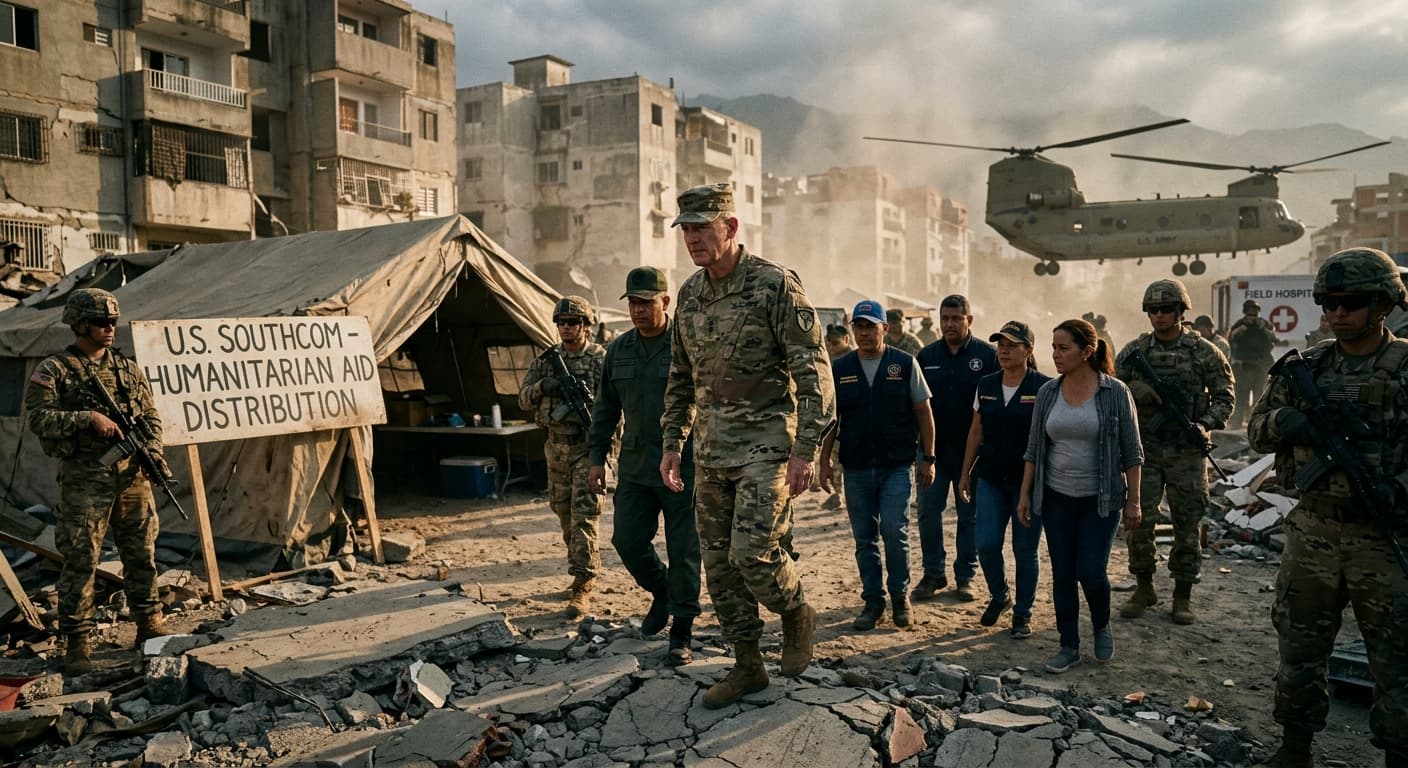
SOUTHCOM's Caracas visit turns Venezuela quake relief into a de facto U.S. protectorate
Gen. Francis Donovan's July 6 meeting with Delcy Rodríguez folds earthquake reconstruction into the Trump administration's oil-and-security tutelage over post-Maduro Venezuela.
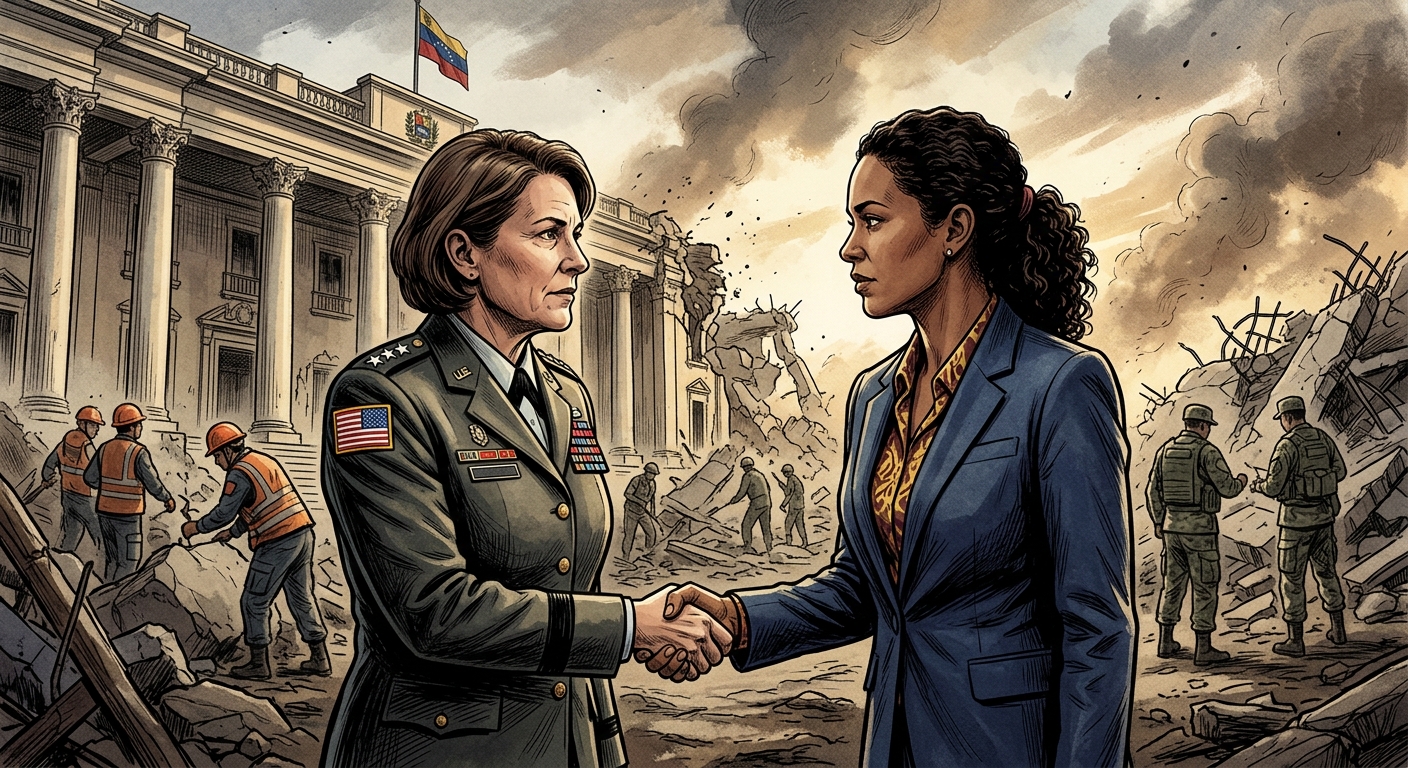
The head of U.S. Southern Command walked into Miraflores on July 6, 2026, six months and three days after U.S. Delta Force teams pulled Nicolás Maduro out of the same city — and the choreography told the story. Gen. Francis Donovan's coordination meeting with interim President Delcy Rodríguez, Interior Minister Diosdado Cabello and U.S. Chargé d'Affaires John Barrett was framed as earthquake reconstruction. In substance, it locked in something larger: a post-quake protectorate in which SOUTHCOM, not the State Department, is the operational spine of the U.S. relationship with a Chavista rump government whose survival now depends on Washington's forbearance. That structural fact — a combatant commander, not a diplomat, running the day-to-day of a hemispheric partner — is the most consequential shift in inter-American security since the 1989 invasion of Panama.
The meeting followed the deadliest natural disaster in Venezuelan history. Twin magnitude 7.2 and 7.5 earthquakes struck the Caracas–La Guaira corridor on June 24, killing more than 3,500 people by July 7 and leaving nearly 18,000 without housing, Al Jazeera reported, citing National Assembly president Jorge Rodríguez. Roughly 60,000 buildings were damaged or destroyed. The Atlantic Council's Adrienne Arsht Latin America Center
put the U.S. commitment at over $300 million and confirmed the twin quakes were the strongest to hit the country in more than a century.
The visit: what was actually agreed
Donovan told reporters on July 1 that "we will remain in Venezuela until the work is finished, and when we finish, we will leave Venezuela," according to Venezuela RED Informativa. The July 6 session in Caracas — reported by EFE via
Confirmado and
Diario Frontera — moved from search-and-rescue to reconstruction: rebuilding Simón Bolívar International Airport in Maiquetía, restoring the La Guaira port complex, and coordinating with international financial institutions.
Rodríguez confirmed she is in direct talks with the U.S. State Department and the International Monetary Fund on recovery financing, according to Diario Frontera. On the U.S. side of the table sat Donovan, Barrett and Maj. Gen. Kevin J. Jarrard, who is overseeing search-and-rescue, Diario Versión Final reported. On the Venezuelan side, Cabello — still under U.S. narcotics indictment — and Defense Minister Rómulo Fuentes.
The mechanics matter. SOUTHCOM has some 900 personnel on the ground, an amphibious transport dock (USS Fort Lauderdale) and a littoral combat ship (USS Billings) off the coast, and has repaired the earthquake-damaged runway at Maiquetía, SOUTHCOM spokesperson Steven McLoud told the Associated Press. Digaloahi Digital, citing Venezuelan officials, put the number of American troops closer to 2,000. The discrepancy is itself informative: neither side is publishing a definitive force figure.
Why this is not Haiti 2010
The instinct is to reach for Haiti 2010, when the U.S. 82nd Airborne effectively ran Port-au-Prince airport for weeks. That analogy misses the political geometry.
The Rodríguez government is a domestic actor whose international legitimacy runs almost exclusively through Washington. After Operation Absolute Resolve on January 3, the Trump White House said explicitly it would "dictate" Venezuelan policy, with press secretary Karoline Leavitt telling reporters the interim government's "decisions are going to continue to be dictated by the United States of America." Trump told The Atlantic in early January that if Rodríguez "doesn't do what's right, she is going to pay a very big price, probably bigger than Maduro." Since then she has signed an $8 billion oil-privatization law on January 29, hosted Energy Secretary Chris Wright at Miraflores on February 11, and watched as the Treasury Department
lifted her personal SDN sanctions on April 1 and then eased sanctions on the Central Bank and three state-owned banks two weeks later, according to the BBC's
Vanessa Buschschlüter.
The reconstruction envelope now being negotiated with SOUTHCOM is the next tranche in that same transactional ladder. What Donovan's presence signals is that the Pentagon — not the White House policy shop, not Foggy Bottom — is the primary interface. That is a direct consequence of USAID's dismantling. As the Council on Foreign Relations noted in its earthquake analysis, the elimination of USAID has shifted disaster response to the State Department's new Bureau of Disaster and Humanitarian Response, which relies on Pentagon airlift and logistics to move at all. CSIS's Ryan Berg put it plainly: "The U.S. military is the most qualified and capable force to assist with the immediate disaster response in Venezuela," in his
June 26 analysis.
Translated: SOUTHCOM is now the executor of U.S. foreign assistance in the Western Hemisphere. Venezuela is the test case.
The domestic legal ceiling — and why it is not binding
Congress has tried and failed to fence SOUTHCOM in. On January 8, 2026, the Senate voted 52–47 to discharge Sen. Tim Kaine's S.J.Res. 98, which would have directed the removal of U.S. forces from "hostilities within or against Venezuela that have not been authorized by Congress," according to the official Senate roll-call record. The measure survived a subsequent point-of-order challenge on January 14 by a 51–50 margin,
per GovTrack, but has not been enacted. The
Congressional Research Service, in a January 12 update by Clare Ribando Seelke, catalogued the outstanding legal questions: the strikes on drug vessels, the port-facility drone strike, the raid itself, and the pending energy arrangement.
None of that has slowed the deployment. Humanitarian relief was never contested legally; that is precisely why folding reconstruction into a military-led framework is such a clean workaround. Donovan's team is doing under Title 10 disaster-relief authorities what would generate a war-powers fight if labeled a stabilization mission.
Who wins, who loses
Follow the balance sheet.
Chevron wins first. Its Pascagoula, Mississippi refinery already processes about 250,000 barrels of Venezuelan crude a day and Chevron executive Andy Walz told the BBC the company sees a path to 350,000–400,000 barrels. Venezuelan monthly crude exports crossed one million barrels a day in March. Reconstruction cash flowing through U.S.-friendly channels — the IMF talks Rodríguez confirmed — reduces sovereign-debt risk and gives Chevron a stabler operating environment. ExxonMobil CEO Darren Woods
told Trump the country was "uninvestable" at a White House meeting, and Rystad Energy estimates $8–9 billion per year in fresh capex would be required to triple output by 2040.
Rodríguez wins politically, at least in the short term. She has kept the Chavista security apparatus intact — Cabello sitting at the same table as Donovan is the picture — while extracting a stream of sanctions relief. The BBC's angry-citizens report from La Guaira found the first Venezuelan firefighters arrived two days after the quake; U.S. and Salvadoran teams filled the gap. That failure is politically toxic domestically, and Donovan's high-profile presence is functionally an air-cover operation for a government the Washington Office on Latin America's Laura Cristina Dib told Al Jazeera has been "the last responder" to its own citizens.
The Venezuelan opposition loses. María Corina Machado and Edmundo González, whom Secretary of State Marco Rubio called the "rightful president" as recently as January 22, 2025, have been sidelined. The
International Crisis Group documented in January that the Trump administration prized stability over transition and "shunned the country's opposition leadership." Six months on, there is still no electoral timetable. CSIS's Mark Cancian warned in a January 5 analysis that "Maduro loyalists will delay, evade, and subvert U.S guidance to retain power"; that forecast is now the operating reality, laundered through earthquake response.
Latin America's non-aligned bloc loses leverage. Brazil's Lula, Colombia's Petro, Mexico's Sheinbaum and Chile's Boric all condemned the January raid as a violation of the U.N. Charter. Six months later, Petro is on the phone with Trump, Sheinbaum has held her line on "collaboration, not subordination," and Lula told reporters in February that Maduro should be tried "in his country, not abroad." None have translated moral objection into policy consequence. NPR's Carrie Kahn
documented the region's rapid rhetorical retreat as early as January 11.
The narco-strategy overhang
Reconstruction is not the only file on Donovan's desk. In February Senate Armed Services Committee testimony, flagged by CSIS's Ryan Berg, Donovan told Sen. Mark Kelly (D-AZ) that boat strikes on suspected drug vessels "aren't the answer" and that SOUTHCOM was moving toward an "extension of Southern Spear" — a "countercartel campaign process that puts total systemic friction across this network." The Al Jazeera interactive on the
military build-up confirmed at least 43 people were killed in kinetic strikes in the Caribbean and Pacific before Absolute Resolve. Reconstruction gives SOUTHCOM legitimate ground access to the same coastline; it also builds the intelligence baseline for counter-narcotics cooperation with a Venezuelan military the CSIS analysis described as "hollowed out."
The parallel timeline is not accidental. The airport Donovan repaired is the airport that will host CH-47 Chinooks and Blackhawks; the port at La Guaira that his engineers will help rebuild is the port through which any future counter-narcotics interdiction would run. This is the dual-use logic of Southern Spear at scale.
"We will remain in Venezuela until the work is finished, and when we finish, we will leave Venezuela." — Gen. Francis Donovan, July 1, 2026
What could break it
Three fault lines are already visible.
First, Venezuelan public anger. The BBC's La Guaira reporting and Al Jazeera's July 7 dispatch both quote residents saying the state arrived last, if at all. Rodríguez marked July 5 independence day with a defensive message of "no social unrest." That is a tell.
Second, the opposition's amnesty and prisoner-release track. Rodríguez has released some political prisoners; Machado's coalition wants elections. If the Trump administration ever tires of Rodríguez's foot-dragging on democratization — CSIS's Cancian predicted several months of undeniable obstructionism before another air campaign — the reconstruction leverage cuts both ways.
Third, oil economics. Rystad Energy's Claudio Galimberti told NPR breakeven for Venezuelan projects is around $80 a barrel while global prices sit $60–70. Without political stability plus subsidies, the private capital Trump keeps promising will not arrive at scale — and the reconstruction bill will land on U.S. and multilateral shoulders.
Diplomat View
The Donovan visit is the moment U.S. Venezuela policy stopped pretending to be about democracy and became about tutelage. The operating model is Panama Canal Zone via Iraq CPA, delivered by a combatant command rather than a viceroy — cheaper, legally more flexible, and politically more deniable than any of the historical precedents. It will hold as long as three things hold: Rodríguez's compliance on oil, Chevron's ability to keep expanding output at Pascagoula, and the absence of a signature Venezuelan-on-American incident that would force Congress off the sidelines. If any one of those breaks — a strike on U.S. personnel, a Chevron nationalization scare, a Rodríguez pivot to Beijing — expect the White House to reach for kinetic escalation before it reaches for the opposition. The revision condition is specific: watch whether SOUTHCOM's presence draws down in September as Donovan promised, or whether it hardens into a permanent Joint Task Force. If a JTF stands up on Venezuelan soil by year-end, the protectorate is durable and the region's non-alignment window has closed.
What to watch next
- July 15–30, 2026: IMF Article IV mission to Caracas; Rodríguez has publicly linked reconstruction financing to the Fund and to a full sanctions lift.
- August 2026: Expected Senate floor action on S.J.Res. 98 successor language; a 51–49 or better vote would begin to constrain future SOUTHCOM authorities.
- September 2026: SOUTHCOM's stated drawdown window. Any move to convert the current force posture into a named Joint Task Force is the tell that "reconstruction" has become permanent forward presence.
- October–November 2026: Colombia's electoral run-in and Brazil's presidential positioning; a leftist backlash could resurrect regional pressure for an OAS or U.N. General Assembly resolution on Venezuelan sovereignty.
Related: Global Politics.
Discover more
US Politics
Virginia's Redistricting Referendum
Virginia's redistricting referendum is drawing a flood of dark money, shaping future elections and the fight for congressional control amid party stakes.

US Politics
White House Pressures Congress for Crypto Leg
The Trump administration's push for the CLARITY Act aims to reshape crypto regulation, impacting trillions in market value and the Trump family's wealth.
India
Women's Reservation Bill 2026: A Political Sh
India's Lok Sabha rejected the Women's Reservation Bill, exposing a political maneuver to redraw electoral maps favoring the north over the south.

Economics
Fed's Amex AML order puts correspondent banking on notice
Federal Reserve's Amex AML order requires board-level controls and a 90-day plan; OCC fined the bank $350 million over enterprise-wide deficiencies.