Solomon Islands Signs US Coast Guard Patrol
Solomon Islands reverses four-year freeze on US maritime access under new PM
Model Diplomat8 min readOceania
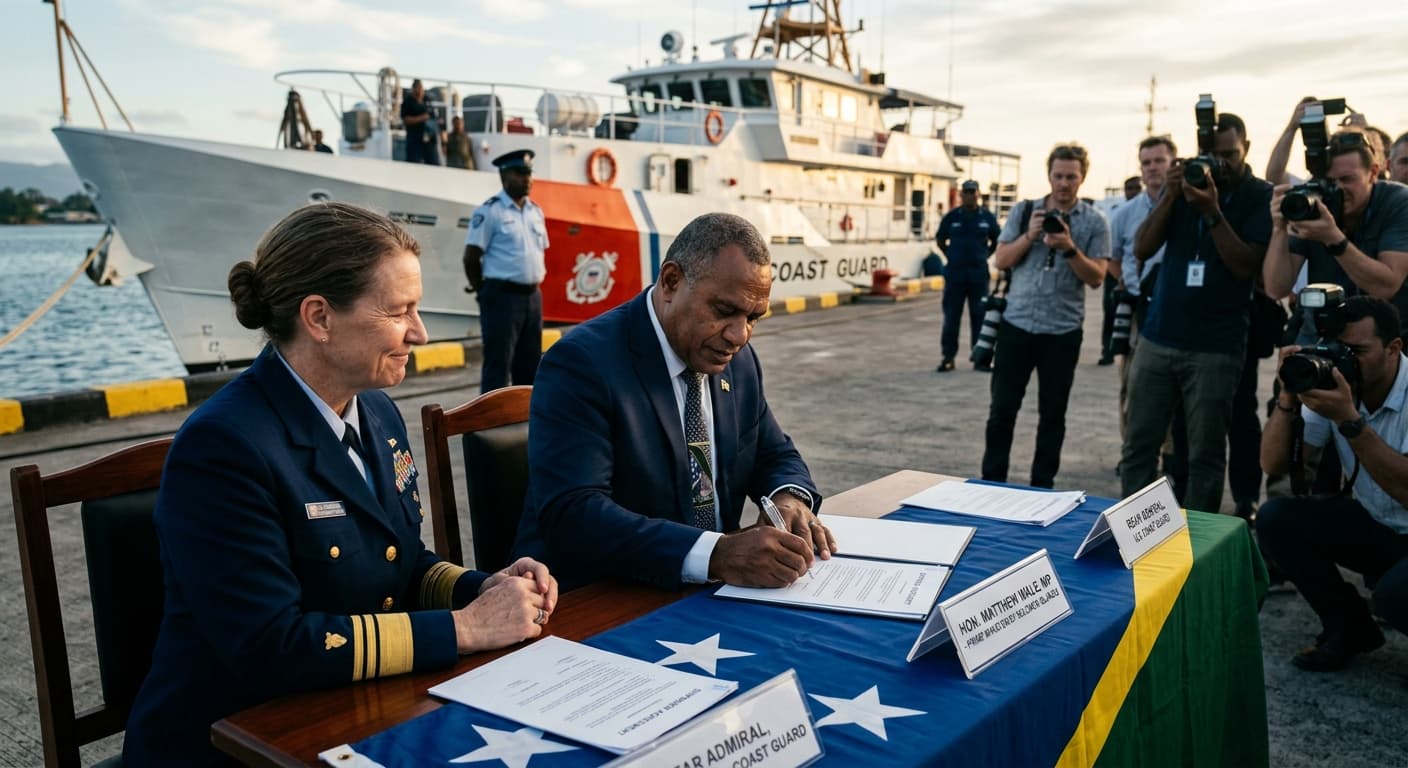
China's Closest Pacific Partner Just Signed a US Coast Guard Patrol Deal — 68 Days After Changing Leaders
The Solomon Islands, Beijing's strongest security ally in the South Pacific, will soon allow US Coast Guard vessels to patrol its 1.3-million-square-kilometer exclusive economic zone with local police aboard, reversing four years of frozen US maritime access under a prime minister who took office barely two months ago.
On July 21, 2026, Prime Minister Matthew Wale of the Solomon Islands met with US Coast Guard Vice Commandant Admiral Thomas Allan in Washington and committed to signing a bilateral shiprider agreement — a deal that places Solomon Islands police officers on American cutters to enforce fisheries laws inside the country's vast territorial waters. Deputy Secretary of State Christopher Landau also signed a Letter of Intent to return the Peace Corps to the archipelago, according to a State Department readout cited by the South China Morning Post.
The substantive news is not the deal itself — Washington now holds shiprider agreements with 12 Pacific Island nations, per the Congressional Research Service. The news is that this agreement exists at all. As recently as August 2022, the same country denied entry to the US Coast Guard cutter Oliver Henry, forcing it to divert to Papua New Guinea, and then imposed a blanket moratorium on all foreign naval visits. That the deal materialized 68 days after Wale's swearing-in on May 15 is the metric that will unsettle Beijing and hearten Canberra in equal measure.
The man who changed the equation
Wale is not a novice to the geopolitical fight he has inherited. For nearly a decade as opposition leader, he was the most persistent critic of the 2022 security pact his predecessor Manasseh Sogavare signed with Beijing — an agreement whose full text has still never been publicly released. When the draft leaked in March 2022, Wale told parliament the deal was "calculated for geopolitical effect" and that its security provisions had "nothing to do with Solomon Islands national security," according to the Solomon Star, cited by Al Jazeera.
He lost that fight. Sogavare survived, deepened ties with Beijing, and was succeeded in 2024 by Jeremiah Manele — the very foreign minister who helped broker the China pact. But on May 15, 2026, after months of political crisis and 12 ministerial resignations from Manele's government, Wale won a parliamentary vote 26-22 and declared "change is coming," the BBC reported.
Then he moved fast.
On June 3, barely three weeks into office, Wale flew to Canberra, met Prime Minister Anthony Albanese, and committed to signing a delayed memorandum of understanding for the regional Pacific Policing Initiative while advancing treaty discussions. More pointedly, he told journalists his government would review all existing security agreements — including the China deal. Australia pledged roughly $35 million in support and had already announced $100 million in December 2024 to expand the Solomon Islands police force, according to CSIS analysis.
The Washington trip, less than two months later, converts momentum into architecture. The shiprider deal and Peace Corps return are precisely the two items Washington tried and failed to secure under Sogavare and Manele — initiatives that "remained unsigned or pending" for years as bilateral relations deteriorated, CSIS noted in its June 2026 assessment of Wale's opening.
What a shiprider deal actually means in these waters
The US Coast Guard currently exercises bilateral law enforcement agreements with over 40 nations globally, with 12 of those in the Pacific Islands. Shiprider agreements place a local law enforcement official on a US vessel, granting that vessel the authority to stop, board, and search suspect vessels in the partner nation's exclusive economic zone and territorial sea — and, where provisions allow, to employ "reasonable force to stop non-compliant vessels," as the publicly available US-Nauru agreement stipulates.
For the Solomon Islands, a country of 700,000 people spread across six major islands and some 900 smaller ones, the practical value is immediate. The country's exclusive economic zone spans more than 1.3 million square kilometers. Its oceanic tuna fisheries contribute an estimated 12% of government revenue and employ more than 1,800 residents, according to World Bank data. The government collects roughly $41 million annually in fisheries access and administration fees. Yet the country has no navy, no coast guard capable of patrolling deep water, and limited maritime domain awareness.
China's distant-water fishing fleet — the largest in the world, which former INDOPACOM Commander Admiral John Aquilino described as a "maritime militia" — has been documented operating across the region, including suspected poaching in Pacific Island EEZs. Gregory Poling of CSIS told a Senate subcommittee in 2025 that "the United States presents itself as a partner in what regional states have identified as one of their top national security challenges, and it allows those states to identify the bad actor, which tend to be Chinese vessels, thereby undermining trust in Beijing."
That is the core strategic logic of the shiprider program: it is maritime law enforcement that serves, simultaneously, as counter-influence. Every Chinese fishing vessel interdicted with a Solomon Islands police officer standing on the deck of a US Coast Guard cutter is a data point in a geopolitical ledger Beijing would prefer remain blank.
The partnership architecture — and its fragility
The China-Solomon Islands security pact is still in force. Wale has not pledged to scrap it, and analysts do not expect him to. Connor Graham, a research fellow at the Lowy Institute's Pacific Islands Program, captured the structural constraint bluntly: "Chinese infrastructure is embedded. China is also critical to Solomon Islands economy as a major export destination, and now, thanks to the security pact, its military and police are increasingly integrated. What changes under Wale is tone, transparency and openness to traditional partners. What doesn't change is the structural weight of seven years of Chinese investment," he told the BBC.
Chinese police trainers remain in Honiara. China has built stadiums, roads, and 161 mobile towers through a $66 million Exim Bank loan to Huawei. The 2022 security pact's leaked draft — the only version ever made public — allowed Chinese warships to dock and replenish, and authorized Beijing to deploy "police, armed police, military personnel and other law enforcement and armed forces" to "assist in maintaining social order," NPR reported.
Wale's coalition is also fragile. He won with 26 votes out of 49. His opponents include former foreign minister Peter Shanel Agovaka, who has "praised China's economic development and voiced his party's support of the one China principle," CSIS reported. Any move perceived as abandoning Beijing outright could fracture his government.
The result is a deliberate hedging strategy: keep the China security architecture intact while layering Western maritime and police partnerships on top. It is what Wale himself calls "balanced international engagement." For Washington, the bet is that layered engagement — shiprider patrols, Peace Corps volunteers, the earthquake monitoring partnership announced in May, the new investment incentive agreement — creates enough institutional density to make a future Chinese push for exclusive security access politically impossible in Honiara.
The capacity problem Washington cannot ignore
The agreement's strategic value will be determined by execution, and execution requires hulls in the water. The US Coast Guard's 14th District is responsible for more than 14 million square miles of ocean with fewer than a dozen cutters and four fixed-wing aircraft, Brookings Institution research notes. The medium-endurance cutter Harriet Lane was moved from Virginia to Hawaii in 2024, and three Sentinel-class fast response cutters — Oliver Henry, Myrtle Hazard, and Frederick Hatch — operate from Guam. But those assets are stretched across the Freely Associated States, American Samoa, and episodic patrols throughout Oceania.
Admiral Linda Fagan, the Coast Guard commandant, has acknowledged the appetite for expanded partnership in the region. But the service is simultaneously pursuing its Polar Security Cutter program, the Offshore Patrol Cutter buildout, and missions ranging from counternarcotics in the Caribbean to search and rescue across the Pacific. A Department of Homeland Security Office of Inspector General report found that the Coast Guard spent $5.9 million per IUU fishing interdiction in 2023-2024, and its detection rates fell short of targets due to "competing priorities and insufficient resources," according to the Congressional Research Service's 2025 report on IUU fishing.
The risk is that the Solomon Islands shiprider agreement becomes an unfunded commitment — a diplomatic win on paper that generates little operational presence. That outcome would be worse than no deal at all, because it would validate Beijing's quiet argument in Pacific capitals: that the United States makes promises it cannot keep.
Diplomat View
What happened in Washington on July 21 is not just a patrol deal. It is the fastest strategic reversal in the modern Pacific. The same country that in August 2022 barred the US Coast Guard from its ports and imposed a blanket naval moratorium — a move widely read as Beijing's writ in Honiara — has now, under a new prime minister elected on a platform of "change," opened its territorial waters to American law enforcement patrols. The 68-day timeline from swearing-in to announced deal is a deliberate signal from Wale to both capitals: his government will balance, not choose.
But the forecast comes with conditions. If the US Coast Guard cannot mount regular, visible patrols in Solomon Islands waters within 12 months — if the agreement sits on a shelf in Honolulu — the diplomatic momentum of July 2026 will dissipate, and Beijing will quietly absorb the episode as another American announcement without follow-through. If Wale's fragile coalition fractures — and the next no-confidence vote is always one parliamentary session away — the deal could be the last signature of a government that never consolidated its hedging strategy into durable architecture. The critical date to watch is the Pacific Islands Forum Leaders Meeting in Palau this September: that is where Wale must demonstrate to regional peers that his balancing act produces tangible results, not just communiqués.
And Beijing's silence so far on the shiprider deal — no official comment as of July 22 — is itself a data point. It suggests either a decision not to publicly contest a sovereign partner's diversification, or a calculation that the response will come later, in private, and in the currency China deploys most effectively in the Pacific: development finance, infrastructure, and police cooperation that no other partner matches. The deal is real. The contest is not over.
What to watch:
- September 2026 — PIF Leaders Meeting in Palau: Wale's first major regional forum as prime minister; a venue where he will be measured against his own commitment to "balanced international engagement"
- End of 2026 — Security deal review deadline: Wale committed to reviewing all security agreements including China's; whether that review produces substantive changes or a status-quo reaffirmation will be the next signal
- First USCG patrol with embarked Solomon Islands police: The operational test of the agreement; any delay beyond mid-2027 would signal execution risk
Discover more

US Politics
SNAP Food Assistance Faces Legal Challenges
In 2026, SNAP faces stricter eligibility rules and mounting legal challenges, threatening food assistance for the millions of Americans who rely on the program.
US Politics
House Ethics Committee Pushes Sexual Miscond.
The House Ethics Committee has shifted responsibility for sexual harassment settlement records to the Office of Congressional Workplace Rights, complicating disclosure efforts.

India
India-South Korea $50B Trade Expansion Plan
India and South Korea target $50 billion in bilateral trade by 2030, focusing on industrial cooperation and strategic alignment amid US pressures.

Economics
Fed's Amex AML order puts correspondent banking on notice
Federal Reserve's Amex AML order requires board-level controls and a 90-day plan; OCC fined the bank $350 million over enterprise-wide deficiencies.