Senkaku Standoff: East China Sea Tensions
Japan and China clash over territorial waters near Senkaku Islands.
Model Diplomat7 min readEast Asia
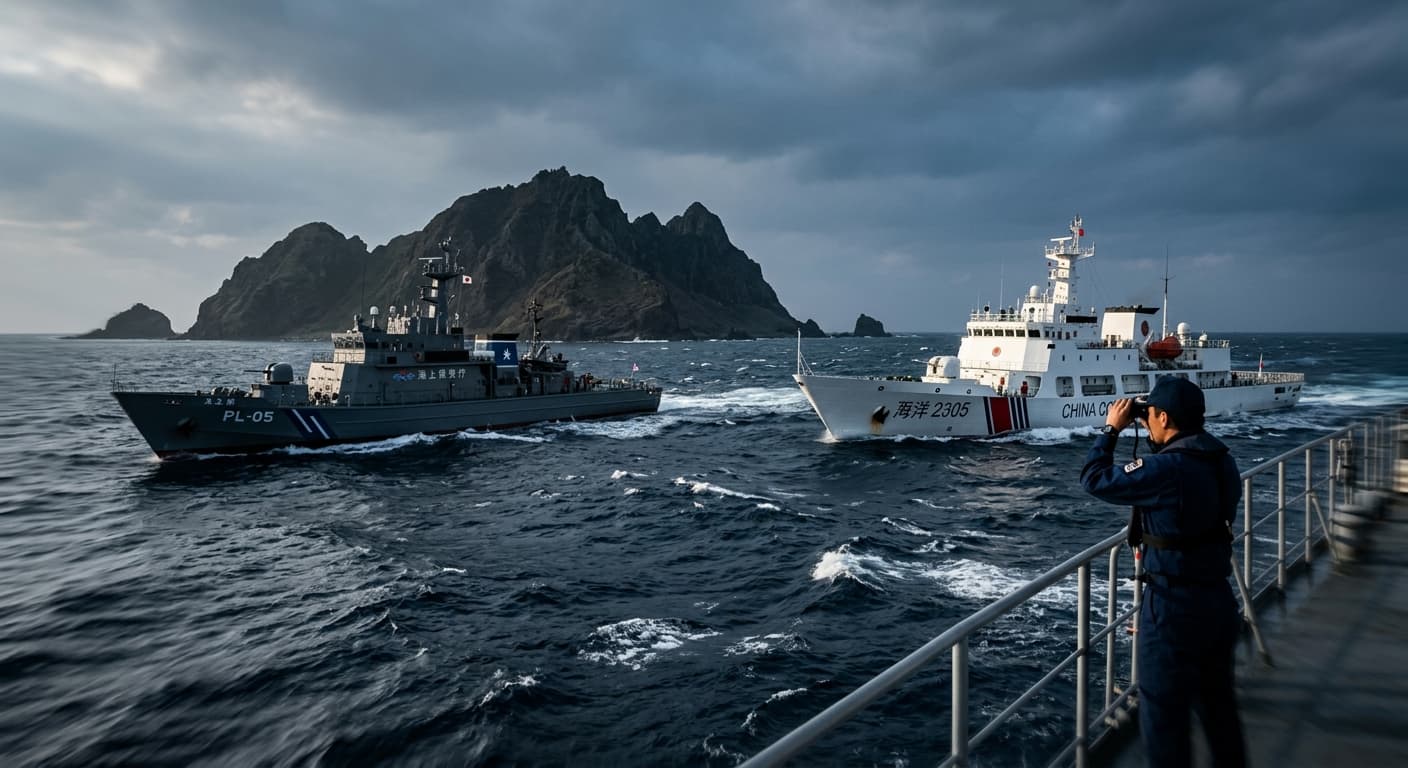
Senkaku standoff: the East China Sea is now the pressure valve for the Taiwan row
Japan and China's July 7 coast-guard face-off near the Senkaku Islands shows Beijing has fused East China Sea coercion with its punishment of Tokyo over Taiwan.
The two-hour confrontation between Japanese and Chinese coast-guard vessels around the Senkaku/Diaoyu Islands on July 7, 2026 was not a routine intrusion. It was the maritime expression of an eight-month punishment campaign Beijing has waged since Prime Minister Sanae Takaichi told the Diet that a Chinese attack on Taiwan could justify Japanese military action — and it means the East China Sea has now been welded to the Taiwan Strait as a single, continuous pressure system that Tokyo can no longer manage as separate files.
According to The Japan Times, the Japan Coast Guard said it expelled two China Coast Guard (CCG) ships that had approached a Japanese fishing vessel inside territorial waters around the islands. Beijing told a mirror-image story: China's
Global Times reported that the CCG had taken "necessary control measures" against the Japanese fishing boat Zuiho Maru after it "illegally" entered Chinese territorial waters off Chiwei Yu, the westernmost rock in the chain. Both versions cannot be true. Both governments issued them anyway.
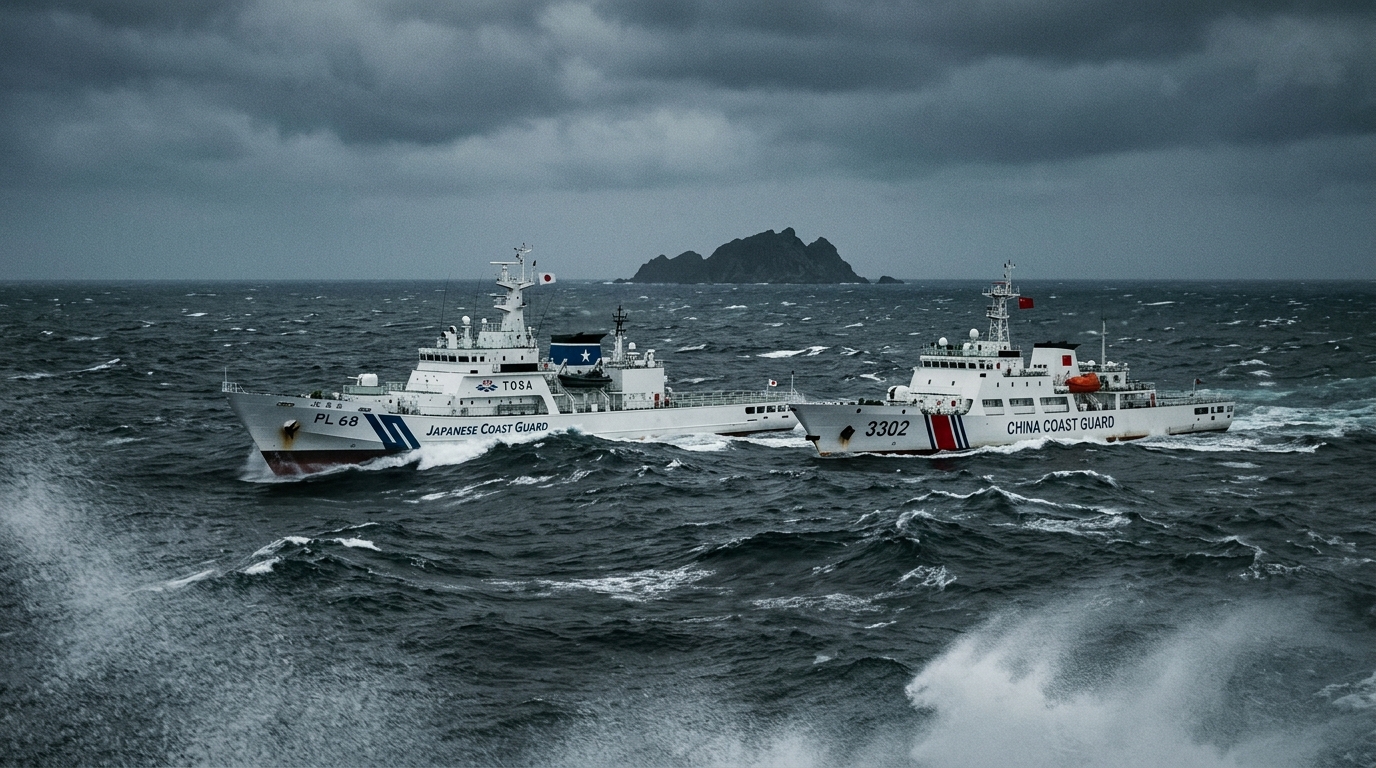
What actually happened, and why the framing matters
The core facts are narrow. A Japanese-flagged fishing boat was operating in waters both governments claim. Two CCG cutters closed on it. Japanese patrol ships interposed themselves, radioed demands to leave, and shadowed the Chinese vessels out. Reporting from The Straits Times and the
BBC's earlier account of the December 2, 2025 incident describes an identical choreography. That is the point: the standoff is now a repeatable script.
Japan's Ministry of Foreign Affairs, in the Diplomatic Bluebook 2025, recorded 39 CCG intrusions into Japan's territorial sea around the Senkakus in 2024, and 355 days of CCG presence in the contiguous zone — the highest since Japan's 2012 nationalisation of the islands. The Bluebook flags an April 2023 intrusion lasting more than 80 hours, at that point the longest ever. Since then the trend has continued straight up:
MOFA's dedicated Senkaku page describes CCG conduct as "unilateral attempts to change the status quo by force or coercion."
The July 7 encounter is thus operationally unremarkable and politically loaded. The China Daily headline on the same day — "China protests Japan's interference in research vessels' work" in "adjacent waters of the Diaoyu Islands" — reframes routine survey activity inside Japan's exclusive economic zone as a Chinese right, and Japanese enforcement as the violation. That inversion, not the ship movements, is the story.
The Taiwan trigger
To read the July 7 face-off as an islands dispute is to miss the wiring. The row began on November 7, 2025, when Takaichi told opposition MP Katsuya Okada in the Diet that a Chinese use of force against Taiwan could constitute a "survival-threatening situation" for Japan under its 2015 collective self-defence framework. Brookings scholar Wu Xinbo, writing in How dangerous is the current China-Japan rift?, notes that Chinese Foreign Minister Wang Yi elevated the remark at the Munich Security Conference to a "very dangerous development" and framed it as evidence Japan retained "ambitions to invade and colonize Taiwan."
Since then, Beijing has run a graduated coercion campaign. Chinese consul general Xue Jian in Osaka posted that the "dirty head that sticks itself out must be cut off," per Al Jazeera; China issued travel warnings; Chinese airlines waived Japan-route change fees; a Japanese Self-Defense Force soldier's off-hours intrusion into the Chinese Embassy in Tokyo was amplified; and in January 2026 Beijing rolled out dual-use export controls covering gallium, germanium, graphite and rare-earth magnets. The
Council on Foreign Relations describes the coast-guard encounters, the seizures, and the export controls as one continuous instrument, not three.
CSIS analyst Emily Benson and colleagues, in China's Rare Earth Campaign Against Japan, draw the sharpest line: previous Chinese minerals curbs were framed as trade retaliation, but the January 6, 2026 package was "explicitly tied to China's foreign-policy signaling" over Taiwan. The Senkakus are the physical theatre for a punishment whose actual message is about Taipei.
Beijing's script, Tokyo's mandate
Beijing has escalated in three stackable layers.
First, maritime. The CCG has moved from patrols to interception attempts on Japanese fishing boats — the maneuver Japan's Coast Guard interrupted on both December 2, 2025 and July 7, 2026. In May 2025 a CCG helicopter took off from a cutter inside Japanese waters and entered Japanese airspace over the islands, prompting a formal MOFA protest delivered by Asian and Oceanian Affairs Bureau chief Masaaki Kanai to the Chinese deputy chief of mission.
Second, economic. On February 24, 2026, China blacklisted 40 Japanese entities from receiving dual-use goods, including Mitsubishi Heavy Industries' shipbuilding group, Kawasaki Heavy Industries, JAXA and Japan's National Defense Academy, per NPR. On June 29 Beijing added 20 more organisations to the blacklist and 20 to a watchlist covering Mitsui E&S, Terra Drone and Hitachi Advanced Systems,
Al Jazeera reported, citing "new militarism." A separate track — noted by
Anadolu Agency — has seen China formally arrest two Japanese employees over alleged rare-earth-related export violations, a hostage-diplomacy pattern well established since the Astellas Pharma case.
Third, symbolic. Tourism to Japan from China collapsed after November's travel advisory; concerts were cancelled; Japan's last two giant pandas were repatriated. The Economist noted that after the 2010 fishing-trawler crisis it took four years to begin reconciliation — and this rift is deeper because Taiwan is now the trigger.
Takaichi, however, has not blinked. She won a snap election that returned the LDP with what Japanese analysts and the BBC call "a historically strong public mandate." Kiyoteru Tsutsui of Stanford's Shorenstein Center told the BBC that Beijing "sees that Takaichi is a pretty strong leader and the pressure campaign could only make her stronger domestically." Her government has already lifted defence spending toward 2% of GDP, launched the JAMSTEC deep-sea rare-earth extraction test at Minamitorishima at depths of 6,000 metres in January 2026 per
Al Jazeera, and, as
CFR's Sheila Smith notes, fast-tracked the 2026 National Security Strategy review.
The regional physics
The Senkakus sit 170 km northeast of Taiwan. That geography is the entire strategic point. Brookings scholar Lynn Kuok, in a study of Beijing's gray-zone coercion, argues that China has relied primarily on the CCG rather than the PLA precisely to keep confrontations below the threshold that would trigger Article 5 of the US-Japan Security Treaty. Successive US administrations have confirmed the Senkakus fall under that clause; the Pentagon reiterated the point in June, per Foreign Minister Toshimitsu Motegi in a
MOFA press conference. Grey zone is the safety valve that lets Beijing punish Tokyo without inviting Washington.
The CSIS analysis by Christopher B. Johnstone and colleagues, Escalating Japan-China Tensions, argues bluntly that "even when [de-escalation] happens, Japan-China relations are likely to stabilize at a new, worse normal." The pattern after 2010 and 2012 was ratchet, not reset: each crisis left the CCG operating deeper and more regularly than before. Japan's
Defense of Japan 2025 digest records that PLA Navy vessels now operate continuously in the East China Sea, and Chinese carrier groups have punched into the western Pacific 22 times since 2016 — with the Fujian, China's third carrier, commissioned in November 2025.
The winner of this dynamic is not obvious. Beijing gets domestic signalling and a demonstration effect for smaller neighbours weighing whether to voice support for Taiwan. Takaichi gets political cover to accelerate rearmament, deep-sea minerals extraction, and closer alignment with Washington and Manila. The loser is the 2008 in-principle agreement to jointly develop East China Sea gas fields, which is now functionally dead, and the pragmatic economic constituency in Tokyo that has argued for two decades that commerce could insulate the relationship from politics.
Diplomat View
The July 7 confrontation is best read not as an incident but as maintenance of a new operating pattern. The forecast: through 2026 the CCG will continue near-daily contiguous-zone presence and periodic attempted interceptions of Japanese fishing vessels, aiming to normalise a scenario in which the Japan Coast Guard is seen defending — not administering — the islands. Beijing will not retract the export controls before the LDP's next major political test, because the coercion campaign is now the demonstration effect for third parties considering Takaichi-style statements on Taiwan. Tokyo will use each incident to justify further defence-budget increases, a harder economic-security regime, and deeper US and Philippine coordination. The forecast changes if: (a) a CCG vessel and a JCG patrol boat collide or a shot is fired, forcing Article 5 consultations with Washington; (b) Xi Jinping and Takaichi meet on the APEC margins in late 2026 and agree even a token communications channel; or (c) Beijing extends dual-use controls into finished automotive rare-earth magnets — the point at which Japanese industry, not the government, would demand a settlement. Absent one of those, expect the "new, worse normal" to be the equilibrium.
What to watch
- Late July–August 2026: Whether the CCG conducts a fresh territorial-sea intrusion timed to the anniversary of Japan's 2012 nationalisation of the islands (September 11). A sustained multi-day intrusion would signal escalation beyond the current tempo.
- October 2026: Takaichi's expected release of the revised National Security Strategy and Defense Buildup Program. The size of the increment above 2% of GDP is the concrete measure of her mandate.
- APEC 2026 (Peru): Any Xi-Takaichi bilateral, or the visible refusal of one, will set the ceiling for de-escalation for the next 12 months.
The Bottom Line
The Senkaku standoff is no longer about the islands. It is the enforcement arm of Beijing's punishment of Tokyo for saying out loud what Japanese strategists have believed for a decade — that a Taiwan contingency is a Japanese security contingency. Until either Takaichi retracts or Beijing accepts she will not, the East China Sea will keep producing incidents like July 7, and each one will lock the "new, worse normal" a little deeper into place.
Discover more

US Politics
White House Pressures Congress for Crypto Leg
The Trump administration's push for the CLARITY Act aims to reshape crypto regulation, impacting trillions in market value and the Trump family's wealth.
India
Women’s Reservation in India
India's 33% women's reservation law is enacted but won't take effect until after 2029 due to political setbacks and census delays.
India
700 Activists Accuse PM Modi of MCC Breach
Over 700 activists allege PM Modi breached election code with a televised address attacking opposition parties just before state elections.

Conflict & Security
Drone Warfare Killing Aid Workers at Unprec
Over 1,000 humanitarian workers killed in three years as cheap armed drones collapse legal protections. Gaza, Sudan, Ukraine, and DRC see deliberate targeting of aid convoys and hospitals with zero prosecutions.