Senkaku face-off signals Japan-China rift
Japan and China clash over Senkaku Islands, marking a new normal.
Model Diplomat8 min readEast Asia
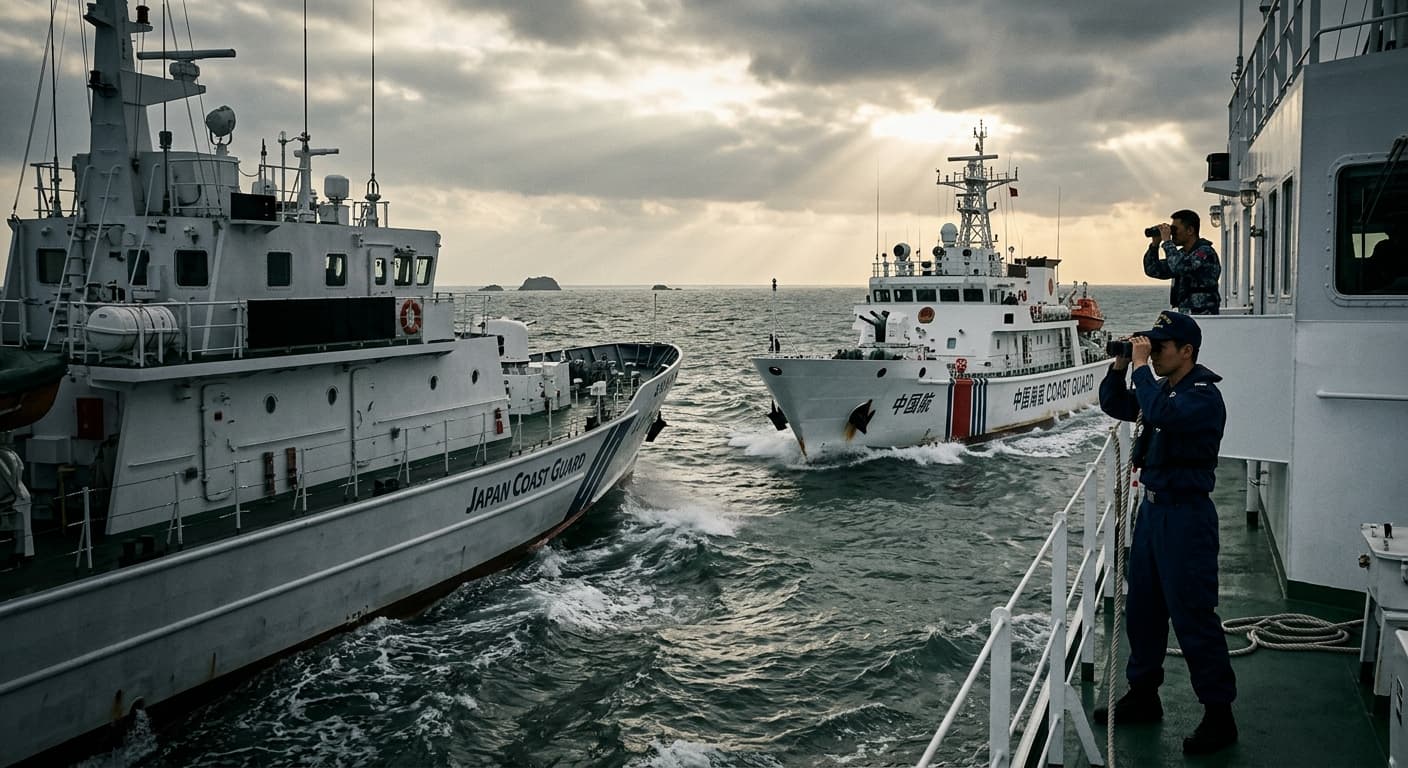
Senkaku face-off signals Japan-China rift is now a permanent condition
Japan and China's coast guards clashed near the Senkaku Islands on July 7, 2026 — the third such standoff since Takaichi's Taiwan remarks turned a maritime dispute into a full economic-security confrontation.
Two China Coast Guard cutters entered Japanese territorial waters around the Senkaku Islands at dawn on July 7, 2026, sought to close on the Japanese trawler Zuihou Maru, and were pushed out by 9:20 a.m. local time by Japan Coast Guard patrol ships. The tactical event was minor. Its meaning is not. Eight months after Prime Minister Sanae Takaichi told the Diet that a Chinese attack on Taiwan could constitute a "survival-threatening situation" for Japan, Beijing has fused three previously separate tools — coast-guard incursions, rare-earth coercion, and the arrest of Japanese nationals — into a single sustained pressure campaign. The face-off is not an incident; it is the daily operating tempo of a new East China Sea normal that Tokyo can no longer roll back at the diplomatic table.
What actually happened on July 7
According to The Japan Times, four Chinese vessels were sailing near the islands when two crossed the 12-nautical-mile line and moved toward the Zuihou Maru. The Japan Coast Guard "issued orders to leave" and positioned patrol vessels between the fishing boat and the CCG cutters until the Chinese ships withdrew. The
Straits Times noted Tokyo called the intrusion "a violation of international law."
Beijing's account is the mirror image. The Global Times reported that the CCG "took necessary control measures" against the Zuiho Maru for "illegally" entering Chinese territorial waters off Chiwei Yu, the westernmost of the disputed islets.
China Daily simultaneously accused Japan of "interfering" with Chinese research vessels in adjacent waters — extending the framing beyond fishing enforcement to broader maritime jurisdiction.
The last such confrontation was on December 2, 2025, per the BBC; before that, Chinese vessels last entered Japanese-claimed waters on June 10. What was once a diplomatic anomaly is now a monthly rhythm.
Why this incident matters more than the last dozen
The Japan Coast Guard's own numbers, cataloged in Japan's Ministry of Foreign Affairs Diplomatic Bluebook 2025, show China Coast Guard vessels intruded into Japan's territorial sea around the Senkakus on 39 separate occasions in 2024 — up from 34 in 2023 and 28 in 2022 — and sailed the contiguous zone on a record 355 days. In 2025 that figure reached 357 of 365 days, the
Observer Research Foundation reported in June 2026, with 1,380 individual Chinese government ships logged over the year — both all-time highs.
That is the salami-slicing baseline. What changed in late 2025 is that Beijing began fusing the maritime campaign with economic and consular tools it had previously kept siloed.
The trigger was November 7, 2025. Answering an opposition question in the Diet, Takaichi said the use of force against Taiwan could meet Japan's legal threshold for exercising limited collective self-defense. As the Japan Institute of International Affairs notes, the substantive content aligned with existing government policy — but a sitting Japanese prime minister had never publicly attached the "survival-threatening situation" trigger to a Taiwan scenario. Wang Yi called it a red line. Xi Jinping's government moved.
The three-domain pressure campaign
Within eight weeks, Beijing rolled out three synchronized pressure tracks that had never previously been combined against Japan.
Rare earths first. On January 6, 2026, China's Ministry of Commerce restricted exports of dual-use rare earths, permanent magnets, gallium, germanium and graphite to Japan. In its analysis of the move, CSIS emphasized what made it new: "the current restrictions are explicitly tied to China's foreign-policy signaling" over Taiwan, unlike the 2024 controls framed as trade retaliation against Washington. Japan imports roughly 63% of its rare-earth metals from China. On February 24, Beijing added 40 Japanese entities — including subsidiaries of Mitsubishi Heavy Industries, Kawasaki Heavy, Fujitsu, Subaru and the Japan Aerospace Exploration Agency — to export-control and watch lists, per
NPR.
Legal risk to Japanese nationals second. On July 1, 2026, Chinese authorities formally arrested two Japanese employees of Fuji Electric over alleged rare-earth-related export violations, Anadolu Agency reported, citing Kyodo. The same day, a CCG cutter ordered Japan's seabed-survey vessel Takuyo to halt work 290 km northwest of Okinawa — inside Japan's own EEZ. Tokyo refused and lodged a protest with Deputy Chief of Mission Shi Yong.
Maritime coercion third — the July 7 face-off. The Zuihou Maru incident is the visible face of a campaign that has already normalized permanent Chinese presence.
Iain Watson and colleagues at the BBC documented the full pressure package after Takaichi's snap-election victory this spring: warships, throttled rare earths, curtailed tourism, cancelled J-pop concerts, even the return of loaned pandas. What Beijing has done, in effect, is import its Lithuania and Australia playbooks — but bolt them onto a live maritime dispute where the Japan-U.S. Security Treaty is a legal tripwire.
The legal-strategic engineering that makes it work
The maritime piece is engineered, not opportunistic. As the Sasakawa Peace Foundation has documented, China's 2021 Coast Guard Law authorizes the CCG to expel foreign government vessels and forcibly board those Beijing deems in violation of Chinese law. Article V of the U.S.-Japan Security Treaty covers only territories "under the administration" of Japan. Every hour a Chinese cutter operates inside the 12-mile line — and every time it approaches a Japanese fishing boat as if enforcing Chinese fisheries law — erodes the "administered by Japan" predicate that anchors U.S. treaty commitments.
That is why the Zuihou Maru confrontation matters more than the raw intrusion count suggests. As Brookings' Lynn Kuok has written, Beijing has calibrated its coast guard so precisely below the kinetic threshold that Tokyo cannot escalate without becoming the first mover — and cannot de-escalate without ceding facts on the water. The Swedish Defence Research Agency
FOI reached the same conclusion: CCG deployments are designed to "outnumber, outperform and outlast" the JCG while keeping the confrontation calibrated below war.
Beijing's May 2025 helicopter incursion into Japanese airspace, protested formally by Tokyo's MOFA, extended the coercive perimeter into the air. Japan's Ministry of Defense flagged the same episode in its
June 2026 China Activities briefing as evidence that "China has been relentlessly continuing its unilateral attempts to change the status quo by force."
Who's winning, who's losing
The winner is Beijing's grey-zone doctrine, not any specific Chinese objective. China has not seized the Senkakus, has not shifted U.S. treaty language, and has not forced Takaichi to retract her Diet comments — she refused, and won a snap election on it. But it has locked Japan into a two-front strain: defending sovereignty at sea while absorbing supply-chain damage on land. Suzuki suspended Swift production in April 2025 because of rare-earth cuts, per CSIS. Nissan reported disruption. The Fuji Electric arrests introduce personal legal risk for every Japanese executive doing rare-earth-adjacent business in China.
The clear loser is the 2008 East China Sea joint-development framework. Negotiations on jointly exploiting the sea's gas resources have been frozen since 2010, and Japan protested new Chinese structures west of the median line as recently as August 2025, per Al Jazeera. That framework is now effectively dead.
The quieter loser is the United States' preferred model of Indo-Pacific deterrence. Washington under President Trump has publicly backed Takaichi — including an unusual pre-election endorsement — but as the Japan Institute of International Affairs noted, the administration has "refrained from endorsing Takaichi's remarks outright," reiterating principles without addressing specific Taiwan scenarios. Trump's April 2026 state visit to Beijing gave Xi political cover to keep pressure on Tokyo while pursuing a U.S.-China thaw. Japan is now, in the phrasing of Stanford's Kiyoteru Tsutsui quoted by the BBC, "shouldering more of the defense burden" — which is precisely what Beijing's pressure was designed to force.
The regional read-across
The Senkaku playbook now travels. On June 1, 2026, per the BBC's Chinese service, CCG cutters conducted "law enforcement patrols" off Taiwan's Orchid Island for the first time — the eastern side of Taiwan, inside what Beijing calls its "near-seas governance" perimeter. The
Observer Research Foundation has separately documented a step-change in Chinese grey-zone activity around Taiwan's Pratas Islands in the past quarter. The same coast guard, the same tempo, the same doctrine — deployed simultaneously across three flashpoints.
That is the second-order effect the wire coverage of July 7 misses. Tokyo, Taipei and Manila are now watching a single integrated Chinese maritime instrument that can be applied in escalatory sequence — and, crucially, in parallel. Japan's response, per the IISS, has been to accelerate deep-sea rare-earth extraction near Minami-Torishima and to treat those deposits as an "economic-security-oriented" strategic asset for a trade bloc with the U.S. and EU — a decoupling calculation that would have been politically impossible before November 2025.
What to watch next
- September 2026 UN General Assembly: first plausible venue for a Takaichi–Li Qiang encounter. A meeting held signals partial de-escalation; a meeting refused confirms the freeze.
- October 2026 Japan Coast Guard budget submission: MOFA and MOD are pushing for expanded southwestern-islands deployment; the yen figure will show whether Takaichi is willing to spend political capital on maritime hardware, or absorb the pressure diplomatically.
- Fuji Electric employees' indictment: Chinese prosecutors have roughly one month from formal arrest to file charges. An indictment tied to rare-earth "smuggling" would set a template for further arrests of Japanese executives.
- First CCG boarding of a Japanese fishing vessel: the doctrinal next step under the 2021 Coast Guard Law. It has not yet happened. When it does, Article V of the U.S.-Japan treaty gets its first real-world stress test.
Diplomat View
The consensus reading — that July 7 was another routine Senkaku incident — is quietly wrong. The correct reading is that Beijing has, since November 2025, industrialized a three-domain coercion package (maritime, economic, consular) that no Japanese government can unwind without a public Taiwan-related retraction Takaichi will not give. That package is now the baseline, not the crisis. Our forecast: Sino-Japanese relations do not "stabilize" in 2026 or 2027; instead, they enter a managed-hostility equilibrium closer to the China–Australia relationship of 2020–22 than to any previous China–Japan freeze. Two conditions would revise this call. First, a Trump–Xi bargain that trades U.S. tech restrictions for Chinese economic pressure relief on Tokyo — plausible given Trump's April Beijing visit, but Takaichi is not currently at that table. Second, a boarding, ramming, or fatality at the Senkakus that forces Tokyo to invoke Article V, at which point the grey zone collapses into a decision Washington has spent a decade trying not to make.
The bottom line: Japan is no longer in a maritime dispute with China. It is in an open, multi-domain coercion contest in which the Senkakus are the visible flashpoint but rare earths, arrests, and Taiwan are the real terrain — and Takaichi has already decided she would rather absorb the pressure than fold.
Discover more
US Politics
SNAP Food Assistance Faces Legal Challenges
In 2026, SNAP faces stricter eligibility rules and mounting legal challenges, threatening food assistance for the millions of Americans who rely on the program.
Global Politics
Trump's Conflicting Messages on Iran War
Trump's mixed messages on Iran reflect a strategy of audience management, benefiting Tehran amid a complex geopolitical landscape.
US Politics
House Ethics Committee Pushes Sexual Miscond.
The House Ethics Committee has shifted responsibility for sexual harassment settlement records to the Office of Congressional Workplace Rights, complicating disclosure efforts.

Economics
Fed's Amex AML order puts correspondent banking on notice
Federal Reserve's Amex AML order requires board-level controls and a 90-day plan; OCC fined the bank $350 million over enterprise-wide deficiencies.