SEC's IPO Roundtable: Major Disclosure Roll
SEC's roundtable signals a shift in IPO disclosure rules.
Model Diplomat8 min readNorth America
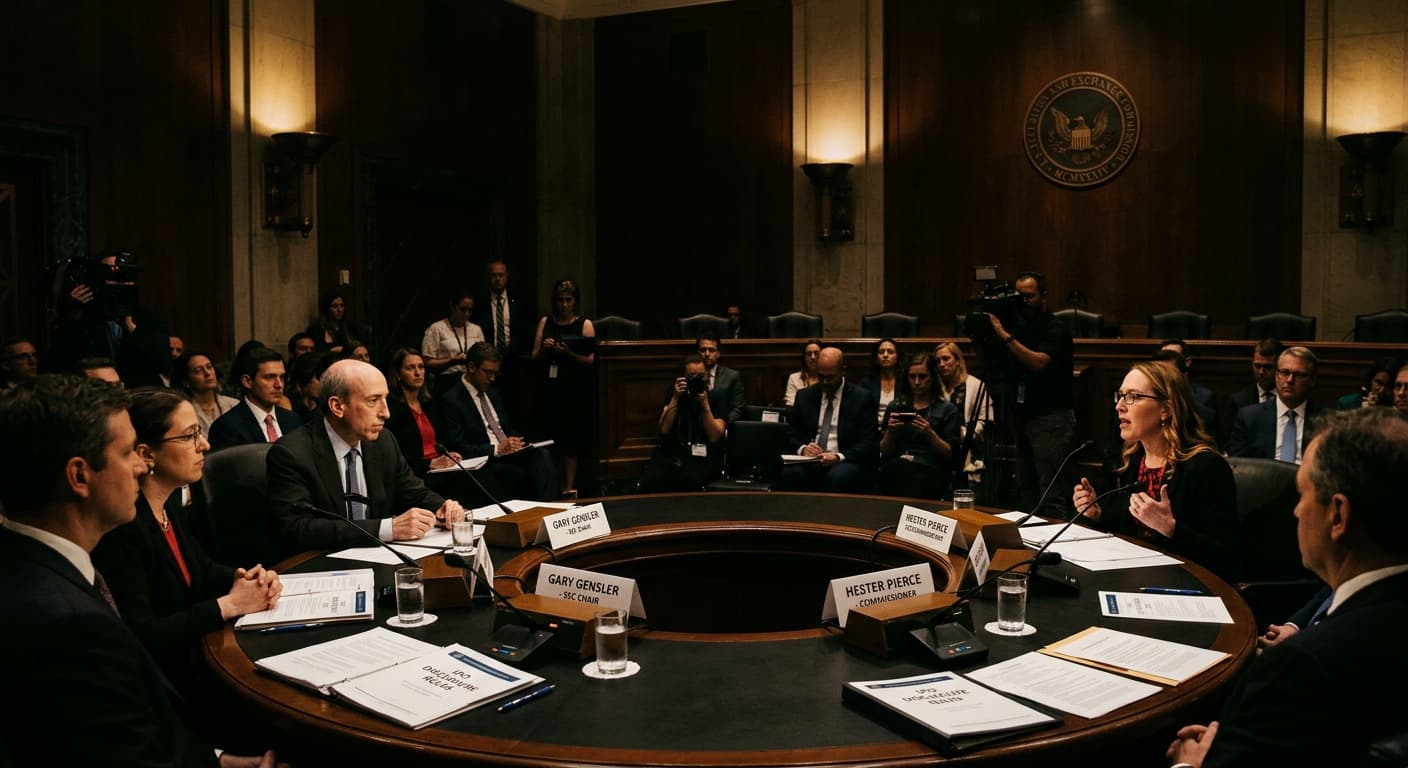
SEC's IPO Roundtable Sets Up the Biggest Disclosure Rollback in 20 Years
The SEC's July 13, 2026 virtual roundtable on modernizing IPOs is the public-facing frame for a rulemaking package that would exempt roughly 81% of public companies from full reporting — a bet that lighter disclosure will bring small firms back to public markets.
The Securities and Exchange Commission's July 13, 2026 virtual roundtable, "Rethinking the Rulebook: Modernizing the IPO Process & Access to Public Capital," is not a fact-finding exercise. It is the public choreography for a rulemaking package already on the tape — optional semiannual reporting proposed May 5 and a sweeping simplification proposal issued May 19 that would strip full disclosure obligations from public companies under $2 billion in float. The beneficiaries are not the small firms that policymakers say they want to bring to market; they are the mid-cap public companies already listed, plus the insiders and private-equity holders whose exit options widen when reporting costs fall. Whether the trade — less investor information for a thicker IPO pipeline — actually lifts small-firm listings is the question academic research has been answering "probably not" for over a decade.
What the SEC is actually convening
The event is hosted by the SEC's Office of the Advocate for Small Business Capital Formation and the Division of Corporation Finance, at 2:00 p.m. Eastern on July 13. According to the SEC's own announcement, the discussion will focus on "ways to support public companies in raising capital and maintaining their public status, modernizing the IPO process, and improving access to the public markets." Registration is not required, per the
Free Writings & Perspectives preview by Mayer Brown's securities practice.
The roundtable sits inside a fast-moving 2026 agenda. The Small Business Capital Formation Advisory Committee flagged the IPO problem at its April 28 meeting, according to the April 16 SEC release, and the 45th Annual Small Business Forum was announced February 13. A
Sunshine Act notice filed June 22 sets the next public committee session for July 21 — eight days after the roundtable. This is a compressed sequence, not a consultation calendar.
Chair Paul Atkins, sworn in on April 22, 2025, has framed the priority repeatedly. In testimony before the House Appropriations subcommittee on May 20, 2025, he committed to "return to our core mission" of "facilitating capital formation." Orrick's securities team, in a memo titled
"Making IPOs Great Again", described semiannual reporting as "likely only the first step in a potentially major overhaul."
The problem the SEC says it is solving
The United States has fewer listed companies than it did thirty years ago, and dramatically fewer than its peers. Research by Craig Doidge, Andrew Karolyi, Kris Shen, and René Stulz, published in the Financial Review in May 2025, pegs the "U.S. listing gap" at 7,162 firms as of 2023 — 32% wider than in 2012. The U.S. had 4,315 listed companies in 2023, down from a 1996 peak of 8,025, according to their
NBER working paper.
Traditional IPO activity has stayed thin. A Congressional Research Service report citing University of Florida finance professor Jay Ritter reports 54 operating-company IPOs raised $12 billion in 2023, against a long-term 1980-2023 average of 209 deals per year. The 2026 headline number looks better — DealBook reported $169 billion in global IPO proceeds in the first half, up 246% year-on-year — but the count of offerings fell to 514 globally, a fourth consecutive annual decline, per the
Free Writings preview. More money, fewer deals: the small-firm IPO remains missing.
What the rulemaking package actually does
Two proposals frame what the July 13 discussion is really about.
The first, issued May 5, 2026, would let public companies opt into semiannual reporting in place of quarterly 10-Qs. In an FT interview transcript, reporter George Steer summarized Atkins's argument: quarterly filings are "too rigid," and management "will have more time to focus on growth." SIFMA and the U.S. Chamber cited the pending proposal in a March 2026
Supreme Court amicus brief, noting the SEC is "reconsidering its quarterly reporting requirements in favor of a less demanding semi-annual reporting regime."
The second, announced May 19, is the more consequential move. According to written testimony by Natalia Renta of Americans for Financial Reform, filed in the House Financial Services Committee record on June 25, 2026, the SEC would "exempt all companies that have been public for less than five years regardless of size and companies with under $2 billion in public float — 81 percent of public companies — from the full suite of reporting requirements." The exempted companies would not have to disclose risk factors, CEO-to-worker pay ratios, pay-versus-performance data, or hold say-on-pay votes, and would lose the auditor attestation of internal control over financial reporting.
A third proposal in the package would expand issuer flexibility on offering timing and communications, and would preempt state securities laws for registered offerings — the sort of Blue Sky preemption that state regulators fought during the JOBS Act debate.
Why the small-business framing is misleading
Here is where the SEC's messaging and the academic literature diverge sharply.
The dominant "IPO-market-is-broken" narrative — that Sarbanes-Oxley and quarterly reporting drove small firms out of public markets — has been contested for a decade. Ritter's alternative, laid out in SSRN working paper 1954788, is the "economies of scope" hypothesis: small firms sell to larger acquirers because integrated distribution and technology have raised the value of being part of a big organization relative to staying independent. Ritter's policy conclusion is blunt: "structural changes (e.g., subsidizing analyst coverage, lowering regulatory burdens) to boost IPO activity would not be very effective."
A 2020 Census-linked study by Chemmanur, He, Ren and Shu using proprietary U.S. Census data on private firms reached a compatible finding. The IPO decline is not driven by a shortage of "exit-eligible" firms, and the propensity to IPO among small private firms is not the main driver of the drop. Product-market competition and the abundance of private-equity financing explain more. A 2025
Federal Reserve staff working paper by Almazan, Swem, Titman and Weitzner found that firms with higher external capital needs are the ones that IPO — precisely the firms that private markets no longer serve as well.
Translation: cutting disclosure will not, on its own, produce the small-firm IPOs Atkins wants. It will, however, materially lower ongoing costs for the mid-cap companies that are already public — the constituency that has lobbied hardest for reporting relief.
Who wins and who pays
The winners are concrete. Mid-cap issuers with under $2 billion in float — a category that captures most of the Russell 2000 — would shed ongoing compliance costs that Orrick estimates run into the millions per year. Insiders and control shareholders of newly public companies gain a five-year runway free of pay-versus-performance and CEO-worker ratio disclosures. Underwriters and issuer counsel gain a more flexible communications regime and preempted state review.
The losers are equally concrete. Index-fund and retail investors — whose capital dominates the market that Atkins wants to reinvigorate — lose disclosure they currently use. Renta's testimony argues the package would "tilt the playing field further in favor of insiders and others who get nonpublic information through business or personal relationships, and against retail and index fund investors."
Empirical work backs the skepticism. A 2023 Management Science study by Robert Stoumbos found that switching from semiannual to quarterly reporting narrows bid-ask spreads by 1.6% — a real liquidity cost of the reverse move. Robert Pozen and Ming Liu, in a
2018 Brookings analysis, noted that when the SEC moved from semiannual to quarterly reporting between 1955 and 1970, the cost of equity capital fell for U.S. public companies. And a UK study Pozen cited found that the UK's 2014 return to semiannual reporting produced no measurable increase in capital investment or R&D. The evidence that less-frequent reporting spurs long-term investment is thin; the evidence that it widens information asymmetry is not.
What Congress is doing in parallel
The SEC is not moving alone. The Greenlighting Growth Act (H.R. 3343) would relax financial-statement reporting requirements for emerging growth companies.
H.R. 8286, reported April 15, 2026, would codify a materiality-limitation standard on all SEC disclosure rulemaking and establish a Public Company Advisory Committee. A separate
Congressional Research Service In Focus catalogs dozens of related capital-markets bills moving through the 119th Congress.
The message from both branches: the disclosure baseline set after Enron and Sarbanes-Oxley is being renegotiated in real time.
Diplomat View
The July 13 roundtable is a signaling event, not a listening exercise. The rulemaking direction is set: a two-tier disclosure regime where roughly four in five public companies operate under a lighter framework than the one that has defined U.S. equity markets since 2003. The forecast: expect the SEC to finalize the semiannual reporting option in Q4 2026, and to advance the broader disclosure-simplification package on a similar timeline, absent a court challenge. The likely near-term effect is a modest bump in mid-cap follow-on activity and possibly a handful of high-profile IPOs — but not the durable revival of the sub-$100 million offering that the "listing gap" literature identifies as the real problem. If small-firm IPO counts remain flat through 2027 despite the rule changes, the Ritter and Doidge-Karolyi-Stulz thesis — that the decline is structural, not regulatory — will have been vindicated, and the disclosure rollback will look like a transfer to incumbents dressed as small-business policy. Revision conditions: a surge in sub-$100M IPO filings after semiannual reporting takes effect, or evidence that private-market alternatives are contracting, would force a rethink.
What to watch next
- July 13, 2026, 2:00 p.m. ET — "Rethinking the Rulebook" roundtable. Watch for named panelists from the buy-side; their absence would signal how narrow the coalition is.
- July 21, 2026 — SBCFAC Sunshine Act meeting, per the
SEC notice. Expect formal committee recommendations on IPO process reforms.
- Early Q4 2026 — Close of the 60-day comment period on the semiannual reporting proposal and, on a parallel track, the May 19 disclosure simplification package. The volume and composition of institutional-investor comments will shape final rule contours.
- Q1 2027 — Likely first SEC action to finalize semiannual reporting; watch for a legal challenge citing the Loper Bright post-Chevron standard, which will decide whether the Atkins agenda survives judicial review.
The Bottom Line
The SEC's July 13 roundtable is not about opening public markets to small business — it is the public prelude to the largest rollback of U.S. corporate disclosure since Sarbanes-Oxley, exempting roughly 81% of listed companies from the full reporting regime. The academic evidence says lighter disclosure will not, by itself, revive small-firm IPOs, because the decline is structural. What the package will do is transfer compliance savings to incumbent mid-caps and their insiders, while shifting information risk onto index-fund and retail investors — a trade the market has been asked to accept before, and which the next 90 days of comment letters will decide again.
Discover more

Global Politics
Xi Jinping Calls China-Russia Ties 'Precious'
Xi Jinping's description of China-Russia ties as 'precious' reflects a strategic imbalance, with Beijing dictating terms in the partnership.

India
Rajnath Singh's Durga Squad for 2026 Polls
Rajnath Singh's Durga Squad promised women's safety in Bengal but has since disappeared from the agenda, revealing BJP's true priorities.

India
700 Activists Accuse PM Modi of MCC Breach
Over 700 activists allege PM Modi breached election code with a televised address attacking opposition parties just before state elections.

Economics
Fed's Amex AML order puts correspondent banking on notice
Federal Reserve's Amex AML order requires board-level controls and a 90-day plan; OCC fined the bank $350 million over enterprise-wide deficiencies.