SEC's IPO Rescue Mission Meets Listing Gap
Paul Atkins aims to revive small-company IPOs amid challenges.
Model Diplomat7 min readNorth America
SEC's IPO Rescue Mission Meets a 30-Year Listing Gap
Paul Atkins is staking his chairmanship on reopening the small-company IPO — but the academic record says regulation isn't what killed it.
The Securities and Exchange Commission's Small Business Capital Formation Advisory Committee (SBCFAC) will convene on July 21, 2026, in the second of three consecutive summer events staged by Chair Paul Atkins to prove he can reopen a small-company IPO market that has been shrinking, on trend, since 1996. Per the SEC's Sunshine Act notice dated June 22, 2026, a majority of Commissioners may attend — a signal that the meeting is not advisory theater but political groundwork for the most sweeping registration-rule overhaul in more than two decades. The problem: three decades of NBER and Federal Reserve research say deregulation cannot, on its own, resurrect an IPO pipeline that private capital, M&A economics, and Nasdaq's own listing arithmetic have already priced out.
That is the argument worth watching. The Atkins agenda will produce winners. They are unlikely to be the mid-market firms the SBCFAC was chartered to serve.

The listing gap the SEC keeps trying to close
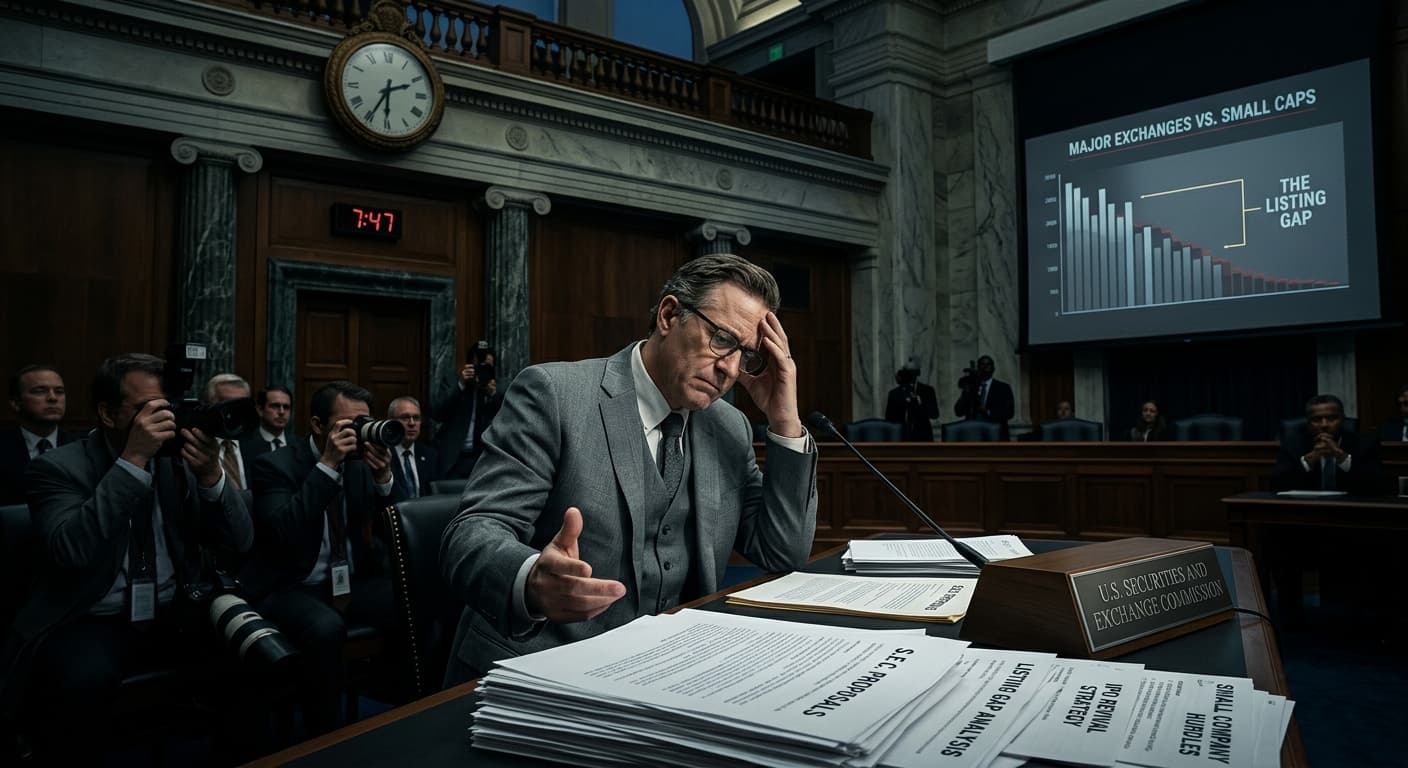
The scale of the collapse is not in dispute. According to the seminal NBER work by Craig Doidge, Andrew Karolyi and René Stulz, the number of U.S. exchange-listed firms fell from 8,025 in 1996 to 4,102 in 2012 — even as non-U.S. listings rose from 30,734 to 39,427 over the same window, per their working paper on the U.S. listing gap. Their 2025 update,
NBER WP 33556, finds the gap has widened through 2023: the U.S. now has roughly half as many listed firms per capita as other developed economies.
The decline is overwhelmingly a small-firm phenomenon. Gao, Ritter and Zhu, in the Journal of Financial and Quantitative Analysis, found that small-company IPOs collapsed from an average of 165 per year in 1980–2000 to just 28 per year in 2001–2012 — a 83% drop that no amount of large-cap activity has offset.
That is the arithmetic on Atkins's desk. His SEC has responded on three fronts: an April 16 announcement directing SBCFAC to explore "ways to encourage more IPOs"; a July 13 public event titled "Rethinking the Rulebook: Modernizing the IPO Process & Access to Public Capital," previewed by Mayer Brown's
Free Writings & Perspectives; and proposed rulemakings unveiled in May 2026 that Atkins's team is billing as the deepest registration overhaul in 20 years. In parallel, Atkins has proposed cutting quarterly reporting to semi-annual — the
Financial Times reported the SEC vote and 60-day comment period in September 2025.
What Atkins is actually proposing
Strip away the branding and the emerging Atkins doctrine has four load-bearing pieces, most of which track Congressional proposals from Rep. Ann Wagner and testimony delivered by former IPO Task Force principal Jonathan Trotter in March 2025.
First, the emerging growth company (EGC) definition would be widened. Trotter's House Financial Services testimony urges lifting the revenue ceiling from $1.235 billion to $3.0 billion and guaranteeing a five-year post-IPO on-ramp — meaningfully softening Sarbanes-Oxley Section 404(b) auditor-attestation exposure. Second, well-known seasoned issuer (WKSI) eligibility would drop from a $700 million public-float threshold to $75 million, opening shelf-registration efficiencies to smaller firms. Third, the
Encouraging Public Offerings Act of 2025 would extend confidential draft-registration submissions and "testing the waters" communications to all issuers, not just EGCs. Fourth, the
Middle Market IPO Cost Act — passed by the House on voice vote in July 2025 and now before Senate Banking — orders GAO to quantify direct and indirect IPO costs for the first time.
The statutory authority for all of this sits in 15 U.S.C. § 78qq, which established the SBCFAC in 2016 to advise the Commission on rules affecting emerging companies and publicly traded firms below $250 million in market cap. The statute is posted at Cornell's Legal Information Institute; the underlying
Public Law 114-284 explicitly excludes enforcement matters from the committee's remit — a limit Atkins is not testing, but is quietly exploiting.
The rhetorical frame is Atkins's own. In his May 20, 2025 testimony to House Appropriations, he pledged to restore capital formation to co-equal status with investor protection and to end "regulation by enforcement." He was confirmed to a full term by a 51–47 Senate vote on October 7, 2025, per the
Congress.gov nomination record. The mandate is thin but sufficient.
The academic problem with the Atkins theory
Here is where a policymaker acting on the SEC agenda should pause. The dominant academic finding is that the U.S. listing gap is not primarily a regulatory artifact.
Gao, Ritter and Zhu explicitly reject the Sarbanes-Oxley story, arguing instead for an "economies of scope" hypothesis: small firms are more valuable being acquired by incumbents that can commercialize their products faster than they can as standalone public companies. Doidge, Karolyi and Stulz concur, and add that abnormally high acquisition rates account for roughly 46% of the missing listings. Michael Ewens and Joan Farre-Mensa, in NBER WP 26317, pin the marginal cause on a 1996 event Atkins's team rarely mentions: the National Securities Markets Improvement Act (NSMIA), which pre-empted state Blue Sky laws for private placements and turned private capital into a genuine substitute for a public listing. The median VC-backed company that does go public now waits seven years, up from four in the 1990s.
Even the GAO tempers the compliance-cost narrative Atkins deploys most often. Its January 2025 study of Sarbanes-Oxley found that Section 404(b) audit fees rose a median $219,000 (13%) in the year a firm crossed the exempt/nonexempt threshold — real money, but a rounding error against the private-market alternative. GAO also found that 73% of restatements in its sample of exempt companies cited material internal-control weaknesses, versus 59% at nonexempt firms. Loosening the on-ramp has second-order costs the Atkins agenda does not price.
The IPOs that do happen have shifted quality. Nain, Ying and Arthur, publishing in the Journal of Empirical Finance in 2025, show that abundant venture capital raises private-market selectivity — meaning weaker firms are the ones left to go public, and post-IPO abnormal returns for retail investors are negative. The economic problem the SBCFAC keeps circling is not that too few small firms can list. It is that most of the ones that could list are worth more selling to Salesforce, Meta, or a private-equity roll-up.
Who actually wins if Atkins gets his rules
Follow the money and two constituencies stand out — neither of them the mid-market manufacturer or biotech the SBCFAC statute imagines.
The first is mega-cap tech. Nasdaq's May 2026 rule change, catalyzed by SpaceX's lobbying, cut the wait for Nasdaq-100 inclusion from months to 15 trading days for eligible mega-caps. Al Jazeera reported that SpaceX priced at roughly $1.8 trillion and drew $70 billion in orders; OpenAI and Anthropic have confidentially filed at reported $1 trillion valuations. A looser Atkins WKSI regime does nothing for them — they are already the biggest issuers on earth — but semi-annual reporting and streamlined confidential filings will make it cheaper for the next generation of $100 billion-plus unicorns to stay public.
The second is microcap. The FT reported that the U.S. microcap IPO market booked 42 offerings in Q4 2024 and 41 in Q1 2025 — the two busiest quarters in 15 years — dominated by China- and Hong Kong-domiciled shell issuers routed through Dominari Securities and RF Lafferty. Nasdaq's own $15 million minimum-raise rule is the marginal constraint here, not SEC disclosure. Any Atkins liberalization on confidential filings and testing-the-waters will lower the friction further for exactly the offerings that FINRA and the SEC's own investor-alerts unit spend their days warning retail buyers about.
The mid-market — the domestic small-cap issuer with $150 million to $500 million in revenue and no easy strategic acquirer — is the constituency the reforms are packaged around and the constituency least positioned to benefit. Alimov's 2026 paper in Small Business Economics finds that even the JOBS Act's $700 million threshold measurably distorted post-IPO acquisition behavior without lifting standalone growth. New thresholds will produce new distortions.
Diplomat View
The Atkins IPO project is best read not as a capital-formation reform but as a political price signal. It reassures issuers, exchanges and the underwriting bar — a durable Republican coalition — that the SEC is now their agency. It does not, on the evidence, credibly bend the listing-gap curve. Expect the July 21 SBCFAC meeting to produce recommendations closely tracking the Wagner/Trotter package: broader EGC, expanded WKSI, universal testing-the-waters, softer 10-K termination rules. Expect the proposed semi-annual reporting rule to be finalized in Q1 2027 over the objection of institutional investors, then challenged in the D.C. Circuit under State Farm arbitrary-and-capricious review.
The forecast that would falsify this view: if the GAO Middle Market IPO Cost study — due within 360 days of enactment of H.R. 3395 — identifies a specific, quantifiable cost line where Atkins's rule changes plausibly move the median mid-market issuer from acquisition-exit to IPO-exit, the deregulation case gets stronger. It has not, in 25 years of NBER, Fed, and Census work, been so identified. Revisit when it is.
What to watch next
- July 21, 2026 — SBCFAC meeting, SEC HQ. Watch for a formal recommendation on EGC/WKSI threshold changes and whether Atkins attends personally.
- Q3 2026 — Close of the 60-day comment period on the semi-annual reporting proposal, and expected SEC votes on the May 2026 registration-modernization rulemakings.
- Senate Banking, 2026 — Movement (or not) on H.R. 3395 and H.R. 3381; both cleared the House by voice vote in July 2025 and have been idle since receipt in the Senate on July 22, 2025.
The Bottom Line
The bottom line: Paul Atkins is trying to solve with SEC rulemakings a listing decline that three decades of peer-reviewed research attributes to private capital abundance, M&A economics and Nasdaq's own listing thresholds — not to disclosure burden. The reforms will pass, and they will materially help mega-cap tech unicorns and microcap Chinese shell issuers. The domestic mid-market small business, in whose name the SBCFAC exists, will remain the constituency the U.S. capital-formation system serves least well.
Discover more

India
Women's Reservation Bill 2026: A Political Sh
India's Lok Sabha rejected the Women's Reservation Bill, exposing a political maneuver to redraw electoral maps favoring the north over the south.

Global Politics
Xi Jinping Calls China-Russia Ties 'Precious'
Xi Jinping's description of China-Russia ties as 'precious' reflects a strategic imbalance, with Beijing dictating terms in the partnership.

India
Women’s Reservation in India
India's 33% women's reservation law is enacted but won't take effect until after 2029 due to political setbacks and census delays.

Conflict & Security
Drone Warfare Killing Aid Workers at Unprec
Over 1,000 humanitarian workers killed in three years as cheap armed drones collapse legal protections. Gaza, Sudan, Ukraine, and DRC see deliberate targeting of aid convoys and hospitals with zero prosecutions.