SEC's IPO Disclosure Rules Under Review
Exploring changes to small business IPO regulations
Model Diplomat5 min readNorth America
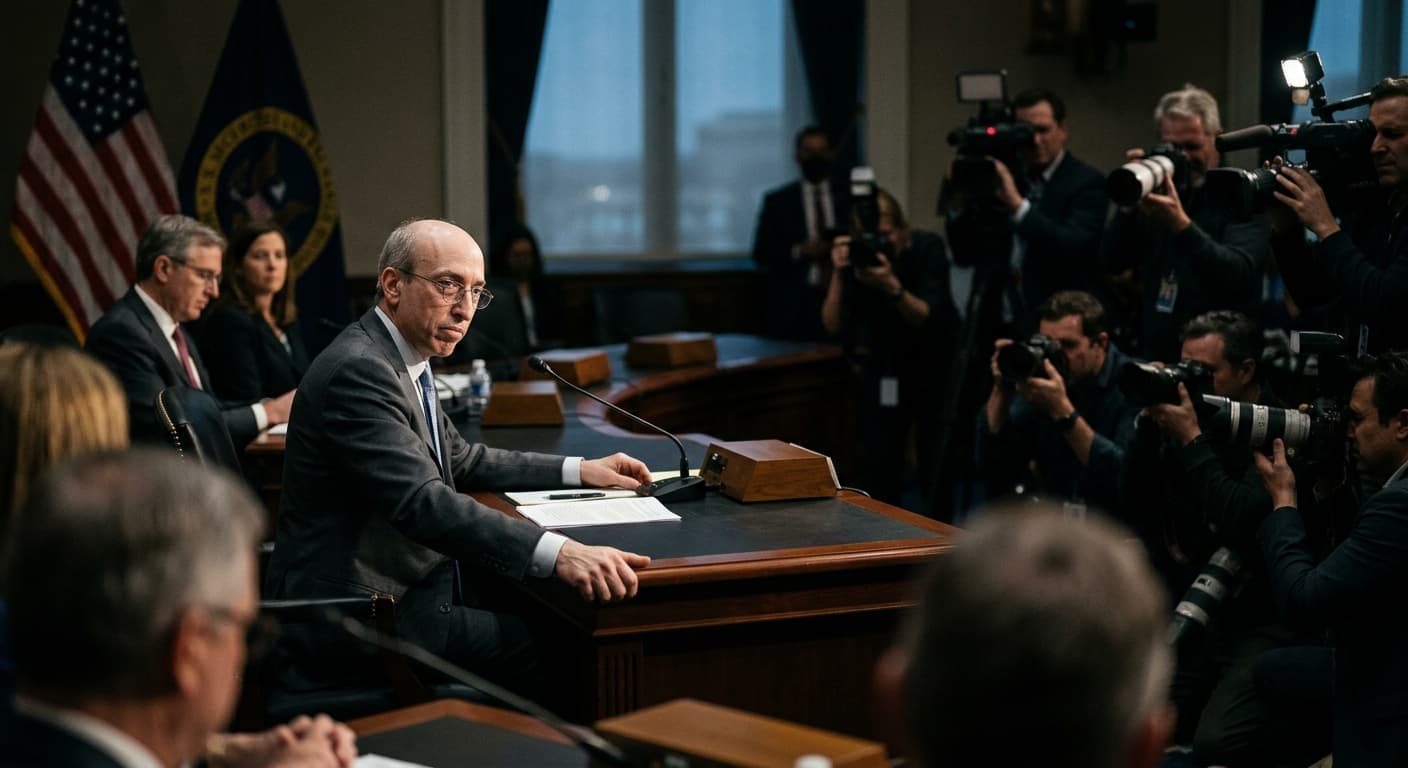
The SEC's Small Business Capital Formation Advisory Committee meets July 21, 2026 to explore loosening IPO disclosure rules — a push Chair Paul Atkins has staked his deregulatory agenda on. The composition of what remains of the public markets is the problem with that bet. In 1975, 61.5% of U.S. listed firms had assets under $100 million (in 2015 dollars); by 2015 that figure was 22.6%, NBER's Stulz reported in 2018. The average annual number of new listings from 2009 to 2016 was 179 — less than one-third of the 683.5 averaged between 1995 and 2000. Small firms did not stop being founded. They stopped choosing to list.
Why? Two competing explanations dominate the literature, and they cut in opposite policy directions.
The regulatory-overreach camp — invoked by every JOBS Act sequel — argues Sarbanes-Oxley, decimalization, and analyst coverage collapse killed the small-firm IPO. The economies-of-scope camp — associated with University of Florida's Jay Ritter in his Brookings work — argues small independent firms became less profitable than they would be inside a larger acquirer, so founders sell rather than list. A third strand, developed by Michael Ewens and Joan Farre-Mensa, points to the deregulation of private markets (particularly the 1996 National Securities Markets Improvement Act and the JOBS Act itself) as the mechanism that made staying private economically dominant, per their
NBER paper on private-equity deregulation.
The empirical work that has looked directly at the regulatory hypothesis has been unkind to it. A 2024 study in the Journal of International Financial Markets examining the EU's SME growth prospectus — the closest analog to what SBCFAC is contemplating — found the streamlined regime cut disclosure length "without curtailing investor protection," but produced no robust evidence of increased IPO activity. A separate
SSRN study by Rose and Solomon tracking 3,081 U.S. IPOs from 1996–2012 concluded that "further regulatory reforms to enhance the small IPO market are thus likely to be either ineffective or bring firms into the public markets which lack the horsepower to remain publicly listed."
That is the empirical wall the Atkins-era SEC is running toward at full speed.
What the agenda actually contains
Chair Atkins told the House Financial Services and General Government subcommittee on May 20, 2025 that the Commission would focus on "providing meaningful pathways for entrepreneurs to obtain the capital that they need to execute their innovative ideas," per his prepared testimony. Three legislative vehicles are moving in parallel:
- H.R. 3381, the Encouraging Public Offerings Act of 2025,
passed the House on June 23, 2025 and would extend to all issuers the ability to file draft registration statements confidentially and to "test the waters" with institutional investors — accommodations currently reserved for emerging growth companies (EGCs).
- H.R. 3395, the Middle Market IPO Cost Act, passed the House and directs the GAO to study why the 7% gross underwriting spread has proved so remarkably sticky across small and mid-cap deals, per the
- An IPO Task Force proposal advanced in
Since 2012, roughly 87% of IPO filers have used the EGC on-ramp, according to CRS Report R45221 — meaning the "reduced" JOBS Act regime is now the default IPO process. Raising the thresholds effectively grandfathers most of what would otherwise be full-disclosure issuers into the scaled regime for another half-decade.
Who wins if the deregulation ships
The clearest beneficiary is Nasdaq. As the Financial Times reported in mid-2025, the U.S. microcap IPO market has had its two busiest quarters on 15-year record — 42 deals in Q4 2024 and 41 in Q1 2025 — even as large-cap issuance stalled on tariff uncertainty. Nasdaq's new $15 million minimum raise for exchange listing triggered a rush of small Chinese and Hong Kong issuers before the rule took effect; small-firm underwriters Dominari Securities and RF Lafferty each took at least seven companies public in the first half of 2025. Nasdaq monetizes each listing; loosening federal disclosure without tightening exchange gatekeeping widens that pipeline.
The FT's reporting matters because it identifies the counterparty problem the SBCFAC has not yet publicly grappled with: the marginal small IPO in 2025 is not a Boston biotech or a Denver software company. It is disproportionately a China- or Hong Kong-domiciled microcap using a small U.S. underwriter, and the SEC's counterpart CSRC in Beijing has itself been tightening approvals because of pump-and-dump concerns.
The clearest losers are retail investors in the aftermarket. Amrita Nain and co-authors, publishing in the Journal of Empirical Finance in 2025, showed that when venture capital supply expands, IPO quality declines because VCs hold back the best companies for later private rounds — and post-IPO abnormal returns show the market doesn't fully price this selection at issue. A 2014 study in the
Journal of Financial Economics found the JOBS Act did produce roughly 21 additional IPOs annually — but disproportionately from firms with high proprietary-disclosure costs (biotech, pharma), i.e., companies with the biggest information asymmetries.
The angle nobody at F Street is saying out loud
The SEC's IPO push and its private-markets push are on a collision course, and the private-markets side is winning — a tension the committee will not put in an agenda memo.
The same committee, at its January 2026 meeting, was working on a regulatory framework for "finders" — unregistered intermediaries who match private issuers with investors — and beginning to explore the private secondary market. If the SEC simultaneously (a) makes it easier to raise capital privately and trade shares in private secondary markets, and (b) makes it marginally cheaper to go public, the arbitrage strongly favors staying private longer, because the private route removes ongoing reporting obligations, Section 404 attestations, and Rule 10b-5 litigation exposure that no amount of IPO on-ramp tinkering touches.
The Fahlenbrach, Sanz, and Stulz NBER paper puts it plainly: "organization capital" — the value of being embedded inside a larger corporate structure — has become the binding constraint, not registration costs. Sarbanes-Oxley compliance costs run in the low millions annually; a decent Series D is worth ten times that in avoided dilution, ongoing reporting obligations, and Rule 10b-5 litigation exposure that no IPO on-ramp touches. The committee can modernize the rulebook. It cannot modernize the math.
Discover more

US Politics
SNAP Food Assistance Faces Legal Challenges
In 2026, SNAP faces stricter eligibility rules and mounting legal challenges, threatening food assistance for the millions of Americans who rely on the program.
India
Congress Accuses Modi of Stalling Women's Law
Congress accuses Modi of stalling women's reservation law by linking it to delimitation, revealing a deeper electoral strategy.

India
Women’s Reservation Bill 2026
The Constitution (131st Amendment) Bill, 2026 was defeated in Lok Sabha, revealing deeper political conflicts over women's reservation and delimitation.

Conflict & Security
Drone Warfare Killing Aid Workers at Unprec
Over 1,000 humanitarian workers killed in three years as cheap armed drones collapse legal protections. Gaza, Sudan, Ukraine, and DRC see deliberate targeting of aid convoys and hospitals with zero prosecutions.